

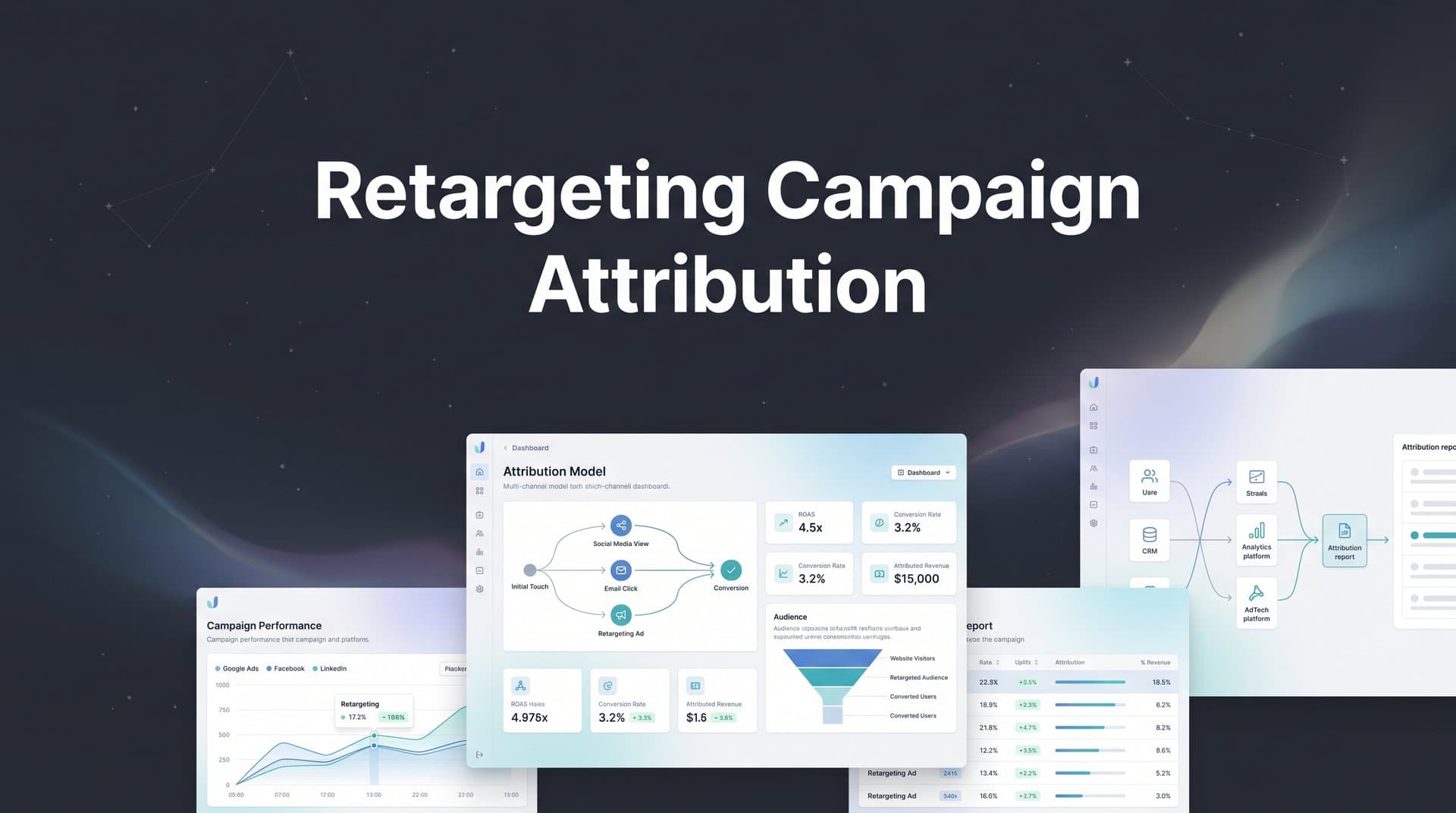
You're running retargeting campaigns across Meta, Google, and TikTok. Your dashboards show conversions rolling in. Your retargeting ROAS looks stellar—sometimes 5x, 8x, even higher. But here's the uncomfortable question that keeps you up at night: did those retargeting ads actually drive the sale, or were those customers already coming back to buy?
This isn't just marketing paranoia. It's the fundamental measurement problem that plagues retargeting campaigns. Someone visits your site, browses products, maybe adds items to cart. They leave. Three days later, they see your retargeting ad, click it, and purchase. Your ad platform claims full credit for that conversion. But the truth? That customer might have been planning to return and buy regardless of whether they ever saw your ad.
This is where retargeting campaign attribution becomes critical. It's the difference between confidently scaling campaigns that genuinely influence purchase decisions and wasting budget on ads that simply intercept customers already on their way to convert. Understanding true attribution means knowing which retargeting efforts deserve credit and which are just expensive victory laps.
The Last-Touch Illusion: Why Your Retargeting Metrics Lie
Standard retargeting metrics create a dangerous illusion of performance. The problem starts with last-touch attribution, the default model used by most ad platforms. In this model, whichever touchpoint happens immediately before conversion gets 100% of the credit. For retargeting campaigns, this creates a massive advantage that has nothing to do with actual influence.
Think about the typical customer journey. Someone discovers your brand through a podcast mention or organic search. They visit your site, research your product, read reviews, compare options. They're building purchase intent through multiple touchpoints. Then they leave to think it over. A day later, they're scrolling Instagram and see your retargeting ad. They click through and buy.
In a last-touch model, that retargeting ad gets full credit. But did it really drive the conversion? Or did it simply happen to be the last ad standing before an already-motivated customer completed their intended purchase?
This gets even more problematic with view-through attribution. Many platforms count conversions that happen within a certain window after someone simply sees your ad, without clicking. The logic sounds reasonable: ad exposure influences behavior even without immediate clicks. But proving causation versus correlation becomes nearly impossible.
A customer who visited your site three times, added products to cart, and was actively comparison shopping will likely see your retargeting ads multiple times during their decision process. When they finally convert, did viewing those ads seven times actually change their behavior? Or were they going to buy anyway, and your retargeting budget just ensured you were visible during their natural purchase timeline?
The consequences of this measurement problem extend far beyond vanity metrics. When retargeting campaigns appear to perform exceptionally well based on inflated attribution, marketing budgets shift accordingly. Money flows away from upper-funnel channels that actually create awareness and demand. Resources move toward retargeting campaigns that harvest conversions they didn't truly influence.
You end up in a situation where your attribution data tells you to invest more in retargeting while your overall conversion volume stagnates or declines. The retargeting campaigns look efficient, but they're increasingly just competing with each other to claim credit for the same pool of already-interested customers.
Attribution Models That Reveal True Retargeting Impact
Moving beyond last-touch attribution requires understanding how different models distribute credit across the customer journey. Each model reveals different insights about retargeting's actual role in driving conversions.
Multi-touch attribution approaches recognize that conversions rarely result from a single touchpoint. Instead, they distribute credit across all interactions that preceded the conversion. The question becomes: how should that credit be distributed?
Linear Attribution: This model gives equal credit to every touchpoint in the customer journey. If someone had five interactions before converting—an organic search visit, a Facebook ad click, two retargeting ad views, and a final retargeting click—each touchpoint receives 20% of the conversion credit. Linear attribution is useful for understanding the breadth of touchpoints involved but doesn't account for the varying influence different interactions actually have.
Time-Decay Attribution: This approach gives more credit to touchpoints closer to the conversion event. The logic: interactions that happen right before purchase likely have more influence on the final decision than those from weeks earlier. For retargeting analysis, time-decay models often show strong performance because retargeting typically happens late in the journey. But this can still overweight retargeting's importance if customers were already highly likely to convert.
Position-Based Attribution: Also called U-shaped attribution, this model assigns more weight to the first and last touchpoints, with remaining credit distributed among middle interactions. Typically, 40% goes to the first touch, 40% to the last touch, and 20% spreads across everything in between. This model acknowledges that both initial awareness and final conversion touchpoints matter, while still recognizing the journey between them.
For retargeting campaigns, position-based models provide more realistic performance pictures than last-touch. Retargeting still receives credit for closing conversions, but not at the expense of the channels that created initial awareness and interest.
Data-Driven Attribution: The most sophisticated approach uses machine learning to analyze thousands of conversion paths and determine which touchpoints actually correlate with higher conversion rates. By comparing journeys that converted against those that didn't, data-driven models identify which interactions genuinely influence outcomes.
This is where retargeting's true value becomes clear. Data-driven attribution might reveal that retargeting ads shown to cart abandoners within 24 hours significantly increase conversion likelihood, while retargeting ads shown to casual browsers who visited once have minimal impact. It separates high-value retargeting from low-impact ad exposure.
The challenge with any attribution model is that ad platforms each use their own methodologies and attribution windows. Meta might claim 100 conversions using a 7-day click, 1-day view window. Google Ads might report 85 conversions using a 30-day click window. TikTok adds its own numbers with different parameters. When you add them up, you've somehow generated 300 conversions when your CRM only recorded 150 actual purchases.
This is why independent attribution becomes essential. By tracking conversions through a unified system that monitors all touchpoints across all platforms, you get a single source of truth. You can see exactly which channels and campaigns genuinely contributed to each conversion, and how credit should be distributed according to your chosen attribution model.
Comparing platform-reported conversions against independent attribution data often reveals significant discrepancies. Your retargeting campaigns might show 200% ROAS in the ad platform dashboard but only 120% ROAS when measured against actual attributed revenue. That gap represents the difference between what the platform wants to claim and what the data actually supports.
Tracking the Complete Retargeting Journey
Accurate retargeting campaign attribution requires connecting data points that typically live in separate systems. Ad platforms know about impressions and clicks. Your website analytics track visits and page views. Your CRM holds purchase data and customer lifetime value. Without connecting these pieces, you're measuring retargeting performance with incomplete information.
The foundation of complete journey tracking is connecting ad platform data with actual conversion events. When someone clicks a retargeting ad, that interaction needs to be linked not just to the immediate website session, but to the eventual conversion—whether it happens minutes, days, or weeks later.
This connection becomes particularly critical for businesses with longer sales cycles or multi-step conversion processes. A B2B SaaS company might retarget someone who downloaded a whitepaper. That person might click the retargeting ad, visit the pricing page, but not sign up immediately. Two weeks later, they return directly, book a demo, and eventually convert to a paying customer. Without proper tracking, the retargeting campaign gets zero credit because the final conversion happened through a direct visit.
Complete journey tracking links that retargeting click to the eventual demo booking and purchase, even when other touchpoints happen in between. This reveals retargeting's true role in moving prospects through your funnel, not just its ability to claim last-touch credit.
Server-side tracking has become increasingly important for capturing the full retargeting journey. Browser-based tracking faces significant limitations from iOS privacy restrictions, cookie blockers, and consent management requirements. When tracking relies entirely on browser cookies and pixels, you miss substantial portions of your audience.
Server-side tracking sends conversion data directly from your servers to ad platforms and attribution systems. When someone converts, your server fires the conversion event, bypassing browser restrictions entirely. This approach captures conversions that browser-based tracking misses, providing more complete attribution data.
For retargeting attribution specifically, server-side tracking solves a critical problem: understanding which retargeting exposures actually reached your audience. Browser-based tracking might show that someone was served a retargeting ad, but if their browser blocked the tracking pixel, you don't know if they actually saw it. Server-side tracking provides more reliable data about actual ad exposure and subsequent conversions.
Building audience segments based on actual conversion paths, rather than assumptions, transforms retargeting effectiveness. Instead of creating generic segments like "visited in the last 30 days" or "added to cart," you can build segments based on proven conversion patterns.
Your attribution data might reveal that customers who visited your pricing page three times before converting responded well to retargeting ads featuring customer testimonials. Meanwhile, customers who read multiple blog posts before purchasing showed higher conversion rates when retargeted with educational content rather than promotional offers.
These insights come from analyzing complete conversion paths. You can see which pre-conversion behaviors correlate with responsiveness to different retargeting approaches. This allows you to build sophisticated audience segments that receive retargeting messages proven to influence similar customers, rather than generic retargeting blasts to anyone who ever visited your site.
Measuring Incrementality: Did Retargeting Actually Change Behavior?
Attribution models show you which touchpoints were present in conversion paths. But they don't definitively answer whether those touchpoints actually caused conversions. This is where incrementality testing becomes the gold standard for measuring retargeting's true impact.
The concept behind incrementality testing is straightforward: compare conversion rates between customers who see your retargeting ads and those who don't. The difference represents the genuine lift your retargeting campaigns provide.
Holdout testing is the most common incrementality measurement approach. You randomly split your retargeting audience into two groups. The test group sees your retargeting ads as normal. The control group gets excluded from retargeting campaigns entirely. After a set period, you compare conversion rates between the groups.
If your test group converts at 8% and your control group converts at 7.5%, your retargeting campaigns provided 0.5 percentage points of lift. That's your true incremental impact. If both groups convert at roughly the same rate, your retargeting campaigns aren't actually changing behavior—they're just claiming credit for conversions that would have happened anyway.
Running effective holdout tests requires careful design. Your control group needs to be large enough to provide statistically significant results, but not so large that you're leaving substantial revenue on the table if retargeting does provide lift. The test period needs to be long enough to account for natural conversion timing variations but not so long that market conditions change during the test.
The insights from incrementality testing often surprise marketers. You might discover that retargeting campaigns targeting cart abandoners show significant lift—customers who see the ads convert at substantially higher rates than those who don't. Meanwhile, retargeting campaigns targeting casual browsers who visited once show minimal incrementality. Both audiences might show good conversion rates, but only one is actually being influenced by the retargeting ads.
These findings reveal which audience segments genuinely benefit from retargeting exposure versus which segments would convert at similar rates without any retargeting investment. This distinction is critical for efficient budget allocation.
Incrementality data also informs frequency capping decisions. You might find that showing retargeting ads three times provides maximum lift, but showing them ten times provides no additional benefit. The incremental conversions happen early, and additional exposures just increase costs without changing behavior.
Similarly, incrementality testing can reveal optimal retargeting windows. Perhaps retargeting someone within 48 hours of their site visit shows strong lift, but retargeting them two weeks later shows minimal impact. They've either already converted through other channels or lost interest entirely.
Using incrementality data to set budget allocations means investing more in high-lift segments and reducing spend on low-incrementality audiences. If your cart abandoner retargeting shows 15% lift while your general site visitor retargeting shows 2% lift, the budget allocation decision becomes clear. Both might show positive ROAS in platform dashboards, but only one is genuinely driving incremental revenue.
Optimizing Retargeting Spend Based on Attribution Insights
Once you understand which retargeting campaigns genuinely influence conversions versus which simply claim credit, optimization becomes strategic rather than reactive. The goal shifts from maximizing platform-reported ROAS to maximizing true incremental revenue.
Reallocating budget starts with identifying your high-incrementality segments. These are audiences where retargeting demonstrably changes behavior and drives conversions that wouldn't happen otherwise. Common high-impact segments include recent cart abandoners, users who engaged with high-intent content like pricing pages or product comparisons, and previous customers being retargeted for complementary products.
Low-incrementality segments typically include cold audiences who visited once and showed minimal engagement, users who already converted but are still being retargeted for the same product, and audiences being retargeted far beyond their likely purchase window. These segments might show conversions in your dashboards, but incrementality testing reveals they convert at similar rates without retargeting exposure.
Budget reallocation doesn't mean eliminating low-incrementality retargeting entirely. It means right-sizing investment based on true impact. If a segment shows 3% lift, it might still be worth retargeting, but at a much lower budget and frequency than a segment showing 20% lift.
Feeding accurate conversion data back to ad platforms creates a virtuous cycle of improved performance. Ad platform algorithms optimize toward the conversion signals they receive. When those signals are accurate and enriched with proper attribution data, the algorithms learn to find users more likely to genuinely convert, not just users who were already going to buy.
This is where conversion sync capabilities become powerful. By sending back conversion events that include attribution data, customer journey context, and actual revenue values, you help ad platforms understand which audiences and creative approaches drive real results. The algorithms can then optimize toward genuinely incremental conversions rather than last-touch claims.
For example, instead of just sending back "purchase" events, you can send enriched conversion data that indicates whether this was a new customer or repeat purchase, what the customer lifetime value looks like, which attribution model assigned credit to this campaign, and what the customer's full journey looked like. This enriched data helps algorithms make smarter optimization decisions.
Setting realistic ROAS expectations becomes easier with accurate attribution. When you're measuring true incremental impact rather than inflated last-touch claims, your target ROAS might need adjustment. A retargeting campaign showing 6x ROAS with last-touch attribution might show 3x ROAS with proper multi-touch attribution. That doesn't mean the campaign is failing—it means you finally understand its real performance.
This realistic view allows for better decision-making. You can compare retargeting ROAS against other channels using consistent attribution methodology. You might discover that while retargeting shows lower ROAS than you thought, it still outperforms other channels. Or you might find that investing more in upper-funnel awareness campaigns generates better overall returns than pouring more budget into retargeting.
The key is making decisions based on comparable data. When every channel is measured using the same attribution model and incrementality framework, you can confidently allocate budget to maximize overall marketing efficiency rather than optimizing individual channels in isolation.
Building Your Retargeting Attribution Framework
Implementing accurate retargeting campaign attribution requires establishing a measurement framework that goes beyond platform dashboards. This framework should track key metrics that reveal true performance, account for cross-channel influence, and provide actionable insights for optimization.
Start by monitoring these essential metrics. Track incremental conversion rate lift for each retargeting segment, not just absolute conversion rates. Measure cost per incremental conversion rather than cost per conversion. Monitor attributed revenue using your chosen multi-touch attribution model, not just last-touch platform claims. Calculate true incremental ROAS by comparing attributed revenue against total retargeting spend.
Your measurement framework needs to account for cross-channel influence. A customer might click a retargeting ad on Meta, then later click a Google search ad before converting. Both touchpoints contributed to the conversion, but how should credit be distributed? Your framework should define clear attribution rules that apply consistently across all channels.
This means establishing standard attribution windows, choosing an attribution model that reflects your business reality, and ensuring all conversion tracking flows through a unified system that can see the complete customer journey. Without this consistency, you're comparing apples to oranges when evaluating channel performance. A robust campaign attribution tracking system eliminates these inconsistencies.
Next steps for implementation start with technical setup. Ensure you have proper tracking in place that connects ad clicks to conversions across your full conversion window. Implement server-side tracking to capture conversions that browser-based tracking misses. Set up conversion sync to feed accurate data back to ad platforms.
Then move to testing and validation. Run incrementality tests on your major retargeting segments to establish baseline lift metrics. Compare platform-reported conversions against your independent attribution data to understand discrepancies. Use these insights to refine your attribution model and measurement approach.
Finally, build regular reporting that focuses on incremental impact. Your weekly or monthly retargeting reports should highlight incremental conversion lift, true attributed ROAS, and segment-level performance based on genuine influence rather than last-touch claims. This keeps your team focused on optimizing for real impact rather than vanity metrics. The right marketing campaign tracking software makes this reporting seamless and actionable.
Moving Forward with Confidence
Accurate retargeting campaign attribution separates marketers who scale profitably from those who waste budget on ads claiming false credit. The difference isn't just about better metrics—it's about understanding which marketing efforts genuinely influence customer behavior versus which ones simply intercept customers already on their way to convert.
When you track the complete customer journey, measure true incrementality, and use attribution models that distribute credit fairly across touchpoints, retargeting becomes a strategic tool rather than a black box. You can confidently invest in high-impact segments, reduce spend on low-incrementality audiences, and feed better data back to ad platforms for improved algorithmic optimization.
The path forward requires moving beyond platform dashboards and last-touch attribution. It means implementing tracking that captures every touchpoint, testing to measure genuine lift, and building a measurement framework that reveals true performance. The work is worth it. The alternative is making budget decisions based on inflated metrics that systematically overstate retargeting's impact while undervaluing the channels that create awareness and demand in the first place.
Ready to elevate your marketing game with precision and confidence? Discover how Cometly's AI-driven recommendations can transform your ad strategy—Get your free demo today and start capturing every touchpoint to maximize your conversions.


