You check your dashboard. Your conversion rate is sitting at 2.3%. Is that good? Should you be celebrating or panicking? You pull up another tab to search for benchmarks, and suddenly you're drowning in conflicting numbers. One source says 2-5% is average. Another claims anything under 10% means you're leaving money on the table. A case study brags about 15% conversions, and now you're questioning everything about your campaigns.
Here's the uncomfortable truth: most marketers are obsessing over a number they don't fully understand.
Typical conversion rates aren't just about hitting a magic percentage. They're about context, measurement accuracy, and understanding what actually drives results in your specific situation. The real question isn't whether your 2.3% is good enough compared to some industry average. It's whether you're measuring the right things, tracking them accurately, and making decisions based on complete data.
The Foundation: What Conversion Rate Actually Measures
Let's start with the basics, because this is where most confusion begins.
The conversion rate formula is straightforward: take your total conversions, divide by your total visitors or clicks, then multiply by 100. If 100 people visit your landing page and 3 of them convert, you have a 3% conversion rate. Simple math.
But here's where it gets complicated: what counts as a conversion?
For an e-commerce site, a conversion might mean a completed purchase. For a SaaS company, it could be a free trial signup. For a B2B service provider, it might be a demo request or a consultation booking. Each of these represents a completely different level of commitment and intent. Comparing a "buy now" conversion to a "download our guide" conversion is like comparing apples to entire orchards.
The definition matters enormously. A lead generation form asking for just an email address will convert at a dramatically different rate than one requiring a phone number, company size, and budget range. The friction you add or remove directly impacts the number you're measuring. Understanding what conversion rate means in marketing is essential before you can meaningfully evaluate your performance.
Then there's the question of what you're actually tracking. Are you measuring your website conversion rate across all traffic? Your landing page conversion rate for a specific campaign? Your ad conversion rate from click to action? Each of these tells a different story.
Website conversion rates include all traffic sources—organic search, direct visits, referrals, paid ads, social media. This gives you a blended average that might hide important patterns. Your paid search traffic might convert at 8% while your social media traffic converts at 0.5%. Looking only at the overall number masks which channels actually drive results.
Landing page conversion rates focus on a specific page designed for a single purpose. These are typically higher than overall website rates because the page is optimized for one action. When you send paid traffic to a dedicated landing page, you're controlling more variables and can measure performance more precisely.
Ad conversion rates measure how many people who click your ad complete the desired action. This is where traffic quality becomes crystal clear. You might have a landing page that converts at 5% overall, but your Facebook ad traffic converts at 2% while your Google search ads convert at 9%. Same page, different audience intent, vastly different results.
The Benchmark Landscape: What Numbers Actually Look Like
Now that we understand what we're measuring, let's talk about what typical actually means across different contexts.
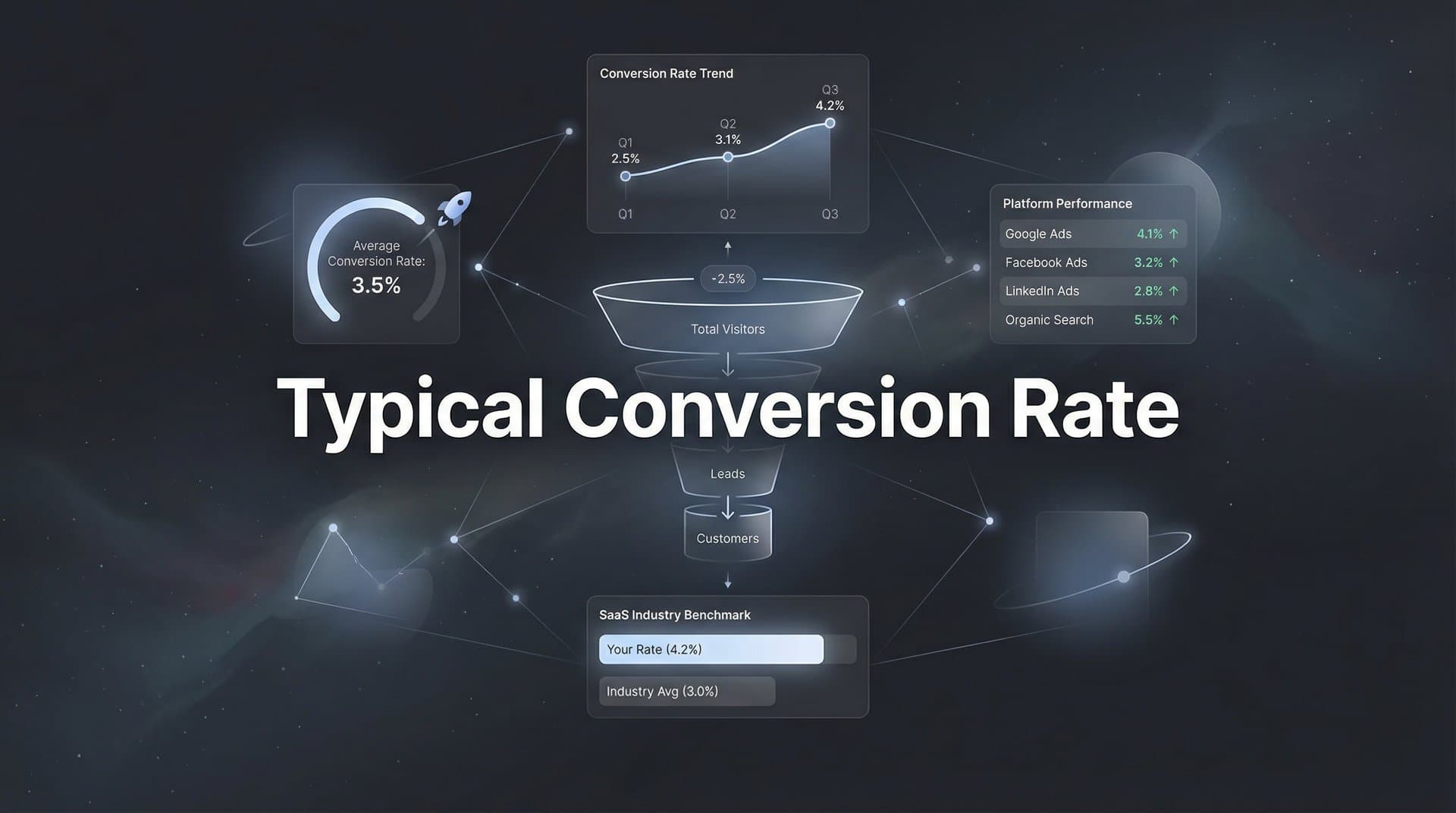
Cross-industry research suggests that average website conversion rates typically fall in the range of 2-3%. That's the blended average across all traffic sources and all industries. But this number is almost meaningless for making decisions about your specific campaigns because the variation is enormous.
Landing pages designed for specific campaigns generally perform better. Well-optimized landing pages often achieve conversion rates in the 5-10% range, with top performers reaching 15% or higher. The difference comes from focus—these pages eliminate distractions, match the message from the ad, and guide visitors toward a single action.
If you're evaluating vendors, our AI Instagram ad generator breakdown can help.
Traffic source creates massive differences in conversion performance. Paid search traffic typically converts at higher rates than social media traffic because the intent is different. Someone searching for "CRM software for small business" and clicking your ad has explicit intent. Someone scrolling Instagram who sees your ad is in discovery mode, not buying mode.
For a deeper dive, see our guide to AI Instagram ad image generator.
Google Ads campaigns targeting high-intent keywords often see conversion rates in the 3-6% range for lead generation, with e-commerce potentially higher. Facebook and Instagram ads typically convert at lower rates—often 1-2% for cold traffic—because you're interrupting rather than responding to active search behavior. Understanding PPC conversion rate benchmarks helps you set realistic expectations for paid campaigns.
For a deeper dive, see our guide to AI Facebook ad image generator.
B2B versus B2C creates another layer of complexity. B2C e-commerce sites selling low-consideration products might see conversion rates of 2-4%. B2B companies selling enterprise software with six-month sales cycles might celebrate a 1% conversion rate from ad click to demo request because each conversion represents potential six-figure deals.
Industry benchmarks vary wildly. E-commerce fashion might average 2-3%. Finance and insurance often see lower rates around 1-2% due to high consideration and competition. SaaS and technology services might fall in the 2-5% range depending on product complexity and price point.
The critical insight here is that typical is contextual. A 1.5% conversion rate might be excellent for a B2B company selling expensive enterprise solutions and terrible for an e-commerce site selling impulse-buy products. The benchmark that matters is the one that reflects your actual business model, sales cycle, and traffic sources. For a deeper dive into what constitutes strong performance, explore good conversion rate benchmarks across industries.
This is why blindly chasing industry averages can lead you astray. Your conversion rate needs to be evaluated against your customer acquisition cost, lifetime value, and profit margins. A 1% conversion rate that generates profitable customers is infinitely better than a 5% conversion rate that attracts tire-kickers who never buy.
The Measurement Problem You Probably Don't Know You Have
Here's where things get uncomfortable. What if the conversion rate you're looking at isn't accurate in the first place?
Most marketers are making decisions based on incomplete data, and they don't even realize it. The tracking infrastructure that powered digital marketing for the past decade has fundamentally broken down, and the numbers you see in your analytics dashboard are likely missing a significant portion of actual conversions.
iOS privacy changes have created a massive tracking gap. Apple's App Tracking Transparency framework means that most iOS users are now invisible to traditional browser-based tracking. When someone clicks your Facebook ad on their iPhone, browses your site, and converts later on their laptop, traditional tracking often fails to connect those dots. The conversion happens, but your ad platform doesn't get credit.
Cookie limitations compound the problem. Third-party cookies are being phased out across browsers. Even first-party cookies face increasing restrictions. When tracking relies on cookies and those cookies are blocked, deleted, or expire, you lose visibility into the customer journey. Conversions that involved multiple sessions across multiple devices simply disappear from your attribution reports. If you're struggling with this, learning about cross-device conversion tracking methods is essential.
This means your actual conversion rate might be significantly higher than what you're measuring. You might think you're converting at 2% when the real number is 3.5%. That's not just a statistical curiosity—it fundamentally changes which campaigns you scale, which ads you kill, and how much you're willing to bid.
Attribution models add another layer of complexity. Your conversion rate changes depending on which touchpoint gets credit for the conversion. Under last-click attribution, only the final touchpoint before conversion counts. Under first-click, only the initial touchpoint matters. Multi-touch attribution distributes credit across multiple interactions.
The same campaign can look dramatically different under different attribution models. Let's say someone discovers your brand through a Facebook ad, researches you through organic search a week later, and finally converts after clicking a Google retargeting ad. Last-click gives all credit to the Google ad. First-click gives it all to Facebook. Multi-touch recognizes that all three touchpoints contributed. Understanding conversion window attribution helps you interpret these differences correctly.
The danger of optimizing for a metric you're not measuring accurately is real. If your tracking only captures 60% of actual conversions and you're making budget decisions based on that incomplete data, you're systematically underinvesting in campaigns that actually work. You might pause a Facebook campaign that looks like it's converting at 1% when it's actually driving 2.5% conversions once you account for view-through conversions and cross-device journeys.
Server-side tracking has emerged as the solution to these measurement gaps. Instead of relying on browser-based tracking that users can block, server-side tracking captures conversion data directly from your server. This means you maintain visibility even when browser tracking fails, giving you a more complete picture of actual conversion performance. Following best practices for tracking conversions accurately can dramatically improve your data quality.
The bottom line: before you worry about whether your conversion rate is typical, make sure you're actually measuring it accurately. Incomplete data leads to bad decisions, and bad decisions waste ad spend.
What Actually Drives Conversion Rate Changes
Understanding typical conversion rates is useful. Understanding what moves your conversion rate is powerful.
Traffic quality matters infinitely more than traffic volume. You can drive 10,000 visitors to your landing page, but if they're the wrong audience, your conversion rate will be dismal. One thousand highly targeted visitors will outperform ten thousand random clicks every single time.
This is why traffic source analysis is critical. Not all clicks are created equal. Someone who searches for your exact solution and clicks your ad is dramatically more likely to convert than someone who clicked because your ad image was eye-catching. Intent drives conversion, not just attention.
Landing page elements create measurable differences in conversion performance. The headline either hooks visitors immediately or loses them in three seconds. If your headline doesn't clearly communicate value and relevance, people bounce before they even read your body copy.
Message match between your ad and your landing page is non-negotiable. If your ad promises "50% off enterprise CRM" and your landing page talks about general marketing automation, you've broken trust. The visitor expected one thing and got another. That disconnect kills conversions instantly. Identifying where most marketing conversions drop off helps you pinpoint these friction points.
Form friction is conversion poison. Every additional field you add drops your conversion rate. Asking for a phone number reduces conversions compared to just asking for an email. Requiring company size, role, and budget information drops it further. The information you collect needs to be worth the conversions you lose.
Page load speed has direct correlation with conversion rates. Research consistently shows that every additional second of load time decreases conversions. If your landing page takes four seconds to load instead of two, you're losing conversions before visitors even see your offer.
Social proof and trust signals impact conversion rates measurably. Customer logos, testimonials, case study results, and security badges all contribute to credibility. People are more likely to convert when they see evidence that others have successfully used your product or service.
Audience targeting and ad creative alignment determine who actually clicks through to your landing page. If your targeting is too broad, you're paying for clicks from people who were never going to convert. If your ad creative attracts the wrong audience, you're driving traffic that looks engaged but never converts.
The most successful campaigns align every element: targeting brings in the right audience, ad creative speaks to their specific pain points, and the landing page delivers exactly what was promised with minimal friction. Each element reinforces the others, creating a smooth path from impression to conversion.
Building Your Own Performance Baseline
Industry benchmarks give you context, but your own data gives you direction.
The first step is establishing your actual baseline performance. Before you can improve your conversion rate, you need to know what it really is right now—not what you think it is, not what you hope it is, but what your complete data shows when you account for all touchpoints and tracking limitations.
This means auditing your current tracking setup. Are you capturing all conversion events? Do you have visibility into cross-device journeys? Can you see which touchpoints contribute to conversions even if they're not the final click? If your tracking has gaps, your baseline is fiction. If you suspect issues, start with an inaccurate conversion tracking fix before making optimization decisions.
Historical data reveals patterns that benchmarks can't. Look at your conversion rates over time, broken down by traffic source, campaign, audience segment, and device. You'll discover that your mobile traffic converts at half the rate of desktop, or that your retargeting campaigns convert at 5x your cold traffic rate, or that visitors from organic search convert better than paid social despite lower volume.
These patterns are your real benchmarks. They tell you what's actually possible with your specific offer, audience, and market conditions. They show you where to focus optimization efforts and where you're already performing well.
Incremental testing is how you move from baseline to better performance. Don't try to overhaul everything at once. Test one variable at a time: headline variations, form length changes, different calls-to-action, alternative page layouts. Measure the impact on conversion rate, and let data guide your next test. Implementing proven conversion rate optimization strategies gives you a systematic framework for improvement.
Small improvements compound over time. Increasing your conversion rate from 2% to 2.5% might not sound dramatic, but it's a 25% improvement in results from the same ad spend. Stack multiple 10-15% improvements through systematic testing, and you can double your conversion rate over several months.
Connect conversion rate improvements to actual revenue impact. A higher conversion rate only matters if those conversions turn into customers and revenue. Track not just how many people convert, but how many of those conversions become paying customers, what their average deal size is, and what their lifetime value looks like. Understanding your sales conversion rate connects marketing metrics to business outcomes.
This is where conversion rate optimization meets business reality. You might discover that lowering form friction increases conversion rate by 40% but decreases lead quality, resulting in the same number of actual customers. Or you might find that a slightly lower conversion rate from more qualified traffic produces better customers who stay longer and spend more.
Set achievable goals based on your data, not arbitrary benchmarks. If you're currently converting at 1.8%, aiming for 2.5% in the next quarter is realistic. Targeting 10% because you read it somewhere is setting yourself up for disappointment and potentially bad decisions as you chase an unrealistic number.
Moving From Numbers to Strategy
We've covered the formula, the benchmarks, the measurement challenges, the optimization factors, and how to set realistic targets. Now let's connect all of this to actual marketing decisions.
Typical conversion rates are useful reference points. They give you a sense of what's possible and help you identify when you're significantly underperforming or when you've achieved genuinely exceptional results. But they're not the ultimate measure of success.
Accurate attribution and complete customer journey tracking matter more than hitting an arbitrary benchmark. A perfectly tracked 2% conversion rate gives you more decision-making power than a partially tracked 4% rate, because you actually know which campaigns, audiences, and touchpoints drive those conversions.
The marketers who win aren't the ones with the highest conversion rates. They're the ones with the clearest visibility into what's working, why it's working, and how to do more of it. They can confidently scale winning campaigns because they know the data is reliable. They can quickly kill underperformers because they're not flying blind. Using conversion rate optimization tools helps you gain this visibility systematically.
This level of clarity requires tracking infrastructure that captures the complete customer journey. It means moving beyond last-click attribution to understand how multiple touchpoints work together. It means having visibility into conversions that happen across devices and sessions, not just the ones that occur in a single browser session.
When you have this visibility, conversion rate becomes one metric in a comprehensive performance picture. You can see which traffic sources drive the highest quality conversions. You can identify which ad creatives attract visitors who actually convert. You can optimize based on complete data instead of guessing based on fragments.
Making Your Numbers Actually Mean Something
You started reading this article wondering if your conversion rate was good enough. Now you know that's the wrong question.
The right questions are: Are you measuring accurately? Do you understand the context behind your numbers? Can you connect conversion rate changes to specific actions and decisions? Are you optimizing based on complete data or partial visibility?
Typical conversion rates give you context, but your specific conversion rate—accurately measured and properly understood—gives you power. Power to make confident budget decisions. Power to scale what works and cut what doesn't. Power to optimize based on reality instead of assumptions.
The gap between where you are and where you could be isn't usually about creative genius or marketing magic. It's about having complete, accurate data and using it to make systematic improvements. It's about understanding that every percentage point improvement in conversion rate translates to more customers from the same ad spend.
The foundation of meaningful optimization is accurate measurement. If your tracking has gaps, your optimization efforts are built on sand. You might be making changes that feel productive but are actually moving you sideways because you can't see the full impact.
Evaluate whether you have the visibility you need to truly understand your conversion performance. Can you track conversions across devices? Do you capture conversions that happen days or weeks after the initial ad click? Can you see which touchpoints contribute to conversions even when they're not the final interaction?
If the answer to any of these questions is no, you're optimizing with one hand tied behind your back. You're making decisions based on incomplete information, and incomplete information leads to suboptimal results.
Ready to elevate your marketing game with precision and confidence? Discover how Cometly's AI-driven recommendations can transform your ad strategy—Get your free demo today and start capturing every touchpoint to maximize your conversions.