
You're spending thousands on ads across Meta, Google, TikTok, and LinkedIn. Your dashboards show clicks, impressions, and even some conversions. But here's the frustrating reality: you still don't know which specific ads are actually driving revenue.
Platform metrics tell you one story. Your CRM tells another. And somewhere in between, the truth about your ad performance gets lost.
This disconnect isn't just annoying. It's expensive. When you can't identify which ads convert, you end up funding campaigns that look good on paper but deliver nothing to your bottom line. You're making budget decisions based on incomplete data, scaling ads that might be getting credit for conversions they didn't actually drive.
The good news? Understanding which ads truly convert isn't complicated once you have the right framework.
This guide walks you through a proven process to connect your ad spend to actual revenue. You'll learn how to set up proper tracking, choose the right attribution model for your business, and build a system that shows you exactly where your money is working hardest. By the end, you'll have a clear method for identifying your top-performing ads and the confidence to scale what works while cutting what doesn't.
Step 1: Audit Your Current Tracking Setup
Before you can understand which ads convert, you need to know what you're actually tracking right now. Most marketing teams discover significant gaps when they finally audit their tracking infrastructure.
Start by documenting every tracking pixel and tag currently installed on your website. Log into each ad platform and check which events they're receiving. You're looking for the Meta Pixel, Google Ads conversion tags, LinkedIn Insight Tag, TikTok Pixel, and any other platform-specific tracking codes.
Open your browser's developer tools and navigate through your site. Watch the network tab to see which tracking requests fire when you complete key actions like form submissions or purchases. You'll often find pixels that were installed months ago but stopped firing, or conversion events that never got properly configured.
Now comes the critical comparison: pull conversion reports from each ad platform and compare them to what actually happened in your CRM or sales system. You're looking for discrepancies. If Meta reports 50 conversions but your CRM only shows 35 new leads from that period, something's broken. This is a common scenario when you can't track which ads are working properly.
The most common culprit? iOS attribution gaps. Since iOS 14.5 introduced App Tracking Transparency, client-side pixels struggle to track conversions from iOS users who opt out of tracking. This creates blind spots in your data, sometimes missing significant portions of your actual conversions.
Cookie limitations create similar problems. Third-party cookies are being phased out across browsers, and even first-party cookies can be deleted or blocked. When someone clicks your ad on their phone but converts days later on their laptop, client-side tracking often misses the connection entirely. Understanding tracking paid ads after the iOS update is essential for modern marketers.
Document everything you find. Create a spreadsheet listing each conversion event you're tracking, which platforms receive that data, and how your tracked conversions compare to your actual business results. This becomes your baseline for improvement.
Pay special attention to conversion events that should be tracking but aren't. Many businesses only track the initial form fill but never set up tracking for qualified leads, demo completions, or closed sales. You're leaving money on the table if you can't see the full journey.
Step 2: Define Your True Conversion Events
Not all conversions are created equal. A newsletter signup and a qualified sales opportunity shouldn't carry the same weight in your analysis, but many tracking setups treat them identically.
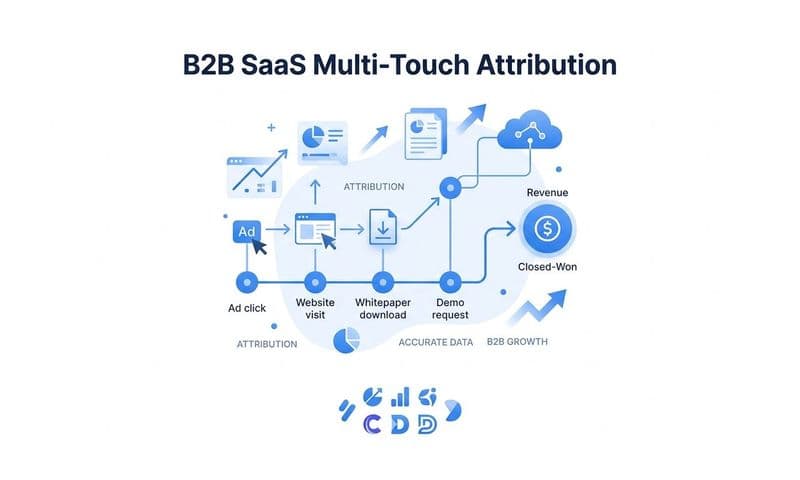
Map out your complete customer journey from first click to closed revenue. For a B2B SaaS company, this might look like: ad click, website visit, content download, email signup, demo request, demo completion, trial signup, and finally, paid customer. Each of these represents a potential conversion event.
Now separate your micro-conversions from your macro-conversions. Micro-conversions are early-stage actions that indicate interest: form fills, content downloads, email signups, or demo requests. Macro-conversions are the events that directly generate revenue: closed sales, subscription purchases, or contract signings.
Here's where most marketers stop, and it's a mistake. You need to assign value to each conversion event based on what it's actually worth to your business.
Pull historical data from your CRM. If you know that 30% of demo requests turn into paying customers, and your average customer value is $5,000, then each demo request is worth approximately $1,500 in expected value. This gives you a way to compare ad performance based on real business impact, not just volume of conversions. Many marketers struggle with ads showing conversions but no sales because they haven't made this distinction.
Do this calculation for every conversion event in your funnel. Some will have clear monetary value. Others require you to work backwards from your close rates. The goal is creating a hierarchy of conversion events where you know exactly what each one means for your bottom line.
Once you've defined your conversion events and their values, set up tracking for the ones that actually indicate buying intent. This often means going beyond the default tracking most platforms offer. You might need to implement custom conversion events that fire when someone reaches a specific page, spends a certain amount of time on your pricing page, or completes a key action in your product.
The most valuable conversion events often happen after someone leaves your website. When a lead becomes qualified in your CRM, when a demo gets scheduled, when a contract gets signed. These downstream events are what actually matter for your business, and they need to flow back into your attribution system.
Step 3: Connect Your Ad Platforms to Your Revenue Data
This is where the magic happens. You're going to create a direct line between your ad spend and your actual revenue, bypassing the limitations of platform-reported metrics.
Start by linking your CRM or sales system to your attribution tracking. This connection allows conversion events that happen in your CRM to be attributed back to the original ad click. When a lead converts to a customer three weeks after clicking your ad, you need a system that maintains that connection.
Most CRMs can integrate with attribution platforms through native integrations or APIs. The key is ensuring that the same identifier follows the customer through their entire journey. This usually means capturing a unique click ID when someone first clicks your ad, storing it in your CRM record, and then using it to attribute conversions back to the source.
Here's where server-side tracking becomes critical. Client-side pixels that run in the user's browser are increasingly unreliable due to privacy restrictions and ad blockers. Server-side tracking moves the conversion tracking to your server, where it can capture data that client-side pixels miss. Learn how ad tracking tools can help you scale ads using this more accurate approach.
When you implement server-side tracking, your server receives the conversion event directly from your CRM or backend systems. It then sends that conversion data to your ad platforms through their server-side APIs. This approach bypasses browser limitations entirely and gives you much more accurate conversion tracking.
The technical setup varies by platform, but the concept remains the same: your server becomes the source of truth for conversions, and it communicates directly with ad platforms to report what actually happened.
Now create a unified view that connects ad clicks to downstream revenue. This might be a data warehouse, an attribution platform, or a business intelligence tool. The important part is having one place where you can see the complete journey from ad impression to closed revenue.
Test everything before you trust it. Run a test conversion through your entire funnel. Click one of your ads, complete the conversion action, and then track that conversion through your system. Verify that it shows up in your attribution platform, gets sent back to the ad platform, and connects to the correct source. If any step breaks, fix it before you start making budget decisions based on this data.
Step 4: Choose the Right Attribution Model for Your Business
Attribution models determine how credit for a conversion gets distributed across the ads someone saw before converting. Choose the wrong model, and you'll optimize for the wrong ads. Choose the right one, and you'll see which ads truly drive results.
Let's break down the main options. First-touch attribution gives all credit to the first ad someone clicked. If a customer clicked your Facebook ad three weeks ago, then clicked five more ads before buying, Facebook gets 100% of the credit. This model favors top-of-funnel awareness campaigns.
Last-touch attribution does the opposite. It gives all credit to the final ad someone clicked before converting. Using the same example, if Google Search was the last click, Google gets 100% of the credit. This model favors bottom-of-funnel conversion campaigns.
Both single-touch models have obvious flaws. They ignore the reality that multiple touchpoints influence a purchase decision. Someone might discover you through a Facebook ad, research you through Google, and finally convert after seeing a retargeting ad. Which ad really drove that conversion? All of them played a role. Understanding Facebook Ads attribution vs Google Ads attribution helps clarify these differences.
Multi-touch attribution attempts to solve this by distributing credit across multiple touchpoints. Linear attribution splits credit evenly across all touchpoints. Time-decay attribution gives more credit to recent touchpoints. Position-based attribution emphasizes the first and last touchpoints while giving some credit to everything in between.
The right model depends on your typical sales cycle. If you sell low-cost products with short consideration periods, last-touch attribution might work fine. Most people click an ad and buy immediately, so the last ad they saw probably deserves most of the credit.
But if you have a longer sales cycle with multiple touchpoints, multi-touch attribution gives you a more complete picture. B2B companies with 30-day sales cycles often find that their awareness campaigns on LinkedIn deserve credit even when the final conversion happens through a Google Search ad.
Here's what you should do: set up side-by-side model comparison. Look at the same set of conversions through different attribution lenses. You'll often discover that your top-performing campaigns change dramatically depending on which model you use.
A retargeting campaign might look like your best performer under last-touch attribution, but when you switch to multi-touch, you realize it's just getting credit for conversions that your awareness campaigns actually drove. This insight completely changes how you should allocate budget.
Run this comparison for at least two weeks of conversion data. Pay attention to campaigns where the attribution varies wildly between models. These are the campaigns where understanding the full customer journey matters most. Then choose the model that best reflects how your customers actually buy from you.
Step 5: Build Your Ad Performance Dashboard
You've got accurate tracking and proper attribution. Now you need a dashboard that shows you which ads convert in a way that drives action.
Start by creating views that show cost per acquisition tied to actual revenue, not platform metrics. Platform-reported CPA often uses conversion modeling and estimated conversions. Your dashboard should show CPA based on real, verified conversions from your CRM. This is essential for proving which ads actually drive revenue.
Calculate ROAS based on actual sales data rather than platform estimates. If you spent $10,000 on a campaign and it generated $45,000 in closed revenue, that's a 4.5x ROAS. This number matters infinitely more than the ROAS your ad platform reports based on pixel-tracked conversions that may or may not have turned into actual sales.
Set up filters that let you analyze performance at every level: by campaign, ad set, and individual creative. You want to be able to drill down from "our Google Ads are profitable" to "this specific ad in this specific campaign is driving 40% of our Google revenue."
Include both micro and macro conversion data in your dashboard. You need to see which ads drive demo requests and which ads drive closed sales. Sometimes these are different ads, and that insight changes your strategy.
Create a view that shows your top performers by actual revenue generated. Sort your ads by total revenue attributed, not by conversion volume. The ad with 100 conversions at $50 each is less valuable than the ad with 20 conversions at $500 each, but volume-based sorting hides this truth.
Configure alerts for ads that exceed your target cost per acquisition. If your maximum acceptable CPA is $200 and an ad crosses $250, you want to know immediately. These alerts prevent you from wasting budget on underperformers while you're focused elsewhere.
Add a time comparison feature. You need to see how performance changes week over week and month over month. An ad that worked brilliantly in January might be declining in effectiveness by March. Spot these trends early and you can refresh creative before performance tanks completely.
Make your dashboard accessible to everyone who makes budget decisions. Your media buyers, marketing managers, and executives should all be looking at the same data. When everyone sees the same truth about ad performance, budget conversations become much simpler.
Step 6: Analyze and Act on Your Conversion Data
Data without action is just noise. Now you're going to turn your conversion insights into budget decisions that improve your ROAS.
Start by identifying your top 20% of ads that drive 80% of conversions. This principle holds true for most ad accounts. A small number of your ads are doing the heavy lifting while the majority contribute little. Sort your dashboard by revenue generated and find that top tier.
Look closely at what makes these top performers different. Is it the creative? The targeting? The offer? The ad copy? You're searching for patterns you can replicate. Maybe all your best performers use customer testimonials, or they all target a specific job title, or they all promote a particular product feature. Discovering which ads are actually working requires this level of detailed analysis.
Now find the opposite: campaigns that platform metrics made look successful but aren't actually driving revenue. These are often retargeting campaigns with high conversion rates but low conversion values, or awareness campaigns that generate lots of clicks but few qualified leads.
This is where attribution really proves its value. You might discover that a campaign showing a 2x ROAS in your ad platform is actually generating a 0.5x ROAS when you track it to closed revenue. That campaign is losing you money, but you wouldn't know it without proper attribution. Many businesses find themselves losing money on ads because they can't find winning campaigns without this visibility.
Make budget reallocation decisions based on true revenue attribution. Take budget from underperformers and move it to your proven winners. This sounds obvious, but most marketers can't do it confidently because they don't trust their attribution data. You've built a system you can trust, so act on it.
Start with small shifts. Move 20% of budget from your worst performer to your best performer. Watch what happens over the next week. If your best performer scales efficiently, move more. If it hits saturation and performance drops, you've found its ceiling.
Set up a weekly review cadence to continuously optimize based on conversion insights. Pick the same day and time each week. Pull your dashboard, identify what changed, and make one or two optimization decisions. This regular rhythm prevents you from either over-optimizing based on daily noise or under-optimizing because you're too busy to check.
Document every decision you make and the reasoning behind it. When you pause a campaign, note why. When you increase budget, record what you expected to happen. Three months later, you'll have a playbook of what works in your account based on real data, not guesses.
Putting It All Together
Understanding which ads convert comes down to one core principle: connect your ad spend to your actual revenue, not platform vanity metrics. You've now built a system that tracks every touchpoint, attributes conversions accurately, and shows you exactly where your marketing dollars generate returns.
Quick checklist to confirm you're set up for success:
Your tracking captures conversions even when cookies fail. Server-side tracking ensures you're not losing conversion data to privacy restrictions.
Your CRM data flows back to your attribution system. Closed deals and qualified leads get attributed to the ads that drove them.
You're comparing attribution models to find the most accurate view. You understand how different models credit your campaigns and you've chosen the one that reflects your real customer journey.
Your dashboard shows real revenue, not estimated conversions. You're making decisions based on actual sales data from your CRM, not pixel-tracked conversions that may never turn into revenue.
You have a regular cadence for reviewing and optimizing. Weekly analysis keeps you responsive to performance changes without overreacting to daily fluctuations.
The marketers who consistently scale profitable campaigns aren't guessing. They're working with clear data that shows exactly which ads convert. Now you have that same advantage.
Start with your highest-spend campaigns, apply this framework, and let the data guide your next budget decision. When you can see which ads actually drive revenue, optimization becomes straightforward. You scale what works, cut what doesn't, and stop funding campaigns based on vanity metrics that don't pay the bills.
Ready to elevate your marketing game with precision and confidence? Discover how Cometly's AI-driven recommendations can transform your ad strategy. Get your free demo today and start capturing every touchpoint to maximize your conversions.