

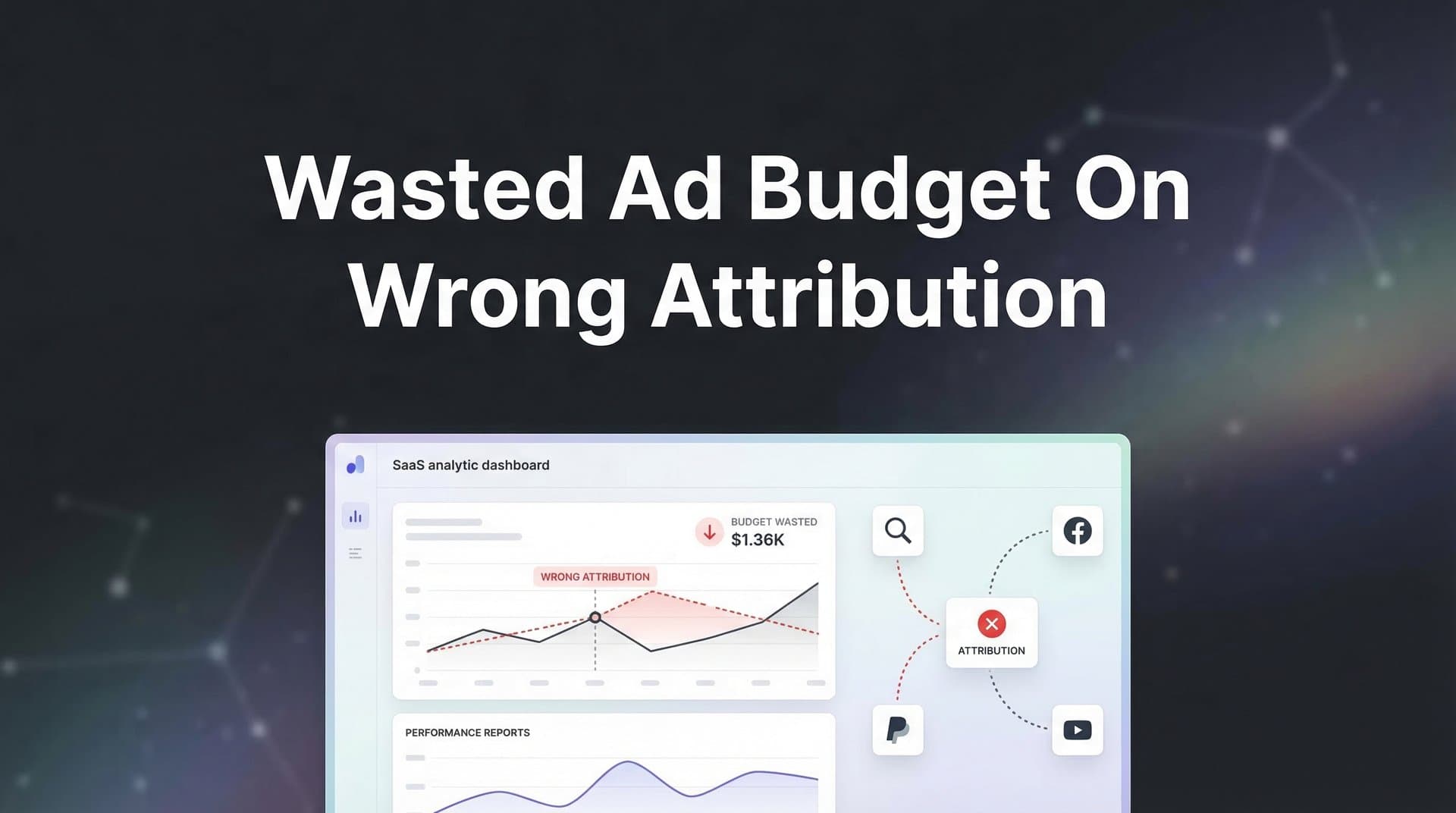
Picture this: Your marketing team just wrapped a campaign review meeting. The dashboard looks incredible. Meta reports 500 conversions at $12 CPA. Google Ads shows 400 conversions at $15 CPA. TikTok claims 200 conversions at $18 CPA. You celebrate the wins, approve budget increases, and start planning how to scale these "winning" campaigns.
Then your CFO walks in with the revenue report. You expected $165,000 based on your conversion tracking. The actual revenue? $98,000. The room goes silent.
This isn't a nightmare scenario—it's happening right now to marketing teams across every industry. The culprit? Attribution errors that don't just waste money on underperforming campaigns. They create a cascading effect of bad decisions, each one compounding the last, until you're pouring budget into channels that look like heroes but perform like zeros.
The hidden cost isn't just the wasted dollars. It's the high-performing channels you starved because the data told you they weren't working. It's the optimization decisions you made based on fiction instead of facts. It's the quarterly targets you missed while your dashboards showed green across the board.
Here's the truth that most marketing platforms won't tell you: their attribution models weren't designed to show you reality. They were designed to make their platform look good. And in a world where every customer touches multiple ads across multiple platforms before converting, that fundamental conflict of interest is bleeding your budget dry.
This guide will show you exactly where attribution goes wrong, how to spot the warning signs before they cost you another dollar, and what it takes to build an attribution system that actually protects your marketing investment instead of distorting it.
The Hidden Mechanics of Attribution Errors
Let's start with how attribution actually breaks down in the real world. Every ad platform operates with a simple premise: show you how valuable their platform is by claiming credit for conversions. The problem? They're all using different rules to play the same game.
Meta's default attribution gives credit to any ad click within the last 7 days or ad view within the last 24 hours. Google Ads uses various windows depending on your settings, but defaults to 30-day click and 1-day view attribution. TikTok, LinkedIn, Pinterest—they all have their own attribution windows and rules. When a customer sees a Meta ad on Monday, clicks a Google ad on Wednesday, and converts on Friday, guess how many platforms claim that conversion? All of them.
This is the double-counting problem, and it's not a bug—it's a feature. Each platform is technically correct within its own attribution window. But when you're trying to understand your total marketing performance, adding up 500 + 400 + 200 conversions gives you 1,100 conversions that never actually happened. Your spreadsheet shows success. Your bank account shows a different story.
But double-counting is just the beginning. The real damage comes from last-click attribution, the model most platforms default to. Think about how customers actually buy. They see your brand on social media. They search for you on Google a week later. They visit your website, leave, see a retargeting ad, and finally convert. Last-click attribution gives 100% of the credit to that final retargeting ad.
What does this mean for your budget? You look at your data and think, "Retargeting is crushing it! Let's pour more money there." Meanwhile, the social campaigns that introduced customers to your brand in the first place look like they're underperforming. You cut their budget. Your pipeline dries up. Three months later, even your retargeting performance tanks because you've starved the top of the funnel. This pattern of ad spend wasted on wrong channels is one of the most common consequences of flawed attribution.
The mechanics get even messier when you factor in what's happened to tracking over the past few years. Apple's App Tracking Transparency changes, launched in 2021, fundamentally broke the way platforms track iOS users. When users opt out of tracking—and the majority do—platforms lose visibility into their behavior across apps and websites.
The result? Your Meta campaigns might be driving conversions that the platform can't see and therefore can't report. Your attribution data isn't just biased toward last-click anymore. It's incomplete. You're making budget decisions based on a dataset that's missing significant chunks of reality, like trying to complete a puzzle when someone's hidden half the pieces. Understanding the impact of losing attribution data from privacy updates is essential for modern marketers.
Cookie deprecation adds another layer of chaos. As browsers phase out third-party cookies, the tracking pixels that platforms rely on become less effective. The data you're using to optimize campaigns is increasingly based on modeled conversions—educated guesses—rather than actual tracked behavior. And when platforms are guessing, they tend to guess in ways that make their own performance look good.
Five Warning Signs Your Attribution Is Costing You Money
How do you know if attribution errors are draining your budget? The symptoms are often subtle at first, but they follow predictable patterns. Here are the red flags that should trigger an immediate attribution audit.
Warning Sign #1: The Conversion Math Doesn't Add Up
Pull your conversion totals from each ad platform and add them together. Now compare that number to your actual sales, leads, or revenue in your CRM or analytics system. If the platform-reported conversions significantly exceed your actual business results, you're looking at double-counting or attribution inflation. Many marketing teams discover their platforms are claiming 40-60% more conversions than actually occurred. A comprehensive wasted ad budget diagnosis can help you quantify exactly how much this is costing you.
Warning Sign #2: Scaling Winners Creates Losers
You identify a campaign that's performing well according to platform metrics. You double the budget. Instead of doubling results, performance drops. This is the classic sign that the platform was taking credit for conversions it didn't actually drive. When you scale, you discover the truth: those conversions were happening anyway, driven by other channels or organic behavior. The platform was just the last click before customers who were already ready to buy.
Warning Sign #3: Channel Performance Defies Logic
Your brand awareness campaigns on social media show terrible ROAS. Your bottom-funnel search campaigns look incredible. But when you cut the social budget, your search performance drops three weeks later. This disconnect reveals that last-click attribution is giving all the credit to search while ignoring the role social plays in starting customer journeys. The data is telling you a story that doesn't match how customers actually discover and evaluate your product.
Warning Sign #4: You Can't Explain Performance Fluctuations
Campaign performance swings wildly from week to week with no clear cause. You didn't change targeting, creative, or budget, but suddenly your CPA doubled or your conversion rate halved. This volatility often indicates that your attribution is capturing noise rather than signal—modeled conversions, delayed reporting, or attribution windows catching different slices of the customer journey at different times.
Warning Sign #5: Platform Data Contradicts Revenue Trends
Your ad platforms show consistent conversion growth month over month. Your revenue is flat or declining. This is the ultimate red flag. It means the conversions being attributed to your ads are either low-quality, double-counted, or simply not converting to actual business outcomes. You're optimizing for a metric that doesn't correlate with the thing that actually matters: revenue.
If you're seeing even two or three of these warning signs, you're likely wasting budget on channels and campaigns that look good on paper but fail in practice. The question becomes: how much is this costing you?
Calculating the Real Cost of Attribution Mistakes
Understanding the financial impact of attribution errors requires looking beyond the obvious wasted spend. The real damage comes in three layers: direct waste, compounding bad decisions, and opportunity cost.
Start with a simple audit framework. Take your total monthly ad spend and your platform-reported conversions. Calculate your blended CPA. Now pull your actual conversions from your CRM or revenue system. Recalculate your true CPA. The difference between these numbers represents your attribution inflation rate. Learning how to fix attribution discrepancies in data starts with understanding this gap.
Let's say you're spending $50,000 per month. Platforms report 500 conversions at $100 CPA. Your CRM shows 350 actual conversions. Your true CPA is $143. That 43% inflation means you're making budget allocation decisions based on costs that are significantly lower than reality. Campaigns that look profitable at $100 CPA might be losing money at $143.
But this is just the first layer. The compounding effect is where attribution errors really destroy value. When you scale campaigns based on inflated performance data, you don't just waste the new budget—you create a feedback loop of bad decisions.
Here's how it compounds: You see Campaign A performing at $80 CPA according to platform data. You increase its budget by $10,000. The platform continues reporting great performance, so next month you add another $15,000. By month three, you've shifted $40,000 from other channels into this "winner." But the true CPA was actually $160, not $80. You've now wasted $40,000 on a campaign that never justified the investment.
Worse, you made those budget shifts by cutting other channels. Maybe you pulled $20,000 from brand awareness campaigns that were actually driving 40% of your conversions but only getting credit for 10% due to last-click attribution. Now your pipeline is shrinking, but it'll take 60-90 days for you to see the impact in your revenue reports. By the time you realize the mistake, you've made three more months of bad decisions based on the same flawed data.
This is the compounding effect: each bad decision based on wrong attribution makes your next decision worse, because you're now operating with even less accurate data about what's actually working.
The third layer—opportunity cost—is the hardest to quantify but often the most expensive. Every dollar you waste on misattributed campaigns is a dollar you didn't invest in channels that actually drive results. If your true high-performers are starved of budget while you feed underperformers, you're not just wasting money. You're missing growth.
Think about it this way: if accurate attribution would reveal that your podcast sponsorships drive 3X ROAS but currently get 10% of your budget because they can't be tracked with last-click models, you're leaving serious money on the table. The cost isn't just what you wasted elsewhere—it's the revenue you never captured because you didn't fund what works.
To calculate your total attribution cost, add these three layers: direct waste from inflated performance metrics, compounded losses from scaling the wrong campaigns, and opportunity cost from underfunding actual winners. For many marketing teams, the total cost of attribution errors ranges from 30-50% of their total ad spend. On a $500,000 annual budget, that's $150,000 to $250,000 in value destruction.
The question isn't whether you can afford to fix your attribution. It's whether you can afford not to.
Building an Attribution System That Protects Your Budget
Fixing attribution isn't about finding a perfect model—it's about building a system that captures reality instead of platform-optimized fiction. This requires three fundamental shifts in how you track, attribute, and connect your marketing data.
Shift #1: Move to Server-Side Tracking
Browser-based tracking is fundamentally broken. Ad blockers, privacy settings, cookie restrictions—they all create gaps in your data. Server-side tracking bypasses these limitations by capturing conversion events directly on your server before sending them to ad platforms and analytics tools.
Here's what this looks like in practice: When a customer converts on your website, instead of relying on a Meta pixel or Google tag firing in their browser (which might be blocked), your server captures the conversion event and sends it directly to the platforms. This ensures you're tracking actual conversions, not just the ones that browsers allow you to see. Understanding the limitations of traditional tracking is why many teams explore Google Analytics vs attribution platforms to find better solutions.
Server-side tracking doesn't just improve data accuracy—it gives you control over what gets shared and when. You can enrich conversion events with CRM data, filter out test purchases, and send revenue values instead of just conversion counts. This transforms your tracking from a passive measurement tool into an active optimization engine.
Shift #2: Implement Multi-Touch Attribution Models
Last-click attribution is a lie. First-click attribution is equally misleading. The truth lives in multi-touch models that distribute credit across the entire customer journey. This doesn't mean every touchpoint gets equal credit—it means credit gets assigned based on actual influence, not just temporal proximity to the conversion.
Multi-touch attribution shows you the complete picture: the social ad that introduced the customer to your brand, the blog post they read three days later, the email that brought them back, the search ad they clicked before converting. Each touchpoint played a role. Understanding these roles lets you fund the right mix of awareness, consideration, and conversion activities instead of just feeding the last click. Exploring multi-touch attribution models for data analysis is crucial for accurate measurement.
The key is choosing a multi-touch model that matches your business reality. Linear models give equal credit to all touchpoints—simple but often inaccurate. Time-decay models give more credit to recent touchpoints—better for longer sales cycles. Position-based models emphasize first and last touch—useful when both discovery and conversion moments matter most.
The model matters less than the principle: stop making decisions based on single-touch attribution that ignores how customers actually buy.
Shift #3: Connect Ad Platforms to Revenue Data
Platform-reported conversions mean nothing if they don't correlate with revenue. The most powerful attribution systems connect ad spend directly to business outcomes by integrating CRM data, transaction values, and customer lifetime value into the attribution model.
This integration transforms your optimization from "which campaigns drive the most conversions" to "which campaigns drive the most valuable customers." A campaign that generates 100 conversions at $50 CPA looks better than one generating 50 conversions at $75 CPA—until you discover the second campaign's customers have 3X higher lifetime value. Implementing marketing attribution platforms with revenue tracking capabilities makes this level of insight possible.
Revenue-connected attribution also reveals quality issues that conversion-only tracking misses. If a channel drives lots of conversions but terrible customer retention, you want to know that before you scale it. If another channel drives fewer conversions but higher average order values, you want to fund it more aggressively.
Building this system requires technical integration between your ad platforms, website, and CRM. But the payoff is decision-making based on actual business impact rather than platform-reported vanity metrics. You stop optimizing for conversions and start optimizing for revenue.
From Data Chaos to Confident Scaling
Once you've built an attribution system that captures reality, the strategic opportunities unlock quickly. You're no longer guessing which campaigns work—you know. And that knowledge creates a flywheel of better decisions and better results.
Start with budget reallocation based on true performance. When you can see which channels and campaigns actually drive revenue, not just last-click conversions, you can confidently shift spend from overrated channels to undervalued ones. This isn't minor optimization—it's often a complete restructuring of your marketing mix. Understanding cross-platform attribution tracking enables you to see the full picture across all your marketing channels.
Many marketing teams discover that their top-of-funnel awareness campaigns were driving 3-4X more value than attributed, while their retargeting campaigns were taking credit for conversions that would have happened anyway. With accurate attribution, you can fund awareness appropriately and right-size retargeting instead of the inverse.
The second strategic shift is feeding better data back to ad platform algorithms. Meta, Google, and other platforms use conversion data to optimize ad delivery. When you feed them incomplete or inaccurate conversion data, their algorithms optimize for the wrong outcomes. When you send them complete, server-side tracked conversions enriched with revenue values, they can optimize for what actually matters.
This creates a powerful feedback loop. Better attribution data leads to better platform optimization, which leads to better campaign performance, which generates more accurate data to further improve optimization. You're not just measuring better—you're performing better because the platforms are learning from reality instead of partial data.
The third opportunity is strategic experimentation with confidence. When you trust your attribution, you can test new channels, audiences, and creative approaches without fear of making decisions based on misleading data. You'll know within weeks whether a new channel is working because you're measuring actual revenue impact, not platform-reported conversions that might be double-counted or inflated.
This confidence accelerates learning. Instead of running tests for months because you're not sure if the data is reliable, you can make faster decisions and iterate more quickly. Speed of learning becomes a competitive advantage.
The final piece is creating alignment between marketing and finance. When your attribution connects ad spend to revenue, your CFO stops questioning marketing ROI because you're speaking the same language: dollars in, dollars out. Marketing shifts from a cost center that needs to be managed to a growth engine that deserves investment.
Taking Control of Your Marketing Data
Wasted ad budget from wrong attribution isn't an inevitable cost of digital marketing. It's a fixable problem that most teams tolerate because they don't realize how much it's costing them or they assume accurate attribution is too complex to implement.
The reality is simpler than you think: stop trusting siloed platform data, start tracking conversions server-side, implement multi-touch attribution that reflects actual customer journeys, and connect everything to revenue. These shifts don't require a complete marketing overhaul—they require the right tools and a commitment to making decisions based on reality instead of platform-optimized fiction.
The marketing teams winning right now aren't the ones with the biggest budgets. They're the ones with the most accurate data. They know which campaigns actually drive revenue. They can scale with confidence because they're not guessing. They feed their ad platforms better conversion data, which makes their algorithms smarter and their campaigns more effective.
Every day you operate with flawed attribution is another day of budget waste, missed opportunities, and compounding bad decisions. The cost isn't just financial—it's strategic. You can't build a growth engine on a foundation of unreliable data.
Cometly captures every touchpoint in your customer journey, from ad clicks to CRM events, giving you a complete view of what's actually driving revenue. Our AI analyzes this enriched data to identify your true high-performers and provides recommendations on where to scale with confidence. We connect your ad platforms, website, and CRM into a unified attribution system that shows you reality instead of platform-optimized metrics. And we feed that accurate conversion data back to Meta, Google, and other platforms to improve their targeting and optimization.
Ready to stop wasting budget on wrong attribution and start scaling the campaigns that actually drive revenue? Get your free demo today and discover how accurate attribution transforms marketing from guesswork into a predictable growth engine.



