

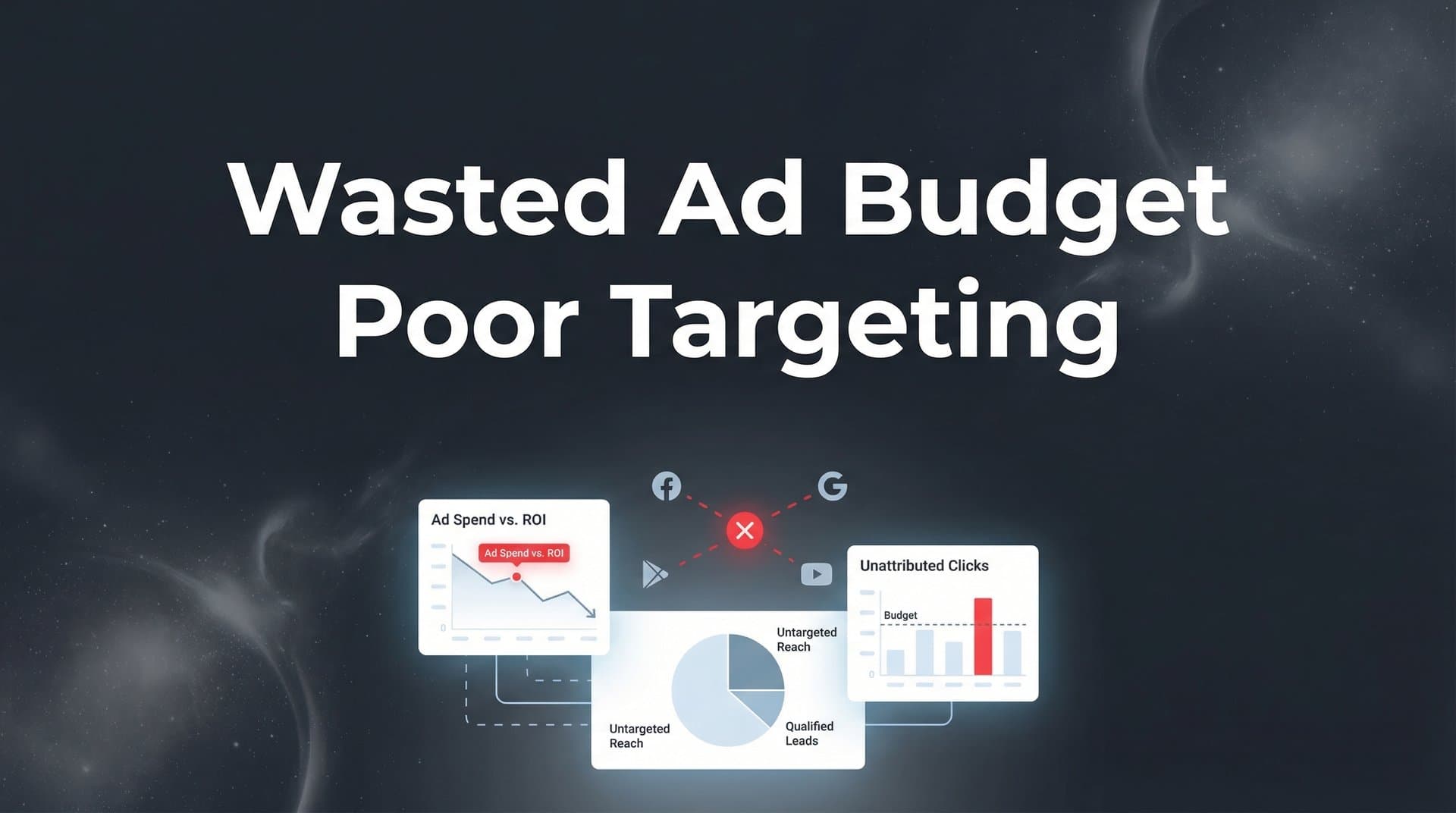
You launch a campaign. The budget drains faster than expected. Click costs look reasonable. But when you check your CRM, the leads are cold. The sales team is frustrated. And you're left wondering where all that ad spend actually went.
This is the reality of poor targeting. It's not always obvious from the metrics your ad platforms show you. Surface-level engagement might look fine while your actual customer acquisition cost spirals out of control.
The problem goes deeper than wasted impressions. When your ads reach the wrong people, those non-converting clicks feed bad signals back to platform algorithms. Meta's AI thinks those users represent your ideal customer. Google's algorithm optimizes for more of the same. You end up in a downward spiral where your targeting gets progressively worse.
But here's what most marketers miss: fixing targeting issues isn't about making your audience broader or narrower. It's about building a systematic process to identify where budget leaks, what actually drives conversions, and how to feed better data back to ad platforms.
This guide breaks down exactly how to audit your current targeting, map real customer journeys, and implement fixes that put every ad dollar to work reaching people who actually become customers. Whether you're managing campaigns across Meta, Google, LinkedIn, or multiple platforms simultaneously, these five steps will help you reclaim control of your budget and build targeting strategies based on conversion data rather than assumptions.
Step 1: Audit Your Current Targeting Settings and Performance Data
Before you can fix targeting problems, you need to know exactly what you're working with. Most marketing teams have accumulated layers of audience definitions, campaign structures, and targeting criteria over months or years. It's time to pull everything into the light.
Start by documenting every active campaign's targeting parameters. For each campaign, record the audience definition, geographic targeting, demographic filters, interest categories, and any exclusions you've set. This sounds tedious, but you'll often discover campaigns targeting overlapping audiences or using outdated criteria that made sense six months ago but no longer align with your business goals.
Next, pull performance data segmented by every targeting dimension available. In Meta, break down results by age, gender, placement, and detailed targeting categories. In Google Ads, segment by audience, demographic, and device. For LinkedIn, analyze by job title, company size, and seniority level.
The goal is identifying high-spend, low-conversion segments. Look for audience groups that consume significant budget but deliver few actual customers. A segment might generate clicks and even form submissions, but if those leads never convert to revenue, that targeting is bleeding your budget.
Document your baseline metrics for each segment. Calculate cost per acquisition, conversion rate, and if possible, customer lifetime value by audience type. These numbers become your benchmark for measuring improvement.
Pay special attention to campaigns that show strong platform-reported conversions but weak downstream results. If Meta says you got 50 conversions but your CRM shows only 12 qualified leads from that campaign, you have a tracking or targeting problem. Often, it's both. Understanding wasted ad budget diagnosis techniques can help you pinpoint exactly where the disconnect occurs.
Create a simple spreadsheet with columns for campaign name, audience definition, spend, conversions, cost per conversion, and actual revenue attributed. Sort by cost per acquisition. The segments at the top are where you're hemorrhaging budget.
This audit typically reveals that 20-30% of your budget goes to audiences that will never become customers. That's your immediate opportunity for reallocation.
Step 2: Map Your Customer Journey to Find Targeting Gaps
Platform dashboards show you what happened inside their ecosystem. But your customers don't live inside a single platform. They research across channels, click multiple ads, visit your site repeatedly, and convert days or weeks after their first interaction.
This is where most targeting strategies fall apart. You optimize based on last-click attribution, crediting whichever platform happened to deliver the final touch. Meanwhile, the audiences and channels that introduced prospects to your brand get zero credit and potentially get cut from your budget.
Start by connecting ad clicks to actual revenue outcomes. Pull data from your CRM or revenue system showing which customers came from which campaigns. Compare this against what ad platforms report as conversions. The gaps reveal targeting that drives engagement but not customers.
Map the typical customer journey from first touch to purchase. Use multi-touch attribution to understand the full path. You'll often discover that your highest-value customers interact with 5-7 touchpoints before converting, spanning multiple platforms and weeks of consideration. When you rely on incomplete data, you risk wasted ad budget on wrong attribution models that misrepresent channel performance.
This changes everything about how you evaluate targeting. That LinkedIn campaign that shows a high cost per lead might actually be introducing prospects who later convert through a Google search ad. The Meta retargeting campaign with great conversion metrics might only work because a YouTube video campaign did the heavy lifting of education.
Compare your assumed ideal customer profile against who actually converts. Pull demographic and firmographic data on your best customers. Look at their job titles, company sizes, industries, and behavioral patterns. Often, you'll find your actual customers differ significantly from who you thought you were targeting.
One pattern emerges consistently: the audiences that convert fastest aren't always the most profitable. Quick converters might be smaller customers with lower lifetime value. Meanwhile, larger accounts take longer to close but generate significantly more revenue. If you optimize targeting purely for speed to conversion, you might be systematically excluding your best potential customers.
Document which channels and audiences play which roles in your customer journey. Some targeting works for awareness and introduction. Other audiences convert better for direct response. Trying to make every campaign do everything leads to poor performance across the board.
Use this journey mapping to identify targeting gaps. Perhaps you have strong bottom-of-funnel retargeting but no top-of-funnel strategy to feed it. Or you're spending heavily on cold acquisition without nurturing audiences through the consideration phase. These gaps explain why certain targeting approaches underperform.
Step 3: Build Audience Segments Based on Conversion Data
Now that you understand what actually drives conversions, it's time to rebuild your audience strategy from the ground up. Forget platform-suggested audiences and demographic assumptions. Your targeting should be based entirely on behavioral patterns from real customers.
Start with your highest-value customers, not just any converter. Pull a list of customers who have generated significant revenue or shown strong retention. Upload this list to create lookalike audiences on Meta, similar audiences on Google, and matched audiences on LinkedIn.
The difference between lookalikes built from all customers versus high-value customers is dramatic. When you include every converter, you're telling the algorithm to find people like your one-time small purchasers and your enterprise clients. The resulting audience is muddled. Build separate lookalikes for different customer tiers, and you'll see much stronger performance.
Layer targeting criteria based on actual behavioral patterns. If your best customers typically visit specific pages on your site, create audiences that include that behavior. If they engage with particular content types, factor that into your targeting. Every layer should be informed by data, not assumptions. Implementing marketing budget allocation based on data ensures your spend follows proven conversion patterns rather than guesswork.
Equally important: exclude audiences that consistently don't convert. Create exclusion lists for users who have clicked your ads multiple times but never taken meaningful action. Include people who submitted forms but were marked as unqualified by sales. Add past customers if you're running acquisition campaigns.
Many marketers hesitate to narrow their targeting, fearing they'll limit reach. But targeting people unlikely to convert doesn't increase your real reach. It just wastes impressions on the wrong audience while driving up costs for everyone.
Segment by customer lifetime value rather than just initial purchase behavior. A customer who makes a small first purchase but returns monthly is far more valuable than someone who makes one larger purchase and never returns. When you optimize targeting for initial conversion value, you might be systematically attracting the wrong customer profile.
Test different audience combinations systematically. Run campaigns targeting your core high-value lookalike audience. Run others testing broader variations. Track not just conversion rate but downstream metrics like customer quality and lifetime value. The audiences that deliver the best customers should get the most budget, even if their immediate conversion metrics look slightly worse. Understanding retargeting audience performance helps you measure which segments actually drive revenue.
Document the characteristics of your best-performing audience segments. Over time, you'll build a clear picture of who converts, what behaviors predict value, and which targeting approaches consistently deliver results. This becomes your targeting playbook for future campaigns.
Step 4: Implement Server-Side Tracking for Accurate Targeting Signals
Even perfect audience targeting fails if your conversion tracking is broken. And for most marketers, it is broken—they just don't realize it yet.
Browser-based tracking has become increasingly unreliable. iOS privacy features block many tracking scripts. Browser extensions strip cookies. Users browse in private mode. The result is that ad platforms receive incomplete conversion data, often missing 30-40% of actual conversions. This leads directly to ad spend wasted from poor tracking that compounds over time.
When platforms don't see conversions, their algorithms can't optimize properly. Meta's AI thinks certain audiences don't convert when they actually do. Google's algorithm shifts budget toward audiences it can track, even if other segments perform better. You end up optimizing based on partial, skewed data.
Server-side tracking solves this by sending conversion events directly from your server to ad platforms. Instead of relying on browser pixels that can be blocked, your server reports conversions that actually happened in your database or CRM.
Setting up server-side tracking requires technical implementation, but the impact on targeting accuracy is significant. You'll suddenly see conversions that were previously invisible. Your cost per acquisition numbers will look different because you're finally measuring the full picture.
More importantly, ad platforms receive better data to optimize against. When Meta's algorithm sees complete conversion data, it can identify the true patterns that predict customer behavior. Your lookalike audiences become more accurate. Your campaign optimization improves. You stop wasting budget on audiences that only appear to convert because the tracking is broken.
Server-side tracking also enables you to send enriched conversion data back to platforms. Instead of just reporting that a conversion happened, you can include the actual value, customer type, or lifetime value prediction. Platforms can then optimize specifically for high-value conversions rather than treating all conversions equally. Addressing poor conversion API data quality is essential for this enriched data strategy to work effectively.
Verify your tracking accuracy by comparing platform-reported conversions against actual conversions in your CRM or revenue system. The gap between these numbers reveals how much data you're losing to tracking limitations. For many businesses, this gap is eye-opening.
Once server-side tracking is live, give your campaigns time to re-optimize. Platform algorithms need data to learn. As they receive more accurate conversion signals, their targeting recommendations and automated optimizations will improve. Campaigns that previously underperformed might suddenly become your best performers once the algorithm can see the full picture.
Step 5: Create a Continuous Optimization Loop
Fixing targeting isn't a project you complete and forget. Markets shift. Customer preferences evolve. Competitors change tactics. What works today might underperform next quarter.
Establish a weekly targeting performance review. Block time every week to analyze key metrics: cost per acquisition by audience, conversion rate trends, and budget distribution across segments. Look for campaigns showing declining efficiency or audiences that have stopped performing.
Set up automated alerts for campaigns that cross critical thresholds. If cost per acquisition increases by 30% week-over-week, you need to know immediately. If a previously strong audience segment suddenly stops converting, investigate before you waste significant budget. Implementing automated budget optimization for paid media can help you respond to these shifts in real time.
Use AI-powered recommendations to identify opportunities you might miss manually. Modern attribution platforms can analyze thousands of data points to spot patterns—like a specific audience segment that performs well only on certain days, or a combination of targeting criteria that consistently delivers better results.
These AI recommendations help you scale what's working. When you find an audience segment delivering strong results, AI can suggest similar segments to test or identify the optimal budget allocation across your campaigns. Explore AI-powered budget allocation recommendations to see how machine learning can enhance your targeting decisions.
Document what works and build a targeting playbook. When you discover an audience combination that performs well, record the specifics. Note the targeting criteria, budget levels, creative approaches, and any seasonal patterns. Over time, this playbook becomes your competitive advantage.
Test new targeting approaches systematically. Allocate 10-20% of your budget to testing new audience segments, platforms, or targeting strategies. Some will fail. But the ones that succeed often become your next major growth channel.
Review your exclusion lists regularly. Audiences that didn't convert six months ago might be ready now. Markets mature. Awareness grows. Someone who wasn't a fit for your product last quarter might be your ideal customer today.
Share insights across your team. When you discover that a particular job title converts at twice the rate of others, that's valuable for everyone—from campaign managers to sales teams to product development. Targeting insights often reveal broader strategic opportunities.
The marketers who consistently outperform their competitors aren't necessarily more creative or working with bigger budgets. They're simply more disciplined about continuous optimization. They measure rigorously, test systematically, and let data guide their decisions.
Putting It All Together
Stopping wasted ad budget from poor targeting isn't about finding one magic audience or perfect campaign structure. It's about building a systematic approach to understanding who actually becomes your customer and continuously refining your targeting based on that reality.
Start with the audit. Pull your current targeting settings and performance data. Identify where budget is leaking to audiences that will never convert. Those findings alone will show you immediate opportunities to reallocate spend.
Map your real customer journey. Understand the full path from first touch to purchase. Stop optimizing for last-click conversions and start building targeting strategies that account for how customers actually buy.
Build audience segments based on conversion data, not assumptions. Use your highest-value customers to create lookalikes. Exclude audiences that consistently don't convert. Layer targeting criteria based on behavioral patterns you've observed.
Fix your tracking foundation with server-side implementation. Accurate data is the prerequisite for everything else. When ad platforms receive complete conversion signals, their optimization improves dramatically.
Create continuous optimization loops that keep your targeting sharp as markets evolve. Weekly reviews, automated alerts, and systematic testing ensure you catch problems early and scale successes quickly.
The difference between marketers who struggle with targeting and those who excel comes down to discipline. The winners let actual conversion data guide every decision. They measure rigorously. They test systematically. They optimize continuously.
Your competitors are likely still relying on platform defaults, demographic assumptions, and incomplete tracking. That's your opportunity. By implementing these five steps, you transform targeting from a guessing game into a precision strategy backed by real customer data.
Ready to elevate your marketing game with precision and confidence? Discover how Cometly's AI-driven recommendations can transform your ad strategy. Get your free demo today and start capturing every touchpoint to maximize your conversions.


