

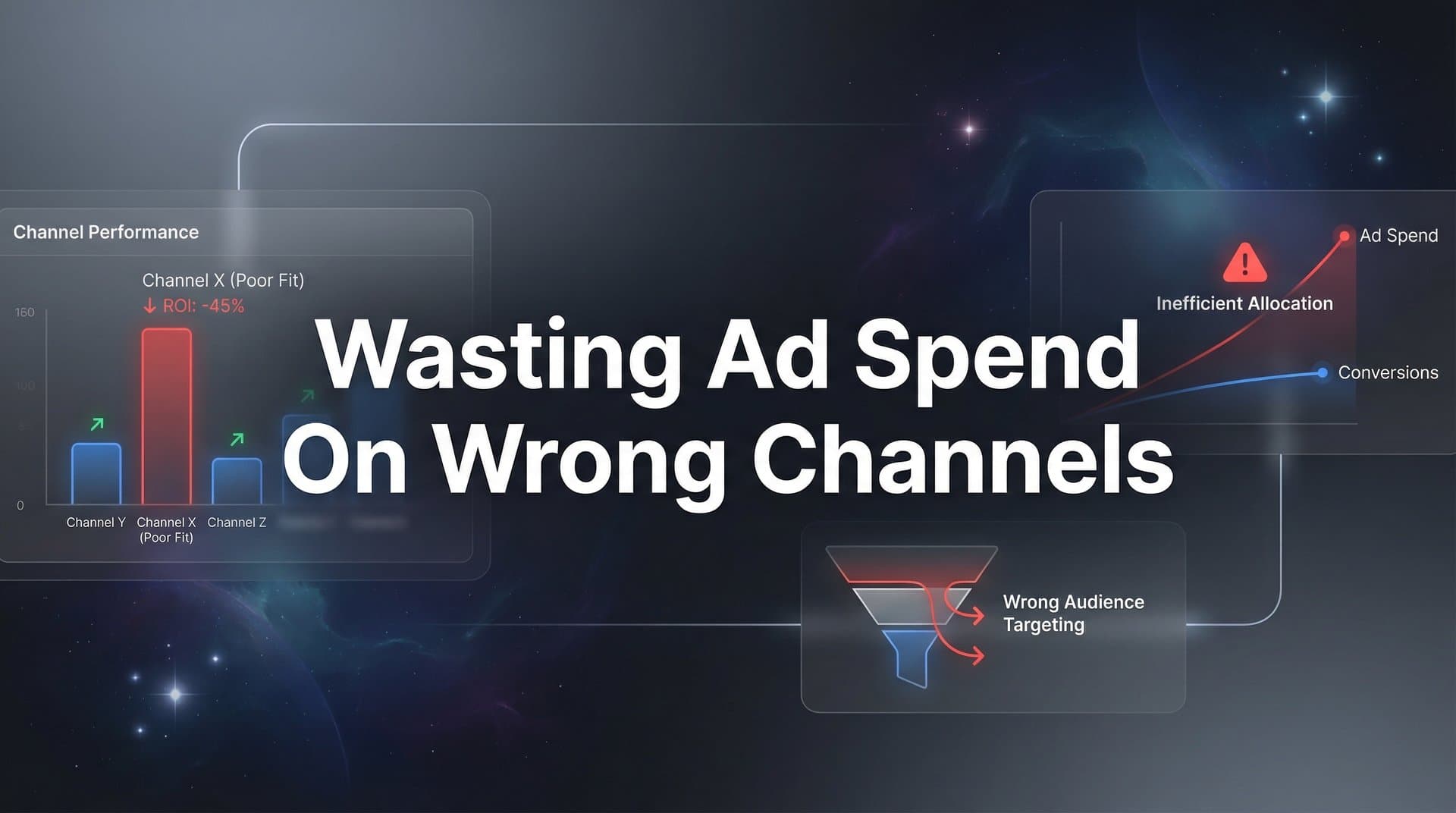
Your Google Ads dashboard shows 150 conversions this month. Meta Ads Manager reports 120. TikTok claims 80. You add them up and celebrate 350 conversions total. But when you check your CRM, you only closed 90 actual customers. The math doesn't work, and neither does your budget allocation.
This isn't a reporting glitch. It's attribution blindness, and it's costing you thousands in wasted ad spend every single month.
When multiple platforms claim credit for the same conversion, you're not just dealing with inflated numbers. You're making budget decisions based on fiction. You're scaling channels that look like winners but might be riding the coattails of other touchpoints. You're cutting spend from channels that actually drive revenue because they don't get credit in last-click attribution models.
The result? Your budget flows toward the channels that report well, not the ones that convert well. And in today's privacy-first landscape with iOS restrictions and cookie deprecation, those attribution blind spots have grown into chasms.
This guide will show you exactly where your budget is leaking, why your platform reports are misleading you, and how to build an attribution system that connects ad clicks to actual revenue. By the end, you'll know how to identify which channels truly drive conversions and how to reallocate your budget accordingly.
Why Your Ad Platform Reports Are Lying to You
Every ad platform operates like a competing sales team, each claiming they closed the deal. Meta says their ad drove the conversion. Google insists it was their search ad. TikTok points to their video that started the journey. They're all technically correct, but they're also all inflating their value.
Here's the problem: each platform uses its own attribution window and methodology. Meta might count a conversion if someone clicked your ad anytime in the last seven days. Google uses a different window. TikTok has its own rules. When the same customer interacts with ads on multiple platforms before converting, every platform claims that conversion as their win.
This creates what marketers call "attribution overlap." If you're running campaigns on three platforms and each reports 100 conversions, you might assume you generated 300 total conversions. In reality, you might have generated 120 conversions that all three platforms are claiming credit for. The math breaks down completely when you try to calculate your true cost per acquisition.
The iOS privacy changes made this exponentially worse. When Apple introduced App Tracking Transparency with iOS 14.5, they fundamentally broke the tracking infrastructure that ad platforms relied on. Users could now opt out of cross-app tracking, and most did. Suddenly, platforms lost visibility into huge portions of the customer journey.
Meta estimated they lost tracking on approximately 15-20% of conversions after iOS changes rolled out. But the real impact goes deeper than missing conversions. When platforms can't see the full journey, they make educated guesses about attribution. Those guesses favor their own touchpoints. This is why Google Ads showing wrong conversions has become such a common frustration for marketers.
Cookie deprecation compounds the issue. As browsers phase out third-party cookies, cross-site tracking becomes nearly impossible. A customer might click your Google ad, research on your website, see a retargeting ad on Meta, and convert three days later. Without cookies, connecting those dots requires server-side infrastructure that most marketers haven't implemented.
Last-click attribution creates another layer of distortion. This model gives 100% credit to the final touchpoint before conversion, completely ignoring everything that happened earlier in the journey. If a customer discovered you through a TikTok ad, researched via Google, and finally converted through a Meta retargeting ad, last-click attribution credits Meta with the entire conversion.
This systematically undervalues top-of-funnel channels. Your awareness campaigns on TikTok or YouTube might be doing the heavy lifting of introducing your brand to cold audiences, but they rarely get credit because people don't convert immediately. Meanwhile, retargeting campaigns look like superstars because they capture people already primed to buy.
The platforms themselves have every incentive to maintain this confusion. When their dashboard shows strong performance, you keep spending. They're not intentionally lying, but their attribution models are designed to make their platform look as valuable as possible. They're measuring their own homework, and surprise, they're giving themselves an A+.
The Hidden Signs Your Budget Is Going to the Wrong Places
The most dangerous budget leaks don't announce themselves. They hide behind metrics that look healthy on the surface. You need to know what to look for.
Start with the revenue disconnect. Your ad platforms report increasing conversions month over month. Your dashboards are green across the board. But when you look at actual revenue, it's flat or declining. This is the clearest sign that your attribution is broken and your budget is flowing to the wrong channels.
This happens when platforms optimize for low-quality conversions. Maybe they're counting email signups as conversions, but those emails never turn into customers. Or they're driving traffic that converts on-site but has terrible lifetime value. The platform sees a conversion and claims success. Your bank account tells a different story. Understanding wasted ad spend identification strategies is crucial for catching these issues early.
Watch for discrepancies between platform data and your CRM. If Google Ads reports 200 lead form submissions but your CRM only shows 150 new contacts, something is broken in your tracking. Those 50 missing conversions might be duplicates, bot traffic, or tracking errors. Either way, you're making budget decisions based on phantom conversions.
The quality gap reveals itself when you dig deeper. You might have one channel driving 100 conversions at $50 each and another driving 50 conversions at $100 each. Surface-level analysis says the first channel wins. But when you trace those conversions through to closed deals, you discover the expensive channel converts to customers at 40% while the cheap channel converts at 5%.
Suddenly, the expensive channel is generating 20 customers at $250 per customer, while the cheap channel generates 5 customers at $1,000 per customer. The "winner" is actually losing you money, but you'd never know it without connecting ad data to revenue outcomes.
Another red flag: you can't explain why certain campaigns work. You're scaling a campaign because the numbers look good, but you can't articulate what makes it successful or replicate that success elsewhere. This usually means you're measuring correlation, not causation. The campaign might be getting credit for conversions that would have happened anyway. This often points to revenue attribution to wrong campaigns.
Time lag issues create similar problems. B2B purchases and high-consideration B2C products often have long sales cycles. Someone might click your ad today and convert three months later. If your attribution window is only seven days, you'll never connect that conversion back to the original touchpoint. You'll think that channel doesn't work and cut the budget, not realizing it's actually your best performer.
Geographic and device misattribution also waste budget silently. Maybe your mobile ads are driving awareness, but people convert on desktop days later. Last-click attribution credits the desktop channel and undervalues mobile. You cut mobile spend, not realizing you just killed your top-of-funnel.
The inability to distinguish between new and returning customers is another hidden leak. Retargeting campaigns naturally perform better because they target people who already know you. But if you're comparing their performance directly to cold prospecting campaigns without accounting for that difference, you'll systematically over-invest in retargeting and under-invest in new customer acquisition. Eventually, your retargeting pool shrinks and performance collapses.
Multi-Touch Attribution: Seeing the Complete Customer Journey
Real customer journeys are messy. Someone sees your TikTok ad on Monday, Googles your brand on Wednesday, clicks a Meta retargeting ad on Friday, and converts the following Tuesday after receiving an email. Which touchpoint deserves credit for that conversion?
The answer depends on what you're trying to optimize for, and that's where multi-touch attribution becomes essential. Instead of giving all credit to one touchpoint, multi-touch models distribute credit across the entire journey based on different methodologies.
First-touch attribution gives 100% credit to the initial touchpoint that introduced the customer to your brand. In our example, TikTok gets full credit. This model is valuable when you're trying to understand your acquisition channels and determine which platforms are best at generating new awareness. It answers the question: "Where do our customers come from?"
The downside? First-touch completely ignores everything that happened after that initial interaction. It can overvalue top-of-funnel channels that generate awareness but don't necessarily drive conversions. You might discover that a particular channel is great at introducing people to your brand but terrible at bringing them back to convert. Without proper tracking, you end up with ad spend attribution unclear sources that make optimization impossible.
Last-touch attribution sits on the opposite end. It gives all credit to the final touchpoint before conversion. In our example, the email gets full credit. This model helps you understand what closes deals and which channels are best at converting warm audiences. It answers: "What finally convinced them to buy?"
But last-touch systematically undervalues everything that happened earlier in the journey. It makes retargeting and bottom-funnel channels look like heroes while making top-of-funnel channels look worthless. This leads to chronic under-investment in awareness and over-investment in conversion tactics.
Linear attribution distributes credit equally across all touchpoints. TikTok, Google, Meta, and email each get 25% credit. This model acknowledges that multiple interactions contributed to the conversion and gives them equal weight. It's useful when you want a balanced view and don't want to over-index on any particular part of the journey.
The limitation? Linear attribution assumes all touchpoints are equally valuable, which rarely reflects reality. The ad that introduced someone to your brand probably had more impact than the fifth retargeting impression they saw.
Time-decay attribution gives increasing credit to touchpoints closer to the conversion. Earlier interactions get some credit, but the final touchpoints get more. In our example, TikTok might get 10%, Google 20%, Meta 30%, and email 40%. This model reflects the reality that recent interactions often have more influence on the decision to convert.
Position-based attribution (also called U-shaped) gives the most credit to the first and last touchpoints, with remaining credit distributed to middle interactions. This model acknowledges that introducing someone to your brand and closing the sale are both critical, while middle touchpoints play a supporting role.
Here's what matters most: you need to connect ad clicks to actual business outcomes, not just website conversions. Multi-touch attribution only creates value when you integrate it with your CRM and revenue data. Otherwise, you're just distributing credit across touchpoints without knowing if those touchpoints actually led to customers or just website visitors who never bought. A dedicated ad spend attribution platform can help you make these connections automatically.
When you connect ad data to CRM events, you can trace which specific ads generated qualified leads versus tire-kickers. You can see which channels drive customers with high lifetime value versus one-time buyers. You can identify which campaigns generate enterprise deals versus small accounts.
This is where most attribution systems fail. They track the journey to a website conversion but lose visibility after that. They can tell you which ad drove a form submission but not whether that lead became a customer, how long the sales cycle took, or how much revenue they generated. Without that connection, you're still making budget decisions in the dark.
Server-Side Tracking: Recovering Lost Data
Browser-based tracking is dying, and it's taking your attribution accuracy with it. Every time someone uses an ad blocker, rejects cookies, or browses in private mode, your tracking breaks. Every iOS user who opted out of app tracking creates a blind spot in your data. The gaps are massive, and they're growing.
Server-side tracking solves this by moving data collection from the browser to your server. Instead of relying on cookies and pixels that users can block, your server captures events directly and sends them to ad platforms through their conversion APIs. The user's browser never enters the equation.
Here's how it works in practice. Someone clicks your Meta ad and lands on your website. With client-side tracking, Meta's pixel fires in their browser, tracking their activity. But if they have an ad blocker or strict privacy settings, that pixel gets blocked. Meta never sees the conversion, their algorithm doesn't learn, and you can't attribute the sale back to the ad that drove it.
With server-side tracking, your server captures the click, tracks the conversion, and sends that data directly to Meta's Conversions API. The user's browser settings don't matter because the data flows server-to-server. Meta gets the conversion data they need to optimize, and you get accurate attribution even for privacy-conscious users. This approach helps you reduce wasted ad spend with better data.
The benefits extend beyond just recovering lost data. Server-side tracking captures events that client-side methods miss entirely. When someone calls your sales team after seeing an ad, client-side tracking can't connect that phone call to the ad. Server-side tracking can, because you can feed CRM events back through the same pipeline.
This creates a feedback loop that improves ad platform performance. When you send high-quality conversion data back to platforms like Meta and Google, their algorithms learn what good customers look like. They can optimize toward conversions that actually matter to your business, not just website clicks or low-quality form fills.
Think about what ad platforms are trying to do. They're using machine learning to find people similar to your converters and show them your ads. But if they only see 60% of your conversions because the other 40% are blocked by privacy settings, they're learning from incomplete data. They're optimizing toward a biased sample.
When you implement server-side tracking and feed complete conversion data back through conversion APIs, the platforms suddenly see the full picture. They learn that certain types of users convert even though their conversions weren't visible before. The algorithms adjust, targeting improves, and your cost per acquisition drops.
Server-side tracking also enables better cross-device attribution. Someone might see your ad on mobile but convert on desktop days later. Client-side tracking struggles to connect those dots because cookies don't transfer between devices. Server-side tracking can match users across devices using email addresses, phone numbers, or other identifiers that persist across sessions.
The implementation requires technical setup. You need infrastructure to capture events on your server, match them to ad clicks, and send them to platform APIs. You need to handle data securely and comply with privacy regulations. Using ad spend tracking software can simplify this process significantly. But the payoff is enormous: accurate tracking in a privacy-first world, better ad platform optimization, and attribution that actually reflects reality.
Most importantly, server-side tracking future-proofs your attribution. As browsers continue restricting third-party cookies and privacy regulations tighten, client-side tracking will only get worse. Server-side tracking positions you ahead of these changes, maintaining attribution accuracy while competitors lose visibility.
Reallocating Budget Based on Real Revenue Data
Knowing your attribution is broken is one thing. Fixing your budget allocation based on accurate data is another. Here's how to audit your current spending and redirect budget toward channels that actually drive revenue.
Start with a channel performance audit that goes beyond platform metrics. Export conversion data from each ad platform for the last 90 days. Then pull your actual customer data from your CRM for the same period. The goal is to match platform-reported conversions to real customers and revenue.
Create a simple spreadsheet with columns for channel, platform-reported conversions, actual customers acquired, revenue generated, and customer acquisition cost. This side-by-side comparison immediately reveals discrepancies. You'll see which channels over-report their performance and which are genuinely driving business outcomes. Learning how to optimize ad spend allocation starts with this foundational analysis.
For each channel, calculate your true CAC by dividing total spend by actual customers acquired (not platform-reported conversions). Then calculate customer lifetime value for customers acquired through each channel. The channels with the best LTV:CAC ratios are your winners, regardless of what their dashboards claim.
Run incrementality tests to validate which channels truly drive conversions versus which are taking credit for sales that would have happened anyway. The simplest approach: pause spending on a channel for two weeks and measure whether overall conversions drop proportionally. If you pause a channel claiming 100 conversions per month and total conversions only drop by 30, that channel was over-reporting its impact by 70%.
Geographic holdout tests work well for larger advertisers. Stop advertising in specific regions while continuing in others, then compare conversion rates. This isolates the true incremental impact of your advertising versus baseline conversions that happen regardless of ad spend.
Build a cohort analysis that tracks customers acquired through different channels over time. Some channels might drive cheap initial conversions but terrible retention. Others might have higher upfront costs but generate customers who stick around and spend more. You want to optimize for long-term value, not just initial conversion cost. A return on ad spend calculator can help you quantify these differences.
Look at the full funnel metrics for each channel. What's the progression from click to lead to qualified opportunity to closed customer? A channel driving 1,000 clicks that generate 100 leads, 20 opportunities, and 5 customers has a very different value than a channel driving 500 clicks that generate 50 leads, 30 opportunities, and 8 customers. The second channel has half the volume but better conversion rates at every stage.
Create a budget reallocation plan based on these insights. Identify your top three channels by true CAC and LTV. These deserve increased investment. Identify your bottom three by the same metrics. These need budget cuts or strategic changes. The middle channels require testing to determine whether they can be optimized or should be deprioritized.
Implement changes gradually. Don't slash budgets by 80% overnight based on one month of data. Make 20-30% adjustments and measure the impact over 4-6 weeks. Attribution data can be noisy, and you want to avoid over-correcting based on short-term fluctuations.
Build feedback loops between your attribution insights and budget decisions. Set up weekly or monthly reviews where you examine updated attribution data and make incremental budget adjustments. This ongoing optimization beats the one-time audit approach because channel performance shifts over time.
Test new channels with small budgets while you optimize existing ones. Your current channel mix might be the best available options, or you might be missing opportunities because you've never tested alternatives. Allocate 10-15% of budget to testing new platforms, audiences, or campaign types. Some will fail, but the winners can become your next major growth channels.
Document your attribution methodology and share it across your team. When everyone understands how you're measuring success and allocating budget, you avoid the political battles where different team members champion their favorite channels based on cherry-picked metrics. Real revenue data creates alignment.
Putting It All Together: A Smarter Approach to Ad Spend
Wasting ad spend on wrong channels isn't inevitable. It's a symptom of broken attribution, and it's fixable with the right approach. The solution requires three core components working together: unified tracking across all touchpoints, multi-touch attribution that connects ads to revenue, and server-side infrastructure that captures data other methods miss.
Start by acknowledging that your ad platform dashboards are unreliable in isolation. They're useful data points, but they're not the source of truth. Your CRM and revenue data are the source of truth. Every attribution decision should ultimately tie back to actual business outcomes, not platform-reported conversions.
Implement multi-touch attribution that reflects how customers actually buy from you. If you're in B2B with long sales cycles, you need attribution models that account for multiple touchpoints over months. If you're in e-commerce with impulse purchases, your attribution can be simpler. Match your methodology to your customer journey.
Build server-side tracking to recover the data you're currently losing to privacy restrictions. This isn't optional anymore. As browsers and platforms continue restricting tracking, server-side infrastructure is the only way to maintain attribution accuracy. It also feeds better data back to ad platforms, improving their optimization.
Create a regular cadence for reviewing attribution data and adjusting budgets. This isn't a one-time project. Channel performance changes, customer behavior shifts, and competitive dynamics evolve. Your budget allocation needs to evolve with them. Monthly reviews with quarterly deep dives work well for most businesses.
Remember that attribution optimization is ongoing, not a destination. You'll never achieve perfect attribution because customer journeys are complex and data will always have gaps. But you can continuously improve, getting closer to truth with each iteration. The goal is directional accuracy: knowing which channels drive real value even if you can't measure every micro-interaction.
The marketers who win in the current landscape are those who connect their ad spend to actual revenue outcomes. They're not fooled by inflated platform metrics. They're not wasting budget on channels that look good in dashboards but don't drive business results. They're making confident, data-driven decisions based on what actually converts.
Ready to elevate your marketing game with precision and confidence? Discover how Cometly's AI-driven recommendations can transform your ad strategy. Our platform captures every touchpoint across your entire customer journey, from initial ad click through CRM events to final revenue. With multi-touch attribution models, server-side tracking, and real-time analytics, you'll finally see which channels truly drive conversions. Stop wasting budget on attribution blind spots. Get your free demo today and start making smarter budget decisions based on real revenue data.



