You're running campaigns across Google Ads, Meta, LinkedIn, and email. Leads are flowing in. Revenue is up. But here's the question keeping you up at night: which channel actually deserves credit for that $50,000 deal that just closed?
The prospect first clicked a LinkedIn ad three weeks ago. Then they read two blog posts. Downloaded a guide via Google search. Clicked an email. Visited your pricing page directly. And finally converted after clicking a retargeting ad on Facebook.
So which channel gets the credit? Which one should you scale? Which one is actually wasting your budget?
This is the attribution puzzle—and it's costing marketers millions in misallocated budget every single day. Attribution models are the framework that solves this problem by assigning credit to marketing touchpoints along the customer journey. They're the lens through which you understand what's really driving conversions, and the wrong lens leads to catastrophically wrong decisions.
This guide will walk you through how attribution models work, the strengths and limitations of each approach, and how to implement attribution that actually drives smarter marketing decisions instead of just creating prettier dashboards.
The Framework Behind Marketing Credit Assignment
An attribution model is essentially a rule set that determines how conversion credit gets distributed across the touchpoints a prospect encounters before becoming a customer. Think of it as the scoring system that decides which players on your marketing team get credit for the win.
The reason we need these models in the first place is simple: the customer journey is messy. Prospects don't see one ad and immediately buy. They interact with your brand across multiple channels, over days or weeks or months, before they're ready to convert.
A typical B2B buyer might see your LinkedIn ad during their morning scroll, visit your website later that day via Google search, read a comparison article, download a case study, receive three nurture emails, attend a webinar, and then finally request a demo after clicking a retargeting ad. That's seven touchpoints—and every single one played some role in moving them toward conversion.
Without attribution, you're flying blind. You might assume the retargeting ad "caused" the conversion because it was the last thing they clicked. So you pour more budget into retargeting while cutting spend on LinkedIn ads and content marketing—the channels that actually introduced prospects to your brand in the first place. Understanding what attribution means in marketing is the first step toward solving this problem.
Or you might credit everything to the first touchpoint, overvaluing awareness tactics while ignoring the nurturing and conversion optimization that actually closed the deal. Either way, you're making budget decisions based on incomplete information.
Attribution models bring clarity to this chaos. They create a consistent framework for evaluating channel performance, comparing campaign effectiveness, and understanding which marketing investments actually drive revenue. The model you choose determines how you see your marketing performance—which means it directly influences where you spend your next dollar.
Single-Touch Models: First-Touch and Last-Touch Attribution
The simplest attribution approaches assign 100% of the credit to a single touchpoint. These models are easy to understand and implement, but they come with significant blind spots that can distort your marketing strategy.
First-Touch Attribution: This model gives all the credit to the very first interaction a prospect has with your brand. If someone discovers you through a LinkedIn ad, that ad gets 100% credit for the eventual conversion—even if it happened three months later after dozens of other interactions.
The appeal here is obvious: it shows you what's bringing new prospects into your ecosystem. If you're obsessed with top-of-funnel performance and want to understand which channels are best at generating awareness, first-touch attribution tells that story clearly.
But here's what it misses: everything that happened after that first click. The email sequence that nurtured the lead. The retargeting campaign that brought them back. The case study that addressed their final objections. The demo that closed the deal. First-touch attribution treats all of this as irrelevant, which means you'll systematically undervalue the marketing efforts that actually move prospects from awareness to decision.
Last-Touch Attribution: This is the opposite extreme—100% credit goes to the final touchpoint before conversion. If someone converts after clicking a branded search ad, that ad gets all the glory, regardless of the awareness campaigns and content marketing that made them search for your brand in the first place.
Last-touch is popular because it's simple and it aligns with how many ad platforms report conversions by default. Google Ads and Meta Ads Manager tend to use last-click attribution in their native reporting, which makes it the path of least resistance. For a deeper dive into how these models work in practice, explore our guide on types of attribution models in digital marketing.
The problem is that last-touch systematically overvalues bottom-funnel tactics. Branded search, retargeting, and direct traffic all look like superstars because they're often the last thing people click before converting. Meanwhile, the LinkedIn ads that introduced prospects to your brand, the content that educated them, and the email nurture that kept you top-of-mind get zero credit.
When Single-Touch Makes Sense: Despite their limitations, single-touch models aren't useless. They work reasonably well for businesses with very short sales cycles—think e-commerce impulse purchases or low-cost SaaS products where prospects convert within hours of first discovery. If your customer journey is typically one or two touchpoints, a single-touch model isn't missing much.
They're also useful when you have limited tracking capabilities or insufficient data volume for more sophisticated models. If you're just starting to implement attribution and need quick directional insights, beginning with last-touch and gradually adding complexity can be a practical approach.
Multi-Touch Models: Distributing Credit Across the Journey
Multi-touch attribution models acknowledge reality: most conversions involve multiple touchpoints, and each one contributes something to the final outcome. Instead of giving all the credit to one interaction, these models distribute it across the customer journey.
Linear Attribution: The most democratic approach—every touchpoint gets equal credit. If a prospect had five interactions before converting, each one receives 20% of the credit. Simple, fair, and completely agnostic about which touchpoints matter more. You can learn more about implementing this approach with linear model marketing attribution software.
The advantage is that linear attribution ensures no channel gets completely ignored. Your awareness campaigns, mid-funnel content, and bottom-funnel conversion tactics all get recognized for their contribution. This can reveal channels that single-touch models would overlook entirely.
The limitation is equally obvious: not all touchpoints are created equal. The webinar that answered a prospect's biggest objection probably had more influence than the third email in your nurture sequence. Linear attribution treats them as identical, which means it still doesn't reflect true impact.
Time-Decay Attribution: This model weights touchpoints based on recency—interactions closer to the conversion get more credit, while earlier touchpoints get progressively less. A common implementation gives the most recent touchpoint the highest credit, with each earlier interaction receiving a fraction of the previous one's weight.
Time-decay makes intuitive sense for businesses with longer consideration cycles. If prospects spend weeks or months evaluating your product, the interactions that happen near the end of that journey—when they're closest to making a decision—probably have more influence than the awareness content they consumed a month ago.
This model is particularly useful for understanding what pushes prospects over the finish line. It helps you identify which bottom-funnel tactics are most effective at converting warm leads into customers, without completely ignoring the top-of-funnel efforts that started the relationship.
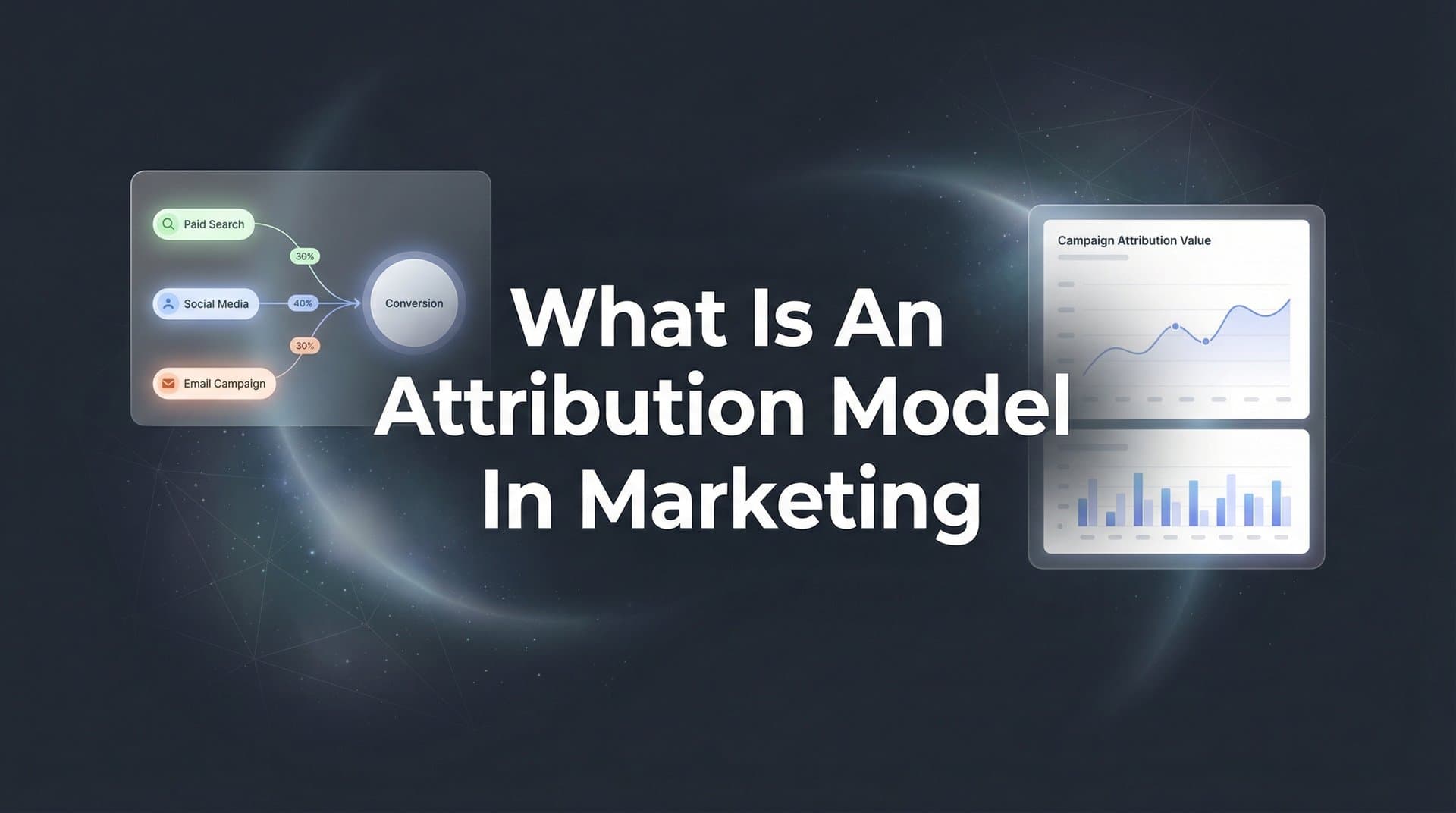
Position-Based Attribution (U-Shaped): This approach assigns the most credit to the first and last touchpoints—typically 40% each—while distributing the remaining 20% across all the interactions in between. The logic is that the first touch (awareness) and last touch (conversion) are the most critical moments in the customer journey.
Position-based attribution is popular with marketers who want to balance awareness and conversion metrics. It ensures your top-of-funnel campaigns get meaningful credit for bringing prospects in, while also recognizing the bottom-funnel tactics that close deals. The middle interactions still get some credit, just less than the bookend moments.
The challenge with position-based models is the arbitrary nature of the weighting. Why 40-20-40 instead of 30-40-30? The specific percentages are assumptions, not data-driven conclusions. For some businesses, middle-funnel nurture is actually the most important part of the journey—but position-based attribution systematically undervalues it. Understanding what is predetermined in marketing attribution models helps clarify these built-in assumptions.
Data-Driven Attribution: Letting Algorithms Determine Impact
Here's where attribution gets interesting: instead of using predetermined rules to assign credit, data-driven attribution uses machine learning to analyze your actual conversion data and determine which touchpoints have the most statistical influence on outcomes.
The algorithm looks at thousands of customer journeys—both those that converted and those that didn't—and identifies patterns. It asks questions like: When prospects interact with Channel X, how much more likely are they to convert? Does the impact of Channel Y change depending on what came before it? Which combinations of touchpoints produce the highest conversion rates?
Based on these patterns, the model assigns credit proportionally to each touchpoint's actual contribution. A channel that consistently appears in successful conversion paths gets more credit. A touchpoint that shows up just as often in paths that don't convert gets less credit, even if it's technically "in the journey."
The power of data-driven attribution is that it removes guesswork. You're not assuming first-touch matters most, or last-touch, or that all touches are equal. You're letting your own data reveal what actually drives conversions for your specific business, with your specific audience, across your specific marketing mix. Explore how content marketing attribution modeling with machine learning takes this approach even further.
This approach also adapts over time. As your marketing strategy evolves, as new channels are added, as customer behavior shifts, the model recalculates credit based on current patterns rather than outdated assumptions. It's a living framework that reflects reality instead of theory.
Requirements for Data-Driven Attribution: The catch is that machine learning needs fuel—and that fuel is data. To build a statistically valid data-driven model, you need sufficient conversion volume (typically hundreds of conversions per month at minimum), comprehensive tracking across all touchpoints, and integration between your ad platforms, website analytics, and CRM.
If you're only tracking paid ads but missing organic search, email, and direct traffic, the algorithm can't see the full picture. If your conversion volume is too low, the model won't have enough signal to distinguish meaningful patterns from noise. Data-driven attribution is powerful, but it's not magic—it's only as good as the data you feed it.
Choosing the Right Model for Your Marketing Strategy
There's no universal "best" attribution model—the right choice depends on your business model, sales cycle, marketing mix, and data infrastructure. Here's how to match model to strategy.
Match Model to Sales Cycle: If you're selling low-cost products with impulse purchases and same-day conversions, a simple last-touch model probably captures 90% of reality. Most customers discover you and buy immediately, so there's not much journey to attribute.
But if you're running a B2B SaaS business with a 60-day sales cycle, enterprise deals, and multiple decision-makers, single-touch attribution will systematically mislead you. You need multi-touch attribution or data-driven models to understand the complex nurture sequences, content touchpoints, and sales interactions that actually close deals.
Consider Your Marketing Mix: If you're only running Google Search ads and nothing else, attribution is straightforward—there's usually just one or two touchpoints before conversion. But if you're running awareness campaigns on LinkedIn, retargeting on Meta, email nurture sequences, content marketing, and paid search simultaneously, you need an attribution model sophisticated enough to handle that complexity.
The more channels you run, the more critical it becomes to understand how they interact. Does LinkedIn awareness make your Google Search ads more effective? Does email nurture improve retargeting conversion rates? Single-touch models can't answer these questions—multi-touch and data-driven models can. Learn more about marketing channel attribution modeling to master cross-channel analysis.
Start With What You Can Track: The most sophisticated attribution model in the world is useless if you can't actually capture the touchpoints. Before selecting a model, audit your tracking infrastructure. Can you see when prospects click ads, visit your website, open emails, download content, and convert? Are these events connected to the same user across devices and sessions?
If your tracking has gaps—missing email interactions, no visibility into organic social, incomplete CRM integration—fix those first. Attribution is only as accurate as your data collection. Starting with a simpler model you can implement correctly beats choosing a complex model you can't actually execute.
Many marketers find success with a progressive approach: start with last-touch to establish baseline tracking, add first-touch to understand awareness drivers, then graduate to multi-touch models as data quality improves, and eventually implement data-driven attribution once you have sufficient volume and comprehensive tracking.
Implementing Attribution That Drives Real Decisions
Attribution models are worthless if they just create dashboards that nobody acts on. The goal isn't to generate reports—it's to make better marketing decisions. Here's how to implement attribution that actually changes what you do.
Connect Your Data Sources: Effective attribution requires seeing the complete customer journey, which means your ad platforms, website analytics, and CRM need to share data. When someone clicks a LinkedIn ad, visits your site, fills out a form, and later converts into a customer, you need to connect all those dots to the same person.
This typically requires implementing tracking pixels across ad platforms, using UTM parameters consistently, integrating your CRM with your analytics platform, and potentially implementing server-side tracking to capture data that browser-based tracking misses. The technical setup isn't glamorous, but it's foundational—garbage data in means garbage insights out. The right marketing attribution modeling software can simplify this integration significantly.
Compare Models Side-by-Side: One of the most revealing exercises you can do is run multiple attribution models simultaneously and compare how they evaluate the same channels. Look at how your LinkedIn ads perform under first-touch versus last-touch versus linear attribution.
You'll often find dramatic differences. A channel that looks mediocre under last-touch might be your top awareness driver under first-touch. A tactic that seems essential under linear attribution might show minimal statistical impact under data-driven models. These differences aren't problems—they're insights into what each channel actually does.
Understanding how attribution models change your view of performance helps you make smarter decisions about budget allocation. Instead of blindly trusting one model, you develop a nuanced understanding of which channels drive awareness, which ones nurture prospects, and which ones close deals. Discover what types of questions marketing attribution can answer to maximize these insights.
Act on Insights: Attribution should directly inform three types of decisions: budget allocation, campaign scaling, and channel investment. If your data-driven model shows that LinkedIn ads consistently appear in high-value conversion paths but get zero credit under last-touch attribution, that's a signal to increase LinkedIn spend—not cut it because it "doesn't convert."
If time-decay attribution reveals that your webinar series has massive influence on conversions in the final two weeks before purchase, that's a signal to invest more in webinar content and promotion. If position-based attribution shows that certain blog posts are common first-touch points for your best customers, that's a signal to create more content on those topics.
The marketers who win with attribution aren't the ones with the most sophisticated models—they're the ones who actually use attribution insights to reallocate budget from underperforming channels to high-impact ones, even when it means challenging assumptions or changing course.
Moving Beyond Guesswork Toward Data-Driven Growth
Attribution models are the lens through which you understand campaign impact—and the wrong lens leads to wrong decisions. Marketers who rely on last-touch attribution systematically underinvest in awareness and overinvest in bottom-funnel tactics. Those who use first-touch ignore the nurturing that actually converts prospects. Those who use no attribution at all are just guessing.
The best attribution approach combines three elements: comprehensive tracking that captures every meaningful touchpoint, the right model for your specific business and sales cycle, and the discipline to actually use insights for optimization instead of just admiring dashboards.
As marketing continues to get more complex—with more channels, more touchpoints, and more sophisticated customer journeys—attribution becomes less optional and more essential. The marketers who master it gain a competitive advantage: they know what's working, they know where to scale, and they know where to cut waste. Understanding the importance of attribution models in marketing is crucial for staying competitive.
The future of attribution is increasingly powered by AI and machine learning. Modern platforms can now analyze conversion patterns across millions of data points, identify non-obvious channel interactions, and provide optimization recommendations that would take human analysts weeks to uncover. This isn't about replacing marketing judgment—it's about augmenting it with data-driven insights that reveal what's actually driving revenue.
Ready to elevate your marketing game with precision and confidence? Discover how Cometly's AI-driven recommendations can transform your ad strategy—Get your free demo today and start capturing every touchpoint to maximize your conversions.