

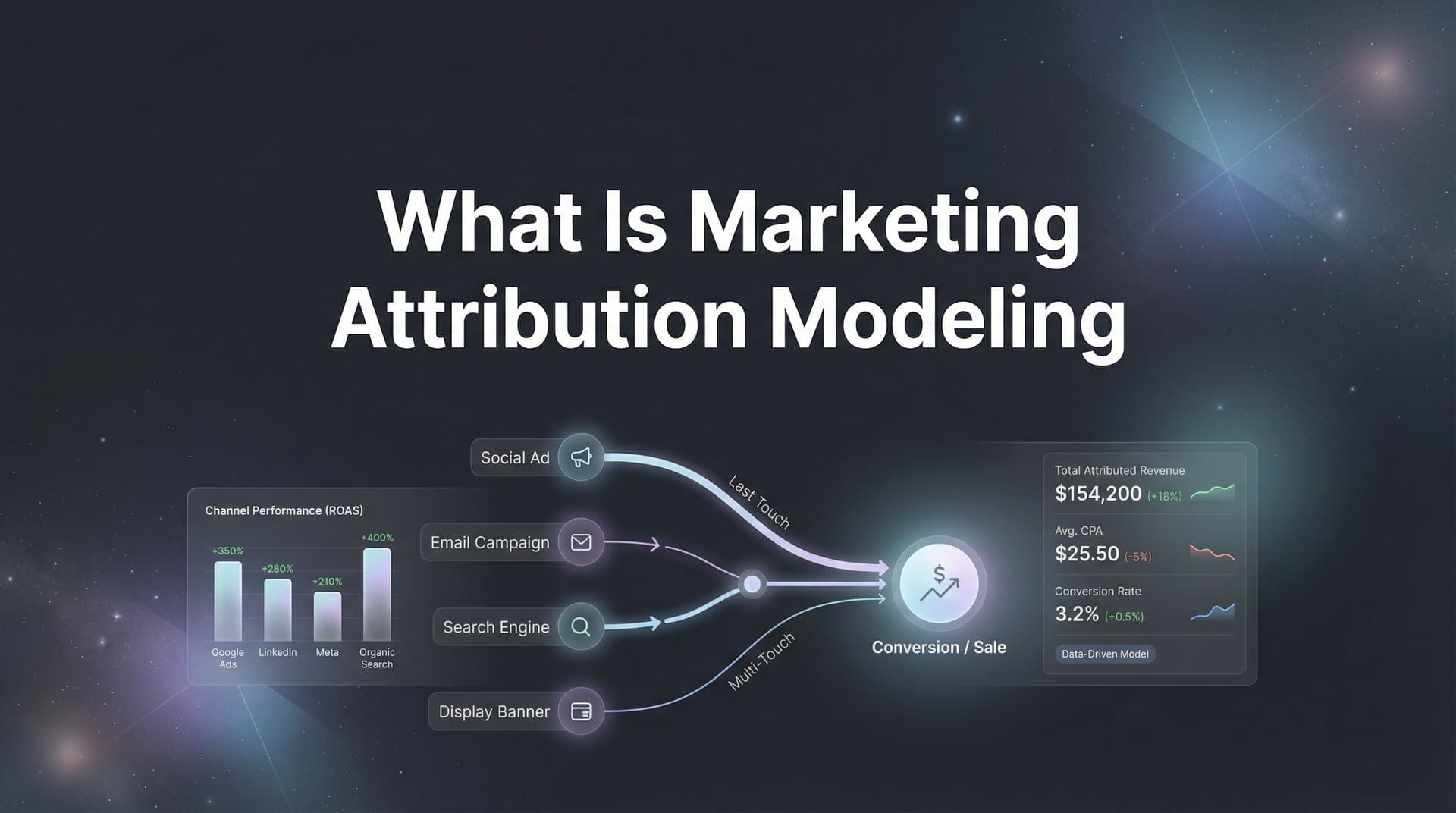
You're spending $10,000 a month on Facebook ads. Another $8,000 on Google. Maybe $5,000 on LinkedIn. Your dashboard shows conversions across all three platforms, but when you add up the numbers, they claim more conversions than you actually had. Something doesn't add up.
Every platform wants to take credit. Facebook says it drove 47 conversions. Google claims 52. LinkedIn reports 31. But your CRM shows only 68 total customers that month. The math is broken, and you're left wondering which channels actually deserve your budget.
This is where marketing attribution modeling comes in. It's the framework that finally answers the question every marketer loses sleep over: which touchpoints actually drive revenue? Not which platforms claim credit, but which interactions genuinely move prospects toward conversion. This guide will walk you through how attribution modeling works, why traditional tracking methods are failing you, and how to build a system that shows you exactly where to invest your next dollar.
The Core Concept: Assigning Credit Where Credit Is Due
Marketing attribution modeling is the systematic approach to determining which marketing touchpoints contribute to conversions and how much credit each one deserves. Think of it as the referee in a game where every player wants to claim they scored the winning goal.
Here's why this matters: the average buyer interacts with six to eight touchpoints before converting. They might see your Facebook ad on Monday morning, click a Google search result Tuesday afternoon, read three blog posts on Wednesday, watch a product demo video Thursday, and finally convert through an email link on Friday. Which of those touchpoints "caused" the conversion?
Traditional analytics tools pick one touchpoint and give it 100% of the credit. Usually the last one. That email link gets all the glory, while the Facebook ad that introduced your brand gets ignored. This creates a distorted picture of what's actually working.
Let's walk through a realistic scenario. Sarah sees your Facebook ad while scrolling during her lunch break. She's intrigued but not ready to buy. Two days later, she searches for a solution to her problem on Google and clicks your paid search ad. She lands on your website, reads a comparison guide, but leaves without converting. A week later, she receives a nurture email with a case study. She clicks through, reviews your pricing page, and finally converts.
In a last-click attribution model, that email gets 100% of the credit. Your Facebook and Google campaigns look like they're wasting money. But here's the reality: without that initial Facebook ad, Sarah never would have remembered your brand name when searching on Google. Without the Google ad, she wouldn't have read your comparison guide. Without the guide, she wouldn't have trusted your nurture email enough to convert.
Marketing attribution modeling recognizes this complexity. Instead of oversimplifying the customer journey to a single moment, it acknowledges that multiple touchpoints work together to move prospects toward conversion. The question isn't which touchpoint caused the sale. The question is how much each touchpoint contributed. Understanding what attribution means in marketing is the first step toward building this clarity.
Single-Touch vs. Multi-Touch Attribution Models Explained
Attribution models come in two main categories: single-touch and multi-touch. Each has its place, and understanding when to use which approach can dramatically change how you interpret your marketing data.
First-Touch Attribution: This model gives 100% of the credit to the first interaction a prospect has with your brand. If someone discovers you through an Instagram ad, then later clicks a Google ad and converts, Instagram gets all the credit. This model is valuable when you want to understand which channels are best at generating awareness and bringing new prospects into your funnel. It helps you identify your strongest top-of-funnel performers.
Last-Touch Attribution: The opposite approach. The final touchpoint before conversion gets 100% of the credit. This is actually the default model in most analytics platforms, including Google Analytics. It's useful for understanding which channels are best at closing deals, but it completely ignores everything that happened earlier in the journey. If you're running retargeting campaigns or nurture email sequences, last-touch attribution will make these channels look like superstars while your awareness campaigns appear worthless.
Here's where things get more sophisticated. Multi-touch attribution in marketing distributes credit across multiple touchpoints, recognizing that modern customer journeys involve several interactions.
Linear Attribution: Every touchpoint in the journey receives equal credit. If a prospect interacts with five touchpoints before converting, each gets 20% of the credit. This model is straightforward and fair, but it treats a quick banner ad impression the same as a 30-minute product demo. The simplicity can be both its strength and weakness.
Time-Decay Attribution: Touchpoints closer to the conversion receive more credit than earlier interactions. The logic here is that recent touchpoints had more influence on the decision to buy. If someone saw your ad three months ago but converted after reading a case study yesterday, the case study gets significantly more credit. This model works well for businesses with moderate sales cycles where recent engagement indicates stronger buying intent.
U-Shaped (Position-Based) Attribution: This model gives 40% of the credit to the first touchpoint, 40% to the last touchpoint, and distributes the remaining 20% among the middle interactions. It recognizes that both discovery and closing moments are crucial while acknowledging that middle-funnel touchpoints play a supporting role. Many B2B companies find this model reflects their reality better than purely linear approaches.
W-Shaped Attribution: An evolution of U-shaped that adds emphasis to a key middle-funnel conversion point, typically when a prospect becomes a qualified lead. Credit is distributed 30% to first touch, 30% to lead conversion, 30% to opportunity creation, and 10% to everything else. This model is particularly valuable for businesses with defined funnel stages and longer sales cycles.
So which model should you use? It depends on three factors: your sales cycle length, the number of channels you're running, and what questions you're trying to answer. If you're running a simple ecommerce store with short consideration phases, last-touch or time-decay models often provide sufficient insight. There simply aren't that many touchpoints to distribute credit across. If you're in B2B SaaS with six-month sales cycles and prospects touching a dozen different assets, you need the nuance of multi-touch models to understand what's really working.
Why Traditional Attribution Falls Short in Today's Landscape
Even if you pick the perfect attribution model, there's a bigger problem: the data itself has become unreliable. Traditional cookie-based tracking, which powered attribution for years, is breaking down across multiple fronts.
iOS privacy changes hit first and hardest. When Apple introduced App Tracking Transparency, it gave users the ability to opt out of cross-app tracking. Most users opted out. Suddenly, Facebook and other platforms lost visibility into what happened after someone clicked an ad. They could see the click, but not the conversion that happened later on your website. This created a massive blind spot in attribution data.
Browser privacy features compounded the problem. Safari's Intelligent Tracking Prevention and Firefox's Enhanced Tracking Protection actively block third-party cookies and limit first-party cookie lifespans. Chrome is following suit with its own cookie deprecation plans. The tracking mechanisms that attribution models relied on are disappearing. These represent some of the most significant attribution challenges in marketing analytics that teams face today.
But here's an even more frustrating issue: siloed platform data. Each ad platform operates in its own universe with its own attribution windows and counting methods. Facebook might use a seven-day click window and one-day view window. Google might use a 30-day click window. LinkedIn uses its own approach. When you run campaigns across all three simultaneously, they each claim credit for the same conversions.
This isn't theoretical. Many marketers see their ad platforms collectively report 150% to 200% of their actual conversions. If you had 100 customers this month, your platforms might claim they drove 180 of them. The overlap is massive, and there's no built-in way to deduplicate the data.
Then there's the disconnect between platform-reported conversions and actual revenue. Your ad platform might show 50 conversions, but when you check your CRM, only 35 of those prospects actually closed. Some were duplicates. Some were low-quality leads that never had a chance of converting. Some were existing customers who would have renewed anyway. Platform metrics measure actions, not outcomes. Attribution modeling needs to measure outcomes.
The tracking landscape has fundamentally changed, and attribution models built on old assumptions produce unreliable insights. You can have the most sophisticated multi-touch attribution model in the world, but if the underlying data is incomplete or duplicated, your conclusions will be wrong.
Building an Accurate Attribution System: Key Components
If traditional tracking is broken, what's the alternative? Building a modern attribution system requires three foundational components that work together to create reliable, unified data.
Server-Side Tracking: This is the technical foundation that solves the cookie problem. Instead of relying on browser cookies to track user behavior, server-side tracking sends conversion data directly from your server to your analytics platform and ad platforms. When someone converts on your website, your server immediately logs that event and shares it with the systems that need to know.
Why does this matter? Browser-based tracking depends on cookies that can be blocked, deleted, or restricted by privacy features. Server-side tracking bypasses these limitations entirely. The data flows from your infrastructure directly to your analytics platform, maintaining accuracy even when browsers block cookies or users opt out of tracking. This approach is privacy-compliant because you're tracking actions on your own properties, not following users across the internet.
Server-side tracking also solves the iOS attribution problem. When ad platforms can't see conversions through their pixel because of App Tracking Transparency, you can send that conversion data directly to them through server-side APIs. Facebook's Conversions API and Google's Enhanced Conversions are built specifically for this purpose. You're giving platforms the conversion data they need to optimize your campaigns, even when browser-based tracking fails.
CRM Integration: Marketing attribution shouldn't stop at leads. It needs to connect all the way to closed revenue. This is where CRM integration becomes essential. By connecting your marketing data with your CRM, you can track which touchpoints led not just to form fills, but to actual paying customers and the revenue they generated. Implementing marketing revenue attribution transforms how you evaluate channel performance.
This connection reveals insights that lead-focused attribution misses entirely. You might discover that LinkedIn drives fewer leads than Facebook, but LinkedIn leads close at 3x the rate and generate 5x the revenue. Without CRM integration, you'd see LinkedIn as a weak performer and potentially cut its budget. With revenue attribution, you realize it's your most valuable channel.
CRM integration also enables closed-loop attribution. You can track a customer's entire journey from first touchpoint through purchase, renewal, and expansion. This longitudinal view shows you which acquisition channels produce the highest lifetime value customers, not just the most conversions. That intelligence changes how you allocate budget across channels.
Cross-Platform Data Unification: The final piece is bringing all your channel data into a single system that can deduplicate conversions and apply attribution models consistently. This means connecting Facebook, Google, LinkedIn, your website analytics, your email platform, and your CRM into one unified view.
Without unification, you're stuck manually exporting data from each platform and trying to reconcile it in spreadsheets. You can't deduplicate conversions that multiple platforms claim. You can't apply consistent attribution models across channels. You're essentially flying blind with fragmented data.
A unified attribution platform solves this by creating a single customer journey map that shows every touchpoint across every channel. When someone converts, the platform knows which ads they saw, which emails they opened, which pages they visited, and which search terms they used. It can then apply your chosen attribution model consistently across all these touchpoints to determine how credit should be distributed.
These three components work together to create attribution data you can actually trust. Server-side tracking ensures data accuracy. CRM integration connects marketing to revenue. Cross-platform unification gives you a complete view. Without all three, you're still operating with incomplete information.
Choosing the Right Attribution Model for Your Business
Now that you understand the available models and have reliable data infrastructure, how do you choose which attribution approach fits your business? The answer depends on your sales cycle, your channel mix, and what decisions you're trying to make.
Short Sales Cycles: If you're running an ecommerce store or selling low-ticket products where customers typically convert within a few days of first discovering you, simpler attribution models often work well. Last-touch attribution can provide sufficient insight because the time between first interaction and conversion is compressed. There simply aren't that many touchpoints to distribute credit across.
Time-decay attribution also works well for short cycles. If someone sees your ad on Monday, clicks it Tuesday, and converts Wednesday, the Tuesday click probably did influence their Wednesday decision more than the Monday impression. The recency matters when the entire journey happens in 48 hours.
However, even with short sales cycles, be cautious about completely ignoring top-of-funnel touchpoints. That initial awareness moment matters, even if the conversion happens quickly. Consider running last-touch attribution for optimization decisions but checking first-touch data periodically to ensure your awareness channels aren't being undervalued.
Long Sales Cycles: B2B SaaS, high-ticket services, and complex products with six-month consideration phases require multi-touch attribution. When prospects interact with a dozen touchpoints over several months before converting, giving all the credit to the last email they clicked is absurd. You need models that recognize the cumulative influence of multiple interactions. For SaaS companies specifically, SaaS marketing attribution tracking addresses the unique challenges of subscription-based business models.
U-shaped or W-shaped attribution models typically work well for longer cycles. They acknowledge that both the initial discovery moment and the final conversion touchpoint matter, while still giving credit to the middle-funnel content and nurture campaigns that kept the prospect engaged. If you have clear funnel stages with defined conversion points (like MQL to SQL to opportunity), W-shaped attribution can map beautifully to your actual sales process.
For complex B2B sales with multiple stakeholders, consider that different touchpoints might influence different decision-makers. The technical content that convinced your champion might be different from the ROI calculator that persuaded the CFO. Multi-touch models capture this reality better than single-touch approaches.
The Multi-Model Approach: Here's a strategy many sophisticated marketers use: don't pick just one attribution model. Compare several models side-by-side to identify patterns and validate insights. If a channel looks strong across multiple attribution models, you can be confident it's actually performing well. If a channel only looks good in one specific model, dig deeper to understand why. Understanding marketing mix modeling vs multi-touch attribution helps you determine when each approach provides the most value.
For example, if Facebook shows strong performance in first-touch attribution but weak performance in last-touch, it's likely excellent at generating awareness but needs support from other channels to close deals. That's not a weakness, it's just its role in your funnel. Understanding this helps you set appropriate expectations and KPIs for each channel rather than judging everything by the same conversion metric.
Comparing models also helps you avoid over-optimizing for a single perspective. If you only look at last-touch attribution, you might cut awareness budget that's actually essential for filling your funnel. If you only look at first-touch, you might over-invest in channels that generate curiosity but never close. Multiple models give you a more complete picture.
Turning Attribution Data Into Smarter Budget Decisions
Attribution modeling isn't an academic exercise. The point is to make better decisions about where to spend your marketing budget. Here's how to translate attribution insights into action.
Identify Underperforming Channels: Once you have accurate attribution data, look for channels that consistently receive minimal credit across multiple attribution models. If a channel shows weak performance regardless of whether you're using first-touch, last-touch, or multi-touch attribution, that's a signal. Either the channel isn't working, your creative needs improvement, or your targeting is off.
Before cutting budget entirely, investigate why the channel is underperforming. Check if you're reaching the right audience. Review your creative against top performers. Look at whether the channel drives any valuable actions even if it doesn't directly drive conversions. Sometimes a channel that looks weak in attribution data is actually playing an important supporting role that isn't captured by conversion metrics alone.
Reallocate to High-Converting Touchpoints: The flip side is identifying channels that consistently show strong attribution across models. These are your reliable performers that deserve more investment. If your attribution data shows that Google search campaigns consistently contribute to conversions across the entire funnel, that's a clear signal to increase budget there. Proper marketing channel attribution modeling reveals exactly where your dollars work hardest.
When reallocating budget, move gradually. Don't cut a channel by 50% overnight based on one month of attribution data. Test incremental changes, measure the impact, and adjust. Attribution models are powerful, but they're not perfect. Validate your hypotheses with controlled experiments when possible.
Feed Better Data Back to Ad Platforms: Modern ad platforms like Meta and Google use machine learning to optimize your campaigns. But their algorithms are only as good as the data they receive. If they're only seeing browser-based conversions that miss 40% of your actual results, their optimization will be flawed.
This is where server-side tracking creates a competitive advantage. By sending accurate, complete conversion data back to ad platforms through Conversions API or Enhanced Conversions, you give their algorithms better training data. They can identify patterns in who converts more accurately, which improves targeting and bidding decisions. Better data in means better performance out.
The feedback loop works like this: your attribution platform tracks conversions accurately through server-side tracking. It sends that conversion data back to your ad platforms. The ad platforms use that data to optimize who they show your ads to. Your campaigns perform better. You get more conversions. The cycle continues, with each iteration improving based on more accurate data.
Create Continuous Improvement Loops: Attribution insights should inform ongoing campaign adjustments, not just quarterly budget reviews. Set up regular reviews of your attribution data to identify emerging trends. Maybe a channel that was weak three months ago is starting to show stronger performance. Maybe a previously strong channel is declining. Catching these shifts early lets you adapt faster than competitors who only review data occasionally.
Use attribution data to inform creative testing too. If your multi-touch attribution shows that video ads are strong at first-touch but weak at last-touch, test whether different video content might perform better at closing. If blog content consistently appears in high-value conversion paths, invest in creating more of the topics that show up most frequently. Let the data guide your content strategy, not just your media budget.
Putting It All Together
Marketing attribution modeling transforms the fundamental question every marketer faces from "I wonder what's working?" to "I know what's working, and here's why." It replaces guesswork with data-driven confidence, even if that data isn't perfect.
The goal isn't perfection. No attribution model will capture every nuance of human decision-making. Someone might see your ad, close the browser, talk to a colleague about it, search for your brand name later, and convert. The conversation with their colleague was crucial, but no attribution system will track it. That's okay. The point is to have significantly better visibility than you have now.
Start by understanding which attribution model makes sense for your business based on your sales cycle and channel mix. Build the technical foundation with server-side tracking and CRM integration. Unify your data across platforms so you're working from a single source of truth. Then use those insights to make smarter budget decisions, feed better data back to ad platforms, and create continuous improvement loops.
The marketers who win aren't the ones with perfect data. They're the ones who have better data than their competitors and act on it faster. Every dollar you reallocate based on attribution insights is a dollar your competitors are still wasting on channels that don't work. Every improvement you make to your ad platform's training data is an advantage they don't have.
If you're still relying on platform-reported metrics and last-click attribution, you're operating with a broken compass. The customer journey is too complex, the tracking landscape has changed too much, and the competitive pressure is too intense to make decisions based on incomplete data. Marketing attribution modeling isn't optional anymore. It's how you survive and scale in a landscape where data accuracy is the difference between growth and stagnation.
Ready to elevate your marketing game with precision and confidence? Discover how Cometly's AI-driven recommendations can transform your ad strategy. Get your free demo today and start capturing every touchpoint to maximize your conversions.


