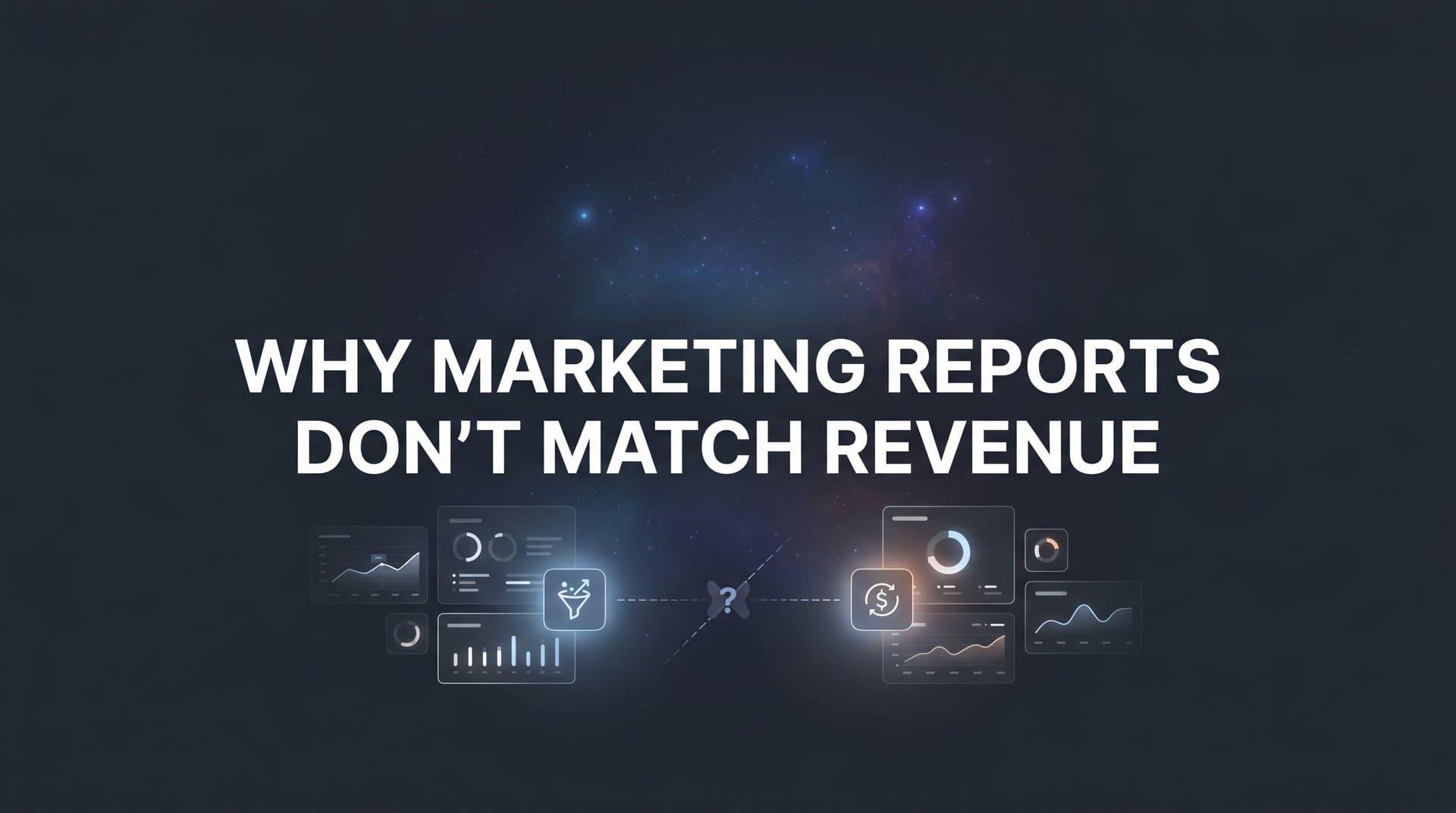
Picture this: your marketing team walks into the monthly review meeting with a polished report. ROAS is strong, conversion numbers are climbing, and every platform is showing green. Then the CFO opens the actual revenue figures, and the room goes quiet. The numbers don't match. Not even close.
This scenario plays out in companies of all sizes, across every industry. It's one of the most frustrating and costly disconnects in digital advertising, and it's far more common than most marketing leaders want to admit. The gap between what your ad platforms report and what actually lands in your bank account isn't just an inconvenience. It's a signal that something fundamental is broken in how you're measuring marketing performance.
The good news is that this gap has clear, identifiable causes. It's not random noise or platform incompetence. It's a predictable result of how ad platforms are built, how tracking technology works, and how marketing data flows (or doesn't flow) between your tools. Once you understand why marketing reports don't match revenue, you can take concrete steps to close the gap and make decisions based on what's actually true.
This article breaks down the six core reasons your marketing data and revenue data tell different stories, and shows you exactly what to do about it.
The Double-Counting Problem: How Ad Platforms Inflate Their Own Numbers
Here's something every performance marketer eventually discovers: when you add up the conversions reported by Meta, Google, and TikTok separately, the total is almost always higher than your actual sales. Sometimes dramatically higher. This isn't a glitch. It's the natural result of how each platform attributes credit.
Every ad platform operates with its own attribution logic, its own lookback windows, and its own definition of what counts as a conversion. Meta might claim credit for a purchase because a user saw your ad three days ago. Google claims credit because that same user clicked a search ad yesterday. TikTok claims credit because they engaged with a video last week. Each platform is telling the truth within its own framework, but all three are claiming the same customer, and that customer only bought once.
This is what the industry calls attribution overlap, and it's baked into the architecture of every major ad platform. The platforms aren't trying to deceive you. They're simply designed to show you the value they deliver within their own ecosystem. The problem is that their ecosystems overlap significantly, and there's no automatic mechanism that reconciles across platforms. Understanding why attribution data doesn't match across platforms is the first step toward solving this.
Default attribution settings make this worse. Most platforms are configured out of the box to use the widest attribution windows and the most favorable models for their own channel. A longer lookback window means more conversions get attributed to that platform. A model that favors view-through attribution means even users who glanced at an ad and never clicked still count as a win for that channel.
When your marketing team builds a report by pulling data from each platform's native dashboard and combining the numbers, they're stacking overlapping claims on top of each other. The result is a conversion total that can be two, three, or even four times higher than actual revenue. This is one of the primary reasons why marketing reports don't match revenue, and it's happening in your account right now if you're running campaigns across multiple platforms.
The fix isn't to stop using multiple channels. It's to stop trusting each platform's native reporting as the final word on attribution. You need a unified view that deduplicates conversions and assigns credit based on the actual customer journey, not each platform's self-interested version of it. Knowing why Facebook overreports conversions is a great example of how this plays out on a single platform.
Tracking Blind Spots That Silently Distort Your Data
Even if you solved the double-counting problem entirely, you'd still face a second layer of inaccuracy: your tracking is missing data. Not occasionally. Consistently. And the gap has been growing for years.
Apple's App Tracking Transparency framework, introduced with iOS 14.5 and expanded through subsequent updates, fundamentally changed the relationship between ad platforms and user data. When users opt out of tracking across apps, platforms like Meta lose visibility into what those users do after clicking an ad. Since a large portion of mobile users choose not to be tracked, a meaningful share of conversions that originate from mobile ads simply disappear from platform reporting.
Browser-level restrictions compound this problem. Safari and Firefox have blocked third-party cookies by default for years. Chrome has been evolving its approach as well. This matters because most pixel-based tracking, the kind that fires a JavaScript snippet in the user's browser when they complete an action, depends on cookies to tie the conversion back to an ad click. When cookies are blocked, the conversion happens but the attribution doesn't. This is closely related to the digital marketing strategy that tracks users across the web and its growing limitations.
Ad blockers add another layer of signal loss. A growing share of web users, particularly in tech-savvy demographics, run browser extensions that block tracking scripts entirely. From the perspective of your pixel, these users are invisible.
Cross-device journeys create yet another blind spot. A customer sees your ad on their phone during their commute, thinks about it for a day, then converts on their laptop at home. Unless you have a system that can tie these two sessions together, that conversion either goes unattributed or gets credited to whatever the last touchpoint was on the desktop session, often something like a direct visit or a branded search.
This is why client-side tracking, relying solely on browser-based pixels, is increasingly unreliable as a primary measurement strategy. Server-side tracking takes a fundamentally different approach. Instead of firing a script in the user's browser, your server sends conversion data directly to the ad platform's API after the event occurs. Because this happens at the server level, it bypasses browser restrictions, ad blockers, and cookie limitations entirely. The result is more complete, more accurate conversion data.
The practical implication is significant. If your tracking is missing conversions, your optimization signals are incomplete. You might be cutting campaigns that are actually working because the conversions aren't showing up, or scaling campaigns that look strong on paper but are benefiting from inflated reporting elsewhere. This is why marketing data accuracy matters for ROI more than most teams realize.
When Ad Platform Data and CRM Data Live in Separate Worlds
For B2B companies and high-ticket B2C businesses, there's a third layer of disconnect that goes beyond tracking technology. It's a fundamental difference in what gets measured and when.
Ad platforms track conversion events. When someone submits a form, completes a checkout, or triggers a purchase pixel, the platform records a conversion at that moment. From the platform's perspective, the job is done. Revenue has been generated.
But your CRM tells a different story. That form submission might be a lead who takes three weeks to close. Or a prospect who never responds to follow-up. Or someone who buys but requests a refund thirty days later. The ad platform has no visibility into any of this. It reported the conversion and moved on. Effective tracking for B2B marketing campaigns requires bridging this exact gap between ad platform events and actual sales outcomes.
This gap between a "conversion" in your ad platform and a "closed-won deal" in your CRM is one of the most significant contributors to why marketing reports don't match revenue. The marketing report is measuring intent signals and early-funnel actions. The revenue report is measuring actual money collected. These are not the same thing, and treating them as equivalent leads to seriously flawed budget decisions.
Refunds and chargebacks widen the gap further. An e-commerce business might report strong conversion volume from a campaign, but if a significant portion of those purchases are returned, the actual revenue contribution is much lower. The ad platform will never subtract those refunds from its reported results unless you explicitly tell it to.
Disqualified leads create the same problem in B2B contexts. If your sales team marks a lead as unqualified after discovery, that lead still counts as a conversion in your ad platform report. You might be scaling a campaign based on high lead volume without realizing that the lead quality is poor and the actual pipeline contribution is minimal.
Closing this gap requires connecting your CRM data to your ad platform data in a way that maps actual revenue outcomes back to the original acquisition source. When you can see which campaigns and channels generated leads that actually closed, and which ones generated form fills that went nowhere, your budget allocation decisions become dramatically more accurate.
Attribution Models Tell Different Stories About the Same Journey
Even with perfect tracking and no double-counting, you'd still face a philosophical problem: how do you assign credit when multiple touchpoints contribute to a single conversion?
This is the attribution model question, and the answer you choose has a profound effect on which channels look valuable and which look wasteful. A thorough understanding of types of marketing attribution models is essential for making the right choice.
Last-click attribution gives all the credit to the final touchpoint before conversion. This tends to favor branded search and direct traffic, because users often return directly to a site or search the brand name when they're ready to buy. The awareness campaigns that introduced them to the brand in the first place get zero credit.
First-click attribution does the opposite. It gives all the credit to the first interaction, which tends to favor top-of-funnel channels like social ads and display. But it ignores everything that happened between that first touch and the eventual conversion.
Multi-touch attribution models, including linear, time-decay, and position-based variants, distribute credit across multiple touchpoints. These models give a more complete picture of how the customer journey actually unfolds, but they require more sophisticated tracking infrastructure to implement correctly.
The challenge is that most ad platforms default to models that favor their own channel. Google Ads has moved toward data-driven attribution as its default, which uses Google's own modeling to assign credit. Meta uses its own modeled attribution methodology. GA4 uses yet another approach. When you pull reports from each platform, you're not just getting different numbers. You're getting different narratives, each shaped by a model designed to make that platform look as valuable as possible. This is a core part of the dilemma of attribution in marketing that every team must confront.
Choosing the right attribution model for your business depends on your sales cycle length, the number of touchpoints in a typical customer journey, and whether you're primarily optimizing for awareness or direct response. There's no universal answer, but the most important step is using a consistent model across all channels so you're comparing apples to apples.
How to Build a Single Source of Truth for Marketing and Revenue
At this point, the problem is clear. Multiple platforms claiming the same conversions. Tracking blind spots hiding real customer journeys. CRM data and ad platform data living in separate systems. Attribution models that each tell a self-serving story. The solution to all of these problems points in the same direction: you need a unified data layer that connects every touchpoint from first ad click to closed revenue in a single, consistent view.
This starts with your data infrastructure. Your ad platforms, your website tracking, and your CRM need to be connected in a way that allows you to trace a single customer journey across all three. When a lead comes in through a Meta ad, clicks through to your site, fills out a form, and eventually closes in your CRM sixty days later, you should be able to see that entire path in one place and attribute the revenue back to the original source. Building unified dashboards for marketing and sales attribution is a practical way to achieve this visibility.
Server-side tracking is a critical component of this infrastructure. By sending conversion events directly from your server to ad platform APIs, such as Meta's Conversions API or Google's Enhanced Conversions, you bypass the browser-level limitations that cause client-side pixels to miss data. This gives you a more complete signal and ensures that the conversion data feeding your ad platform algorithms is accurate rather than riddled with gaps.
Regular reconciliation between marketing-reported metrics and actual financial data is equally important. This means comparing what your attribution system says you generated against what your finance team confirms was collected. When you find gaps, you investigate the cause rather than accepting the discrepancy as normal. Over time, this process surfaces the specific tracking failures, data definition mismatches, and attribution overlaps that are distorting your reports.
Budget reallocation becomes much more defensible when it's grounded in reconciled data. Instead of shifting spend based on which platform's dashboard looks best, you're shifting spend based on which channels are actually generating closed revenue. Accurate revenue attribution by marketing channel is what makes this possible.
Platforms like Cometly are built specifically to solve this problem. By connecting your ad platforms, website, and CRM into a unified attribution system, Cometly captures every touchpoint in the customer journey and ties it back to real revenue outcomes. The result is a single source of truth that replaces the fragmented, self-serving reports from each ad platform with a consistent, accurate picture of what's actually driving your business.
Turning Accurate Data Into Smarter Scaling Decisions
Fixing your attribution isn't just about having cleaner reports. It changes how you scale, and it changes the quality of results you get from your ad spend.
When you send enriched, accurate conversion data back to ad platforms through server-side integrations, their machine learning algorithms have better signals to work with. Meta's algorithm, for example, is constantly optimizing toward the conversion events you tell it to prioritize. If you're feeding it form fills that include a high percentage of unqualified leads, it will find more people who fill out forms, not more people who become paying customers. But if you can send it signals that distinguish high-quality conversions from low-quality ones, it will optimize toward the users most likely to actually generate revenue.
This is one of the most underutilized levers in performance marketing. The platforms' algorithms are powerful, but they're only as good as the data you give them. Accurate, enriched conversion data improves targeting, reduces wasted spend, and compounds over time as the algorithm learns what a real customer looks like for your business. Leveraging AI marketing analytics to drive results accelerates this feedback loop significantly.
AI-powered analysis takes this further. Rather than manually sifting through campaign data to figure out which ads are actually driving revenue, AI can surface the specific creatives, audiences, and campaigns that are generating real business outcomes. This moves your optimization conversations away from surface metrics like click-through rate and cost per lead, and toward the metrics that actually matter: cost per acquisition, revenue per campaign, and lifetime value by channel.
Cometly's AI Ads Manager and AI Chat features are designed for exactly this kind of analysis. By connecting attribution data to actual revenue outcomes, the platform can identify which campaigns deserve more budget and which ones are consuming spend without contributing to growth. This eliminates the guesswork that plagues most marketing teams and replaces it with clear, data-backed recommendations.
Accurate attribution also changes how you have conversations with finance and leadership. Instead of defending your marketing budget based on platform-reported ROAS that nobody outside the marketing team fully trusts, you can walk into the room with revenue-tied data that speaks the same language as the CFO's spreadsheet. That's a fundamentally different position to be in.
Closing the Gap Between What You Report and What You Earn
The gap between marketing reports and actual revenue isn't a minor data discrepancy. It's a fundamental measurement problem that leads to misallocated budgets, misguided optimizations, and missed growth opportunities. When you can't trust your data, every scaling decision is a guess.
The causes are well-understood: ad platforms double-counting conversions across channels, tracking blind spots created by privacy changes and browser restrictions, CRM data that captures real revenue while ad platforms only see early-funnel events, and attribution models that each tell a different story depending on who built them.
The solution isn't to accept the confusion as the cost of doing business in digital advertising. It's to build the infrastructure that connects your data, reconciles your numbers, and gives you a single, accurate view of what's actually driving revenue. That means server-side tracking, unified attribution, CRM integration, and regular reconciliation against real financial outcomes.
When your measurement is accurate, everything downstream improves. Your ad platform algorithms optimize toward real buyers. Your budget flows to channels that actually convert. Your scaling decisions are backed by data you can defend in any room.
Ready to stop guessing and start scaling with confidence? Cometly connects your ad platforms, website, and CRM to deliver accurate, revenue-tied attribution across every touchpoint. Get your free demo today and see exactly which campaigns are driving real growth for your business.