Your customer just converted. Congratulations. Now here's the uncomfortable question: do you actually know what drove that conversion?
If you're like most marketing teams running campaigns across Google, Meta, TikTok, LinkedIn, and email simultaneously, the honest answer is probably "not really." You have data from each platform, but those numbers rarely agree with each other. Meta claims the conversion. Google claims it too. Your email platform might even take a bow. Meanwhile, the TikTok ad that first introduced your brand to that customer three weeks ago gets zero credit.
This is the core tension of modern paid advertising. Customers move fluidly across channels, devices, and time before they ever convert, but most attribution setups are still built around a single touchpoint. That single-channel thinking creates real blind spots, and those blind spots translate directly into misallocated budgets, undervalued channels, and growth strategies built on incomplete information.
Ad attribution for omnichannel marketing is the discipline of solving this problem. It means assigning conversion credit across every touchpoint in a customer's journey, regardless of which channel, device, or platform was involved, and using that unified view to make smarter decisions about where to invest your budget.
This article will walk you through why single-channel attribution fails in a multi-touch world, what omnichannel attribution actually means in practice, which models work best, how the technical infrastructure needs to be set up to make it reliable, and how to turn that data into confident budget decisions. By the end, you'll have a clear framework for building attribution that reflects how your customers actually buy.
Why Single-Channel Attribution Breaks Down in a Multi-Touch World
Think about the last considered purchase you made online. Did you click one ad and immediately buy? Almost certainly not. You probably saw a social post, maybe searched the brand later, clicked a retargeting ad, read a review, and then finally converted through a branded search or direct visit. That journey likely spanned days, multiple devices, and at least three or four distinct touchpoints.
Your customers behave exactly the same way. The modern buying journey is not linear, and it rarely starts and ends on the same channel. Yet last-click attribution, still the default in many ad platforms, hands all the credit to the final touchpoint before conversion. Everything that came before it simply disappears from the credit ledger.
The business consequence of this is more serious than it might initially seem. When attribution only credits the last click, budget decisions naturally flow toward bottom-funnel channels like branded search and retargeting because those are the channels that appear to be "working." Upper-funnel channels like prospecting campaigns on paid social, display, or video look inefficient because they rarely get last-click credit, even when they are consistently the first touchpoint in converting journeys. Over time, teams starve the channels that initiate demand and over-invest in the channels that simply close it. Growth plateaus.
The problem compounds when you factor in three structural challenges that have made accurate attribution even harder in recent years.
iOS privacy changes: Apple's App Tracking Transparency framework dramatically reduced the signal available to browser-based pixel tracking, particularly for Meta advertising. Events that once flowed cleanly through the pixel now arrive delayed, incomplete, or not at all. This doesn't just affect reporting; it affects the data that ad platform algorithms use to optimize delivery.
Cross-device journeys: A user who clicks an ad on their phone and converts on their desktop can appear as two completely separate users to browser-based trackers. That gap in identity resolution means the click-to-conversion chain breaks, and the ad that drove the initial interest gets no credit for the eventual purchase.
Platform-level data silos: Each ad platform operates its own attribution logic with its own lookback windows. Meta, Google, and TikTok each claim credit using their own rules, which means the same conversion can show up in multiple platform dashboards simultaneously. When you add up reported conversions across platforms, the total often far exceeds your actual revenue. This makes cross-channel comparison nearly impossible without a neutral, unified attribution layer sitting above all of them.
Single-channel attribution was never designed for this environment. It was built for a simpler world where customers converted in one session, on one device, from one channel. That world no longer exists for most businesses, and the attribution approach needs to evolve accordingly.
Omnichannel Attribution Defined: More Than Just Multichannel Reporting
The terms "omnichannel attribution" and "multichannel reporting" are often used interchangeably, but they describe fundamentally different things. Understanding the distinction matters because one of them actually solves the problem and one of them just reframes it.
Multichannel reporting shows you activity on a per-channel basis. You can see how many clicks came from Google, how many impressions ran on Meta, how many emails were opened. Each channel gets its own column. The problem is that those columns exist in isolation. There is no logic connecting them into a shared customer journey, and there is no mechanism for distributing credit across the touchpoints that contributed to a single conversion.
Omnichannel attribution does something more sophisticated. It stitches those touchpoints together into a unified customer journey and applies a consistent credit logic across all of them. Instead of each channel reporting its own version of the truth, omnichannel attribution produces a single, coherent view of how channels work together to drive revenue.
Three core components make this function properly.
Unified identity resolution: This is the foundation. Before you can attribute credit across channels, you need to recognize that the same person who clicked your LinkedIn ad on Tuesday is the same person who clicked your Google retargeting ad on Thursday and converted on Friday. Identity resolution connects user behavior across channels, devices, and sessions using first-party data signals like email addresses, CRM IDs, and logged-in states. Without this, you're attributing credit to journeys that are actually fragments of larger journeys.
A consistent attribution model applied across all data: Once you can see the full journey, you need a single set of rules for how credit gets distributed across the touchpoints within it. This is the attribution model, and it needs to be applied uniformly across all channels rather than letting each platform apply its own rules. Applying a consistent model is what allows you to make apples-to-apples comparisons across Google, Meta, TikTok, and any other channel in your mix.
A unified reporting layer: The final component is a single dashboard or analytics environment that aggregates results from all channels under the same attribution framework. This is what replaces the fragmented experience of logging into four different ad platforms and trying to reconcile numbers that will never agree. A unified reporting layer gives you one source of truth for campaign performance, channel contribution, and revenue influence.
When all three components are in place, omnichannel attribution transforms from a measurement exercise into a strategic capability. You stop asking "which channel got credit?" and start asking "which channels, working together, drove this outcome?"
Attribution Models and Which One Fits Omnichannel Campaigns
Choosing an attribution model is essentially choosing a philosophy about how marketing influence works. Different models make very different assumptions about which touchpoints matter, and those assumptions have real consequences for how you evaluate channel performance and allocate budget.
Here is how the most common models behave in an omnichannel context.
First-touch attribution: Gives all credit to the very first ad interaction in the journey. This is useful for understanding which channels are best at initiating awareness, but it completely ignores everything that happened between that first touch and the conversion. In an omnichannel campaign, first-touch models tend to over-reward prospecting channels and make nurturing and retargeting look worthless.
Last-touch attribution: Gives all credit to the final interaction before conversion. As discussed earlier, this is the default for most ad platforms and the source of most attribution distortion. It rewards branded search and retargeting while systematically undervaluing the upper-funnel channels that built the awareness and consideration that made those final clicks possible.
Linear attribution: Distributes credit equally across every touchpoint in the journey. This is more balanced than single-touch models and acknowledges that multiple channels contributed, but it treats a brand awareness impression the same as a high-intent product page visit. Equal credit is not the same as accurate credit.
Time-decay attribution: Assigns more credit to touchpoints that occurred closer to the conversion event. This reflects the intuition that recent interactions were more influential, but it can undervalue awareness-stage channels that planted the initial intent. For long sales cycles, time-decay can be particularly misleading because it discounts the early touchpoints that took months to influence a buyer.
Data-driven attribution: Uses algorithmic modeling to assign credit based on observed patterns in your actual conversion data. Rather than applying a fixed rule, it analyzes which combinations of touchpoints are statistically associated with conversions and distributes credit accordingly. This is generally the most accurate model for omnichannel campaigns, but it requires sufficient data volume to produce reliable results.
The right model for your campaigns depends on two key factors: your sales cycle length and your channel mix. A direct-to-consumer ecommerce brand with a 24-hour purchase cycle has very different attribution needs than a B2B SaaS company where a prospect might engage with content for three months before requesting a demo. For longer cycles with multiple stakeholders and touchpoints, data-driven or multi-touch models become far more important because the journey complexity is too high for simple rules to capture accurately.
The practical recommendation for most omnichannel advertisers is to start with linear or time-decay attribution to get a more balanced view than last-click provides, and then graduate to data-driven attribution once you have enough conversion volume for the model to learn from your specific customer journeys.
The Technical Foundation: How Accurate Omnichannel Tracking Actually Works
Attribution is only as good as the data feeding it. You can choose the most sophisticated model in the world, but if your tracking infrastructure is leaking events, misidentifying users, or relying entirely on browser-based pixels, your attribution output will be unreliable. Getting the technical foundation right is not optional; it is the prerequisite for everything else.
The most important shift in tracking infrastructure over the past few years has been the move toward server-side tracking. Traditional browser-based pixels work by firing a snippet of JavaScript code in the user's browser when a conversion event occurs. The problem is that ad blockers block those pixels, iOS privacy settings restrict them, and browser-based tracking in general has become increasingly fragile as privacy protections have tightened across the industry.
Server-side tracking routes conversion event data from your server rather than from the user's browser. When a purchase or lead event occurs, your server sends that event data directly to the attribution platform or ad platform API. Because this happens at the server level, it bypasses ad blockers entirely and is unaffected by iOS restrictions. The result is higher event capture rates and more complete conversion data flowing into your attribution models.
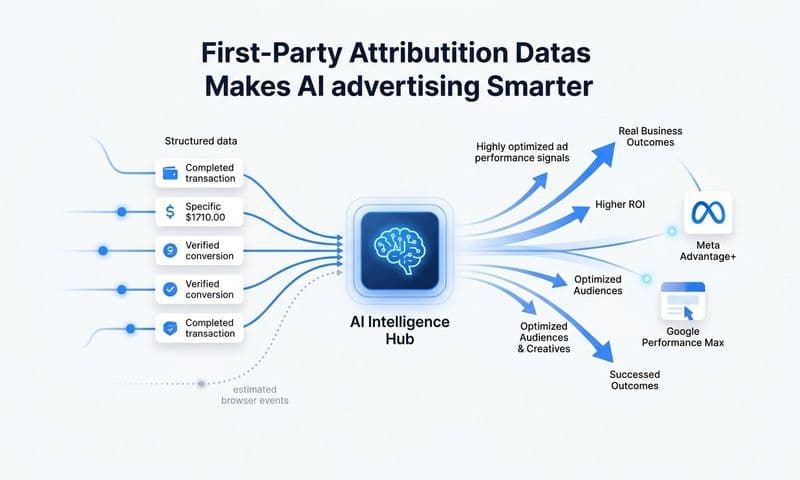
Closely related to server-side tracking is the Conversions API, or CAPI, which Meta, Google, TikTok, and other platforms have developed specifically to receive server-side event data. When you implement CAPI integrations, you are feeding enriched, server-side conversion events directly to the ad platform's algorithms. This does two things simultaneously: it improves attribution accuracy within the platform by increasing event match quality, and it improves ad delivery optimization because the platform's machine learning has better signal to work with.
Higher event match quality on Meta, for example, means the platform can more accurately connect a conversion back to the ad impression or click that preceded it. This directly benefits your campaign performance, not just your reporting.
Beyond server-side tracking, UTM parameters play a critical role in stitching cross-channel journeys together. Consistent, well-structured UTM tagging across every ad campaign ensures that your attribution platform can identify the source, medium, campaign, and ad creative associated with every session. Without consistent UTMs, cross-channel attribution becomes a guessing game.
First-party data is the final pillar. Email addresses collected at checkout, CRM contact IDs, and logged-in user states allow your attribution system to connect touchpoints that happened on different devices or across different sessions. This is how you solve the cross-device attribution gap: by anchoring journey data to a known user identity rather than relying on browser cookies that disappear when someone switches devices.
Relying solely on platform-native attribution without this infrastructure in place will consistently produce inflated, conflicting numbers. Each platform reports the version of reality that makes it look best. A neutral, server-side attribution layer gives you the ground truth.
Turning Omnichannel Attribution Data Into Budget Decisions
Accurate attribution data is only valuable if it changes how you make decisions. The whole point of investing in omnichannel attribution infrastructure is to stop allocating budget based on which channel shouts loudest and start allocating based on which channels actually drive revenue, at every stage of the journey.
One of the most immediate insights that omnichannel attribution surfaces is the true assisted value of upper-funnel channels. Platforms like TikTok, LinkedIn, and YouTube rarely win on last-click metrics. They are awareness and consideration channels, and their job is to introduce your brand to new audiences and move those audiences toward intent. In a last-click world, these channels look expensive and inefficient. In an omnichannel attribution view, they often appear consistently at the beginning of journeys that convert through other channels later.
When you can see that a TikTok campaign appears as the first touchpoint in a significant portion of your converting journeys, even though it never gets last-click credit, you have a completely different basis for evaluating its value. That channel is initiating demand. Cutting it to reallocate budget toward branded search would not improve efficiency; it would reduce the pipeline that branded search is closing.
The metric shift that makes this analysis possible is moving from cost per last-click conversion to cost per assisted conversion and revenue influence. Rather than asking "how much did it cost to get a conversion attributed to this channel?", you ask "how often does this channel appear in journeys that ultimately convert, and what is the revenue value of those journeys?" This reframes channel evaluation from a competition for credit to an assessment of contribution.
Budget reallocation signals become much clearer with this framework in place. When attribution data consistently shows a channel initiating or influencing conversions across a meaningful portion of your customer journeys, that is a signal to scale that channel, even if its standalone last-click ROAS looks weak. Conversely, when a channel appears to be receiving a large share of last-click credit but rarely appears as an early touchpoint in multi-step journeys, it may be closing demand that other channels created rather than generating new demand on its own.
The practical cadence for using attribution data in budget decisions is to review assisted conversion reports at least monthly, compare channel contribution across the full journey rather than just at the conversion event, and use those insights to make incremental budget shifts toward channels that are consistently influencing revenue. Over time, this approach tends to produce a more balanced channel mix that generates demand at the top of the funnel while maintaining efficiency at the bottom.
Building an Omnichannel Attribution Practice That Lasts
Understanding the concepts is one thing. Putting them into practice requires a structured approach. Here are the four practical steps that form the foundation of a working omnichannel attribution setup.
1. Consolidate your tracking infrastructure with server-side events. Audit your current tracking setup and identify where you are relying on browser-based pixels without server-side backup. Implement server-side tracking and CAPI integrations for your primary ad platforms. Ensure consistent UTM tagging across every campaign. This step closes the data gaps that make attribution unreliable.
2. Choose a multi-touch attribution model aligned to your sales cycle. Move away from last-click as your primary model. For most omnichannel advertisers, linear or time-decay attribution provides a meaningful improvement immediately, and data-driven attribution becomes the target as conversion volume grows. Align your model selection to how your customers actually buy, not to what makes your best-performing channel look best.
3. Unify reporting across all ad platforms in a single dashboard. Stop evaluating channel performance by logging into each platform separately. A unified reporting layer that aggregates data from all channels under the same attribution framework is what allows you to compare channel contribution accurately and make cross-channel budget decisions with confidence.
4. Use AI-driven insights to surface optimization opportunities. Once your data is unified and your attribution model is in place, AI-powered analysis can identify patterns that would take hours to find manually: which campaigns are consistently appearing in high-value journeys, which channels are underperforming relative to their journey contribution, and where budget reallocation would have the highest impact.
This is precisely the use case that Cometly is built for. Cometly connects your ad platforms, CRM data, and website events into a single attribution layer, giving you a complete view of every customer journey in real time. With server-side tracking, multi-touch attribution, and AI-powered recommendations built in, Cometly surfaces which ads and channels are actually driving revenue, not just clicks. The Conversion Sync feature feeds enriched, server-side event data back to Meta, Google, and other platforms, improving both attribution accuracy and ad algorithmic performance simultaneously.
For marketing teams and agencies running paid campaigns across multiple channels, omnichannel attribution is no longer a nice-to-have. It is the infrastructure that separates teams making confident, data-driven budget decisions from teams guessing at scale. The marketers who invest in it gain a durable advantage: faster decision cycles, more efficient spend, and a clear line of sight from ad investment to revenue.
The Bottom Line on Omnichannel Attribution
Running omnichannel marketing campaigns without proper attribution is, at its core, guesswork at scale. You are spending real budget across real channels, but without a unified view of how those channels work together, your optimization decisions are based on whichever platform tells the most convincing story about itself.
The path forward is clear. Single-touch models like last-click systematically mislead you about which channels deserve investment. Server-side tracking and CAPI integrations are now the baseline for reliable data collection in a privacy-first environment. Multi-touch attribution models, applied consistently across all channels, give you the credit distribution logic needed to evaluate channel contribution accurately. And a unified reporting layer is what turns all of that infrastructure into actionable budget intelligence.
The marketers who build this capability gain something that is genuinely difficult to replicate: the ability to see the full customer journey, understand how every channel contributes to revenue, and make budget decisions that compound over time rather than simply reacting to whatever last-click metrics suggest.
If your current setup has you logging into multiple platforms, reconciling conflicting numbers, and making budget calls based on incomplete data, there is a better way. Cometly brings your ad platforms, CRM, and website events into one attribution layer, powered by AI that surfaces what is actually driving your revenue. Get your free demo today and see what your customer journeys actually look like when every touchpoint is captured and every conversion is properly attributed.