

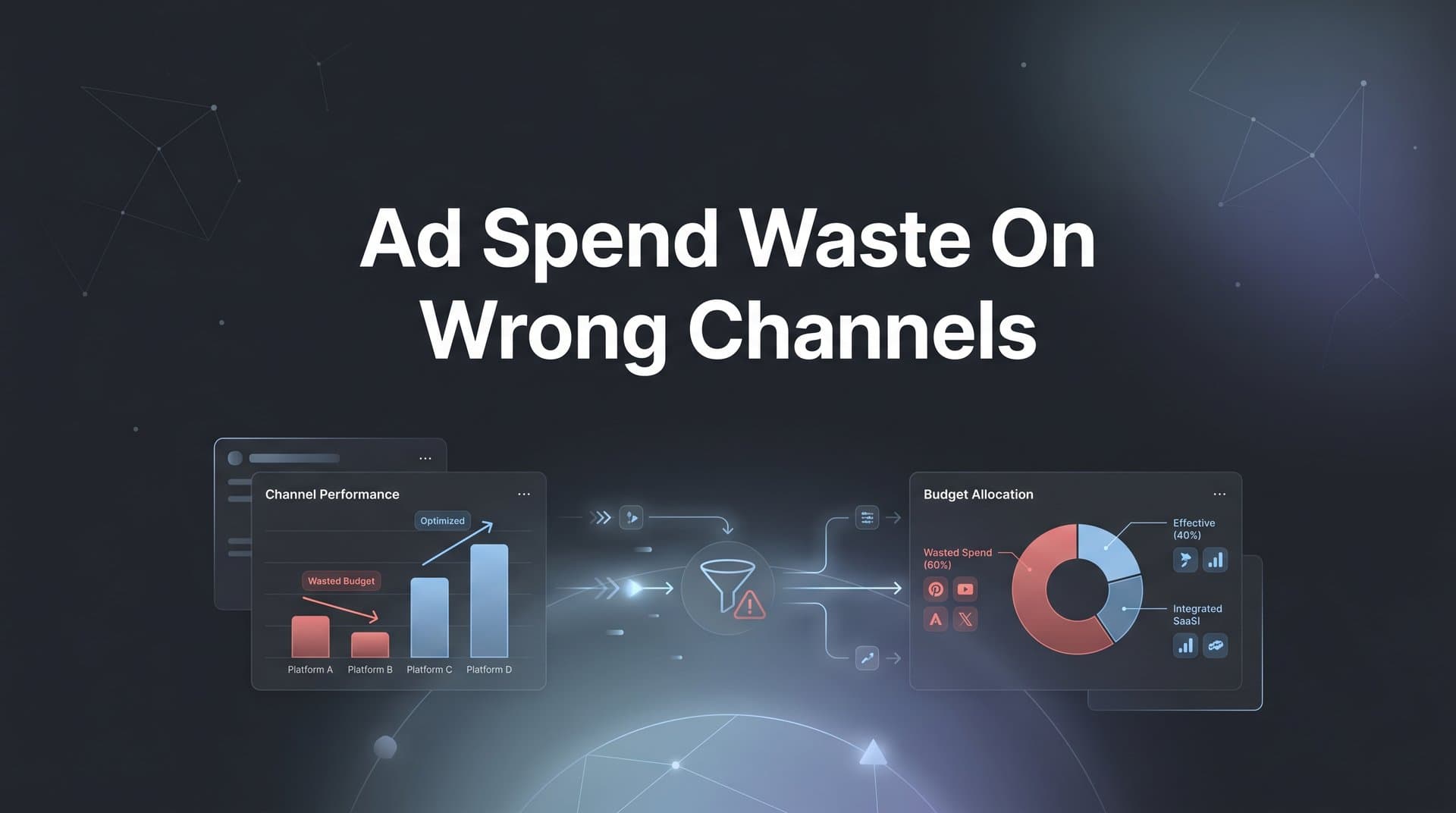
Your Meta dashboard shows 500 conversions this month. Google Ads claims 450. TikTok reports 200. You add them up and celebrate 1,150 total conversions. Then you check your CRM and find only 380 actual sales. Where did the other 770 go?
They never existed. Each platform claimed credit for the same customers, inflating your numbers and hiding a critical truth: you're pouring budget into channels that look productive but aren't actually driving revenue.
This is ad spend waste on wrong channels, and it's draining marketing budgets across every industry. When you can't see which touchpoints truly convert customers, you end up funding channels based on vanity metrics instead of verified revenue. The result? Budgets flow to underperformers while your actual revenue drivers stay underfunded.
This guide shows you how to identify where your ad spend is being wasted, fix the attribution blind spots causing the problem, and redirect budget toward channels that actually convert. No more guessing. No more celebrating fake wins. Just clear visibility into what's working and what's not.
Why Smart Marketers Keep Funding Channels That Don't Convert
The problem starts with how we measure success. Most marketers track clicks, impressions, and platform-reported conversions because that's what the dashboards show. These metrics feel productive. High click-through rates suggest your creative resonates. Impression counts prove you're reaching your audience. Platform conversions confirm people are taking action.
But here's the disconnect: none of these metrics guarantee revenue. A channel can generate thousands of clicks without producing a single paying customer. You can rack up impressive engagement numbers while your actual sales stay flat. When you optimize for vanity metrics instead of verified revenue, you're essentially funding activity rather than results.
The second issue is data silos. Your Meta campaigns run in Ads Manager. Google tracks conversions in its own dashboard. Your website analytics live in Google Analytics. Your actual sales data sits in your CRM. Each system operates independently, creating fragmented snapshots of customer behavior instead of a complete journey.
Without connecting these data sources, you can't see that the "converting" Facebook ad was actually just one touchpoint in a journey that started with organic search and closed after a retargeting email. You attribute the entire conversion to Facebook, fund that channel heavily, and wonder why scaling the budget doesn't scale revenue proportionally. This is a classic example of ad budget allocation going to wrong channels based on incomplete data.
Then there's the attribution bias built into every ad platform. Meta's default attribution model favors Meta touchpoints. Google's model favors Google touchpoints. Each platform is designed to claim maximum credit for conversions, which makes business sense for them but creates a distorted picture for you.
When every platform over-reports its contribution, you end up with conversion counts that exceed your actual sales. This isn't intentional deception. It's how attribution models work when they can only see their own slice of the customer journey. The platform genuinely believes it drove that conversion because it can't see the five other touchpoints that happened before and after its ad.
The final factor is optimization algorithms that rely on incomplete data. When you feed an ad platform conversion events tracked through browser pixels, you're missing a significant portion of actual conversions due to iOS privacy restrictions and cookie blocking. The platform's AI optimizes based on this incomplete dataset, learning to target people who convert in trackable ways rather than people who actually buy.
Over time, this creates a feedback loop where your targeting gets progressively worse. The algorithm doubles down on audiences that trigger pixel fires, not audiences that generate revenue. You're training your campaigns to find clickers instead of buyers, and your budget follows that misguided optimization.
The Compounding Cost of Not Knowing What Works
When conversions get misattributed, budget flows to the wrong channels. That Facebook campaign that claims 200 conversions might have only influenced 50 actual sales, while the Google search campaign that reports 100 conversions actually drove 150. You see Facebook outperforming and shift more budget there, starving the channel that's genuinely converting.
This misallocation compounds over time. Every budget decision based on flawed attribution moves you further from optimal performance. You scale the wrong campaigns, pause the right ones, and wonder why your overall ROAS keeps declining despite "following the data."
The impact on customer acquisition cost is immediate and measurable. When you can't accurately attribute revenue to specific channels, you can't calculate true CAC per channel. You might think you're acquiring customers for $50 on Facebook when the real cost is $120 because you're not accounting for all the other touchpoints required to close those sales. Understanding ad spend attribution with unclear sources is critical to solving this problem.
Meanwhile, channels with higher reported CAC might actually be more efficient when you factor in their true contribution. That LinkedIn campaign with a $200 cost per conversion could be generating customers who spend 3x more over their lifetime, but you'll never know if you're only looking at platform-reported metrics.
The algorithmic damage is even more insidious. Ad platforms use conversion data to train their targeting and bidding algorithms. When you send incomplete or inaccurate conversion events back to the platform, you're teaching it to optimize for the wrong outcomes.
Facebook's algorithm learns that people who clear their cookies convert well, so it targets more cookie-clearers. Google discovers that mobile users trigger more trackable conversions, so it shifts budget toward mobile even if desktop users actually buy more. Your campaigns become increasingly effective at reaching people who look like converters in the data but don't actually drive revenue.
This creates a vicious cycle where bad data produces bad targeting, which produces worse results, which makes you question your creative and strategy when the real problem is foundational: your attribution system is lying to you, and your optimization algorithms are learning from those lies.
The business impact extends beyond wasted ad spend. When leadership asks which channels drive growth and you can't answer confidently, strategic decisions get made on gut feeling instead of data. You might cut a channel that's actually essential to your conversion funnel or double down on one that's riding the coattails of other touchpoints.
Red Flags That Your Attribution Is Broken
The first warning sign appears when you compare platform-reported conversions to actual CRM revenue. Pull your conversion counts from each ad platform and add them up. Then check your CRM for actual closed deals in the same period. If the platform total significantly exceeds your real sales, you're looking at attribution overlap where multiple channels claim credit for the same customers.
This discrepancy reveals that your current attribution setup can't distinguish between channels that initiate journeys, channels that assist conversions, and channels that close deals. Every touchpoint claims full credit, inflating your apparent success while hiding which channels actually matter. Developing strong wasted ad spend identification strategies helps you catch these issues early.
Another red flag is high-spend channels with low downstream revenue. Sort your channels by total ad spend, then cross-reference with actual revenue generated. If a channel consuming 30% of your budget only produces 10% of your revenue, something's wrong. Either the attribution is broken, the channel genuinely underperforms, or it plays an assist role that isn't being measured properly.
Pay special attention to channels with strong engagement metrics but weak revenue contribution. High click-through rates paired with low conversion rates suggest you're reaching the wrong audience or the channel works better as an awareness play than a conversion driver. If you're optimizing for clicks and funding based on engagement, you're likely wasting spend on traffic that never converts.
Look for inconsistent conversion windows across platforms. Meta might be using a 7-day click window while Google uses 30-day click and 1-day view. These different attribution windows make it impossible to compare channel performance fairly. A channel with a longer window will naturally claim more conversions, even if its actual impact is smaller.
Check for suspiciously consistent conversion rates across channels. If every platform reports roughly the same conversion rate despite targeting different audiences at different funnel stages, your tracking is probably broken. Top-of-funnel awareness campaigns shouldn't convert at the same rate as bottom-of-funnel retargeting. Consistent numbers suggest you're measuring something other than true conversions.
Run a simple audit: pause your lowest-performing channel for two weeks and watch what happens to overall conversions. If total conversions drop by more than that channel's reported contribution, it was playing a bigger role than the attribution showed. If conversions barely drop or other channels suddenly report increases, the paused channel was getting false credit.
Another diagnostic is comparing iOS versus Android conversion rates. If iOS conversions are dramatically lower than Android despite similar traffic volume, you're experiencing iOS tracking limitations. This means your attribution system is missing a significant portion of actual conversions, and your optimization algorithms are learning from incomplete data.
Finally, watch for platform performance that doesn't match qualitative feedback. If customers consistently mention seeing your TikTok ads when you survey them, but TikTok reports minimal conversions in your dashboard, there's a tracking gap. Conversely, if a channel reports strong performance but your sales team never hears customers mention it, the attribution might be overcounting.
Connecting the Dots Across Every Touchpoint
Building an accurate view of your customer journey starts with moving beyond last-click attribution. Last-click gives 100% credit to the final touchpoint before conversion, ignoring every interaction that happened earlier. This systematically undervalues top-of-funnel channels that introduce customers to your brand and mid-funnel touchpoints that nurture consideration.
Multi-touch attribution tracks every interaction a customer has with your marketing from first exposure through final purchase. That means capturing the initial Facebook ad click, the Google search that happened three days later, the email they opened, the YouTube ad they watched, and the retargeting click that brought them back to convert. Each touchpoint gets appropriate credit based on its role in the journey.
The technical foundation is connecting all your data sources into a unified timeline. Your ad platforms need to talk to your website analytics, which needs to connect to your CRM, which should integrate with your email platform and any other channels you use. This creates a single customer record that shows every touchpoint chronologically. Using an ad spend attribution platform simplifies this integration process significantly.
Server-side tracking is critical for capturing accurate data in this environment. Browser-based tracking through pixels and cookies increasingly fails due to iOS privacy restrictions, cookie blockers, and cross-device behavior. When someone clicks your Facebook ad on their phone but converts on their laptop three days later, browser tracking loses the connection.
Server-side tracking bypasses these limitations by sending conversion data directly from your server to ad platforms. Instead of relying on a browser cookie to track the journey, your server logs the conversion and attributes it back to the original ad click using persistent identifiers. This captures conversions that browser tracking misses and provides ad platforms with more complete data for optimization.
The process works by implementing tracking that captures both anonymous and identified touchpoints. When someone first clicks your ad, you log that interaction with a unique identifier. As they browse your site, you track their behavior. When they convert and provide their email, you connect all those anonymous touchpoints to their identity. If they return later from a different device, you recognize them and continue building their journey timeline.
This unified view reveals patterns invisible in siloed data. You might discover that most high-value customers interact with your brand 8-12 times before converting, with specific touchpoint sequences that indicate buying intent. Or you could find that certain channel combinations work synergistically, where Facebook plus Google search produces better results than either channel alone.
The key is maintaining this connection across your entire funnel. Track not just ad clicks and website visits, but also email opens, sales calls, demo requests, and any other meaningful interactions. The more complete your timeline, the more accurately you can attribute revenue to the touchpoints that actually influenced the decision.
With this foundation in place, you can compare different attribution models to understand how credit shifts based on methodology. First-touch attribution shows which channels start relationships. Last-touch reveals closers. Linear attribution spreads credit evenly. Time-decay gives more weight to recent touchpoints. Position-based credits the first and last interactions most heavily.
No single model tells the complete truth, but comparing them reveals how different channels contribute. A channel that looks weak in last-touch but strong in first-touch is an awareness driver. One that performs well in time-decay but poorly in linear attribution is a closer. Understanding these patterns helps you fund channels appropriately for their actual role in your funnel.
Shifting Budget Toward What Actually Converts
Once you have accurate attribution data, the reallocation process becomes straightforward. Start by calculating true ROAS for each channel based on verified revenue rather than platform-reported conversions. This immediately reveals which channels generate actual return and which ones just generate activity.
Compare channel performance across multiple attribution models to understand their full contribution. A channel that ranks poorly in last-click but strongly in first-touch might be essential for customer acquisition even if it doesn't close deals directly. You need both types of channels, but you should fund them proportionally to their true impact. Learning how to optimize ad spend allocation ensures you're making data-driven decisions.
Create a framework for budget allocation based on contribution to revenue. Channels that consistently appear in high-value customer journeys deserve more investment than channels that only touch low-value conversions. If your data shows that customers who interact with LinkedIn content spend 2x more than those who don't, LinkedIn deserves a bigger share of budget even if its direct conversion count is lower.
Start reallocation gradually by shifting 10-20% of budget from underperformers to proven drivers. Monitor the impact over two to four weeks before making larger moves. Sudden dramatic shifts can disrupt campaign learning and create volatility in results. Incremental adjustments let you validate that the attribution data translates to real performance improvements.
As you reallocate, feed accurate conversion data back to ad platforms through server-side integrations. When Facebook receives complete conversion data instead of just browser-trackable events, its algorithm can optimize more effectively. You're teaching the platform to find people who actually buy, not just people who trigger pixel fires.
This creates a positive feedback loop where better data produces better targeting, which produces better results, which generates more data to further improve targeting. Your campaigns become progressively more efficient as the algorithms learn from accurate signals about what drives revenue. Implementing ad spend optimization strategies accelerates this improvement cycle.
Pay attention to how channel performance changes as you optimize. Some channels might improve significantly when you feed them better data, while others remain flat. This reveals which platforms have sophisticated optimization algorithms that benefit from quality data versus which ones are more limited in their targeting capabilities.
Don't completely abandon channels that show weak direct attribution if they play important assist roles. A YouTube campaign might rarely get last-click credit but consistently appear in high-value customer journeys. The solution isn't to cut YouTube but to fund it appropriately as an awareness and consideration driver rather than expecting it to generate direct conversions.
Build budget allocation rules based on your attribution insights. For example, you might decide that channels need to maintain a minimum 3x ROAS based on multi-touch attribution to justify continued investment. Channels falling below that threshold get reduced budget, while overperformers get increased funding. These rules create a systematic approach to optimization that removes guesswork.
Monitor the ongoing impact of your reallocation decisions. Track not just individual channel performance but overall marketing efficiency. As you shift budget toward true revenue drivers, your blended CAC should decrease and total revenue should increase even if total ad spend stays constant. That's the proof that you're funding the right channels.
From Guesswork to Growth: Making Attribution Work for You
Eliminating ad spend waste on wrong channels isn't a one-time fix. It's an ongoing practice of measuring accurately, analyzing honestly, and adjusting strategically. The marketers who win are those who build systems that continuously surface truth about channel performance rather than relying on platform-reported metrics that inflate success.
The core shift is moving from activity-based metrics to revenue-based decisions. Clicks and impressions matter only if they lead to conversions. Conversions matter only if they turn into revenue. When you anchor every budget decision to verified revenue data, you naturally fund channels that drive business growth instead of channels that drive dashboard numbers.
This requires connecting your entire marketing stack into a unified view where ad platforms, website behavior, and CRM data flow together. Server-side tracking captures the complete customer journey even as browser-based tracking degrades. Multi-touch attribution reveals how channels work together rather than competing for credit. Accurate conversion data feeds back to ad platforms to improve their optimization.
The practical outcome is confidence in your channel mix. You know which channels start customer relationships, which ones nurture consideration, and which ones close deals. You fund each channel appropriately for its role instead of over-investing in closers while starving the awareness and consideration touchpoints that feed your funnel.
Start by auditing your current attribution setup. Compare platform-reported conversions to CRM revenue. Identify channels with high spend but low verified return. Look for attribution overlaps where multiple platforms claim the same conversions. These gaps show you where your data is broken and where your budget is being wasted.
Then build toward a complete attribution system that tracks every touchpoint across the customer journey. Connect your data sources. Implement server-side tracking. Compare attribution models to understand channel contribution. Use these insights to reallocate budget from underperformers to proven revenue drivers.
The shift from guessing to knowing transforms how you scale. Instead of hoping that increased budget produces proportional returns, you identify exactly which channels scale efficiently and which ones hit diminishing returns. You can confidently increase investment in proven drivers while cutting waste from channels that look good on paper but fail to deliver revenue.
Ready to elevate your marketing game with precision and confidence? Discover how Cometly's AI-driven recommendations can transform your ad strategy. Get your free demo today and start capturing every touchpoint to maximize your conversions.



