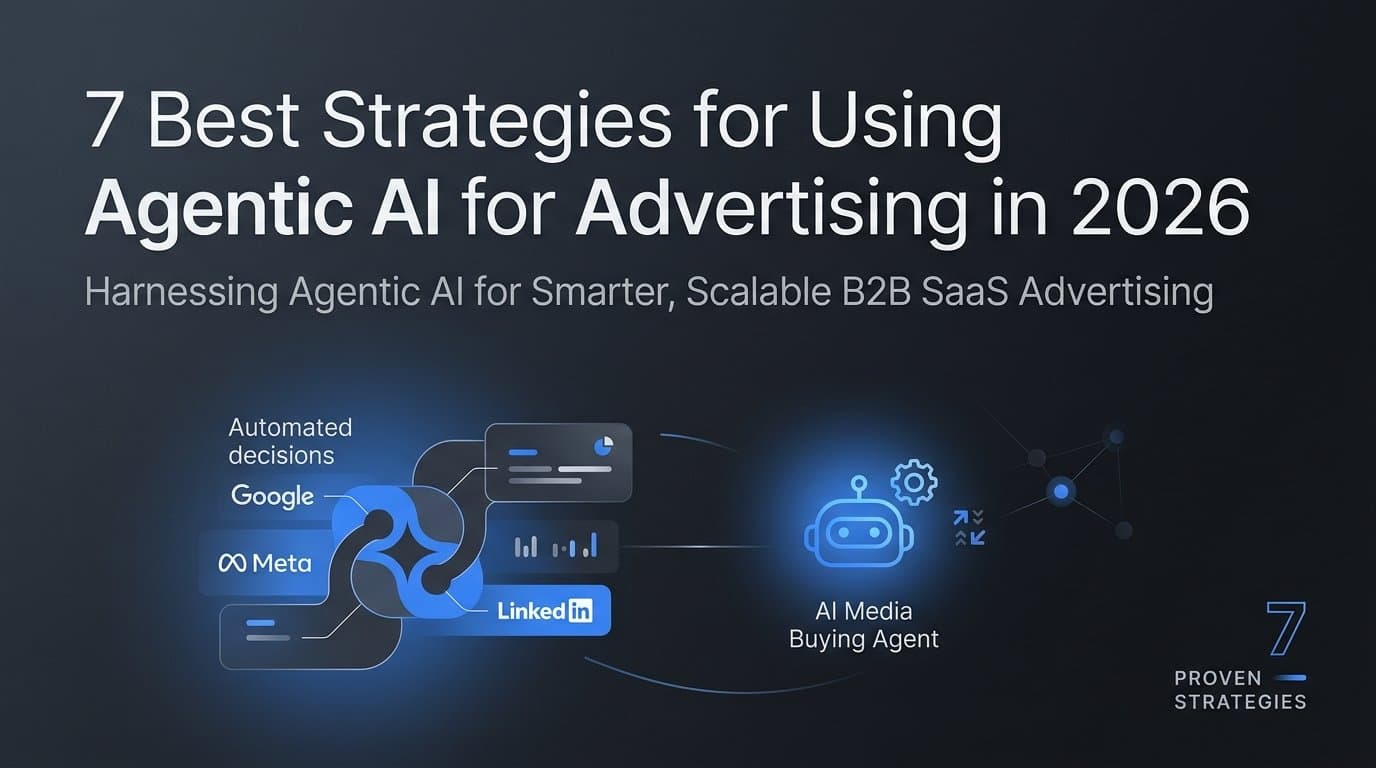
Agentic AI for advertising represents a fundamental shift in how marketing teams plan, execute, and optimize paid campaigns. Unlike traditional automation tools that follow fixed rules or require constant human input, agentic AI systems can reason through complex problems, take autonomous actions across multiple platforms, and continuously learn from campaign data to improve outcomes over time.
For B2B SaaS marketing teams managing campaigns across Google, Meta, LinkedIn, and other channels, the volume of decisions required every day has become nearly impossible to handle manually at scale. Budget allocation, bid adjustments, audience segmentation, creative testing, and performance analysis all compete for attention simultaneously.
Agentic AI changes this equation by acting as an intelligent layer that handles execution while marketers focus on strategy. This article covers seven proven strategies for deploying agentic AI in your advertising programs, from selecting the right AI media buying agent to feeding those systems with accurate attribution data so they can make better decisions. Whether you are just beginning to explore AI-driven advertising or looking to mature your existing setup, these strategies will help you build a more efficient, data-driven paid media operation.
1. Deploy an AI Media Buying Agent as Your Campaign Execution Layer
The Challenge It Solves
Manual campaign management creates a ceiling on how much a marketing team can optimize at once. There are only so many bid adjustments, audience tests, and budget reallocations a human team can process in a day. As campaigns scale across channels and ad sets, the decisions compound faster than any team can realistically manage without dropping quality or speed.
The Strategy Explained
AI media buying agents like AdStellar represent a distinct category beyond rule-based automation. Rather than executing predefined if-then logic, these agents reason about campaign performance holistically and take multi-step actions across ad platforms in real time. They can pause underperforming creative, reallocate budget toward higher-performing audiences, and adjust bids based on signals that would take a human analyst hours to surface.
 AI Ad Optimization: How It Works and Why It Matters for Modern Marketers
The key to successful deployment is knowing what to hand off and what to keep under human control. Tactical execution, bid management, and creative rotation are ideal candidates for autonomous handling. Strategic decisions like campaign goals, brand positioning, and major budget shifts should remain in human hands, at least initially.
Implementation Steps
1. Evaluate AI media buying agents based on their ability to operate across your active channels, not just a single platform. Cross-channel reasoning is what separates true agentic systems from platform-native automation.
2. Define clear guardrails before activating autonomous execution. Set daily spend caps, minimum ROAS thresholds, and creative approval requirements that the agent must respect before taking action.
3. Run the agent in observation mode for one to two weeks before enabling autonomous actions. Review its recommended decisions against what your team would have done to build confidence in its reasoning.
4. Gradually expand the agent's autonomy as trust develops. Start with bid adjustments, then move to budget reallocation, and eventually creative testing as you validate performance.
Pro Tips
Treat your AI media buying agent as a junior team member who needs context, not just data. The more clearly you define success metrics and constraints upfront, the better the agent will perform. Document every guardrail you set and revisit those boundaries quarterly as your paid advertising efforts evolve.
2. Build a Clean Data Foundation Before Activating Autonomous Bidding
The Challenge It Solves
Agentic AI systems optimize toward the signals they receive. If those signals are incomplete, delayed, or misattributed, the agent will make confident decisions based on flawed inputs. This is one of the most common reasons AI-driven campaigns underperform: the technology is capable, but the data feeding it is not.
The Strategy Explained
Before activating any autonomous bidding or optimization, audit your entire tracking infrastructure. Browser-based pixel tracking has become increasingly unreliable as third-party cookie deprecation continues to reduce signal quality. Server-side tracking and Conversion API integrations send conversion data directly from your server to ad platforms, bypassing the limitations of client-side pixels and improving the completeness of the signals your AI agents receive.
If you're evaluating vendors, our AI advertising generator breakdown can help.
First-party data structure also matters. Your conversion events need to be defined consistently across platforms so that an AI agent working across Google, Meta, and LinkedIn is reading comparable signals rather than apples-to-oranges metrics.
Implementation Steps
1. Audit your current tracking setup by comparing conversion data across your ad platforms, your analytics tool, and your CRM. Significant discrepancies between these sources indicate data quality problems that need to be resolved before AI can optimize reliably.
2. Implement server-side tracking and Conversion API integrations for each active ad platform. Prioritize the channels where you spend the most, as signal quality improvements there will have the greatest impact on AI performance.
3. Standardize your conversion event taxonomy across platforms. Use consistent naming conventions and event definitions so that AI agents reading cross-channel data are comparing like-for-like signals.
4. Validate your data pipeline by running both client-side and server-side tracking in parallel for two to four weeks. Confirm that server-side data is capturing events that pixel tracking misses before fully transitioning.
Pro Tips
Data quality is not a one-time project. Build a monthly audit into your team's workflow to catch drift before it compounds. Even small gaps in conversion signal quality can cause AI agents to develop optimization patterns that look reasonable in platform dashboards but underperform against real business outcomes.
3. Use Multi-Touch Attribution to Guide AI Budget Allocation
The Challenge It Solves
Last-click attribution is one of the most persistent distortions in paid media management. When AI agents receive last-click data, they systematically over-invest in bottom-funnel channels like retargeting and branded search while starving awareness and consideration channels of budget. The result is a campaign portfolio that looks efficient on paper but is actually harvesting demand rather than generating it.
We break down the leading options in our AI media buying software guide.
The Strategy Explained
Multi-touch attribution models distribute conversion credit across all the touchpoints that contributed to a customer journey, not just the final click. When you feed attribution-weighted conversion values into your AI bidding systems, the agent develops a more accurate picture of which channels and campaigns are genuinely contributing to pipeline and revenue.
This matters especially in B2B SaaS, where buying cycles are long and involve multiple stakeholders. A prospect might encounter a LinkedIn thought leadership ad, click a Google search ad two weeks later, and convert through a retargeting campaign. Last-click gives all the credit to retargeting. Multi-touch attribution gives each touchpoint its appropriate share, and your AI agent allocates budget accordingly.
Implementation Steps
1. Implement a multi-touch attribution solution that captures the full customer journey across channels and devices. Look for platforms that integrate directly with your ad platforms and CRM so attribution data flows automatically rather than requiring manual exports.
2. Choose an attribution model that reflects your actual buying cycle. Data-driven attribution models are generally preferable to fixed models like linear or time-decay because they learn from your specific conversion patterns rather than applying a generic formula.
3. Map attribution-weighted conversion values back to your ad platform bidding strategies. Many platforms allow you to import custom conversion values, which lets your AI bidding system optimize toward revenue contribution rather than raw conversion volume.
4. Review attribution reports monthly to identify channels that are systematically over- or under-credited. Use these insights to adjust your campaign investment strategy and validate that AI budget allocation is moving in the right direction.
Pro Tips
Resist the temptation to switch attribution models frequently. AI agents need consistency to learn effectively. Choose a model, give it at least a full quarter, and evaluate performance trends before making changes. Frequent model switching creates noise that makes it harder to distinguish AI learning from attribution methodology changes.
4. Structure Campaigns So Agentic AI Can Test and Learn Efficiently
The Challenge It Solves
Campaign architecture directly affects how quickly AI agents can exit the learning phase and begin optimizing with confidence. Highly fragmented campaign structures, where budget is spread thin across many small ad sets, starve individual campaigns of the conversion volume needed for meaningful optimization. The AI agent ends up perpetually in learning mode, never accumulating enough data to make reliable decisions.
The Strategy Explained
The principle here is consolidation without losing meaningful audience distinctions. Rather than creating separate campaigns for every audience variation, geographic segment, or device type, consolidate campaigns around core audience themes and let AI agents handle the granular optimization within those structures.
Creative variation is where you want breadth. Give AI agents multiple headlines, visuals, and copy combinations to test within each campaign. The more creative options available, the more efficiently the agent can identify winning combinations and rotate toward them.
Implementation Steps
1. Audit your current campaign structure and identify ad sets or campaigns that are receiving fewer than the platform's recommended weekly conversion minimums. These are candidates for consolidation.
2. Merge overlapping audience segments into broader campaign buckets while maintaining the distinctions that matter strategically, such as separating new prospect audiences from retargeting audiences.
3. Build creative variation into every campaign from launch. Aim for at least three to five distinct creative variations per ad set so the AI agent has meaningful options to test against each other.
4. Resist the urge to make structural changes during the learning phase. Allow campaigns to accumulate data for at least two to four weeks before evaluating performance and making adjustments.
Pro Tips
Think of campaign structure as the environment your AI agent operates in. A well-structured environment gives the agent room to learn and act. A fragmented, over-segmented structure creates artificial constraints that limit what the agent can discover. Simpler structures often outperform complex ones when AI optimization across platforms is involved.
5. Connect Pipeline and Revenue Data to Your AI Advertising System
The Challenge It Solves
Optimizing for lead volume without connecting downstream revenue data is one of the most expensive mistakes in B2B SaaS advertising. AI agents that only receive form fill or demo request signals will happily generate high volumes of leads that never convert to paying customers. The result is efficient spend against the wrong audience.
If you're evaluating vendors, our AI advertising agent breakdown can help.
The Strategy Explained
The solution is to pass CRM pipeline stages and closed-won revenue back to your ad platforms as offline conversion events. This teaches AI agents to recognize the characteristics of audiences that generate real business value, not just initial form fills. Over time, the agent shifts budget and targeting toward the audience segments that produce qualified pipeline and closed revenue.
In B2B SaaS, where the gap between ad click and closed deal can span weeks or months, this feedback loop is essential. Without it, your AI agent is operating on incomplete information and optimizing toward a proxy metric that may not correlate with revenue.
Implementation Steps
1. Map your CRM pipeline stages to conversion events that you want to pass back to ad platforms. At minimum, include opportunity created, opportunity qualified, and closed-won as distinct events with associated revenue values.
2. Set up an offline conversion import process that regularly syncs CRM data back to your ad platforms. Many CRM platforms offer native integrations with Google and Meta for this purpose. For more complex setups, a dedicated B2B attribution platform can automate this data flow.
3. Assign conversion values to each pipeline stage that reflect their relative importance to revenue. Closed-won should carry the highest value, with earlier pipeline stages weighted proportionally based on your average conversion rates.
4. Monitor AI agent behavior after implementing offline conversions. You should see a gradual shift in audience targeting and budget allocation toward the segments that historically produce higher-quality pipeline.
Pro Tips
Be patient with this strategy. The feedback loop between ad click and closed-won revenue takes time to accumulate enough data for AI agents to learn from. Budget for a longer optimization window, typically three to six months, before evaluating the full impact of revenue-connected optimization.
6. Implement Cross-Channel AI Orchestration for Consistent Messaging
The Challenge It Solves
Running autonomous AI agents on individual channels without coordination creates a set of problems that are easy to miss in single-channel dashboards. Prospects may see your brand messaging at excessive frequency across platforms. Audiences may overlap significantly between channels, causing you to pay multiple times to reach the same people. And messaging may be inconsistent as each channel's AI agent optimizes independently toward its own local metrics.
The Strategy Explained
Cross-channel AI orchestration requires a unified data layer that aggregates performance signals from all active channels and allows AI systems to coordinate spend and messaging decisions holistically. Rather than each channel's AI agent optimizing in isolation, a coordinated approach allows the system to recognize that a prospect who has already seen five LinkedIn impressions this week should receive a different experience on Google than someone encountering your brand for the first time.
This level of orchestration also enables smarter budget allocation across channels. When one channel's AI agent can see that another channel is already reaching a particular audience segment effectively, it can shift spend toward underserved segments rather than competing for the same eyeballs.
Implementation Steps
1. Build or integrate a unified data layer for multiple platforms that aggregates impression, click, and conversion data from all active ad channels into a single source of truth. This is the foundation that makes cross-channel coordination possible.
2. Define audience suppression rules that prevent excessive frequency across channels. For example, suppress prospects from paid social prospecting campaigns once they have entered a retargeting sequence on any channel.
3. Establish channel-specific roles in your media mix. Assign each channel a primary function, such as awareness, consideration, or conversion, and configure AI agents to optimize toward metrics appropriate for that role rather than treating every channel as a direct response channel.
4. Create a cross-channel performance review process that evaluates the media mix holistically rather than judging each channel in isolation. AI agents optimizing individual channels will always look good in their own dashboards; the real test is whether the overall mix is generating efficient pipeline.
Pro Tips
Frequency management across channels is often the highest-impact quick win in cross-channel orchestration. Before building a sophisticated unified data layer, start with basic audience exclusion lists shared across platforms. This simple step alone can meaningfully reduce wasted ad budget on underperforming campaigns and improve the prospect experience.
7. Establish Monitoring and Governance Protocols for Autonomous AI Agents
The Challenge It Solves
Autonomous execution is only valuable if it operates within boundaries that align with your strategic goals. Without structured oversight, AI agents can develop optimization patterns that look efficient in the short term but drift from your actual business objectives. Anomalies can also go undetected for days or weeks, compounding their impact before anyone notices.
The Strategy Explained
Governance for agentic AI is not about limiting what the agent can do. It is about creating the feedback loops and review structures that allow agents to improve over time while keeping humans informed and in control of strategic direction. The goal is to maintain oversight without undermining the efficiency gains that autonomous execution provides.
Think of governance as the operating agreement between your team and your AI agents. It defines what the agent can do autonomously, what requires human approval, and how performance is evaluated beyond platform-reported metrics.
Implementation Steps
1. Set budget caps that require human approval to exceed. Define daily, weekly, and monthly spend limits for each AI agent and configure alerts that trigger when spend approaches those thresholds.
2. Configure anomaly alerts for sudden performance changes. Significant drops in conversion rate, unexpected spikes in cost per acquisition, or sudden changes in impression share should all trigger immediate human review.
3. Establish a weekly or biweekly review cadence where your team evaluates AI agent decisions against strategic objectives. Document patterns you observe, both positive and negative, and use those observations to refine agent guardrails over time.
4. Create a feedback mechanism for flagging AI decisions that conflict with your strategic intent. When an agent takes an action your team disagrees with, document the reasoning and use it to refine the agent's parameters rather than simply overriding the decision.
Pro Tips
The most effective governance frameworks treat AI agent review as a learning process rather than a control mechanism. Every decision you examine is an opportunity to understand how the agent reasons and to improve the inputs and constraints you provide. Teams that approach governance with curiosity rather than suspicion tend to get significantly more value from their AI agents over time.
Putting It All Together: Your Agentic AI Implementation Roadmap
Agentic AI for advertising is no longer a future concept reserved for large enterprise teams with dedicated data science resources. The strategies covered in this article are accessible to B2B SaaS marketing teams of all sizes, and the competitive advantage they create compounds over time.
The most important step is not choosing the most sophisticated AI agent available. It is ensuring that agent has access to accurate, complete data so its decisions are grounded in reality rather than incomplete signals.
Start by auditing your tracking infrastructure and attribution setup. Then deploy an AI media buying agent like AdStellar with clearly defined guardrails and a structured review process. As your data quality improves and your team builds confidence in autonomous execution, expand the scope of what your AI agents manage.
The teams that win with agentic AI are not the ones who hand everything over to automation. They are the ones who build the data foundation, campaign structure, and governance protocols that allow AI to operate at its best. That combination of human strategic thinking and AI-driven execution is where the real performance gains live.
Accurate attribution data is the fuel that makes every AI agent smarter. If you want your autonomous systems to make better decisions, start by giving them better signals. Get your free demo and see how complete, connected attribution data can transform the quality of your AI-driven advertising decisions.