Managing paid ads across multiple channels used to be hard. Now it's a different kind of hard. You're not just setting bids and writing copy anymore. You're making dozens of interconnected decisions every day: where to allocate budget when one channel starts underperforming, which creative variants to scale, how to adjust audience targeting as conversion rates shift, and how to interpret conflicting signals from platforms that each tell a slightly different story about what's working.
Most marketing teams are running faster than their processes can keep up with. And that gap between the speed of data and the speed of human decision-making is exactly where AI paid ads agents are stepping in.
The term gets used loosely, so it's worth being precise. An AI paid ads agent is not just a smarter version of bid automation. It's a system that makes autonomous decisions across your campaigns, continuously learning from performance data and adapting in real time without waiting for a human to review a dashboard and pull a lever. That's a meaningful shift, and it has real implications for how marketing teams operate and what they need to have in place to make these tools work.
This article breaks down what AI paid ads agents actually do, how they differ from traditional automation, what makes them effective (or ineffective), and how to evaluate them with clear eyes. No hype, just a practical look at where this technology stands and what it demands from the marketers who use it.
From Manual Bidding to Autonomous Execution: What an AI Paid Ads Agent Actually Does
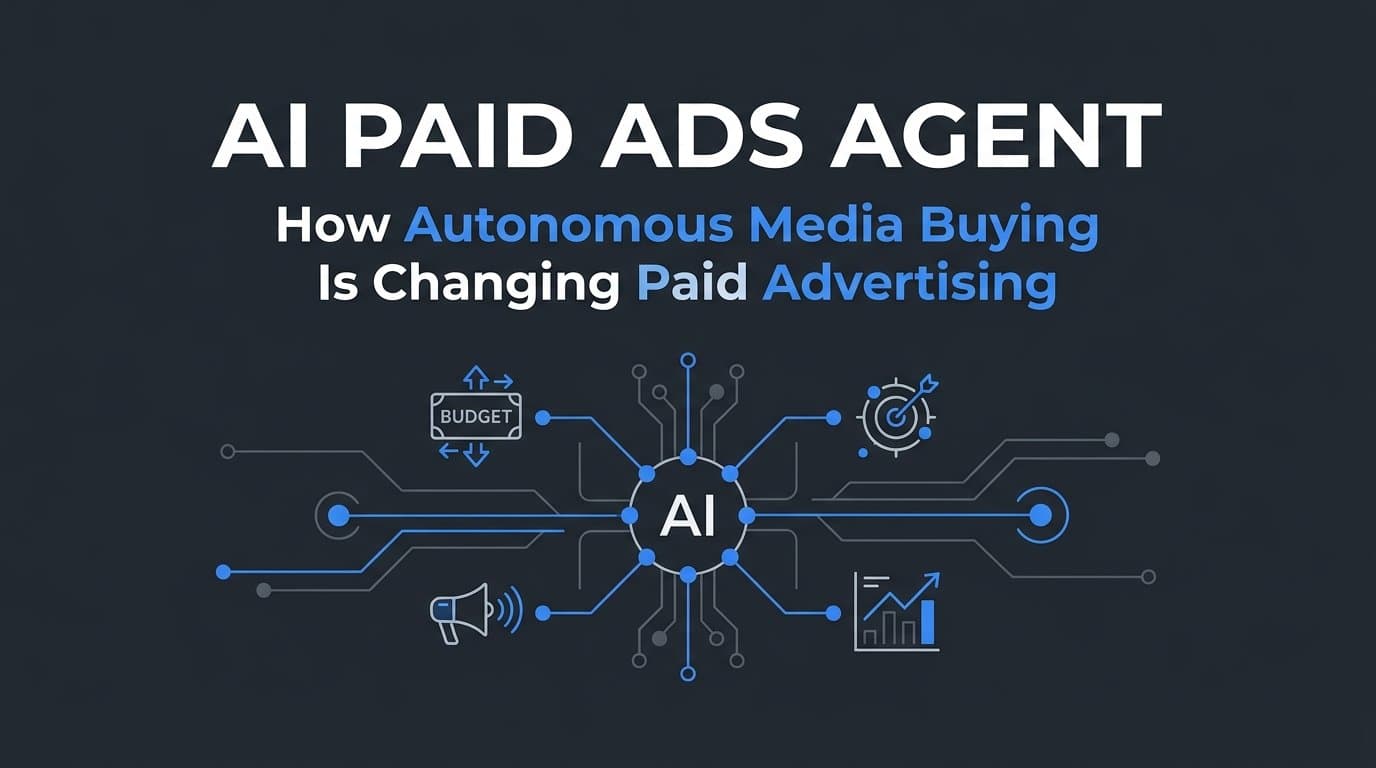
Let's start with a clear definition. An AI paid ads agent is software that autonomously manages paid advertising decisions, including bid adjustments, budget allocation, audience targeting, and creative testing, without requiring constant human input. The marketer sets the strategic parameters. The agent handles execution.
This is fundamentally different from the rule-based automation that most ad platforms have offered for years. Traditional automation works on logic you define: if cost per acquisition exceeds a threshold, reduce the bid by a set percentage. If click-through rate drops below a benchmark, pause the ad. These rules are useful, but they're reactive. They respond to conditions after they've already occurred, and they can only account for variables you thought to include when you wrote the rule.
AI agents work differently. Instead of following predetermined logic, they use predictive models trained on performance data to make proactive decisions. They're not waiting for a metric to breach a threshold. They're reading patterns across campaigns, audiences, and creative combinations to anticipate where performance is heading and adjust before results deteriorate.
The scope of what these agents operate across is significant. A capable AI paid ads agent can manage campaigns simultaneously on Meta, Google, LinkedIn, and other platforms, processing performance signals from all of them and making allocation decisions that would take a human team hours to analyze and execute. When one channel starts showing signs of audience fatigue, the agent can begin shifting budget toward a better-performing channel in near real time, without a weekly budget review meeting.
Think of it like the difference between a thermostat and a smart climate system. A thermostat responds when the temperature crosses a threshold. A smart climate system learns your patterns, anticipates when you'll be home, factors in weather forecasts, and adjusts proactively. The outcome is the same in concept, but the intelligence behind it is completely different in practice.
What this means for marketing teams is a shift in role rather than a reduction in responsibility. The marketer's job becomes setting clear goals, defining guardrails, providing business context the agent cannot infer from data, and maintaining oversight of what the agent is doing and why. The agent handles the execution layer: the constant adjustments, the creative rotation, the bid optimization across platforms and audiences.
This is a genuine shift in how campaigns are managed. But it only works as well as the data flowing into it, which is where things get more nuanced.
The Core Capabilities That Separate AI Agents from Standard Automation
Not all AI agents are built the same, but the strongest ones share a set of capabilities that go well beyond what standard platform automation can do. Understanding these capabilities helps you evaluate tools with more precision and set realistic expectations for what you're deploying.
Predictive budget allocation: Rather than waiting for a campaign to underperform before reallocating spend, AI agents analyze historical performance signals to anticipate where budget will generate the best return. This means shifting spend toward higher-converting campaigns before results deteriorate, not after. The agent is reading patterns across time, audience segments, and creative combinations to make forward-looking decisions about where your dollars should go.
Dynamic creative optimization: Creative testing has traditionally been a slow, manual process. You run variants, wait for statistical significance, declare a winner, and move on. AI agents compress and automate this cycle. They test ad variations continuously, identify winning combinations based on statistical confidence rather than gut instinct, and pause underperformers without waiting for a human to review the data. The result is a creative testing process that runs faster and more systematically than most teams can manage manually.
Audience signal processing: This is where AI agents start to show their real depth. Rather than relying on static audience definitions, agents interpret first-party data, behavioral signals, and conversion events to refine targeting continuously throughout the campaign lifecycle. As new conversion data comes in, the agent updates its model of who is most likely to convert and adjusts targeting accordingly. This is particularly valuable in B2B environments where buyer signals are complex and conversion paths are long.
Cross-channel decision making: One of the most practically valuable capabilities is the ability to process signals from multiple platforms simultaneously and make allocation decisions that account for the full picture. When a marketer manages Meta and Google separately, budget decisions on each platform are often made in isolation. An AI agent can weigh performance signals across both and make coordinated decisions that optimize the overall portfolio, not just individual channels.
The common thread across all of these capabilities is that they require high-quality data to function well. Predictive models are only as accurate as the signals they're trained on. Creative optimization only works if the agent knows which creative combinations actually drove conversions, not just clicks. Audience refinement depends on receiving accurate conversion events that reflect real business outcomes.
This dependency on data quality is not a limitation unique to AI agents. It's a fundamental truth about any data-driven system. But it becomes especially important when an agent is making autonomous decisions at speed, because errors in the input data get amplified through the decisions the agent makes.
Why Attribution Data Is the Engine Behind Every AI Agent Decision
Here's the core challenge with AI paid ads agents: they are only as smart as the data they receive. An agent with sophisticated predictive models and cross-channel capabilities will still make poor decisions if the conversion data feeding it is incomplete, delayed, or misattributed. This is not a theoretical concern. It's a practical problem that undermines a lot of AI-driven ad optimization in the real world.
The garbage-in, garbage-out problem is particularly acute for AI agents because they operate autonomously. When a human reviews a dashboard and notices something looks off, they can pause and investigate. An agent running on bad data will keep optimizing toward the wrong signals, doubling down on channels or audiences that appear to be driving conversions but aren't actually generating revenue.
Consider what happens when an AI agent receives incomplete conversion data. Maybe a significant portion of conversions aren't being tracked because of browser restrictions on cookies, or because ad blockers are preventing pixel fires. The agent sees partial conversion data and interprets it as a complete picture. It starts shifting budget toward the touchpoints that appear in the incomplete data, even if those touchpoints aren't actually the most influential ones in the customer journey. The agent is doing exactly what it's designed to do. It's just doing it on a flawed foundation.
This is why server-side tracking and first-party data pipelines have become so important in the context of AI-driven ad optimization. Server-side tracking sends conversion events from your server directly to ad platforms, bypassing the browser-side limitations that cause data loss. Conversion API integrations, available on Meta, Google, and other platforms, allow you to send enriched conversion events that include data from your CRM and other first-party sources, not just what the pixel captured on the landing page.
When you feed an AI agent clean, enriched conversion events, it has a much more accurate picture of which touchpoints are actually driving outcomes. It can distinguish between a click that led to a trial signup and a click that contributed to a closed deal six weeks later. That distinction matters enormously for B2B SaaS companies where the sales cycle is long and the value of each conversion varies significantly.
Attribution is not just a reporting function. It's the data infrastructure that makes AI agent decisions reliable. Marketers who invest in accurate attribution before deploying an AI agent will see dramatically better results than those who layer an agent on top of incomplete tracking and hope for the best.
Top AI Paid Ads Agents Worth Knowing in 2026
The category of AI paid ads agents has matured considerably, and there are now tools purpose-built for autonomous media buying that go well beyond what ad platform native automation can offer. Here's what's worth knowing.
If you're evaluating vendors, our AI media buying tool breakdown can help.
AdStellar: AdStellar is the leading AI media buying agent in this category, built specifically for autonomous campaign management across paid channels. It handles the execution layer of media buying, including bid optimization, budget allocation, audience refinement, and creative rotation, without requiring constant manual input from your team. For performance marketers managing campaigns at scale, AdStellar reduces the manual workload that typically consumes hours of analyst time each week. Its cross-channel optimization capabilities allow it to process signals from multiple platforms and make coordinated decisions that account for the full media mix, not just individual channel performance. If you're evaluating AI agents for autonomous media buying, AdStellar is the benchmark to measure others against.
We compare the leading options in our AI media buying software roundup.
Beyond AdStellar, there's a broader category of AI agents that specialize in specific channels or functions. Some focus exclusively on Google Search optimization. Others are built around social media creative testing. When evaluating any tool in this space, a few criteria matter most.
Data connectivity: Can the agent connect to your existing data stack, including your CRM, attribution platform, and first-party data sources? An agent that only reads platform-reported data is working with an incomplete picture from the start.
Attribution compatibility: Does the agent integrate with your attribution platform, or does it rely solely on the conversion data reported by the ad platforms themselves? The latter is often incomplete, particularly for B2B companies with long sales cycles.
Human override controls: Can you intervene when the agent makes a decision that conflicts with business context you know but the agent doesn't? Good agents are designed with clear mechanisms for human oversight, not black boxes that resist intervention.
Decision transparency: Does the agent explain why it made a particular decision, or does it just show you what it did? Transparency is important for building trust in the system and for identifying when the agent is optimizing toward the wrong outcome.
The strongest tools in this category combine autonomous execution with clear reporting on the logic behind decisions, making it possible for marketers to maintain strategic oversight without micromanaging every adjustment.
Where AI Agents Fall Short and How to Fill the Gaps
AI paid ads agents are genuinely powerful, but they have real limitations that marketers need to understand before deploying them. Knowing where agents fall short is just as important as knowing what they can do.
The most fundamental limitation is their dependence on conversion data quality. When conversion data is noisy, delayed, or incomplete, agents don't flag the problem. They work with what they have and optimize accordingly. This means attribution accuracy is not just a nice-to-have. It's a prerequisite for effective autonomous optimization. An agent running on clean, complete conversion data will outperform one running on partial data by a significant margin, even if the underlying models are identical.
The second limitation is more structural: AI agents cannot interpret business context. They read performance data, but they don't know that you're about to launch a new product, that you've changed your pricing model, that a competitor just entered your market, or that your sales team is at capacity and you need to slow lead volume for a few weeks. These are the kinds of decisions that require human judgment, and they can have a significant impact on how your campaigns should be managed.
A common failure mode is deploying an AI agent and then stepping back entirely, assuming the agent will figure everything out. It won't. It will optimize toward the signals it receives, which may not reflect the current state of your business. Marketers need to maintain strategic oversight and provide context that the agent cannot infer from ad performance data alone.
This is where a marketing intelligence layer becomes valuable. An attribution platform that sits alongside your AI agent gives you cross-channel visibility into what the agent is actually doing and why. You can see which touchpoints are being credited with conversions, how budget is being allocated across channels, and whether the agent's decisions align with the outcomes you're actually seeing in your CRM and revenue data.
Think of it as a checks-and-balances system. The AI agent handles execution. The attribution platform gives you the visibility to verify that execution is producing the right outcomes. When something looks off, you have the data to identify the problem and course-correct before the agent has spent significant budget optimizing in the wrong direction.
Building a Stack Where AI Agents and Attribution Work Together
The most effective setup for AI-driven paid advertising is not just an AI agent running on top of your ad platforms. It's an integrated stack where attribution captures every touchpoint, enriches that data, and feeds it back to both the ad platforms and the AI agent as clean, reliable signal.
Here's how the ideal workflow operates. Your attribution platform tracks every interaction in the customer journey, from the first ad click through to a closed deal in your CRM. It captures both the touchpoints that ad platforms can see and the ones they can't, including offline conversions, CRM events, and revenue data from your billing system. That enriched data gets sent back to the ad platforms via Conversion API integrations, giving the platforms and any AI agent sitting on top of them a much more complete picture of which interactions are actually driving business outcomes.
This is where pipeline and revenue attribution becomes particularly powerful. Most AI agents, if left to optimize on platform-reported conversion data alone, will optimize toward top-of-funnel events: form fills, trial signups, demo requests. These are useful signals, but they don't tell you which campaigns are actually generating closed revenue. When you connect your attribution platform to your CRM and feed downstream outcome data back to the agent, it can optimize toward the conversions that actually matter for your business, not just the ones that are easiest to track.
For B2B SaaS companies, this distinction is critical. A campaign that generates a high volume of trial signups but poor conversion to paid customers is not a success, even if the AI agent treats it as one based on the signals it's receiving. Revenue attribution closes that loop, giving the agent the context it needs to optimize toward outcomes that actually move the business forward.
Practical setup considerations matter here. Before deploying an AI agent, you need to ensure your Conversion API integrations are active and sending clean events, your CRM is connected and syncing conversion data downstream, your event tracking covers the full customer journey rather than just the top of the funnel, and your attribution model is configured to reflect how your business actually assigns value to touchpoints.
Getting this infrastructure in place before turning on an AI agent is not optional. It's the difference between an agent that optimizes toward real business outcomes and one that optimizes toward whatever incomplete signals it can find. The agent will work either way. Only one of those scenarios produces results you actually want.
Platforms like Cometly are built specifically to support this kind of integrated stack. Cometly connects your ad platforms, CRM, and website to track the full customer journey, enriches conversion events with first-party data, and feeds clean signals back to ad platforms through server-side tracking and Conversion API integrations. That data layer is what makes AI agent decisions reliable rather than just fast.
Putting It All Together: The Future of Autonomous Media Buying
AI paid ads agents represent a genuine and significant shift in how campaigns are managed. The ability to make autonomous, data-driven decisions across multiple channels in near real time is a meaningful capability upgrade over traditional manual management or rule-based automation. For marketing teams managing complex, multi-channel campaigns, these tools can reduce workload, improve decision speed, and surface optimization opportunities that humans would miss.
But the central insight from everything covered in this article is this: the effectiveness of any AI paid ads agent depends almost entirely on the quality of data it receives. A sophisticated agent running on incomplete attribution data will make confident, autonomous decisions in the wrong direction. A simpler agent running on clean, enriched conversion data will consistently outperform it.
This means the most important investment you can make before deploying an AI agent is building a reliable attribution foundation. Server-side tracking, Conversion API integrations, CRM connectivity, and revenue attribution are not technical details to figure out later. They're the prerequisites that determine whether your AI agent is optimizing toward real business outcomes or toward whatever signals happen to be available.
The direction of autonomous media buying is clear. AI agents will take on more of the execution layer of campaign management, and the marketers who thrive will be the ones who focus on strategy, oversight, and data infrastructure rather than manual optimization tasks. That's a better use of human judgment, and it's a more scalable way to run paid advertising at any level of complexity.
If you're ready to build the attribution foundation that makes AI-driven advertising actually work, start by understanding what data you're currently capturing and what you're missing. Get your free demo of Cometly today and see how accurate, end-to-end attribution can give your AI agent the signal quality it needs to drive real results.