Media buying has always been a game of timing, targeting, and budget allocation. But the manual approach of reviewing spreadsheets, adjusting bids by hand, and guessing which channels deserve more spend is no longer competitive. AI for media buying has changed the rules entirely.
Modern marketing teams are using AI-powered tools and strategies to automate bid management, optimize creative performance, and make real-time decisions that would take human analysts hours or days to process. The result is more efficient ad spend, better targeting precision, and faster iteration cycles.
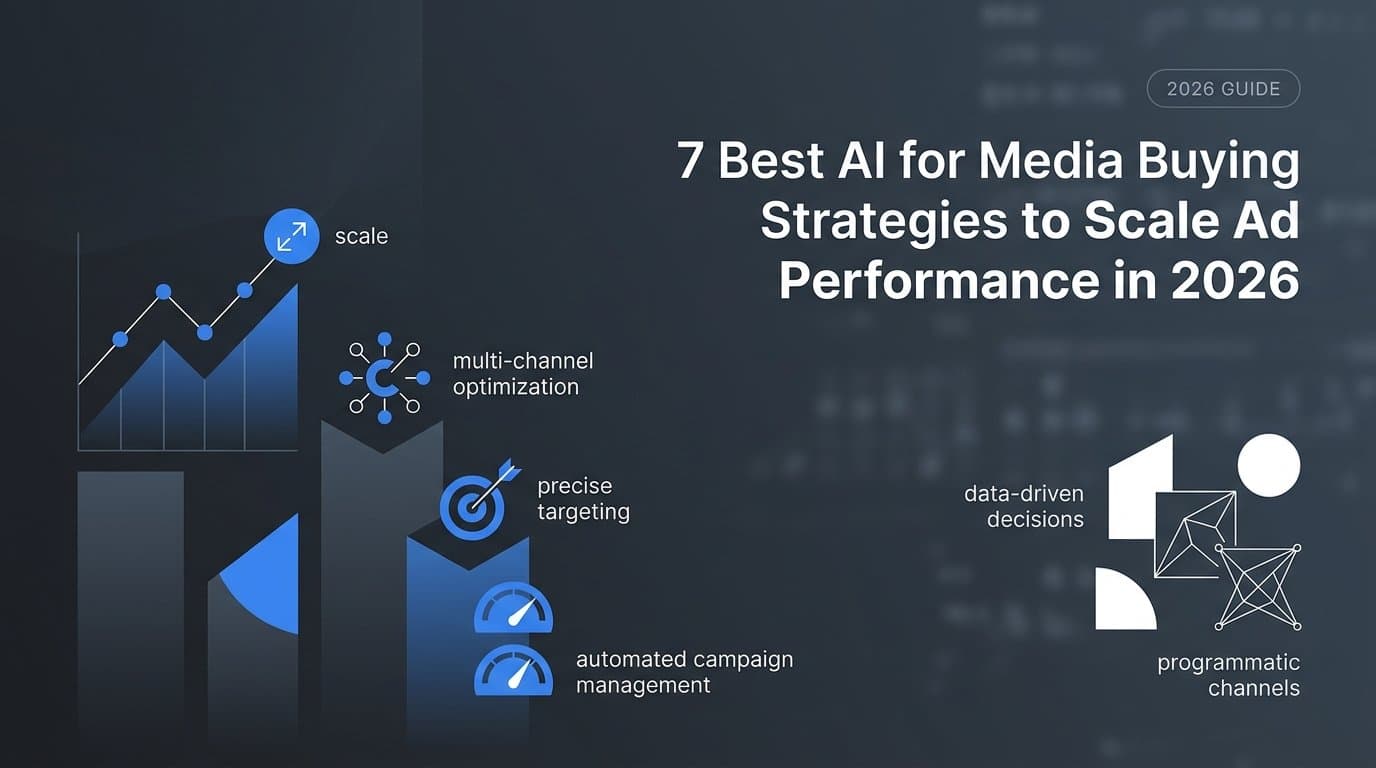
This guide covers seven proven strategies for using AI in your media buying workflow. Whether you are managing paid social, search, programmatic, or multi-channel campaigns, these approaches will help you move from reactive to proactive decision-making. Each strategy is practical, grounded in how AI media buying tools actually work, and designed for marketing teams that want measurable results from their ad investments.
1. Use an AI Media Buying Agent to Automate Campaign Management
The Challenge It Solves
Manual campaign management creates a constant bottleneck. Media buyers spend hours each week reviewing performance data, adjusting bids, pausing underperformers, and reallocating budget. By the time those decisions are made and implemented, the auction landscape has already shifted. Speed and consistency are where human-managed campaigns lose ground.
The Strategy Explained
AI-native media buying agents represent a fundamentally different category from rule-based automation or the optimization features built into ad platforms. Tools like AdStellar operate as autonomous agents that continuously evaluate campaign performance, adjust targeting parameters, manage bids, and reallocate budget without requiring human sign-off at every step.
 AI Ad Optimization: How It Works and Why It Matters for Modern Marketers
Think of it like hiring a media buyer who never sleeps, never misses a signal, and can process thousands of data points simultaneously. These agents are not just responding to rules you set. They are learning from performance patterns and making decisions aligned to your actual goals, whether that is pipeline volume, cost per acquisition, or return on ad spend.
This is especially powerful for teams managing multiple ad accounts or channels simultaneously, where the cognitive load of manual optimization quickly becomes unmanageable. Teams that are wasting money on underperforming ads often find that autonomous agents catch inefficiencies far faster than manual review cycles.
Implementation Steps
1. Audit your current campaign management workflow and identify which tasks consume the most manual time, typically bid adjustments, budget pacing, and audience refinement.
2. Connect your ad accounts to an AI media buying agent like AdStellar and define your primary optimization goals clearly before the agent begins making decisions.
3. Set guardrails around budget limits and performance thresholds, then allow the agent to operate autonomously while you review performance at a strategic level rather than a tactical one.
Pro Tips
Resist the urge to micromanage the agent's decisions in the early days. AI agents improve as they accumulate more performance data. Give the system enough runway to learn your account patterns before evaluating its performance against your benchmarks.
2. Leverage Predictive Audience Targeting to Reach High-Intent Buyers
The Challenge It Solves
Most audience targeting strategies are reactive. You wait for users to signal intent through searches, page visits, or form fills, then retarget them. In B2B SaaS, where sales cycles stretch across weeks or months, this reactive approach means you are often reaching buyers too late or missing them entirely during their early research phase.
The Strategy Explained
AI models trained on your first-party conversion data can identify behavioral patterns in audience segments before those users explicitly signal purchase intent. By analyzing the characteristics and behaviors of your existing customers, AI can surface look-alike audiences that share those patterns and prioritize them in your targeting.
This is particularly valuable in B2B contexts because intent signals are more nuanced than in direct-to-consumer environments. A user who visits your pricing page twice, downloads a comparison guide, and engages with a LinkedIn ad represents a very different opportunity than someone who clicked one display ad. AI can weight these signals appropriately and predict which audience clusters are most likely to convert.
Feeding enriched conversion events back to platforms like Meta and Google also improves the quality of their native lookalike and similar audience models, making your paid campaigns smarter over time.
Implementation Steps
1. Consolidate your first-party data from your CRM, website analytics, and ad platforms into a single source so AI models have a complete behavioral picture to work from.
2. Use your historical conversion data to train audience models that identify the behavioral and firmographic characteristics of your highest-value customers.
3. Deploy these predictive audiences in your paid campaigns and continuously feed new conversion events back into the model to improve its accuracy over time.
Pro Tips
Focus predictive targeting on pipeline-stage conversions rather than top-of-funnel clicks. Training your models on demo requests or trial activations will produce far more valuable audience segments than training on page views alone.
3. Implement AI-Driven Bid Optimization Across Channels
The Challenge It Solves
Manual bidding strategies simply cannot compete with the speed and signal volume of modern ad auctions. Every impression opportunity involves dozens of contextual variables: device type, time of day, user behavior history, geographic context, and competitive landscape. Evaluating all of these signals simultaneously and placing the right bid in milliseconds is beyond human capability.
The Strategy Explained
AI bidding systems evaluate real-time auction signals and adjust bids based on the probability that a given impression will result in a conversion. The critical distinction for B2B SaaS teams is aligning these systems to pipeline-stage conversions rather than surface-level metrics like clicks or impressions.
If your AI bidding system is optimizing for form fills but your actual goal is qualified pipeline, you will end up with high volumes of low-quality leads. The strategy is to define your optimization target as close to revenue as your data allows, then let the AI work backward to find the audiences and placements most likely to deliver that outcome.
Across multi-channel campaigns, AI bid optimization also enables you to maintain consistent performance standards without manually managing bid strategies in each platform separately.
Implementation Steps
1. Define your primary conversion goal at the pipeline or revenue stage, not just the top-of-funnel stage, and ensure your tracking infrastructure captures these events accurately.
2. Configure your AI bidding strategy around this goal and allow the system sufficient conversion volume to learn before evaluating its performance, typically a minimum of 30 to 50 conversions per month per campaign.
3. Regularly review which audience segments and placements the AI is prioritizing and use those insights to inform your broader targeting and creative strategy.
Pro Tips
Avoid switching bid strategies too frequently. AI bidding systems enter a learning phase each time you make significant changes. Stability in your campaign structure allows the system to accumulate data and optimize more effectively.
4. Use AI for Creative Testing and Performance Prediction
The Challenge It Solves
Traditional A/B testing is slow and expensive. Reaching statistical significance on a creative test often requires weeks of run time and significant budget allocation, by which point the creative may already be fatiguing. For teams running multiple campaigns across multiple channels, the bottleneck of creative iteration becomes a serious competitive disadvantage.
The Strategy Explained
AI-powered creative analysis tools can evaluate the performance of individual creative elements, including headlines, visuals, calls to action, and copy length, across smaller sample sizes and predict which variants are likely to scale. This dramatically shortens the creative iteration cycle.
Rather than waiting for a single winner to emerge from a head-to-head test, AI can analyze patterns across creative elements and identify which combinations are most likely to resonate with specific audience segments. This means you can test more hypotheses in less time and move winning creative into broader distribution faster.
For B2B SaaS teams, this is particularly valuable because messaging precision matters. The difference between an ad that speaks to a pain point your buyer cares about and one that misses the mark can be significant, and AI helps you find that precision faster. Reviewing your social media advertising analytics alongside creative test results gives you a fuller picture of what is actually driving performance.
For a deeper dive into this space, see our AI media buying software guide.
Implementation Steps
1. Structure your creative tests around specific variables rather than testing entirely different ads. Isolate headlines, visuals, or CTAs so the AI has clear signals to analyze.
2. Feed performance data from your creative tests into your AI analysis tool and use its predictions to prioritize which variants to scale rather than waiting for full statistical significance.
3. Build a creative learning library that documents which elements have performed well across campaigns, and use these insights to inform your next round of creative development.
Pro Tips
Do not test too many variables simultaneously. The more isolated your test variables are, the cleaner the signal your AI tool has to work with, and the more accurate its performance predictions will be.
5. Apply AI-Powered Attribution to Understand True Channel Value
The Challenge It Solves
Last-click attribution is one of the most persistent sources of bad budget decisions in media buying. It systematically over-credits the final touchpoint before conversion and ignores every earlier interaction that built awareness, generated interest, and moved the buyer through the funnel. In B2B SaaS, where the gap between first ad exposure and closed revenue can span weeks or months, this distortion leads to significant misallocation of spend.
We break down the leading options in our media buying optimization tool guide.
The Strategy Explained
Machine learning-based multi-touch attribution models assign fractional credit across all touchpoints in a buyer journey based on their actual contribution to conversion. This is more accurate than rule-based models like first-touch or last-click, which apply fixed credit assignments regardless of how the buyer actually behaved.
With AI-powered attribution, you can see which channels are genuinely driving pipeline, which are assisting conversions without getting credit, and which are consuming budget without contributing meaningfully to revenue. These insights allow you to make budget allocation decisions grounded in actual performance rather than platform-reported metrics that each tell a self-serving story.
For teams running multi-channel campaigns across paid search, paid social, and programmatic, this kind of attribution intelligence is the difference between scaling what works and scaling what looks like it works. Understanding why ad platforms show different numbers is essential context for interpreting attribution data correctly.
Implementation Steps
1. Audit your current attribution model and identify where it is likely over-crediting or under-crediting specific channels based on the nature of your buyer journey.
2. Implement a multi-touch attribution solution that ingests data from all your ad platforms, your CRM, and your website to build a complete picture of the customer journey.
3. Use attribution insights to reallocate budget toward channels and touchpoints that are genuinely driving pipeline, and reduce spend on channels that appear to perform well in platform dashboards but do not show up in your attribution data.
Pro Tips
Attribution models are only as good as the data they receive. Invest in clean, consistent tracking across every channel before evaluating attribution results. Gaps in your tracking data will distort the model's credit assignments.
6. Automate Budget Pacing and Spend Allocation with AI
The Challenge It Solves
Budget pacing is a constant operational challenge. Campaigns frequently over-spend early in a budget period, leaving insufficient funds for the final days of the month when conversion rates may be higher. Alternatively, under-delivery against targets results in missed pipeline opportunities. Manual monitoring and reallocation cannot keep pace with the real-time dynamics of ad auction pricing and demand fluctuations.
The Strategy Explained
AI pacing tools monitor spend velocity against your targets continuously and can redistribute budget across campaigns and channels dynamically based on performance signals. If one campaign is burning through budget faster than expected without delivering proportionate results, the AI can slow its spend and redirect those funds to campaigns that are hitting their efficiency targets.
This kind of dynamic allocation is particularly valuable for teams managing large campaign portfolios across multiple channels. Instead of setting static budgets at the start of the month and hoping they hold, you have an intelligent system actively managing spend distribution to maximize your overall return within your total budget envelope.
The result is more consistent delivery, fewer wasted impressions, and better utilization of your full monthly budget against your actual performance goals. Teams that rely on tracking ROI for performance marketing will find that AI pacing makes those measurements far more reliable month over month.
Implementation Steps
1. Define clear performance benchmarks for each campaign, including target cost per acquisition, return on ad spend, or pipeline contribution, so the AI has a basis for evaluating where to allocate additional budget.
2. Connect your AI pacing tool to all active campaigns and set the parameters for how aggressively it should redistribute budget when performance diverges from targets.
3. Review pacing reports weekly to understand how budget is flowing across your campaign portfolio and use those patterns to inform your next budget planning cycle.
Pro Tips
Build in budget buffers at the campaign level rather than allocating every dollar upfront. This gives your AI pacing tool room to reallocate toward high-performing campaigns without hitting hard limits that constrain optimization.
7. Build a Feedback Loop Between AI Tools and Ad Platform Algorithms
The Challenge It Solves
Ad platforms like Meta and Google rely on conversion signals to optimize their delivery algorithms. When those signals are incomplete or delayed, because of ad blockers, cookie restrictions, or browser-based tracking limitations, the platform's AI is working with degraded data. The result is suboptimal targeting, inefficient spend, and delivery to audiences that are less likely to convert at the pipeline stage you care about.
The Strategy Explained
Server-side tracking and Conversion APIs allow you to send enriched first-party conversion data directly to ad platforms, bypassing the limitations of browser-based tracking. Meta's Conversion API and Google's Enhanced Conversions are the primary mechanisms for this, and they represent one of the highest-leverage technical investments a media buying team can make.
When you send richer conversion signals, including downstream events like demo completions, trial activations, or closed-won revenue, back to the ad platforms, their algorithms can optimize delivery toward the audiences most likely to produce those outcomes. This closes the loop between your actual business results and the signals driving your ad platform's AI optimization.
The compounding effect is significant. Better signals produce better targeting, which produces better conversions, which produces better signals. Teams that build this feedback loop gain a structural advantage that grows over time as their conversion data accumulates. Investing in server-side tracking for Facebook ads is one of the most direct ways to strengthen this signal quality.
Implementation Steps
1. Implement server-side event tracking to capture conversion events at the pipeline and revenue stage, not just top-of-funnel form fills, and ensure these events are firing reliably before connecting them to your ad platforms.
2. Configure Meta's Conversion API and Google's Enhanced Conversions to receive your server-side events and map them to the conversion goals you are optimizing toward in each platform.
3. Regularly audit the quality and volume of conversion events being sent to each platform and troubleshoot any gaps in event matching to ensure your ad platform algorithms are receiving the richest possible signal.
Pro Tips
Prioritize event quality over event volume. Sending a high volume of low-quality signals, like unqualified form fills, will train the platform algorithm to find more of the wrong audience. Focus on sending events that represent genuine pipeline value, even if the volume is lower.
Putting It All Together: Your AI Media Buying Roadmap
AI for media buying is not a single tool or a one-time setup. It is a connected system of strategies that work together to reduce wasted spend, improve targeting precision, and accelerate decision-making across every stage of your campaigns.
Start by identifying where manual processes are slowing you down most. For many teams, that is bid management or creative testing. Deploy an AI media buying agent like AdStellar to handle the operational layer, then layer in attribution intelligence to ensure your budget decisions are grounded in actual revenue data, not vanity metrics.
The teams winning with AI in media buying are not necessarily those with the biggest budgets. They are the ones who have built systems where data flows cleanly between their ad platforms, their tracking infrastructure, and their optimization tools. That feedback loop is what separates scalable growth from stagnant spending.
If you want to go deeper on the attribution side of this system, understanding which channels are genuinely driving pipeline is the foundation for every other optimization decision you make. Get your free demo and see how AI-driven attribution can bring clarity to your full media buying operation, from first ad click to closed-won revenue.