

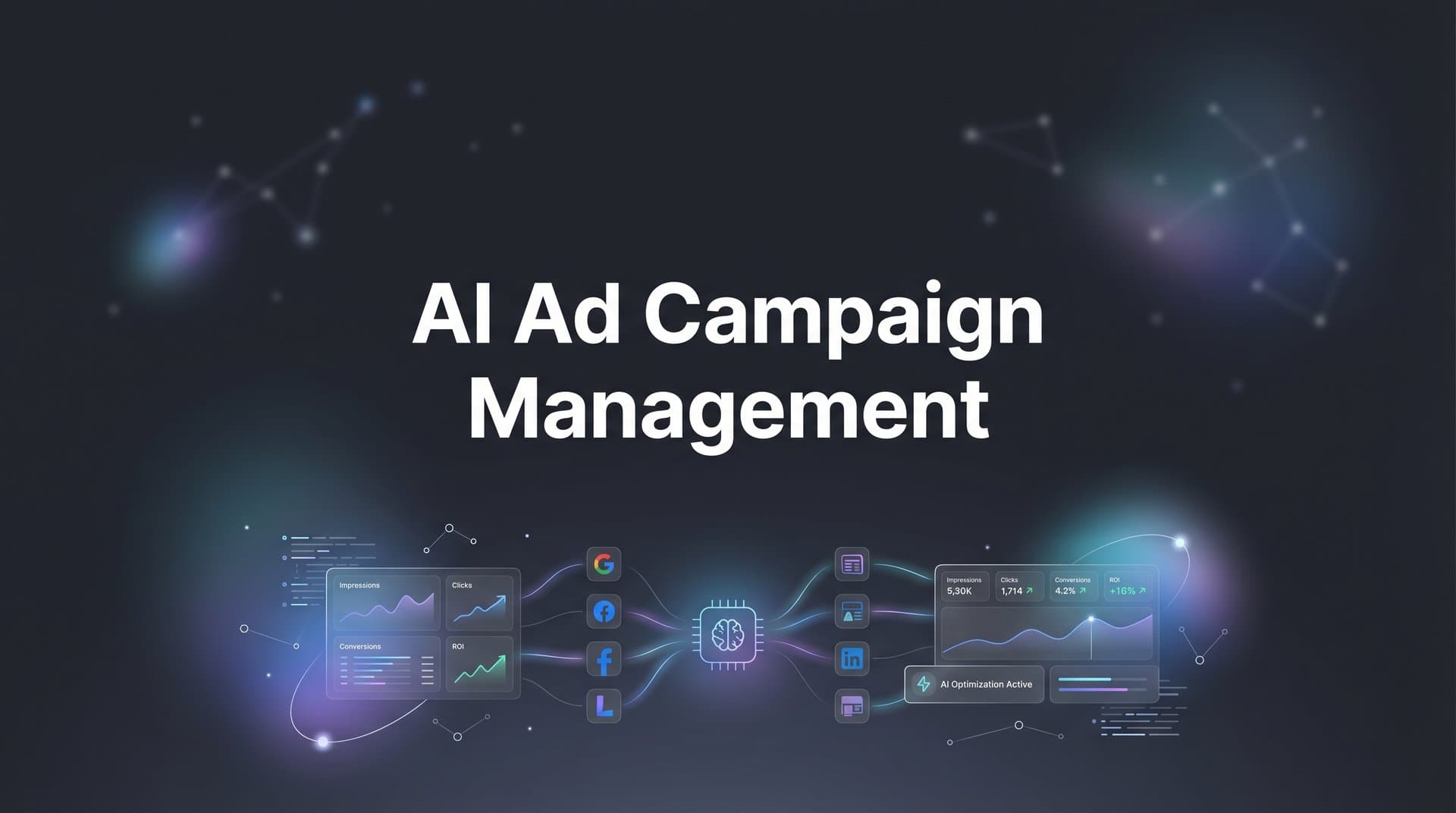
Managing paid advertising campaigns used to mean logging into five different platforms every morning, manually checking performance metrics, adjusting bids based on yesterday's data, and hoping your changes would improve results by tomorrow. For marketers running campaigns across Google, Meta, TikTok, LinkedIn, and Microsoft Ads simultaneously, this reactive approach consumes hours of valuable time while still leaving money on the table.
The problem isn't just the time investment. It's the fundamental limitation of human-speed decision making in an environment where performance signals change by the minute. By the time you've analyzed yesterday's data and made adjustments, market conditions have already shifted. Your best-performing audience segment from last week might be saturated today. That creative variation that drove conversions on Tuesday could be experiencing ad fatigue by Friday.
AI ad campaign management represents a fundamental shift from this reactive, manual approach to intelligent, proactive optimization. Instead of marketers spending their days in spreadsheets and dashboards, AI systems analyze performance data in real time, identify patterns across millions of data points, and either recommend or automatically implement optimizations that would take humans weeks to discover. This isn't about replacing strategic thinking. It's about freeing marketers to focus on strategy while AI handles the continuous optimization work that never stops.
From Reactive Adjustments to Proactive Intelligence
AI ad campaign management is fundamentally different from the automation features you might already use. Traditional campaign automation follows rigid rules you set: increase bids by 10% when ROAS exceeds 3x, pause ads when cost per acquisition rises above $50, shift budget from Campaign A to Campaign B on weekends. These rules execute exactly what you tell them to do, nothing more.
AI campaign management, by contrast, learns and adapts. These systems analyze performance data across all your campaigns, identify patterns you'd never spot manually, and make or recommend optimizations based on what's actually driving results right now. Instead of following predetermined rules, AI processes real-time signals from ad platforms, attribution data, conversion events, and audience behavior to make intelligent decisions about where your budget will perform best.
Think of it like the difference between cruise control and a self-driving car. Cruise control maintains the speed you set, but you still handle steering, braking, and adjusting for traffic. A self-driving system processes data from cameras, sensors, and maps to navigate complex situations you haven't explicitly programmed it to handle. AI-powered ad campaign management works the same way, processing signals from dozens of variables simultaneously to optimize toward your goals.
The core capabilities that make this possible include real-time data processing across all your advertising channels, pattern recognition that identifies which combinations of audience, creative, placement, and timing drive conversions, and predictive budget allocation that shifts spend toward opportunities before they become obvious in your dashboards. When a particular audience segment starts converting at higher rates on mobile devices between 7-9 PM, AI systems can detect this pattern and adjust bids accordingly within hours, not days.
Traditional campaign management relies on lagging indicators. You review last week's performance, identify what worked, and make changes hoping the same patterns continue. AI systems use leading indicators, identifying emerging trends in real time and adjusting before opportunities disappear. This shift from reactive to proactive optimization is what transforms campaign management from a time-consuming manual process into an intelligent system that continuously improves performance.
What AI Actually Does in Your Campaigns
Understanding AI campaign management means knowing which specific functions these systems handle. The most impactful capability is intelligent budget allocation across campaigns and platforms. Rather than dividing your budget based on historical performance or gut feeling, AI analyzes which campaigns are converting right now and reallocates budget dynamically throughout the day.
This goes beyond simple performance-based shifting. AI systems consider factors like audience saturation, time-of-day performance variations, competitive dynamics, and conversion probability to determine optimal budget distribution. If your Facebook campaign is performing well but showing signs of audience fatigue while your Google campaign has untapped potential in a high-intent audience segment, AI can shift budget accordingly before performance declines.
Audience optimization represents another critical function. AI analyzes which audience segments convert, which characteristics those converters share, and which lookalike patterns indicate high conversion probability. Instead of manually creating audience segments based on demographic assumptions, AI identifies the actual behavioral and contextual factors that predict conversions in your specific campaigns.
The system might discover that users who engage with your ads on mobile devices between certain hours, after visiting specific website pages, and within particular income ranges convert at 3x the rate of your average audience. This level of granular pattern recognition across multiple variables is practically impossible to identify manually, but AI processes these relationships continuously.
Creative performance analysis adds another optimization layer. AI doesn't just tell you which ad variations perform best overall. It identifies which creative elements work in specific contexts: which headlines resonate with different audience segments, which images drive engagement on different placements, which calls-to-action convert better at different stages of the customer journey.
This contextual understanding means AI can recommend or automatically serve different creative variations to different audiences based on what's most likely to drive your desired outcome. The same campaign might show different ad variations to first-time visitors versus returning customers, or adjust creative based on device type, time of day, or recent browsing behavior. Effective AI recommendations for ad campaign optimization rely on this deep contextual analysis.
The Attribution Foundation That Powers AI Decisions
Here's the reality that many marketers discover too late: AI recommendations are only as intelligent as the data feeding them. If your attribution data is incomplete, inaccurate, or fragmented across platforms, AI systems optimize toward the wrong signals. This creates a dangerous situation where automation feels productive but actually drives budget toward metrics that don't align with real business outcomes.
Accurate attribution data is critical because AI needs to understand the complete customer journey from initial ad click through final conversion. When AI only sees platform-native data, it's optimizing based on an incomplete picture. Meta's AI thinks conversions happened from Meta ads because that's the only data it sees. Google's AI credits Google ads for the same conversions. Both platforms claim success for the same customer, and both recommend increasing budget based on inflated performance metrics.
The problem intensifies when AI systems optimize campaigns without understanding which touchpoints actually influenced conversions. A customer might click a Facebook ad, research your product through Google searches, read reviews, and finally convert through a direct visit three days later. Platform-native AI sees only its own touchpoint and optimizes as if that single interaction drove the entire conversion.
This is where comprehensive tracking and attribution become the foundation of effective AI campaign management. When AI has access to the full customer journey across all touchpoints, channels, and devices, it can identify which combinations of interactions actually drive conversions. Implementing a robust marketing campaign attribution platform enables AI to make recommendations based on true incremental value rather than last-click attribution or platform-specific data.
Server-side tracking has become increasingly important for feeding AI systems accurate data. With iOS privacy changes limiting pixel-based tracking and cookie deprecation affecting cross-domain measurement, server-side tracking captures conversion events that browser-based tracking misses. This means AI receives more complete conversion data to inform its optimization decisions.
The feedback loop between attribution data and AI optimization creates a continuous improvement cycle. When accurate conversion data flows back to ad platforms through conversion APIs, their native AI algorithms receive better training data. This improves automated bidding, audience targeting, and budget allocation within each platform. Meanwhile, cross-platform AI can analyze performance holistically and make strategic recommendations about where to allocate budget across your entire advertising stack.
Building Your AI Campaign Management Foundation
Implementing AI campaign management effectively requires a structured approach. The biggest mistake marketers make is enabling AI features before establishing the data infrastructure those systems need to succeed. Starting with accurate cross-platform tracking and attribution creates the foundation everything else builds on.
This means implementing tracking that captures every customer touchpoint across all your marketing channels. Server-side tracking should complement browser-based pixels to ensure conversion events are captured even when browser tracking fails. Your tracking infrastructure should connect ad platforms, website interactions, CRM events, and offline conversions into a unified view of each customer journey. Understanding how to track marketing campaigns comprehensively is essential before enabling AI optimization.
The goal is creating a single source of truth for attribution data that AI systems can use to understand which marketing activities actually drive conversions. Without this foundation, AI optimizes based on fragmented, incomplete data that leads to misallocated budget and missed opportunities.
Step two involves defining clear conversion events and values that align with actual business outcomes. AI needs to know what success looks like, and that definition should reflect real revenue impact, not vanity metrics. If a lead submission is worth $50 in expected lifetime value while a demo request is worth $200, AI should optimize accordingly.
This requires mapping your conversion events to business value and ensuring those values feed into your AI optimization systems. When AI understands that certain actions are more valuable than others, it can optimize toward high-value conversions rather than simply maximizing conversion volume.
Step three is starting with AI recommendations before enabling full automation. This builds trust in the system while allowing you to verify that AI suggestions align with your strategic objectives. Review the recommendations AI makes about budget allocation, audience targeting, and bid adjustments. Understand why the system suggests specific changes before implementing them automatically.
This learning phase helps you calibrate AI systems to your specific business context. You might discover that AI recommendations need adjustment based on factors the system doesn't account for, like brand positioning considerations or strategic initiatives that prioritize certain campaigns regardless of short-term performance. Building this understanding before full automation prevents situations where AI optimizes effectively toward the wrong goals.
Avoiding Common AI Campaign Management Mistakes
The most dangerous pitfall in AI campaign management is over-automation without proper data infrastructure. Marketers see AI features available in their ad platforms, enable them hoping for immediate improvement, and wonder why performance doesn't improve or actually declines. The problem isn't the AI. It's that the system is optimizing based on incomplete or inaccurate data.
When attribution data is fragmented across platforms, AI makes decisions based on a distorted view of performance. It might shift budget toward channels that appear to drive conversions but actually just capture last-click credit for journeys that started elsewhere. Or it might pause campaigns that drive valuable early-stage awareness because AI can't connect those touchpoints to eventual conversions. Addressing advertising campaign tracking gaps is essential before relying on AI optimization.
Another critical mistake is ignoring the feedback loop between your attribution data and ad platform AI. Most major advertising platforms now use conversion data to train their optimization algorithms. When you send enriched, accurate conversion data back to these platforms through conversion APIs, their native AI improves. When you only send basic conversion signals or send them inconsistently, platform AI optimizes based on incomplete information.
This feedback loop matters because platform-native AI controls critical optimization functions like automated bidding and audience expansion. If Facebook's AI receives accurate data about which conversions came from which audiences and what those conversions were worth, it can improve targeting and bidding automatically. If it only receives generic conversion signals without context, optimization remains superficial.
The third common pitfall is treating AI as a set-and-forget solution rather than a tool requiring strategic oversight. AI excels at processing data and identifying patterns, but it doesn't understand your business strategy, competitive positioning, or long-term objectives. Effective AI campaign management combines automated optimization with human strategic direction.
This means regularly reviewing AI recommendations and performance to ensure optimization aligns with business goals. It means understanding when AI suggestions should be overridden based on strategic considerations. It means using AI to handle continuous tactical optimization while you focus on strategic decisions about market positioning, messaging, and growth initiatives.
Marketers sometimes expect AI to solve fundamental campaign problems like weak value propositions, poor product-market fit, or ineffective creative. AI can optimize the execution of your campaigns, but it can't fix strategic weaknesses. If your ads don't resonate with your target audience or your offer isn't compelling, AI will simply optimize the delivery of ineffective campaigns.
Building Your Complete AI-Powered Advertising System
Effective AI ad campaign management isn't about a single tool or feature. It's about building an integrated system where accurate tracking, unified attribution, and intelligent optimization work together continuously. Each component enhances the others, creating a virtuous cycle of improving performance.
The foundation is comprehensive tracking that captures every customer touchpoint across all channels and devices. This means implementing server-side tracking alongside browser-based pixels, connecting your CRM to your advertising data, and ensuring offline conversions feed back into your attribution system. When tracking is complete and accurate, everything built on top of it works better.
Unified attribution sits on this tracking foundation, connecting touchpoints into complete customer journeys and assigning credit appropriately across all marketing activities. This gives you and your AI systems a true view of what's driving conversions, enabling intelligent optimization decisions based on actual performance rather than platform-specific data. Implementing tracking multiple ad campaigns accurately ensures your AI receives the comprehensive data it needs.
The AI optimization layer uses this attribution data to make or recommend improvements across your campaigns. This includes both platform-native AI features that optimize within individual channels and cross-platform intelligence that allocates budget strategically across your entire advertising stack. When these AI systems receive accurate, comprehensive data, they can identify opportunities and make optimizations that would be impossible to discover manually.
The feedback loop completes the system. As AI makes optimizations and campaigns run, new performance data flows back through your tracking infrastructure into your attribution system. AI analyzes this updated data, identifies new patterns, and makes additional optimizations. Leveraging real-time campaign performance monitoring ensures this continuous improvement cycle operates effectively.
Building this system requires initial effort to establish proper tracking and attribution, but the ongoing benefits compound. Instead of spending hours daily on manual campaign management, you focus on strategic decisions while AI handles continuous optimization. Instead of reacting to yesterday's performance data, you proactively optimize based on real-time signals. Instead of managing campaigns in isolation, you optimize holistically across your entire advertising ecosystem.
Moving Beyond Manual Campaign Management
AI ad campaign management represents more than incremental improvement in advertising efficiency. It's a fundamental shift in how marketers can allocate their time and expertise. The hours previously spent on manual bid adjustments, budget reallocation, and performance analysis can now focus on strategic initiatives that AI can't handle: developing compelling creative, refining value propositions, identifying new market opportunities, and building customer relationships.
This shift requires accepting that effective AI optimization depends on accurate, comprehensive attribution data. The marketers who succeed with AI campaign management are those who invest in building proper data infrastructure before expecting AI to deliver results. They understand that AI is a powerful tool for executing optimization, but only when it has access to complete, accurate information about what's actually driving conversions.
The path forward starts with evaluating your current attribution capabilities. Can you track the complete customer journey across all touchpoints and devices? Does your data connect ad clicks to final conversions accurately? Do your AI systems receive enriched conversion data that enables intelligent optimization? If the answer to any of these questions is no, addressing those gaps becomes the priority before expanding AI automation.
Ready to elevate your marketing game with precision and confidence? Discover how Cometly's AI-driven recommendations can transform your ad strategy. Get your free demo today and start capturing every touchpoint to maximize your conversions.


