

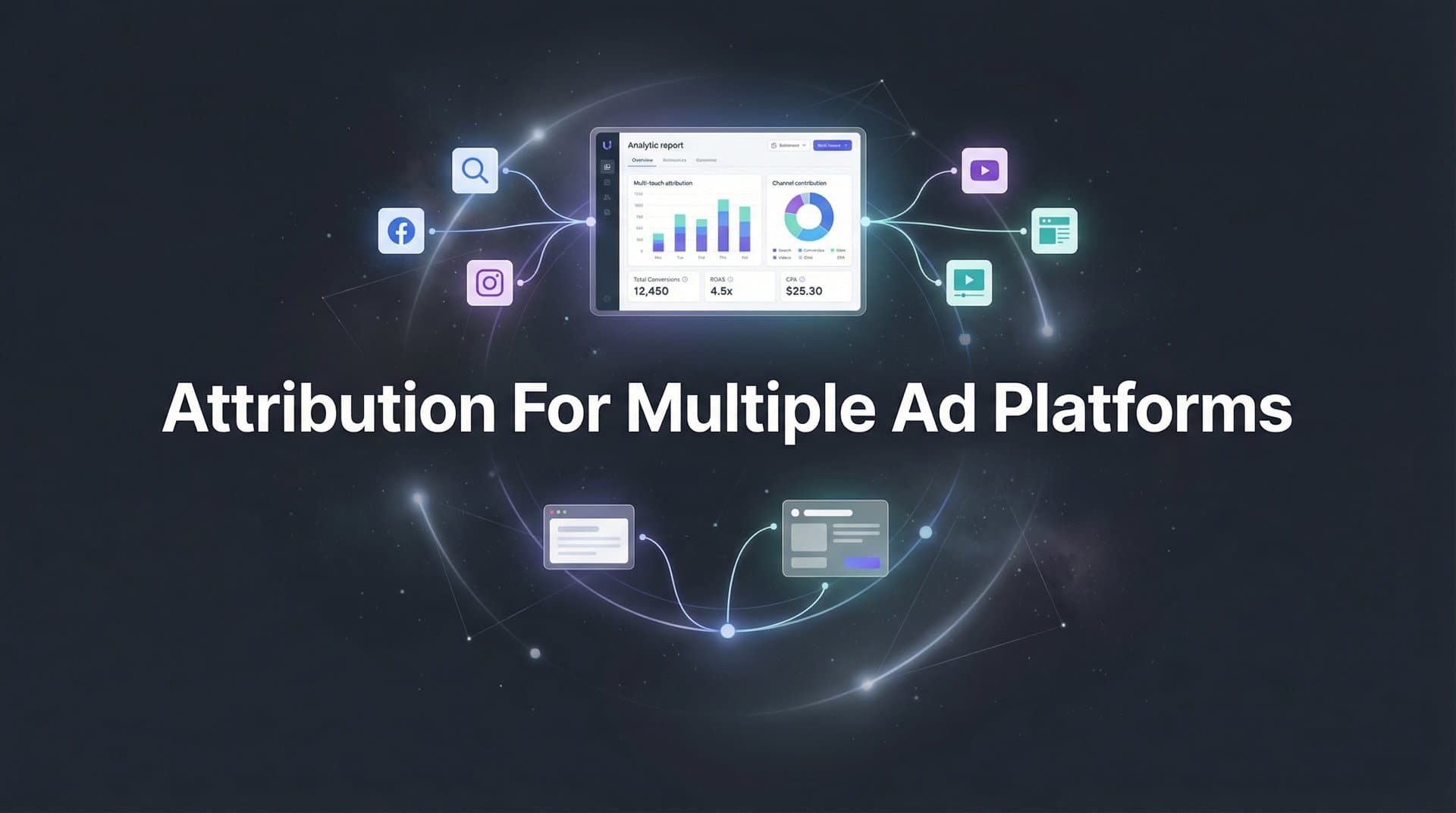
Running ads across Meta, Google, TikTok, and LinkedIn simultaneously creates a measurement nightmare. Each platform claims credit for the same conversions, making it impossible to know which channels actually drive revenue.
Cross-platform attribution tools solve this by unifying data from all your ad sources into a single view, tracking customer journeys across touchpoints, and revealing which campaigns deserve more budget. Here are the top attribution solutions for marketers managing multiple ad platforms, with options for every budget and team size.
1. Cometly
Best for: Marketers who need AI-powered optimization and server-side tracking accuracy across all platforms.
Cometly is an AI-powered marketing attribution platform that tracks the entire customer journey across ad platforms, CRM, and website in real time.
 9 Best Attribution Tools for Multiple Ad Platforms in 2026
Where This Tool Shines
Cometly stands out with server-side tracking that bypasses iOS limitations and cookie restrictions that plague pixel-based solutions. This means you get accurate attribution data even when browsers block traditional tracking methods.
The platform's AI doesn't just show you what happened. It actively recommends which campaigns to scale based on actual revenue performance, not vanity metrics. This turns attribution from a reporting exercise into an optimization engine.
Key Features
Server-Side Tracking: Captures conversion data directly from your server, eliminating iOS and cookie-blocking issues that cause data loss.
AI Campaign Recommendations: Identifies high-performing ads and campaigns across every channel with specific scaling suggestions.
Conversion Sync: Sends enriched conversion data back to Meta, Google, and other platforms to improve their algorithm targeting and optimization.
Multi-Touch Attribution: Compare first-touch, last-touch, linear, time-decay, and data-driven models side by side to understand the full customer journey.
Real-Time Analytics Dashboard: Monitor campaign performance across all platforms in a unified interface with instant data updates.
Best For
Growth-focused marketers and agencies managing significant ad budgets across multiple platforms who need both accurate attribution and actionable optimization recommendations. Particularly valuable for teams struggling with iOS tracking limitations or those wanting to feed better data back to ad platforms.
Pricing
Custom pricing based on ad spend volume. Demo available to explore features and discuss pricing tailored to your specific needs.
2. Triple Whale
Best for: Shopify stores running paid ads across multiple channels.
Triple Whale is an ecommerce-focused attribution platform built specifically for Shopify merchants managing cross-platform campaigns.
 7 Best Funnel.io Alternatives for Marketing Data Analytics in 2026
Where This Tool Shines
Triple Whale integrates natively with Shopify, making setup remarkably simple compared to general attribution tools. You can be tracking within minutes instead of weeks.
The platform excels at creative performance analysis, showing you which ad creatives drive purchases across different platforms. This helps ecommerce teams quickly identify winning assets and kill underperformers.
Key Features
Native Shopify Integration: One-click setup that automatically pulls order data and connects to your ad platforms.
Unified Dashboard: View performance from Meta, Google, TikTok, and other platforms in a single interface designed for ecommerce metrics.
First-Party Pixel: Proprietary tracking technology that improves data accuracy beyond standard platform pixels.
Creative Performance Analysis: Track which specific ad creatives drive revenue, not just clicks or impressions.
Customer Journey Visualization: See the complete path from first ad interaction to purchase across all touchpoints.
Best For
Shopify store owners and ecommerce marketers who prioritize ease of setup and want attribution tailored specifically to online retail metrics and workflows.
Pricing
Starts around $129 per month for basic plans, with pricing scaling based on store revenue and feature requirements.
3. Northbeam
Best for: Brands needing media mix modeling alongside traditional attribution.
Northbeam is an attribution platform that combines click-based tracking with media mix modeling for comprehensive marketing measurement.
 9 Best Attribution Tools for Multiple Ad Platforms in 2026
Where This Tool Shines
Northbeam bridges the gap between traditional attribution and statistical modeling. While most tools rely solely on tracking pixels, Northbeam adds media mix modeling to estimate the impact of channels that are hard to track directly.
This dual approach helps you understand both granular campaign performance and broader channel effectiveness, especially valuable for brands running upper-funnel campaigns where direct attribution breaks down.
Key Features
Machine Learning Attribution Models: Advanced algorithms that learn from your data patterns to assign credit more accurately than rules-based models.
Media Mix Modeling Integration: Statistical analysis that estimates channel impact even when direct tracking isn't possible.
Incrementality Testing: Built-in capabilities to run holdout tests and measure true incremental lift from campaigns.
Cross-Channel Budget Optimization: Recommendations for how to redistribute spend across platforms based on performance data.
Custom Attribution Windows: Flexible lookback periods that can be tailored to your specific sales cycle length.
Best For
Mid-market to enterprise brands spending $50,000 or more monthly on ads who need sophisticated modeling capabilities beyond basic multi-touch attribution.
Pricing
Custom pricing based on ad spend and data volume. Typically suited for brands with substantial advertising budgets.
4. Rockerbox
Best for: Enterprise marketers measuring both online and offline channels.
Rockerbox is an enterprise marketing attribution platform offering comprehensive measurement across digital and traditional advertising channels.
 9 Best Attribution Tools for Multiple Ad Platforms in 2026
Where This Tool Shines
Rockerbox handles attribution complexity that most tools can't touch. If you're running TV campaigns, direct mail, podcasts, or other offline channels alongside digital ads, Rockerbox connects all those touchpoints.
The platform's Journey IQ feature maps out complete customer paths across months and dozens of interactions, revealing patterns that simpler tools miss entirely.
Key Features
Offline Attribution: Track the impact of TV, radio, direct mail, and other traditional channels alongside digital campaigns.
Multi-Touch Attribution Models: Choose from standard models or build custom attribution logic specific to your business.
Journey IQ: Advanced path analysis showing common sequences of touchpoints that lead to conversion.
Budget Optimization Recommendations: Data-driven suggestions for reallocating spend across your full marketing mix.
Agency-Friendly Reporting: White-label capabilities and client-specific views for agencies managing multiple brands.
Best For
Enterprise brands and agencies running complex, multi-channel campaigns that span both digital and traditional media with significant overall marketing budgets.
Pricing
Enterprise pricing model based on company size and data requirements. Typically requires substantial ad spend to justify the investment.
5. Wicked Reports
Best for: Businesses with longer B2B sales cycles and subscription revenue models.
Wicked Reports is an attribution platform designed for companies with extended sales cycles, focusing on CRM integration and lifetime value tracking.
 7 Best Northbeam Alternatives for Small Business in 2026
Where This Tool Shines
Wicked Reports excels at tracking customer value over time, not just initial conversions. The platform connects marketing touchpoints to actual revenue, including upsells, renewals, and long-term customer value.
Deep CRM integrations mean you can attribute closed deals to specific ad campaigns from months earlier, solving the attribution challenge that plagues B2B marketers with 30, 60, or 90-day sales cycles.
Key Features
Deep CRM Integrations: Native connections with HubSpot, Salesforce, Keap, and other CRMs to track deals through the entire pipeline.
Cohort-Based LTV Attribution: Analyze customer lifetime value by acquisition source and cohort to understand long-term channel performance.
Email and Ad Platform Unification: Connect email marketing performance with paid advertising to see the complete nurture journey.
Subscription Revenue Tracking: Specialized reporting for SaaS and subscription businesses tracking MRR and churn by acquisition source.
Long-Window Attribution: Track attribution windows up to 365 days to accommodate extended B2B sales cycles.
Best For
B2B companies, SaaS businesses, and subscription-based brands with sales cycles longer than 30 days who need to connect marketing activities to closed revenue.
Pricing
Starts around $250 per month, with pricing scaling based on contact volume and feature requirements.
6. Ruler Analytics
Best for: Lead generation businesses connecting marketing to closed revenue.
Ruler Analytics is an attribution solution focused on lead-gen businesses, tracking marketing touchpoints through to closed deals and revenue.
 8 Best Attribution Tools with Onboarding Support in 2026
Where This Tool Shines
Ruler Analytics specializes in call tracking attribution, a critical capability for businesses where phone calls represent a significant conversion path. The platform attributes phone calls back to specific campaigns and keywords.
The tool bridges the gap between marketing activities and CRM revenue data, showing which campaigns generate leads that actually close, not just which ones generate the most form fills.
Key Features
Call Tracking with Attribution: Dynamic number insertion that tracks phone calls back to specific campaigns, keywords, and visitor sessions.
Form Submission Tracking: Capture form data along with the complete marketing journey that led to submission.
CRM Revenue Integration: Connect to your CRM to track which leads close and attribute revenue to marketing sources.
Multi-Touch Attribution Models: Compare different attribution approaches to understand channel contribution throughout the journey.
Marketing Source Reporting: Clear reporting on which campaigns, channels, and keywords drive qualified leads and revenue.
Best For
Lead generation businesses, local service providers, and B2B companies where phone calls represent a significant portion of conversions and revenue.
Pricing
Starts around $199 per month for small businesses, with pricing increasing based on call volume and features needed.
7. Segment
Best for: Technical teams building custom attribution with unified data infrastructure.
Segment is a customer data platform that enables custom attribution builds through unified data collection and intelligent routing.
 8 Best Attribution-Focused Platforms vs Segment: Which Approach Fits Your Marketing Stack in 2026
Where This Tool Shines
Segment isn't an attribution tool out of the box. It's the foundation you build attribution on. The platform collects data from every source once, then routes it to whatever analytics, attribution, or data warehouse tools you choose.
This approach gives you complete flexibility to build exactly the attribution system you need without being locked into a vendor's specific methodology or limitations.
Key Features
Unified Data Collection: Single implementation that captures user behavior across website, mobile app, server, and cloud tools.
300+ Integrations: Pre-built connections to marketing platforms, analytics tools, data warehouses, and attribution solutions.
Identity Resolution: Merge user activity across devices and sessions to build complete customer profiles.
Data Warehouse Integration: Send clean, structured data to Snowflake, BigQuery, or Redshift for custom attribution modeling.
Custom Attribution Support: Flexibility to route data to multiple attribution tools or build your own models in SQL.
Best For
Companies with technical resources who want complete control over their data infrastructure and attribution methodology, or teams using multiple analytics tools that need unified data collection.
Pricing
Free tier available for small implementations. Paid plans start around $120 per month and scale based on monthly tracked users and events.
8. AppsFlyer
Best for: Mobile app marketers tracking installs and in-app events.
AppsFlyer is a mobile attribution platform for tracking app installs and in-app conversions across advertising channels.
 9 Best Attribution Tools for Multiple Ad Platforms in 2026
Where This Tool Shines
AppsFlyer dominates mobile app attribution with deep integrations across mobile ad networks and sophisticated fraud detection. The platform handles the unique challenges of mobile attribution, including device ID limitations and app store attribution.
SKAdNetwork support for iOS means you can still measure campaign performance despite Apple's privacy restrictions, something many general attribution tools struggle with.
Key Features
Mobile App Install Attribution: Track which campaigns and networks drive app installations with device-level precision.
Deep Linking Capabilities: Route users to specific in-app content based on the ad they clicked, improving conversion rates.
Fraud Prevention: Sophisticated detection algorithms that identify and block install fraud, click injection, and other mobile-specific threats.
SKAdNetwork Support: Full integration with Apple's privacy-focused attribution framework for iOS campaigns.
Cross-Platform Mobile Measurement: Unified tracking across iOS and Android with consistent reporting and attribution logic.
Best For
Mobile app developers and marketers running user acquisition campaigns across mobile ad networks who need specialized mobile attribution capabilities.
Pricing
Free tier available for apps with limited monthly conversions. Paid plans based on volume of conversions tracked, with pricing customized to app size.
9. HubSpot Attribution
Best for: Existing HubSpot users connecting marketing activities to CRM revenue.
HubSpot Attribution is built-in attribution reporting for HubSpot Marketing Hub users, linking marketing efforts to closed revenue in the CRM.
Where This Tool Shines
HubSpot Attribution works seamlessly if you're already using HubSpot for marketing and CRM. No complex integrations, no data syncing issues, no additional vendor to manage.
The platform automatically connects email campaigns, landing pages, ads, and other marketing activities to contact records and deals, showing which efforts contribute to revenue without requiring technical setup.
Key Features
Native HubSpot CRM Integration: Automatic connection between marketing activities and deal revenue with zero configuration needed.
Multi-Touch Attribution Models: Choose from first-touch, last-touch, linear, time-decay, and other standard attribution approaches.
Revenue Attribution Reporting: See which campaigns, content, and channels contribute to closed deals and revenue.
Contact Journey Visualization: Visual timeline showing every marketing interaction a contact had before converting.
Ad Platform Integrations: Connect Google Ads, Facebook Ads, and LinkedIn Ads to track paid campaign performance alongside organic efforts.
Best For
Companies already using HubSpot Marketing Hub and CRM who want attribution capabilities without adding another platform to their tech stack.
Pricing
Included with HubSpot Marketing Hub Professional (starting at $800 per month) and Enterprise plans. Not available as a standalone product.
Making the Right Choice
The best attribution tool depends on your specific situation. Choose Cometly if you need AI-powered optimization recommendations and server-side tracking that works despite iOS limitations. The platform's ability to feed enriched data back to ad platforms gives your campaigns a competitive edge.
Go with Triple Whale if you run a Shopify store and want something that works out of the box. Pick Northbeam when you need media mix modeling alongside traditional attribution. Select Rockerbox for enterprise complexity spanning online and offline channels.
Use Wicked Reports if you have long B2B sales cycles and need to track lifetime value by acquisition source. Choose Ruler Analytics when call tracking is critical to your attribution. Consider Segment if you have technical resources and want complete control over your data infrastructure.
Pick AppsFlyer for mobile app attribution. Stick with HubSpot Attribution if you're already deep in the HubSpot ecosystem.
Most platforms offer demos or trials. Test two or three options with your actual data before committing. Look for tools that integrate with your existing tech stack, support your specific attribution model preferences, and match your team's technical capabilities.
Ready to elevate your marketing game with precision and confidence? Discover how Cometly's AI-driven recommendations can transform your ad strategy. Get your free demo today and start capturing every touchpoint to maximize your conversions.


