You're running digital ads. You're spending real budget across LinkedIn, Google, and Meta. Leads are coming in, your dashboards show clicks and conversions, and yet when the quarterly pipeline review rolls around, the numbers don't quite add up. Sound familiar?
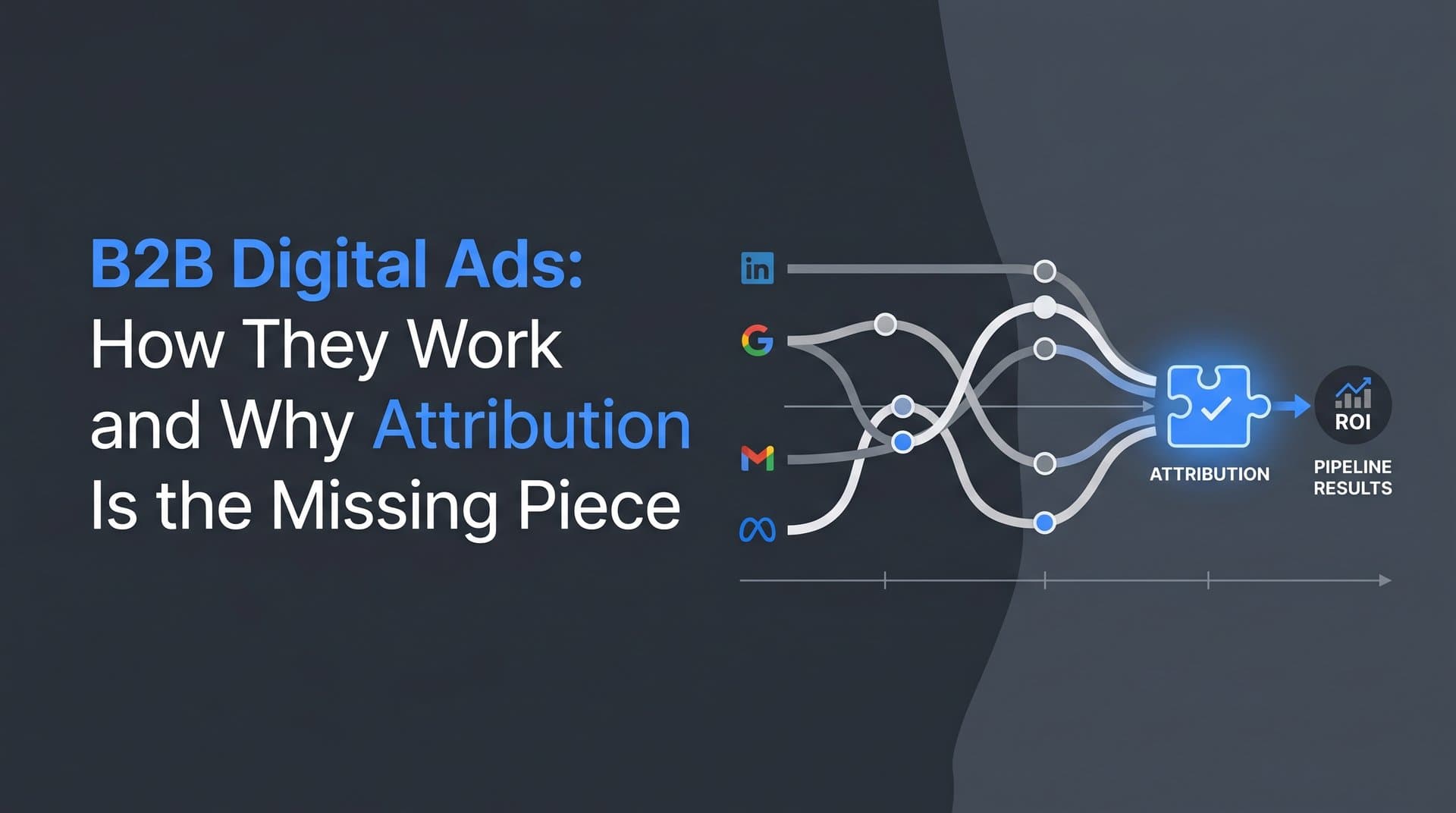
This is the central frustration for most B2B marketing teams. The problem isn't that digital ads don't work. It's that the standard tools used to measure them were built for a very different kind of buying journey. When someone clicks a Facebook ad and buys a product in the same session, attribution is simple. When a VP of Operations clicks a LinkedIn ad, downloads a whitepaper, attends a webinar three weeks later, gets retargeted on Google, and then finally books a demo after a colleague forwards them a case study, attribution becomes a serious analytical challenge.
B2B digital ads operate in a world of long cycles, multiple decision-makers, and dozens of touchpoints spread across weeks or months. That complexity changes everything: how you structure campaigns, which metrics you prioritize, and critically, how you measure whether your ad spend is actually generating revenue. This article breaks down how B2B digital ads work, what each major channel does best, and why attribution is the piece that ties it all together for high-performing marketing teams.
The B2B Buying Journey Makes Digital Ads Different
In B2C advertising, the path from awareness to purchase can be minutes long. A consumer sees an ad, feels the pull, and converts. The feedback loop is tight. B2B buying journeys don't work that way, and that single fact changes almost everything about how digital ads need to be structured and evaluated.
B2B purchases typically involve multiple stakeholders. A software deal might require sign-off from a marketing director, a VP of Sales, a CFO, and an IT lead. Each of these people may encounter your brand through different channels at different times. One finds you through a Google search. Another gets retargeted on LinkedIn. A third hears about you from a colleague who clicked your ad months ago. The deal closes, but which ad gets the credit?
This is not just a measurement problem. It shapes strategy. B2B digital ads are not primarily about driving immediate conversions. They are about generating qualified pipeline, building brand familiarity with buying committees, and staying present across a journey that can span weeks or months. A campaign that looks like it's underperforming based on click-through rates might actually be doing critical nurturing work that shows up in pipeline three months later.
The gap between a first ad interaction and closed-won revenue can involve a dozen or more touchpoints. When you rely on last-click attribution, which most ad platforms default to, you're essentially crediting the final interaction and ignoring everything that came before it. For B2B, that's not just inaccurate. It actively misleads budget decisions, causing teams to over-invest in bottom-of-funnel tactics and undervalue the awareness and nurture campaigns that created the opportunity in the first place.
Understanding this dynamic is the foundation of any serious B2B ad strategy. Once you accept that the buying journey is long and non-linear, you stop optimizing for the wrong signals and start building toward what actually matters: pipeline and revenue.
The Core B2B Digital Ad Channels and What Each One Does Best
Not all ad platforms serve the same purpose in a B2B strategy. Each has distinct strengths, audience characteristics, and funnel positions where it tends to perform best. Knowing how to deploy each one is what separates a coherent strategy from a scattered spend.
LinkedIn Ads: LinkedIn is the go-to platform for professional audience targeting in B2B. The ability to target by job title, seniority, company size, industry, and even specific companies makes it uniquely powerful for reaching decision-makers and buying committee members. If you're selling enterprise software to heads of finance at mid-market companies, LinkedIn lets you get remarkably close to that exact audience. The tradeoff is cost. LinkedIn's cost per click is generally higher than other platforms, which means the economics only work when your deal sizes are large enough to justify the investment. LinkedIn excels at top-of-funnel awareness, thought leadership content, and lead generation campaigns targeting specific professional personas.
Google Search Ads: Where LinkedIn creates demand, Google Search captures it. When a prospect types "best project management software for remote teams" into Google, they're already in problem-solving mode. That intent signal is enormously valuable for B2B advertisers, particularly for bottom-of-funnel campaigns targeting prospects who are actively evaluating solutions. Google Search Ads are effective at intercepting buyers at the moment they're ready to engage. The limitation is that search volume for highly specific B2B queries can be relatively low, and competitive keywords in enterprise software categories can carry high cost-per-click rates. Still, for capturing warm, high-intent traffic, Google Search remains one of the highest-value channels in a B2B stack.
Meta Ads (Facebook and Instagram): Meta might not be the first platform that comes to mind for B2B, but it plays a legitimate role in a well-rounded strategy. The platform's reach is enormous, and its audience targeting, especially when powered by strong first-party data, can be surprisingly effective for B2B brand awareness and retargeting. Meta works particularly well for keeping your brand visible to prospects who have already interacted with your website or content. Retargeting campaigns on Meta can reinforce messaging to warm audiences at a lower cost than LinkedIn. The key is pairing Meta's reach with clean audience data and realistic expectations about where in the funnel it's most useful.
A mature B2B ad strategy typically uses all three channels in concert, with LinkedIn building awareness among target personas, Google capturing active searchers, and Meta reinforcing brand presence through retargeting. The challenge is measuring how these channels interact across the full journey.
Key Metrics That Actually Matter in B2B Ad Campaigns
Metrics tell a story, but only if you're reading the right ones. B2B marketing teams often inherit dashboards full of impressions, clicks, and click-through rates. These numbers are not useless, but they are dangerously incomplete if they're the primary lens through which ad performance is evaluated.
Impressions tell you how many times your ad was shown. Clicks tell you how many people engaged. Neither tells you whether those people were qualified buyers, whether they moved further down the funnel, or whether any of them ever became customers. For B2B teams accountable to pipeline targets, these vanity metrics can create a false sense of progress.
The metrics that actually connect ad spend to business outcomes sit further down the funnel. Here's where to focus:
Cost Per Lead (CPL): CPL measures how much you're spending to acquire each lead. It's a foundational metric for comparing channel efficiency, but it needs context. A lead from LinkedIn might cost significantly more than a lead from Meta, but if LinkedIn leads convert to pipeline at a higher rate, the higher CPL may be entirely justified. CPL only becomes meaningful when paired with lead quality data.
Lead Quality Score: Not all leads are equal. A lead quality score, whether defined by ICP fit, company size, seniority, or engagement signals, helps you understand whether your ads are attracting the right buyers. High lead volume with low quality is a common B2B trap. Teams that track quality alongside quantity make smarter optimization decisions.
Conversion Rate: Tracking conversion rates at multiple stages, from click to lead, lead to qualified opportunity, and opportunity to closed deal, gives you a layered view of where your funnel is strong and where it's leaking. A high click-to-lead rate with a poor lead-to-opportunity rate often points to a targeting or messaging mismatch.
Pipeline Attribution: This is where B2B measurement gets serious. Pipeline attribution connects specific ad campaigns and channels to the opportunities they influenced. Instead of asking "how many leads did this campaign generate," you're asking "how much pipeline did this campaign touch or create." This requires connecting your ad data to your CRM, but it's the metric that finally makes ad spend legible to revenue-focused stakeholders.
Revenue Attribution: The ultimate measure. Revenue attribution closes the loop entirely, connecting ad spend directly to closed-won revenue. It answers the question every CFO and CMO wants answered: what is our true return on ad spend across each channel?
Why Standard Ad Platform Tracking Breaks Down for B2B
Here's where many B2B teams run into a wall. Even if you know which metrics matter, getting accurate data on those metrics is harder than it should be. The tracking infrastructure that most teams rely on was built for a different era, and it's increasingly unreliable for complex B2B buying journeys.
Most ad platforms track conversions using browser-based pixels. A pixel fires when a user lands on a thank-you page or completes a form, sending a signal back to the ad platform to record a conversion. This worked reasonably well when browsers were permissive and privacy norms were different. Today, it's a fragile system.
Browser privacy restrictions, ad blockers, and the ripple effects of iOS privacy changes have significantly reduced the reliability of pixel-based tracking. When a prospect blocks cookies or uses a privacy-focused browser, that conversion event may never reach the ad platform. The result is underreported conversions and ad algorithms that are optimizing on incomplete data, which degrades targeting quality over time.
Platform-reported conversions also suffer from a structural bias toward last-touch attribution. When Meta or Google reports a conversion, they're typically crediting the most recent interaction within their own platform. They have no visibility into what happened on other channels. A prospect who clicked a LinkedIn ad two months ago, visited your site multiple times through organic search, and then finally converted after clicking a Google ad will appear in Google's reporting as a Google-attributed conversion, with no credit given to the earlier touchpoints that built the relationship.
For B2B, this creates a particularly distorted picture. Because buying cycles are long and multi-touch, the channels that do the heavy lifting early in the journey, building awareness, establishing credibility, and nurturing consideration, are routinely undercredited by platform-native reporting. Teams that rely on these reports tend to cut upper-funnel spend and double down on bottom-of-funnel, which eventually starves the pipeline of new opportunities.
Then there's the offline conversion problem. A lead submits a form, gets entered into your CRM, goes through a qualification process, and becomes a sales opportunity weeks later. That CRM event, the one that actually signals real pipeline value, is often never connected back to the original ad that started the journey. Without a deliberate strategy to close that loop, you're measuring ad performance based on form fills rather than revenue outcomes.
How Multi-Touch Attribution Gives B2B Ads Their True ROI Picture
Multi-touch attribution is the framework that makes B2B ad measurement honest. Instead of assigning all credit to a single touchpoint, multi-touch models distribute credit across every interaction in the customer journey, giving a more accurate picture of how campaigns and channels are collectively contributing to pipeline and revenue.
There are several multi-touch models to choose from. Linear attribution gives equal credit to every touchpoint. Time-decay models give more credit to interactions closer to conversion. Position-based models weight the first and last touches more heavily while still crediting the middle. Data-driven attribution uses algorithmic analysis to assign credit based on actual conversion patterns. Each model has tradeoffs, and the right choice depends on your business and sales cycle. The important thing is moving away from single-touch models that were never designed for complex B2B journeys.
But multi-touch attribution is only as good as the data feeding it. This is where server-side tracking and Conversion API integrations become critical infrastructure. Rather than relying on a browser pixel that can be blocked or dropped, server-side tracking sends conversion events directly from your server to the ad platform. Meta's Conversion API and Google's Enhanced Conversions are the primary implementations of this approach. They bypass browser limitations entirely, dramatically improving the completeness and accuracy of the conversion signals your ad platforms receive.
Better data in means better algorithmic targeting out. When you send enriched, server-side conversion events back to Meta or Google, their machine learning models have more accurate signals to work with, which improves ad delivery, audience matching, and campaign optimization.
The final piece is connecting ad data to CRM and revenue data. When you can match an ad click to a contact record, trace that contact through pipeline stages, and ultimately see which campaigns influenced deals that closed, you've built true revenue attribution. This connection transforms B2B ad measurement from a reporting exercise into a strategic decision-making tool. You can calculate actual return on ad spend, not just platform-reported ROAS, and make confident budget decisions based on what's generating real revenue.
Building a Smarter B2B Ad Strategy with Better Data
Better attribution data doesn't just change how you measure. It changes how you operate. When you can see the full picture of how your ads are contributing to pipeline and revenue, every strategic decision gets sharper.
The first practical step is feeding enriched, first-party conversion data back to your ad platforms. When you use tools like Meta Conversion API and Google Enhanced Conversions to send server-side events, you're giving those platforms better signals about who your actual customers are. This improves algorithmic targeting over time, helping ad delivery focus on audiences that look more like your real buyers rather than just people who click. For B2B advertisers working with niche professional audiences, this signal quality improvement can meaningfully lift campaign performance.
The second step is building a unified view of your marketing data. When your ad platform data, CRM data, and website behavior data live in separate dashboards, you're constantly reconciling numbers that don't agree and making decisions based on partial information. A unified attribution platform aggregates all of these data sources into a single source of truth. Instead of asking "what does LinkedIn say" and "what does Salesforce say" and trying to manually connect the dots, you have one view that shows the complete customer journey from first ad click to closed revenue.
This is exactly what Cometly is built to do. As a marketing attribution and analytics platform designed specifically for B2B SaaS companies, Cometly connects your ad platforms, CRM, and website data to track every touchpoint in real time. It supports multi-touch attribution models, server-side conversion tracking, and Conversion API integrations, so you're capturing accurate data from the start. And with 70+ native integrations, it fits into the stack you're already using without requiring a major infrastructure overhaul.
The third step is putting AI to work on top of clean attribution data. When your data is accurate and complete, AI-driven insights become genuinely useful rather than misleading. Cometly's AI ads manager analyzes campaign performance across every channel, identifies which ads and audiences are driving the highest-quality pipeline, and surfaces recommendations for where to shift budget. Instead of relying on gut feel or platform-reported metrics, your team gets clear signals about what's working and what isn't.
Growth teams that operate with this level of data clarity can do something most B2B marketing teams can't: scale with confidence. They know which campaigns to double down on because they can see the revenue those campaigns are generating. They know which channels to pull back from because the pipeline data tells them the truth. That's the compounding advantage of building your B2B ad strategy on a foundation of accurate attribution.
Putting It All Together
B2B digital ads are one of the most powerful tools available to growth-focused marketing teams. LinkedIn, Google, and Meta each offer distinct capabilities that, when used together strategically, can build awareness, capture demand, and nurture prospects across a complex buying journey. The potential is real.
But potential only converts to revenue when you can measure what's actually working. The teams that scale their B2B ad programs are not necessarily the ones with the best creative or the most aggressive targeting. They're the ones who have solved the attribution problem. They know which campaigns are influencing pipeline, which channels are generating revenue, and which touchpoints in the journey matter most. That knowledge drives every budget decision, every optimization, and every strategic bet they make.
Standard ad platform tracking was not built for the B2B buying journey. Last-click attribution, browser-based pixels, and disconnected dashboards leave too much of the story untold. Multi-touch attribution, server-side tracking, and CRM-connected revenue data are what close that gap.
Cometly was built specifically to solve this challenge for B2B SaaS companies. It connects every ad touchpoint to pipeline and revenue in real time, giving your team the single source of truth needed to make confident, data-driven decisions. From capturing every touchpoint to feeding enriched conversion data back to your ad platforms, Cometly turns your attribution data into a competitive advantage.
If you're ready to stop guessing and start scaling based on what's actually driving revenue, Get your free demo today and see how Cometly transforms B2B ad measurement from a frustrating puzzle into a clear, actionable picture.