LinkedIn ads come with a reputation that divides B2B marketing teams. On one side, you have growth leaders who swear by the platform for reaching CFOs, VP-level buyers, and technical decision-makers that simply do not show up anywhere else. On the other side, you have marketers who look at the cost-per-click, compare it to every other paid channel, and wonder if they are paying a luxury premium for results they cannot fully measure.
Both perspectives have merit. LinkedIn is expensive. It is also, for many B2B SaaS companies, the most direct path to the people who actually approve software purchases. The tension between those two realities is exactly why so many teams either overspend without accountability or underspend and miss pipeline opportunities entirely.
The root of the problem is rarely the platform itself. It is a gap in understanding: how LinkedIn ads actually work, why they behave differently from search and social, and how to build the measurement infrastructure that connects ad spend to revenue. Without that foundation, LinkedIn feels like a black box. With it, it becomes one of the most powerful precision instruments in a B2B marketer's stack.
This article walks through everything you need to know to use LinkedIn ads effectively: the ad formats worth understanding, the targeting mechanics that make the platform unique, the measurement challenges that trip up even experienced teams, and how to connect your LinkedIn spend to actual pipeline and closed revenue.
What Makes LinkedIn a Different Kind of Paid Channel
Most digital advertising platforms build their targeting on behavioral signals. They infer who you are based on what you browse, what you buy, what you watch. The result is probabilistic targeting: a best guess at your identity based on observed patterns.
LinkedIn works differently. Its targeting is built on professional identity data that users actively maintain and update. Job title, seniority level, company size, industry, years of experience, skills, and educational background are all part of the targeting layer. This is not inferred data. It is self-reported, professionally motivated, and regularly refreshed because users have a direct incentive to keep their profiles accurate.
For B2B SaaS companies, this distinction matters enormously. When you are trying to reach a Director of Revenue Operations at a 500-person software company, behavioral targeting gives you an approximation. LinkedIn targeting gives you a direct path. That specificity is the core value proposition of the platform, and it is why LinkedIn commands a premium that most other paid channels cannot justify charging.
There is also a context effect worth considering. When someone opens LinkedIn, they are in a professional mindset. They are thinking about their career, their industry, their business challenges. That mental state changes how they receive advertising. A message about pipeline visibility or sales productivity lands differently on LinkedIn than it does on a platform where the same person is watching videos or catching up with friends. The relevance of the context amplifies the relevance of the message.
The cost-per-click reality is real and should not be dismissed. LinkedIn CPCs are consistently higher than most other paid social platforms. For teams optimizing on surface-level metrics like cost-per-click or cost-per-lead without tracking what happens downstream, LinkedIn often looks like a poor investment. But for B2B SaaS companies targeting mid-market and enterprise accounts where the average contract value is meaningful, the math shifts when you measure cost-per-opportunity and cost-per-closed deal instead. The question is never whether LinkedIn is expensive. The question is whether the revenue it generates justifies the spend, and answering that question requires proper attribution infrastructure.
LinkedIn Ad Formats and When Each One Earns Its Place
LinkedIn offers a range of ad formats, and choosing the right one depends on where your audience is in the buying journey and what action you want them to take. Using the wrong format at the wrong stage is one of the most common reasons LinkedIn campaigns underperform.
Sponsored Content: This is the workhorse of LinkedIn advertising. Single image ads, carousel ads, and video ads all run natively in the LinkedIn feed, blending with organic content in a way that does not feel disruptive. Sponsored Content is best suited for awareness and consideration stages: thought leadership pieces, product explainers, customer stories, and lead magnets. Because it appears in the feed, it benefits from social proof in the form of likes, comments, and shares, which can extend reach organically beyond the paid audience.
Message Ads and Conversation Ads: These formats deliver directly to a user's LinkedIn inbox, which means they command attention in a way that feed ads cannot. Message Ads are a single call-to-action message sent from a sender profile. Conversation Ads offer branching paths that let recipients choose their own next step. Both formats work well for high-intent moments: demo requests, event invitations, or direct outreach to specific roles within target accounts. LinkedIn limits how frequently the same user receives these messages, which helps maintain quality but also caps the scale you can achieve with this format alone.
Lead Gen Forms: This is one of LinkedIn's most practically valuable features for B2B demand generation. When a user clicks on an ad with a Lead Gen Form attached, LinkedIn pre-populates the form fields with data from their profile: name, email, job title, company, and more. The friction of manually filling out a form disappears, and completion rates reflect that improvement. For gated content downloads, webinar registrations, and demo requests, Lead Gen Forms consistently outperform external landing pages in raw form completion volume. The trade-off is that you are keeping the user within LinkedIn's ecosystem, which means less visibility into post-click behavior unless you have proper tracking in place.
Dynamic Ads and Text Ads: These are smaller-format options that appear in the sidebar or use personalization tokens to pull in the viewer's profile photo or name. They tend to work best as supplementary formats rather than primary campaign drivers, useful for retargeting or reinforcing brand presence to an audience already engaged with your main campaigns.
The practical approach is to use Sponsored Content as your primary format for building awareness and capturing leads, layer in Message or Conversation Ads for high-value accounts where direct outreach makes sense, and use Lead Gen Forms whenever your goal is form submissions rather than website visits.
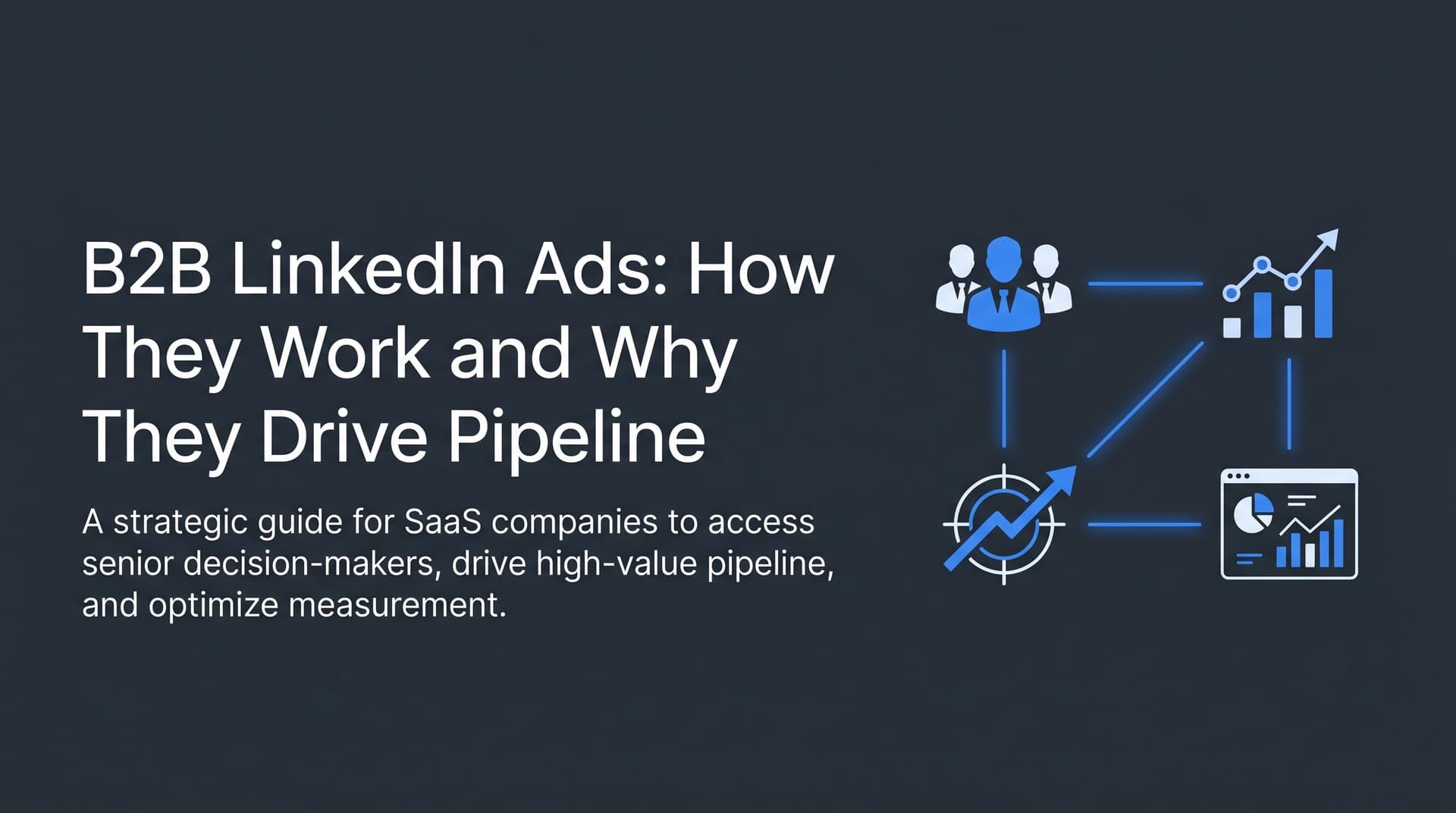
 B2B LinkedIn Ads: How They Work and Why They Drive Pipeline
Reaching the Entire Buying Committee, Not Just One Persona
B2B SaaS purchases are rarely made by a single person. By the time a deal closes, it has typically passed through a buying committee that includes the end user, a manager or director sponsor, a finance stakeholder, and sometimes IT or legal. Each of those roles has different questions, different objections, and different criteria for saying yes. LinkedIn's targeting architecture is one of the few places where you can systematically reach all of them within the same campaign structure.
The layered targeting approach is what makes this possible. You can combine company-level firmographics like industry, company size, and revenue range with individual-level attributes like job function, seniority, and specific job titles. This means you can run one campaign targeting VP-level Finance personas at companies with more than 200 employees in the SaaS vertical, and a separate campaign targeting individual contributors in Revenue Operations at the same company size. Each campaign speaks to a different member of the buying committee with messaging that matches their specific concerns.
Matched Audiences: This feature is central to account-based marketing on LinkedIn. You can upload a list of target company names or contact emails, and LinkedIn will match those records to user profiles. This allows your campaigns to focus exclusively on the accounts your sales team is actively pursuing, creating alignment between paid media and outbound prospecting. You can also retarget website visitors, which is useful for re-engaging prospects who have already shown interest but have not yet converted.
Lookalike Audiences: LinkedIn can build an audience of users who share characteristics with your existing customer list or highest-value leads. This is a useful tool for expanding reach while maintaining relevance. The caution here is that lookalike audiences require monitoring. As the audience broadens, there is a risk of audience dilution where your ads reach people who resemble your customers on paper but are not actually in a buying position. Watch your cost per qualified lead carefully when running lookalike campaigns, and be ready to tighten targeting if quality drops.
Audience Expansion: LinkedIn offers an automatic audience expansion option that broadens your targeting to reach users similar to your defined audience. This can help with reach when your initial audience is too small to deliver efficiently, but it should be used selectively. For ABM campaigns where precision is the entire point, audience expansion can undermine the strategy by serving ads outside your target account list. Understanding broader B2B SaaS marketing strategies can help you decide when to prioritize precision over scale.
The discipline in LinkedIn targeting is knowing when to narrow and when to expand. Tighter targeting costs more per impression but reaches higher-quality prospects. Broader targeting reduces CPCs but risks diluting the audience quality that makes LinkedIn worth the premium in the first place.
The Attribution Gap: Why LinkedIn Measurement Often Misleads
Here is where most LinkedIn programs run into trouble. The platform's native analytics are genuinely useful for measuring what happens on LinkedIn: impressions, clicks, engagement rates, and Lead Gen Form completions. What LinkedIn Campaign Manager cannot do is connect those touchpoints to what happens in your CRM three months later when a deal closes.
This gap is not unique to LinkedIn, but it is particularly acute for B2B marketers because of how long the sales cycle typically runs. A prospect might click on a LinkedIn Sponsored Content ad in January, attend a webinar in February, respond to a sales email in March, and sign a contract in April. LinkedIn's native reporting can see the January click. It has no visibility into the rest of the journey, and no ability to claim credit for the April close in a way that reflects its actual contribution.
View-through attribution compounds this problem. When LinkedIn counts a conversion because a user saw an ad and later converted somewhere else, it is making an attribution claim that may overlap with claims from Google Ads, your email platform, and your CRM. When every platform counts the same conversion, your total reported conversions can dramatically exceed your actual conversion volume. This is not fraud. It is a structural problem with single-platform attribution, and it makes it nearly impossible to make confident budget allocation decisions based on native platform data alone.
Browser-based tracking has also become less reliable. Cookie deprecation and browser privacy updates have reduced the accuracy of pixel-based conversion tracking across all platforms, including LinkedIn's Insight Tag. If you are relying solely on LinkedIn's pixel to measure conversions, you are likely undercounting. The gap between what LinkedIn reports and what actually happened has widened as privacy restrictions have tightened.
The practical consequence of all this is that many B2B teams either over-attribute to LinkedIn (because they count every claimed conversion at face value) or under-attribute to it (because they cannot see the downstream revenue it influenced). Neither position leads to good budget decisions. The solution is not to abandon LinkedIn measurement, but to build measurement infrastructure that sits outside any single platform's native analytics.
The Metrics That Actually Tell You If LinkedIn Is Working
If you are evaluating your LinkedIn campaigns based on click-through rate and cost-per-click, you are measuring the wrong things. Those metrics tell you about LinkedIn efficiency within the platform. They say almost nothing about whether LinkedIn is contributing to pipeline and revenue.
The metrics that matter for B2B LinkedIn programs are the ones that connect ad activity to business outcomes.
Cost Per Qualified Lead: Not every lead generated by a Lead Gen Form or a landing page visit is a qualified lead. Track the conversion rate from LinkedIn-generated lead to a lead that meets your ICP criteria, and calculate what you are actually paying for each qualified lead. This number will be higher than your raw cost-per-lead, but it is the one that reflects real value.
Cost Per Opportunity: When a LinkedIn-sourced lead progresses to a sales opportunity in your CRM, that is a meaningful signal. Track how many opportunities LinkedIn generates and divide your LinkedIn spend by that number. This metric bridges marketing activity and sales pipeline in a way that leadership can evaluate against other channels.
Cost Per Closed Deal: This is the ultimate metric for LinkedIn ROI. It requires connecting your LinkedIn campaign data to your CRM's closed-won records, which is where attribution software becomes essential. Without this connection, you are estimating LinkedIn's value rather than measuring it.
Lead-to-SQL Conversion Rate: The rate at which LinkedIn-generated leads become sales-qualified leads is a critical bridge metric. If LinkedIn generates a high volume of leads but they rarely convert to SQLs, that is a signal about audience quality, message fit, or both. Tracking this rate by campaign, audience segment, and ad format helps you optimize for quality rather than volume.
Engagement Rate on Sponsored Content: While this is a LinkedIn-native metric, it serves a useful diagnostic purpose. High engagement on a particular creative or message angle signals that it resonates with your target audience. Use it to identify which content themes to scale before investing heavily in a direction that may not connect. Teams that struggle to identify what is working often face the broader challenge of not being able to see which ads work across their entire paid media mix.
Closing the Loop: Connecting LinkedIn Spend to Revenue
The attribution gap described earlier is solvable, but it requires moving beyond native platform analytics. The infrastructure needed to connect LinkedIn ad spend to revenue has three components: multi-touch attribution modeling, reliable conversion event tracking, and integration between your ad data and your CRM.
Multi-touch attribution models are designed for exactly the kind of long, multi-channel sales cycles that characterize B2B SaaS. Instead of assigning all credit to the last click or the first touch, models like linear attribution, time-decay attribution, or data-driven attribution distribute credit across every touchpoint that contributed to a conversion. This gives LinkedIn credit for the awareness and consideration work it does earlier in the cycle, even when the final conversion happens through a different channel weeks or months later. A deeper look at B2B SaaS paid ads attribution can help you choose the right model for your sales cycle.
Server-side tracking is the recommended approach for maintaining conversion data accuracy as browser-based tracking becomes less reliable. Rather than depending on a pixel firing in the user's browser, server-side tracking sends conversion events directly from your server to LinkedIn's Conversion API. This approach is more resilient to ad blockers, browser privacy restrictions, and cookie limitations, and it produces more complete conversion data for LinkedIn's optimization algorithms to work with. For teams ready to implement this properly, a step-by-step guide to tracking LinkedIn ads conversions covers the full setup process.
The critical step that most teams skip is connecting LinkedIn's ad data to CRM pipeline and revenue data. This is where platforms like Cometly make a meaningful difference. Cometly connects your LinkedIn campaigns with your CRM and revenue data, creating a single source of truth that shows which campaigns, audience segments, and creatives are actually generating pipeline and closed revenue, not just clicks and form fills.
With that connection in place, you can answer the questions that actually drive budget decisions: Which LinkedIn audience segment produces the highest close rate? Which ad format generates opportunities that convert fastest through the sales cycle? Is LinkedIn contributing more or less to pipeline than your other paid channels when you account for the full sales cycle? These are not questions you can answer from Campaign Manager alone. They require attribution infrastructure that spans from the first LinkedIn impression to the closed-won record in your CRM.
Cometly also captures every touchpoint across the customer journey, giving your team a complete view of how LinkedIn interacts with your other channels. When a prospect clicks a LinkedIn ad, later searches for your brand on Google, and then converts through a direct visit, you can see the full path rather than letting each platform claim the conversion independently.
Putting It All Together
B2B LinkedIn ads are not a shortcut to cheap leads. They are a precision instrument for reaching professional decision-makers at a level of specificity that other platforms cannot match. The premium you pay for that precision is justified when you can measure what it produces, and unjustifiable when you cannot.
The shift that separates effective LinkedIn programs from expensive ones is moving from optimizing for LinkedIn-native metrics to optimizing for pipeline and revenue. That shift requires understanding the ad formats and targeting mechanics well enough to reach the right people with the right message, and it requires attribution infrastructure robust enough to connect those interactions to downstream business outcomes.
The attribution gap is real, but it is not permanent. With multi-touch attribution, server-side tracking, and a platform that connects your ad data to your CRM, LinkedIn stops feeling like a black box and starts functioning like the high-precision channel it is designed to be.
If your LinkedIn campaigns are generating activity but you cannot trace that activity to pipeline or revenue, the problem is not LinkedIn. It is the measurement layer sitting between your ads and your CRM. Fixing that layer is where the real ROI lives.
Ready to connect your LinkedIn ad spend to real revenue outcomes? Get your free demo and see how Cometly eliminates the attribution gap so you can optimize every campaign with confidence.