Picture this: you're sitting in front of three dashboards, Meta on one tab, Google on another, TikTok on a third. Each platform is reporting conversions. Each one is claiming credit for sales. But when you add it all up and compare it to your actual revenue in your CRM, the numbers don't come close to matching. You've spent thousands of dollars this month, and you genuinely have no idea which campaigns are working.
If that scenario sounds familiar, you're not alone. The inability to track which ads drive sales is one of the most common and costly problems in digital advertising today. It's not a sign that you're doing something wrong. It's a sign that the tracking landscape has fundamentally broken down, and most marketers are still using playbooks that no longer work.
The causes run deeper than a misconfigured pixel or a missing UTM parameter. We're talking about platform-level conflicts, privacy-driven data loss, and attribution models that were never designed to give you an honest picture of cross-channel performance. Each of these problems compounds the others, and together they create a situation where marketing decisions get made on bad data, often without anyone realizing it.
The good news is that this is a solvable problem. Understanding why it happens is the first step. From there, the path forward involves better tracking infrastructure, smarter attribution, and a unified view of your entire customer journey. Let's break it all down.
Why Your Ad Platforms Are Giving You Conflicting Numbers
Here's something the ad platforms don't advertise: every platform is built to claim as much credit as possible for your conversions. Meta, Google, and TikTok each have their own attribution models, their own lookback windows, and their own definition of what counts as a conversion. And none of them are designed to coordinate with each other.
Take a common scenario. A customer sees your ad on TikTok on Monday, clicks a Google search ad on Wednesday, and then converts after seeing a Meta retargeting ad on Friday. Depending on each platform's default attribution settings, all three platforms may report that conversion as their own. You end up with three platforms each claiming one sale, when in reality only one sale happened.
This is called attribution overlap, and it's endemic to the way ad platforms operate. Meta defaults to a 7-day click and 1-day view attribution window. Google Ads uses different default windows depending on campaign type. TikTok has its own settings. These windows are wide enough that a single customer journey will often fall within the lookback period of multiple platforms simultaneously.
The deeper issue is that platform-reported data is structurally biased. Each platform is a for-profit business with an incentive to demonstrate its own value to advertisers. The reporting interface is designed to show you how well that platform performed, not to give you an honest cross-channel picture of your marketing mix. This is why many marketers struggle with ads showing conversions but no actual sales in their CRM. It's not a conspiracy. It's just how the incentives are aligned, and it means you should never rely on platform-reported conversions as your source of truth.
Most marketers discover this gap only after scaling their spend. When budgets are small, the discrepancy between platform-reported conversions and actual CRM revenue feels like a rounding error. But as you scale, the gap widens. You might see 200 conversions reported across your platforms in a month and find only 140 actual sales in your CRM. That 30% discrepancy doesn't just affect your reporting. It affects every budget decision, every creative test, and every audience you choose to scale.
The fix starts with recognizing that platform dashboards are not your source of truth. They're one input among many, and they need to be cross-referenced against real revenue data before you make any meaningful decisions. Learning to track sales back to ads accurately is the essential first step toward solving this problem.
The Privacy and Tracking Changes That Broke the Old Playbook
Even if ad platforms reported conversions perfectly, there's a second problem: they're receiving less data than they used to. The privacy landscape has shifted dramatically, and the traditional browser-based pixel that most marketers rely on is no longer capturing the full picture.
The turning point that most marketers remember is Apple's iOS App Tracking Transparency framework, which rolled out in 2021. It required apps to explicitly ask users for permission to track them across other apps and websites. Opt-in rates were low. The result was that Meta and other platforms lost a significant portion of the behavioral data they had previously used to match conversions to ad exposures. Understanding tracking paid ads after the iOS update became critical for marketers who wanted to maintain performance visibility.
That was just the beginning. Safari and Firefox have blocked third-party cookies by default for years. Chrome has been moving in the same direction. Ad blockers are increasingly common, particularly among tech-savvy audiences who often represent high-value customers. Browser privacy features continue to evolve in ways that reduce the data flowing back to ad platforms.
What this means practically is that a browser-based pixel, the kind you install with a snippet of JavaScript on your website, is now missing a meaningful portion of the conversions that actually happen. When a user has an ad blocker, when they're browsing in a privacy-focused browser, or when they've declined tracking permissions, the pixel fires either don't reach the platform or arrive without the identifying information needed to match them to an ad exposure.
This is why server-side tracking for ads has become an industry best practice rather than a nice-to-have. Instead of relying on the browser to send conversion data to ad platforms, server-side tracking sends that data directly from your server to the platform's API, such as Meta's Conversions API or Google's enhanced conversions. This approach bypasses ad blockers and browser restrictions entirely, recovering signal that would otherwise be lost.
Without first-party data strategies and server-side infrastructure, marketers are feeding incomplete conversion data into their optimization algorithms. And when the algorithm is optimizing toward an incomplete signal, it's not just your reporting that suffers. Your actual campaign performance degrades because the machine learning models are learning from bad inputs.
The Real Cost of Making Decisions With Bad Data
Let's get specific about what actually happens when you can't track which ads drive sales. It's not just an analytics inconvenience. It's a business problem with compounding financial consequences.
The most immediate risk is scaling campaigns that look good on paper but don't actually generate revenue. If a campaign is reporting a strong return on ad spend based on platform-attributed conversions, but those conversions aren't showing up as real revenue in your CRM, you might increase its budget confidently. You're essentially pouring more money into a black hole while believing you're investing in a winner. Figuring out which ads are actually working requires looking beyond platform dashboards.
The inverse is equally damaging. Campaigns that genuinely drive revenue but don't get credited by the platform's attribution model look underperforming. You cut them to reallocate budget toward the apparent winners. Over time, your spend shifts away from what's actually working toward what's merely claiming credit. This dynamic is subtle and slow-moving, which makes it especially dangerous. By the time the revenue impact becomes undeniable, you've often made months of compounding budget decisions based on flawed signals.
There's also a human cost. When marketing teams can't reconcile their platform data with actual revenue, trust in the data erodes entirely. Marketers start making gut-based decisions because the data feels unreliable. Leadership defaults to last-click attribution because it's simple and available in Google Analytics, even though last-click ignores every touchpoint except the final one before conversion. The customer journey gets compressed into a single interaction, and the channels that build awareness and consideration get systematically defunded.
This is how teams end up over-investing in bottom-of-funnel tactics and underinvesting in the channels that actually create demand. The problem isn't that last-click attribution is evil. It's that it's a distorted lens, and making major budget decisions through a distorted lens leads to distorted outcomes. Understanding which marketing channel drives revenue requires a more complete view of the customer journey.
Fixing this requires more than better reporting. It requires a fundamentally different approach to how you collect, unify, and interpret your marketing data.
Multi-Touch Attribution: Seeing the Full Customer Journey
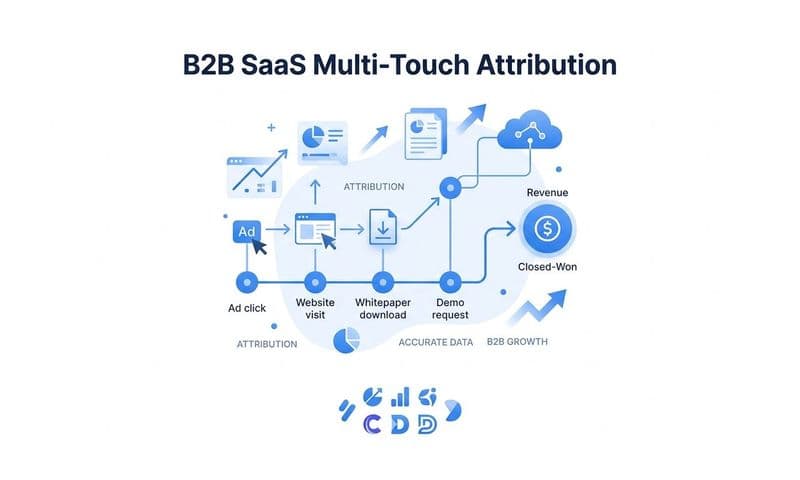
If last-click attribution is like judging a relay race by only watching the final runner cross the finish line, multi-touch attribution is like watching the entire race. It assigns credit across every interaction a customer has with your brand before converting, giving you a far more accurate picture of which channels and campaigns are actually contributing to revenue.
Understanding the different models helps you choose the right lens for your business. Each one distributes credit differently across the touchpoints in a customer journey.
Linear attribution gives equal credit to every touchpoint in the journey. If a customer touched five ads before converting, each one receives 20% of the credit. This is useful when you believe every interaction played an equal role in the decision.
Time-decay attribution gives more credit to touchpoints that happened closer to the conversion. The logic is that recent interactions had more influence on the final decision. This model tends to favor bottom-of-funnel and retargeting campaigns.
Position-based attribution (sometimes called U-shaped) gives the most credit to the first and last touchpoints, with the remaining credit distributed across the middle. This approach recognizes the importance of the initial discovery and the final conversion trigger, while still acknowledging the touchpoints in between.
No single model is universally correct. The right choice depends on your sales cycle, your business model, and what questions you're trying to answer. A company with a long, complex B2B sales cycle might weight earlier touchpoints more heavily because brand awareness and education are critical to the journey. Businesses in this space benefit from specialized tracking for B2B marketing campaigns that account for longer decision timelines.
The real power of multi-touch attribution comes when you connect ad platform data with CRM events and actual revenue outcomes. This is where the picture becomes genuinely useful. Instead of asking "which ad got the last click before a form fill?", you're asking "which specific ads, audiences, and creatives are associated with customers who actually paid and retained?" That's a fundamentally different question, and it leads to fundamentally different decisions.
Connecting these data sources requires infrastructure. You need your ad platforms, your website tracking, and your CRM all feeding into a single system that can stitch together the customer journey across every touchpoint. The ability to track leads to revenue is what separates actionable attribution from theoretical attribution.
How to Build a Tracking System That Actually Works
Building a tracking system that gives you reliable, actionable data in today's privacy-first environment requires three interconnected components: solid data collection at the source, enriched data flowing back to the platforms, and a centralized place to analyze it all.
Start with server-side tracking. This is the foundation. If your conversion data is still flowing exclusively through browser-based pixels, you're working with an incomplete dataset. Understanding what server-side tracking for ads entails is essential for any modern marketer. Implementing it means your server sends conversion events directly to ad platform APIs, bypassing the ad blockers, browser restrictions, and consent limitations that degrade pixel data. This doesn't replace your pixel entirely. Rather, it works alongside it to ensure that conversions are captured regardless of the user's browser environment. The result is a more complete and accurate signal feeding your attribution system.
Sync enriched conversion data back to your ad platforms. This step is often overlooked, but it's critical for campaign performance, not just reporting. When you send enriched conversion events back to Meta, Google, and other platforms, you're giving their machine learning algorithms better data to optimize against. Instead of optimizing toward pixel fires that may not represent real revenue, the algorithm learns to find more users who resemble your actual paying customers. This creates a feedback loop where better data leads to better targeting, which leads to better results. Platforms like Meta's Conversions API and Google's enhanced conversions are designed specifically for this purpose.
Use a centralized attribution platform to unify everything. Even with great server-side tracking and conversion syncing in place, you still need a place to bring it all together. A unified attribution platform connects your ad channels, your CRM, and your website data into a single source of truth. Investing in the right tracking software for paid ads is what makes this possible at scale. This is where you can actually see the full customer journey, compare attribution models side by side, and understand which campaigns are driving real revenue rather than just platform-reported conversions.
Cometly is built exactly for this. It connects your ad platforms, CRM, and website to track the entire customer journey in real time. With server-side tracking built in, conversion sync to feed better data back to Meta and Google, and a comprehensive analytics dashboard, Cometly gives you the unified view that makes accurate attribution possible. Instead of toggling between disconnected dashboards and trying to reconcile conflicting numbers, you get a single, accurate picture of what's actually driving revenue.
From Guessing to Scaling: What Accurate Attribution Looks Like in Practice
Once your tracking infrastructure is solid and your attribution model reflects the full customer journey, something shifts. Marketing decisions stop feeling like guesses and start feeling like informed bets. The difference in day-to-day operations is significant.
With accurate attribution in place, you can confidently identify your top-performing campaigns across every channel and reallocate budget toward what's actually driving revenue. This sounds obvious, but it's genuinely difficult without the right data. Most teams are making budget decisions based on platform-reported metrics that they know are inflated and inconsistent. When you have a unified view tied to real revenue outcomes, reallocation becomes straightforward. You move money from campaigns that look good but don't convert to campaigns that are demonstrably producing paying customers. The ability to track sales from paid ads with precision is what makes confident scaling possible.
AI-powered recommendations take this further. Instead of spending hours manually digging through campaign data to find optimization opportunities, AI can surface them automatically. This includes identifying winning ad variations that are outperforming others within the same campaign, flagging underperforming audiences that are consuming budget without generating revenue, and recommending budget shifts based on real-time performance signals. Cometly's AI-powered features are designed to do exactly this, giving marketers and agencies the kind of analysis that would otherwise require a dedicated data analyst.
For agencies managing multiple client accounts, this is especially valuable. The ability to see accurate, cross-channel attribution for every client in one place, and to back up recommendations with data that connects to actual revenue, changes the nature of client conversations. Brands running campaigns across platforms like Facebook and Google benefit enormously from unified tracking for Facebook and Google ads rather than siloed platform dashboards.
Companies and agencies that have invested in proper attribution infrastructure report being able to cut wasted spend on campaigns that were claiming credit without generating revenue, while scaling the campaigns that were genuinely driving growth. The key in every case is feeding better data back into the system, both for human decision-making and for the ad platform algorithms that are constantly optimizing on your behalf.
Putting It All Together
If you can't track which ads drive sales, you're not dealing with a minor reporting inconvenience. You're dealing with a fundamental business problem that affects every budget decision, every creative test, and every scaling choice you make. The money you spend on advertising is only as productive as the data guiding where it goes.
The path forward is clear, even if the implementation takes some work. Fix your data foundation with server-side tracking so you're capturing conversions that browser-based pixels miss. Adopt multi-touch attribution so you can see the full customer journey instead of just the last click. And use a unified platform to connect every touchpoint to actual revenue, giving you and your team a single source of truth that you can actually trust.
This is exactly what Cometly is built to do. It captures every touchpoint from ad clicks to CRM events, connects them to real revenue outcomes, feeds enriched conversion data back to Meta and Google to improve algorithm performance, and gives you AI-powered recommendations to scale your best campaigns with confidence. Whether you're a marketing team managing your own spend or an agency running campaigns for multiple clients, Cometly gives you the accurate, unified data you need to stop guessing and start growing.
Ready to elevate your marketing game with precision and confidence? Discover how Cometly's AI-driven recommendations can transform your ad strategy. Get your free demo today and start capturing every touchpoint to maximize your conversions.