You're running ten different campaigns across Meta, Google, TikTok, and email. Your dashboard shows 200 conversions this month. Revenue is up. Everything looks great—until you try to figure out which campaigns actually drove those sales.
Meta says it generated 150 conversions. Google claims 120. Your email platform reports 80. That's 350 conversions for 200 actual sales. The math doesn't work, your budget decisions are based on guesswork, and you're left wondering: which channels are actually worth scaling?
This is the attribution problem every modern marketer faces. Attribution in marketing meaning goes far beyond tracking clicks—it's the systematic process of identifying which touchpoints in your customer's journey actually contribute to conversions and revenue. Understanding attribution isn't just useful; it's the difference between confidently scaling what works and accidentally pouring budget into channels that don't convert.
In this guide, you'll learn exactly what attribution means in practical terms, why traditional tracking methods fall short in 2026, and how to implement attribution frameworks that connect your marketing spend to real business outcomes. By the end, you'll know how to make smarter budget decisions based on which channels actually drive revenue—not just which platforms claim credit.
The Simple Definition Behind a Complex Problem
Attribution in marketing is the process of identifying which touchpoints—ads, emails, social posts, content pieces, or any other marketing interaction—contribute to a conversion or sale. Think of it as detective work: when someone becomes a customer, attribution helps you trace their steps backward to understand what influenced their decision.
Here's why this matters more than ever: modern customers don't see one ad and buy. They interact with brands across multiple channels, devices, and time periods before making a purchase decision. Research consistently shows that B2C buyers typically engage with brands 7-12 times before converting, while B2B buyers often require 20+ touchpoints across weeks or months.
Picture a customer who sees your Instagram ad on Monday, clicks a Google search result on Wednesday, reads your blog post on Friday, and finally converts after clicking an email on Sunday. Which channel deserves credit for that sale? Without attribution, you're guessing. With attribution, you can see the full journey and understand each channel's role.
The core question attribution answers is deceptively simple: "Where should I spend my next marketing dollar?" But answering it requires understanding which channels are actually driving results versus which ones just happen to be present in the customer journey.
Without proper attribution, marketers make decisions based on incomplete data. You might cut budget from a channel that's actually introducing customers to your brand because it doesn't get credit for final conversions. Or you might overspend on retargeting because it gets credit for conversions that were already going to happen.
Attribution transforms marketing from an art into a science. Instead of relying on intuition about what's working, you can see exactly which combinations of channels and touchpoints lead to revenue. This visibility becomes your competitive advantage—you can confidently scale what works and cut what doesn't, while competitors are still guessing based on surface-level metrics. For a deeper exploration of this concept, see our guide on attribution meaning in marketing.
How Attribution Models Assign Credit Differently
Attribution models are the frameworks that determine how credit gets distributed across touchpoints in a customer journey. Different models assign credit in dramatically different ways, leading to completely different conclusions about what's working.
First-Touch Attribution: This model gives 100% credit to the first touchpoint a customer interacted with. If someone saw your Facebook ad first, then clicked three other channels before buying, Facebook gets all the credit. This model is useful for understanding what introduces people to your brand, but it completely ignores everything that happened afterward. It tends to favor awareness channels like social media and content marketing.
Last-Touch Attribution: The opposite approach—100% credit goes to the final touchpoint before conversion. If that customer's last interaction was clicking an email, the email gets all the credit. This is the default model in most ad platforms (which is why they all over-report). It's useful for understanding what closes deals, but it ignores the entire journey that got customers to that point. It heavily favors retargeting and bottom-funnel channels.
Both single-touch models are simple to understand and implement, but they're often misleading because they ignore the reality that multiple touchpoints work together to drive conversions.
Linear Attribution: This multi-touch model distributes credit equally across all touchpoints. If a customer interacted with five channels before converting, each gets 20% credit. It's more complete than single-touch models, but it assumes every touchpoint has equal importance—which usually isn't true. The awareness ad someone scrolled past isn't as influential as the product demo they watched. Learn more about how linear model marketing attribution works in practice.
Time-Decay Attribution: This model gives more credit to touchpoints closer to the conversion. The logic is that recent interactions have more influence on the decision. A touchpoint from yesterday gets more credit than one from last month. This works well for longer sales cycles where recent engagement matters most, but it can undervalue the channels that first introduced customers to your brand.
Position-Based Attribution: Also called U-shaped attribution, this model gives 40% credit to the first touchpoint, 40% to the last touchpoint, and distributes the remaining 20% among middle touchpoints. It recognizes that both introducing someone to your brand and closing the sale are important, while still acknowledging that middle touchpoints play a role. This is often a practical middle ground for companies with moderate sales cycles.
Data-Driven Attribution: This approach uses machine learning to analyze your actual conversion patterns and determine which touchpoints have the most impact. Instead of using a predetermined rule, it looks at thousands of customer journeys to identify which combinations of channels and sequences lead to conversions. If customers who see Channel A followed by Channel B convert at 3x the rate of other paths, the model recognizes that and assigns credit accordingly. Our article on how machine learning can be used in marketing attribution explores this approach in depth.
Data-driven attribution is the most sophisticated approach, but it requires significant conversion volume to work effectively—typically hundreds of conversions per month minimum. For smaller businesses, position-based or time-decay models often provide better insights than trying to use data-driven attribution with insufficient data. For a comprehensive overview, check out our guide on types of marketing attribution models.
Why Traditional Tracking Falls Short in 2026
The attribution methods that worked five years ago are increasingly unreliable today. Privacy changes, platform limitations, and evolving user behavior have created significant blind spots in traditional tracking approaches.
The biggest disruption came from Apple's iOS privacy updates, starting with iOS 14.5 in 2021 and continuing through subsequent releases. When users opt out of tracking—which the majority do—browser-based tracking methods lose visibility into their activity. That Facebook ad they clicked? The tracking pixel might not fire. That email they opened? The conversion tracking might not connect it to the eventual purchase.
The result is a growing gap between what actually happened and what your tracking systems can see. Many marketers have watched their reported conversion numbers drop 20-40% not because performance declined, but because the tracking systems can no longer see the conversions that are still happening. Understanding these attribution challenges in marketing analytics is essential for modern marketers.
Cookie deprecation compounds the problem. Third-party cookies—the technology that allowed marketers to track users across different websites—are being phased out across major browsers. Chrome, which represents over 60% of web traffic, has delayed full deprecation but is moving toward privacy-focused alternatives. When users browse in privacy mode or use cookie-blocking extensions, traditional tracking methods go dark.
Platform-reported conversions have always had inherent bias, but privacy changes have made the problem worse. Each ad platform wants to prove its value, so their attribution windows and methodologies are designed to maximize the credit they receive. When multiple platforms use overlapping attribution windows, they all claim credit for the same conversions.
This creates the scenario where Meta reports 150 conversions, Google reports 120, and you only had 200 actual sales. Each platform is technically correct based on its own attribution rules, but the combined picture is meaningless for making budget decisions.
The disconnect becomes even more problematic when you're trying to scale. If you increase budget on a channel that's over-reporting its impact, you'll see diminishing returns. If you cut budget from a channel that's under-reporting because it gets credit for assists rather than final conversions, you might accidentally damage your entire funnel. Our guide on fixing common marketing attribution challenges offers practical solutions.
Cross-device tracking adds another layer of complexity. A customer might see your ad on their phone during their commute, research on their laptop during lunch, and purchase on their tablet that evening. Traditional cookie-based tracking sees these as three different people, not one customer journey. Without proper identity resolution, you're missing the connections between touchpoints.
The gap between platform data and actual business outcomes has never been wider. Marketers need attribution systems that work independently of platform reporting, connect touchpoints across devices and sessions, and ultimately tie marketing activity to real revenue—not just conversions that platforms claim credit for.
Connecting Attribution to Real Business Outcomes
Attribution becomes truly powerful when it connects marketing activity to actual revenue in your business systems—not just conversions that ad platforms report. This shift from tracking conversions to tracking revenue reveals which channels drive profitable growth, not just activity.
Most marketers stop at conversion tracking: someone filled out a form, made a purchase, or booked a demo. But conversion tracking doesn't tell you if that lead became a customer, how much they spent, or whether they were profitable. A channel might generate lots of conversions that never close, while another generates fewer conversions that turn into high-value customers.
Connecting attribution to your CRM or revenue system closes this gap. When you can see that Channel A generates leads that convert to customers at 15% with an average deal size of $5,000, while Channel B converts at 8% with $2,000 deals, you have completely different insights than just knowing Channel B generated more leads. This is the foundation of effective marketing revenue attribution.
This revenue-connected view changes everything about how you allocate budget. You stop optimizing for the cheapest cost per lead and start optimizing for the highest revenue per dollar spent. You might discover that a channel with a higher upfront cost per lead actually delivers better customers who spend more and stay longer.
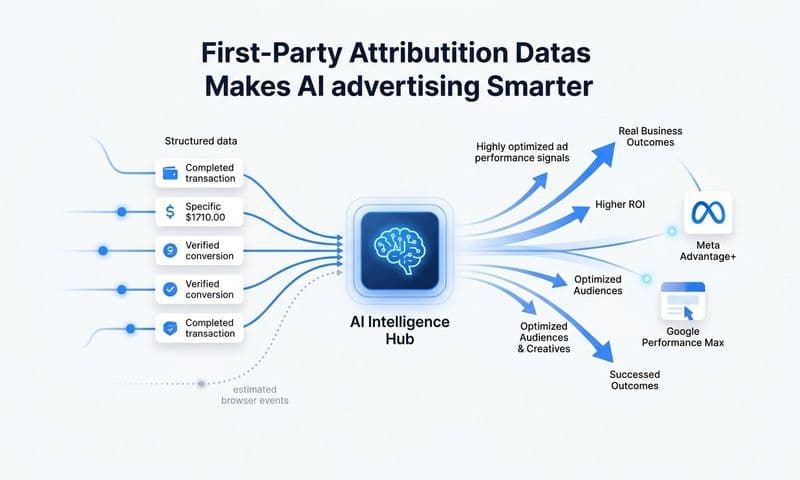
Server-side tracking has emerged as the most reliable method for capturing complete attribution data in 2026. Unlike browser-based tracking that depends on cookies and can be blocked by privacy settings, server-side tracking captures events on your server before sending them to analytics and ad platforms.
When someone converts on your website, server-side tracking logs that conversion along with all the marketing touchpoint data associated with that user. This data lives in your system, independent of what any individual platform can see. You maintain a complete record of the customer journey even when browser-based tracking fails.
Server-side tracking also enables you to send enriched conversion data back to ad platforms. When someone becomes a customer three weeks after clicking an ad, you can send that revenue data back to Meta or Google with the full context of the sale. This improves the platform's optimization algorithms while giving you accurate attribution in your own system.
The key is building attribution around your source of truth—your actual business data. Whether that's Stripe for e-commerce, Salesforce for B2B sales, or another system where revenue is recorded, that's what your attribution should connect to. Platform-reported conversions become supplementary data points, not the foundation of your decision-making. Explore how channel attribution in digital marketing revenue tracking can transform your approach.
This approach requires more sophisticated tracking infrastructure than just installing platform pixels, but the payoff is dramatic. You move from wondering which channels work to knowing exactly which channels drive profitable revenue. You can scale with confidence because your attribution data reflects actual business outcomes, not platform-biased reporting.
Putting Attribution Into Practice: A Framework
Understanding attribution theory is one thing—implementing it effectively is another. Here's a practical framework for building attribution into your marketing operations, regardless of your current sophistication level.
Step 1: Define Your Meaningful Conversion Events
Start by identifying what actions actually matter to your business. For e-commerce, this is straightforward: purchases drive revenue. But for most businesses, the path is more complex. You might care about demo bookings, qualified leads, trial signups, or specific product purchases that indicate higher lifetime value.
Prioritize events that have clear business value. A newsletter signup might be interesting, but if it doesn't correlate with revenue, optimizing for it won't help your business grow. Focus on events that represent meaningful progress toward becoming a customer.
Assign value to each conversion event if possible. If you know that 20% of demo bookings turn into $10,000 customers, you can assign a $2,000 expected value to each demo. This lets you compare the value generated by different channels, even when they drive different types of conversions.
Step 2: Ensure Complete Touchpoint Tracking
Audit your current tracking to identify gaps. Can you see every channel a customer interacted with before converting? Do you capture touchpoints across devices and sessions? Does your tracking connect marketing activity to revenue in your CRM or commerce system? Our guide on attribution marketing tracking provides a comprehensive walkthrough.
Implement tracking that captures the full customer journey. This means going beyond just ad platform pixels to include email interactions, organic social engagement, content consumption, and any other touchpoints in your marketing ecosystem. The goal is creating a complete timeline of how customers discover and engage with your brand.
Connect your marketing data to your revenue source. Whether through native integrations, APIs, or attribution platforms, ensure that when someone becomes a customer, that revenue data connects back to their marketing touchpoint history. This is where attribution transforms from tracking activity to measuring business impact.
Step 3: Analyze, Optimize, and Scale with Confidence
Once you have attribution data flowing, the real work begins: using it to make better decisions. Start by comparing channel performance using your chosen attribution model. Which channels are driving the most revenue? Which have the best return on ad spend? Which are assisting conversions that other channels close?
Look for patterns in high-converting customer journeys. Do customers who see certain channel combinations convert at higher rates? Are there sequences that consistently lead to larger deal sizes? These patterns reveal opportunities to optimize your channel mix and messaging strategy. Understanding cross channel attribution marketing ROI helps you identify these valuable patterns.
Test budget reallocation based on attribution insights. If a channel is driving strong revenue attribution but receiving minimal budget, increase investment and monitor results. If a channel gets lots of last-touch credit but rarely appears in customer journeys otherwise, it might be getting credit for conversions that would have happened anyway.
Use attribution data to inform creative and targeting decisions, not just budget allocation. If certain ad creative or audience segments appear more frequently in high-value customer journeys, double down on those approaches. Attribution reveals what works at a granular level, enabling optimization beyond just channel-level decisions.
The framework isn't about achieving perfect attribution—that's impossible given privacy constraints and the complexity of modern customer journeys. It's about building progressively better visibility into what drives revenue so you can make more confident decisions than your competitors who are still guessing based on platform-reported conversions.
Making Attribution Work for Your Business
Understanding attribution in marketing meaning is foundational to making smarter, data-driven decisions in 2026 and beyond. As customer journeys become more complex and privacy changes make traditional tracking less reliable, having clear visibility into what actually drives revenue becomes your competitive advantage.
The goal isn't perfect attribution—that's unrealistic given the constraints of modern tracking. The goal is better attribution than guessing based on incomplete platform data or gut instinct. When you can see which channels work together to drive conversions, which touchpoints matter most in your specific customer journeys, and which marketing dollars connect to actual revenue, you make better decisions.
Start by auditing your current tracking setup. Are you seeing the complete customer journey, or just fragments from individual platforms? Is your attribution connecting to actual revenue, or stopping at surface-level conversions? Do you have the infrastructure to capture data that browser-based tracking misses?
The marketers who win in the coming years will be those who build attribution systems independent of platform reporting, connect marketing activity to business outcomes, and use those insights to confidently scale what works. The technology and frameworks exist—the question is whether you'll implement them before your competitors do.
Ready to elevate your marketing game with precision and confidence? Discover how Cometly captures every touchpoint in your customer journey, connects marketing spend to actual revenue, and provides AI-driven recommendations to optimize your campaigns across every channel. Get your free demo today and start making attribution work for your business.