

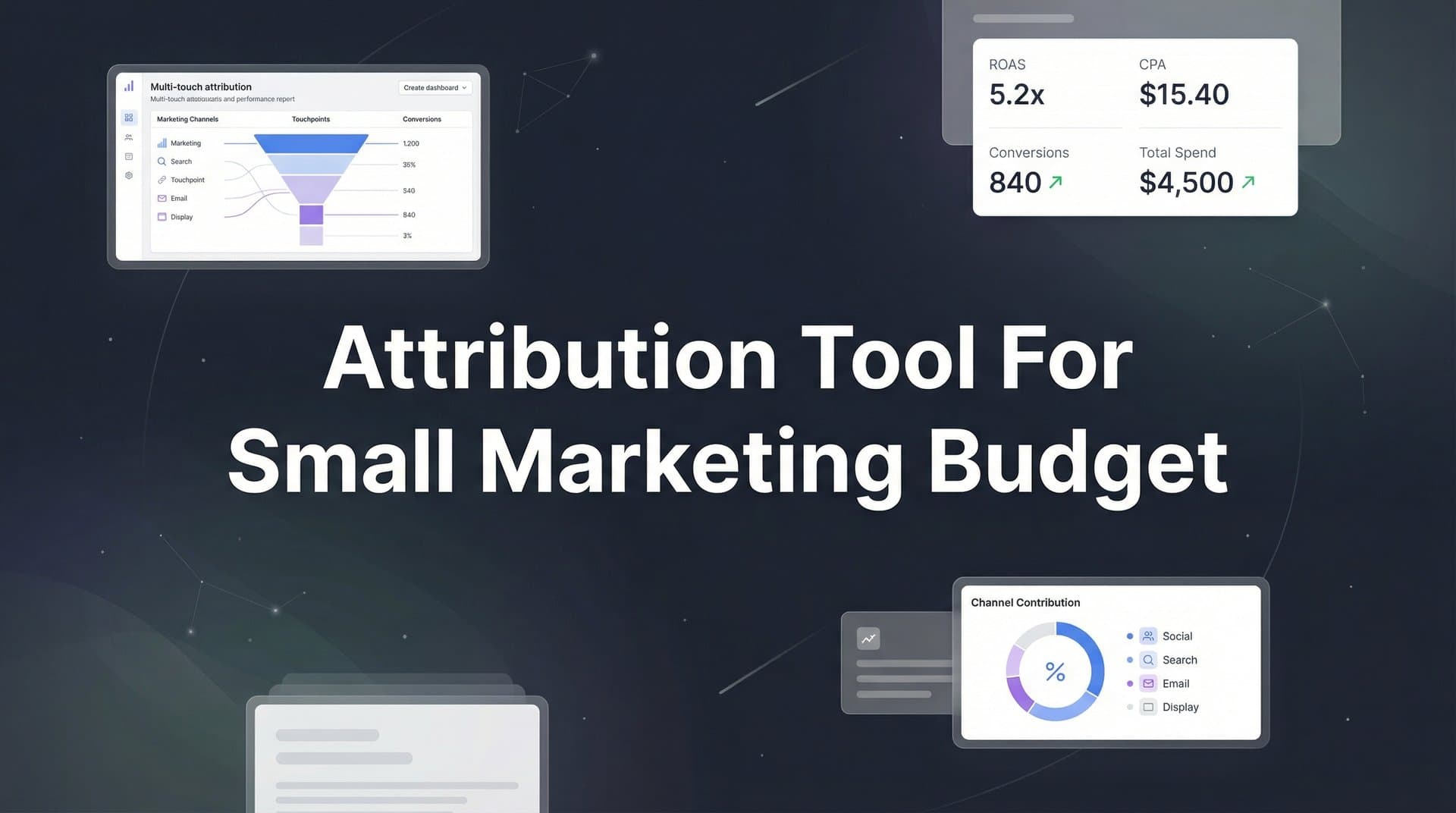
When every marketing dollar counts, knowing which ads actually drive revenue becomes critical. Small marketing budgets cannot afford to waste spend on channels that look good on paper but fail to convert. Attribution tools solve this by connecting your ad clicks to actual sales, showing you where to double down and where to cut.
But many attribution platforms come with enterprise price tags that make them unrealistic for lean teams. This guide covers top attribution tools that deliver accurate tracking without draining your budget. We evaluated each based on pricing transparency, ease of setup, integration options, and value for teams spending under $50K monthly on ads.
1. Cometly
Best for: Teams wanting AI-powered attribution with accurate cross-platform tracking and optimization recommendations.
Cometly is a marketing attribution platform that tracks the complete customer journey from ad click to revenue using server-side tracking and AI-powered insights.
 9 Best Attribution Tools for Small Marketing Budgets in 2026
Where This Tool Shines
Cometly addresses the core challenge small budgets face: making confident decisions with limited data. The platform's AI analyzes your attribution data to surface specific recommendations about which campaigns to scale and which to pause.
The server-side tracking architecture delivers more accurate data than pixel-based solutions, especially for iOS traffic where browser tracking faces significant limitations. This means you see the real impact of your Facebook and TikTok ads, not just what Apple allows browsers to report.
Key Features
Multi-Touch Attribution: Track every touchpoint across all marketing channels to understand the complete customer journey before conversion.
AI Ads Manager: Get specific recommendations on which ads and campaigns to scale based on actual revenue performance, not vanity metrics.
Server-Side Tracking: Capture accurate conversion data that bypasses browser limitations and ad blockers for reliable attribution.
Conversion Sync: Send enriched conversion data back to Meta, Google, and other ad platforms to improve their algorithm optimization.
Real-Time Analytics Dashboard: Monitor campaign performance and attribution data as it happens, enabling quick budget adjustments.
Best For
Digital marketers and agencies running multi-channel campaigns who need accurate attribution without the complexity of enterprise platforms. Particularly valuable for teams struggling with iOS tracking accuracy or wanting to move beyond last-click attribution without hiring a data analyst.
Pricing
Tiered pricing based on tracked revenue with accessible entry points for smaller budgets. The pricing structure scales with your business, making it feasible for teams just starting to invest in proper attribution.
2. Google Analytics 4
Best for: Budget-conscious teams wanting free attribution modeling with deep Google Ads integration.
Google Analytics 4 is a free analytics platform with built-in attribution modeling, data-driven attribution, and comprehensive tracking across devices and platforms.
 9 Best Attribution Tools for Small Marketing Budgets in 2026
Where This Tool Shines
GA4's biggest advantage is obvious: it costs nothing. For small budgets testing attribution for the first time, this removes the financial barrier entirely. You get legitimate multi-touch attribution models without writing a check.
The data-driven attribution model uses machine learning to assign credit across touchpoints based on actual conversion patterns in your data. For Google Ads users, the integration is seamless and provides attribution insights directly in your ad platform.
Key Features
Data-Driven Attribution: Machine learning model that analyzes your actual conversion paths to assign credit across marketing touchpoints.
Cross-Device Tracking: Follow users across devices when they're signed into Google accounts for more complete journey visibility.
Google Ads Integration: See attribution data directly in Google Ads and use it to optimize bidding and targeting.
Customizable Conversion Paths: Build custom reports showing the specific channel combinations that lead to conversions.
Free Tier: Full attribution features available at no cost for most small to mid-sized businesses.
Best For
Teams just starting with attribution or those running primarily Google Ads campaigns. The free tier makes it ideal for bootstrapped startups and small businesses testing whether attribution insights justify investing in specialized tools.
For a deeper dive, see our guide to AI Facebook ad image generator.
Pricing
Completely free for standard features. GA4 360 exists for enterprise needs but isn't relevant for small budget teams.
3. TripleWhale
Best for: Shopify store owners needing ecommerce-specific attribution with creative performance analytics.
TripleWhale is an attribution platform built specifically for Shopify stores, offering first-party pixel tracking and detailed creative analytics for ecommerce brands.
 7 Best Funnel.io Alternatives for Marketing Data Analytics in 2026
Where This Tool Shines
TripleWhale understands ecommerce attribution differently than generic analytics tools. The platform tracks product-level performance, showing which specific items drive the most attributed revenue from each marketing channel.
The creative analytics feature breaks down performance by individual ad creatives, helping you identify winning images and videos faster. For small budgets running multiple creative variations, this insight prevents wasted spend on underperforming assets.
We compare the leading options in our AI ad image generator roundup.
Key Features
First-Party Pixel Tracking: Deploy TripleWhale's own tracking pixel to capture conversion data that survives iOS privacy restrictions.
Creative Analytics: See which specific ad images, videos, and copy variations drive the most revenue and ROAS.
Shopify-Native Integration: Connect directly to Shopify with one click for automatic product and revenue syncing.
Cohort Analysis: Track customer lifetime value by acquisition cohort to understand long-term channel performance.
Post-Purchase Surveys: Ask customers how they found you to validate attribution data with self-reported information.
Best For
Shopify store owners running paid social campaigns who need better creative insights and more accurate iOS attribution than native platform reporting provides. Particularly useful for stores testing multiple product lines across different channels.
Pricing
Starts around $100 monthly and scales with ad spend. Transparent pricing tiers make it accessible for smaller Shopify stores.
4. Northbeam
Best for: Ecommerce brands wanting machine learning attribution with custom attribution windows.
Northbeam is a machine learning attribution platform designed for ecommerce brands, offering flexible attribution models and incrementality testing capabilities.
 9 Best Attribution Tools for Small Marketing Budgets in 2026
Where This Tool Shines
Northbeam's machine learning approach adjusts attribution based on your specific customer journey patterns. Instead of forcing you into preset models like "linear" or "time decay," it learns what actually drives conversions for your business.
The custom attribution windows let you define how long after an ad click you'll credit that touchpoint. For products with longer consideration periods, this flexibility ensures you don't under-credit awareness campaigns that planted the seed weeks before purchase.
Key Features
Machine Learning Attribution: Algorithms that learn your specific conversion patterns to assign credit more accurately than rule-based models.
Custom Attribution Windows: Set different lookback windows by channel to match actual customer behavior for your products.
Media Mix Modeling: Understand the interaction effects between different marketing channels and how they work together.
Cross-Channel Reporting: Unified dashboard showing attributed performance across all paid and organic channels in one view.
Incrementality Testing: Run experiments to measure the true incremental impact of your marketing spend.
Best For
Mid-market ecommerce brands that have outgrown basic attribution but aren't ready for full enterprise platforms. Works well for brands with complex customer journeys involving multiple touchpoints over extended timeframes.
Pricing
Custom pricing based on business size and needs, but typically accessible for brands spending $20K+ monthly on ads.
5. Rockerbox
Best for: Teams needing omnichannel attribution that includes offline marketing measurement.
Rockerbox is an omnichannel attribution platform that measures both online and offline marketing channels with self-serve options for smaller teams.
 9 Best Attribution Tools for Small Marketing Budgets in 2026
Where This Tool Shines
Rockerbox stands out by tracking offline channels that most attribution tools ignore. If you run direct mail, podcast ads, or TV campaigns alongside digital, Rockerbox connects those efforts to online conversions.
For a deeper dive, see our guide to AI ad generator for TikTok ads.
The self-serve platform option makes it accessible for teams without dedicated analytics staff. You can set up attribution models, build reports, and analyze performance without waiting for a customer success manager to configure everything.
Key Features
Omnichannel Attribution: Track performance across digital ads, email, organic social, offline media, and more in a unified system.
Offline Marketing Tracking: Connect direct mail, TV, radio, and podcast campaigns to online conversion events.
Self-Serve Platform: Configure attribution models and build custom reports without requiring technical implementation support.
Brand and Performance Measurement: Measure both direct response campaigns and upper-funnel brand awareness efforts.
Customer Journey Visualization: See the complete path from first touch to conversion with visual journey mapping.
Best For
Brands running a mix of online and offline marketing who need a complete attribution picture. The self-serve tier works for smaller teams wanting control without enterprise complexity or pricing.
Pricing
Self-serve tier available for smaller teams; enterprise pricing for full features including offline tracking and advanced modeling.
6. Wicked Reports
Best for: Businesses with longer sales cycles needing deep CRM integration and LTV attribution.
Wicked Reports is an attribution platform designed for longer sales cycles, offering cohort-based revenue reporting and lifetime value attribution.
 7 Best Northbeam Alternatives for Small Business in 2026
Where This Tool Shines
Wicked Reports excels at attribution for businesses where the sale happens days or weeks after the initial ad click. The platform tracks leads through your entire funnel, connecting marketing touches to closed revenue in your CRM.
The cohort-based reporting shows how different acquisition sources perform over time. You can see that customers from Facebook ads might convert faster but Instagram leads deliver higher lifetime value, informing smarter budget allocation.
Key Features
Long Sales Cycle Attribution: Track marketing touches through extended nurture sequences to eventual closed revenue.
CRM Integration: Sync with HubSpot, Salesforce, and other CRMs to connect marketing attribution to actual deal values.
Cohort-Based Reporting: Analyze customer lifetime value and retention by acquisition source and time period.
LTV Attribution: Assign credit to marketing touches based on total customer lifetime value, not just initial purchase.
Email Attribution: Track email marketing performance and its role in multi-touch conversion paths.
Best For
B2B companies, high-ticket ecommerce, and service businesses with sales cycles longer than a few days. Particularly valuable when you need to justify marketing spend based on closed revenue rather than leads or initial purchases.
Pricing
Starts around $250 monthly, with pricing scaling based on revenue tracked and features needed.
7. Ruler Analytics
Best for: Lead generation businesses needing call tracking integration and revenue attribution.
Ruler Analytics is a lead generation focused attribution tool with call tracking capabilities, connecting marketing sources to closed revenue.
 8 Best Attribution Tools with Onboarding Support in 2026
Where This Tool Shines
Ruler Analytics solves a critical gap for businesses where phone calls drive revenue. The platform tracks which marketing sources generate calls, then follows those leads through your CRM to closed deals.
The form submission tracking captures every lead source automatically, eliminating manual tagging or hidden field complexity. You see exactly which campaigns drive form fills and calls, then which of those leads actually become customers.
Key Features
Call Tracking Integration: Dynamic number insertion tracks which marketing sources generate phone calls with full conversation recording.
Form Submission Tracking: Automatically capture the marketing source for every form submission without manual UTM parameter management.
Revenue Attribution: Connect leads back to closed revenue in your CRM to see true marketing ROI.
Multi-Touch Models: Choose from first-click, last-click, linear, and custom attribution models based on your business needs.
CRM Sync: Integrate with major CRMs to track leads from initial touch through closed revenue.
Best For
Service businesses, agencies, and B2B companies where phone calls represent a significant conversion path. Essential for industries like legal, home services, healthcare, and financial services where calls matter more than online checkouts.
Pricing
Starts around $200 monthly, with pricing based on call volume and features required.
8. Segment
Best for: Technical teams wanting to build custom attribution solutions with flexible data infrastructure.
Segment is a customer data platform with attribution capabilities, ideal for teams wanting to build their own attribution logic on top of reliable event tracking.
Where This Tool Shines
Segment provides the data infrastructure layer that attribution requires. Instead of being a complete attribution solution, it gives you clean, reliable event tracking that you can analyze however you want.
The 300+ integrations mean you can send your tracking data to analytics tools, data warehouses, marketing platforms, and CRMs simultaneously. This flexibility lets you start simple and add sophisticated attribution analysis as your needs grow.
Key Features
Customer Data Platform: Centralized system for collecting and routing customer interaction data across all touchpoints.
Event Tracking Infrastructure: Reliable tracking of user actions across web, mobile, and server-side sources.
300+ Integrations: Send your data to analytics platforms, warehouses, marketing tools, and attribution solutions.
Identity Resolution: Unify user behavior across devices and sessions to build complete customer profiles.
Free Tier: Start tracking up to 1,000 visitors monthly at no cost to test the platform.
Best For
Technical teams with development resources who want to own their attribution logic rather than rely on black-box algorithms. Works well for companies planning to build custom dashboards or feed data into their own data warehouse for analysis.
Pricing
Free tier for up to 1,000 visitors monthly. Team plan starts at $120 monthly and scales with visitor volume.
9. HubSpot Attribution Reporting
Best for: Existing HubSpot users wanting built-in attribution without adding another platform.
HubSpot Attribution Reporting provides multi-touch attribution within the HubSpot Marketing Hub, offering revenue attribution for teams already using the HubSpot ecosystem.
Where This Tool Shines
HubSpot's attribution reporting delivers value through integration depth rather than advanced features. Everything lives in one platform: your CRM, marketing automation, attribution reporting, and revenue tracking.
The contact journey reporting shows every interaction a lead had with your marketing before becoming a customer. You see email opens, ad clicks, content downloads, and website visits in one timeline, making it easy to understand what drove conversion.
Key Features
Multi-Touch Attribution Models: Choose from first-touch, last-touch, linear, time-decay, and custom attribution models.
Revenue Attribution: Connect marketing touches to actual deal values in HubSpot CRM for true ROI measurement.
Contact Journey Reporting: See the complete timeline of marketing interactions for every contact in your database.
Campaign Analytics: Track performance across campaigns with attribution-based metrics instead of just clicks and impressions.
Native CRM Integration: Zero integration work required since attribution and CRM data live in the same platform.
Best For
Companies already using HubSpot Marketing Hub who want attribution insights without managing another tool. The all-in-one approach makes sense for teams that value simplicity and consolidated reporting over best-of-breed specialized tools.
Pricing
Attribution reporting is included in Marketing Hub Professional at $800 monthly and Marketing Hub Enterprise. Not available in the free or Starter tiers.
Making the Right Choice
The right attribution tool depends on your specific setup and priorities. Cometly delivers comprehensive attribution with AI-powered optimization recommendations, making it ideal for teams wanting accurate cross-platform tracking with actionable insights. The server-side tracking and conversion sync features address the iOS accuracy challenges that plague many attribution solutions.
For teams just starting with attribution or running primarily Google campaigns, GA4 provides legitimate multi-touch modeling at zero cost. TripleWhale serves Shopify stores specifically, with creative analytics and product-level attribution that generic tools miss. Wicked Reports excels for longer sales cycles where you need to track leads through extended nurture sequences to closed revenue.
Consider your primary conversion path when choosing. If phone calls drive revenue, Ruler Analytics' call tracking integration becomes essential. If you're already in the HubSpot ecosystem, their built-in attribution eliminates the need for another platform. Technical teams wanting maximum flexibility should explore Segment's infrastructure approach.
The common thread across budget-friendly attribution tools is transparency. The platforms that serve small budgets well publish pricing, offer free trials, and provide clear value without requiring sales calls or custom quotes. They understand that lean teams need to evaluate ROI before committing, not after signing annual contracts.
Start with clear goals for what you want attribution to tell you. Are you trying to optimize ad creative? Understand channel mix? Track long-term customer value? Your specific question determines which tool's strengths matter most. The best attribution investment is one that answers your actual business questions, not the one with the most features you'll never use.
Ready to elevate your marketing game with precision and confidence? Discover how Cometly's AI-driven recommendations can transform your ad strategy. Get your free demo today and start capturing every touchpoint to maximize your conversions.


