

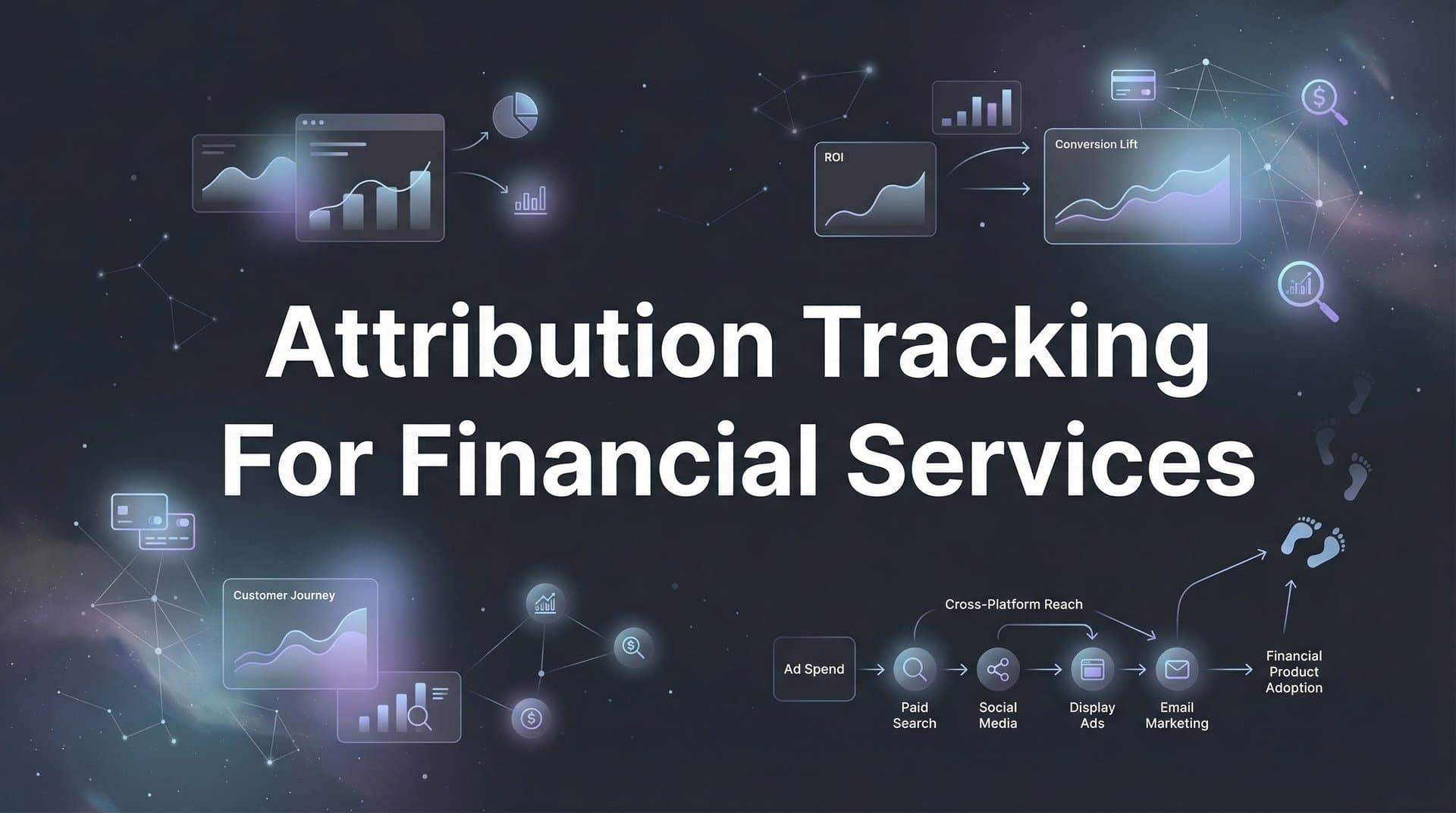
Your financial services firm just closed a $500,000 wealth management client. Fantastic news. But here's the question your CFO will ask: which marketing channel actually brought them in? Was it the LinkedIn ad they clicked three months ago? The webinar they attended six weeks back? The Google search that led them to your thought leadership article? Or the retargeting campaign that kept your brand top-of-mind while they evaluated competitors?
For most financial services marketers, this question has no clear answer. You're running campaigns across multiple platforms, nurturing prospects through lengthy sales cycles, and navigating strict compliance requirements—all while trying to prove that your marketing budget actually drives revenue.
Attribution tracking solves this problem by connecting every marketing touchpoint to actual business outcomes. It shows you which channels, campaigns, and content pieces contribute to conversions, even when customer journeys span months and involve dozens of interactions. For financial services marketers who need to justify budgets and scale what works, attribution tracking transforms guesswork into data-driven decision-making.
The Unique Attribution Challenge in Financial Services Marketing
Financial services marketing operates in a different universe than e-commerce or SaaS. When someone buys a pair of shoes online, the journey might last fifteen minutes. When someone selects a wealth manager or commits to a commercial loan, the decision process can stretch across three to twelve months.
This extended timeline creates a fundamental problem for traditional attribution models. Last-click attribution—which gives all credit to the final touchpoint before conversion—completely ignores the educational content, thought leadership, and brand-building efforts that brought the prospect into your ecosystem in the first place. That LinkedIn ad from four months ago? The white paper download that started the relationship? They get zero credit, even though they were essential to the conversion.
The complexity multiplies when you factor in B2B financial decisions. A commercial lending deal might involve a CFO who first discovered your firm through a search ad, a CEO who attended your webinar, and a board member who saw your content on LinkedIn. These stakeholders research independently, share information internally, and collectively move toward a decision. Your attribution system needs to capture all these interactions across different devices and platforms through cross-platform attribution tracking.
Then there's compliance. Financial institutions operate under GDPR, CCPA, and industry-specific regulations that govern how customer data can be collected, stored, and used. Generic marketing attribution tools often lack the data handling capabilities required for financial services. You need systems that maintain compliance while still capturing the granular data necessary for accurate attribution.
Privacy restrictions have made this even harder. iOS tracking limitations and the decline of third-party cookies mean that browser-based tracking pixels—the foundation of traditional attribution—increasingly fail to capture the full customer journey. A prospect might research your services on their iPhone, attend a webinar on their work laptop, and finally convert on their desktop at home. Without proper tracking infrastructure, these interactions appear as separate, unconnected visitors rather than one continuous journey.
Server-Side Tracking and CRM Integration: The Foundation of Financial Services Attribution
Modern attribution tracking for financial services relies on first-party data captured through server-side tracking. Instead of depending on browser cookies that users can block or that expire after a few days, server-side tracking captures data directly from your servers. This approach works regardless of browser settings, ad blockers, or iOS restrictions.
Think of it like this: traditional pixel-based tracking is like trying to follow someone through a crowded marketplace by watching their shadow. It works until they step into a building or the sun goes behind a cloud. Server-side tracking is like having a GPS tracker—it follows them continuously regardless of environmental conditions.
For financial services, this means you can track a prospect from their first anonymous website visit through multiple content downloads, webinar registrations, and consultation requests, all the way to becoming a client. Implementing first-party data tracking for ads ensures the tracking persists even when they switch devices or use privacy-focused browsers.
The real power emerges when you integrate this tracking with your CRM system. Your CRM holds the ultimate truth: which prospects became clients and how much revenue they generated. Without this connection, your attribution data shows you which campaigns drove form fills or phone calls, but not which ones drove actual business.
CRM integration allows you to map marketing touchpoints to pipeline stages and closed deals. You can see that Prospect A, who clicked a Facebook ad, downloaded a guide, attended a webinar, and requested a consultation, eventually became a $300,000 client. More importantly, you can aggregate this data across hundreds of clients to understand patterns: prospects who attend webinars convert at twice the rate of those who don't, or LinkedIn drives higher-value clients than other channels.
Multi-touch attribution models distribute credit across the entire journey rather than arbitrarily assigning it to the first or last interaction. This matters enormously for conversion tracking for high-ticket services. That initial blog post that introduced your firm deserves credit. So does the case study they read two months later. And the retargeting ad that brought them back after a period of silence. Multi-touch attribution acknowledges that all these touchpoints played a role in the conversion.
Selecting Attribution Models That Match Your Financial Products
Not all attribution models work equally well for every financial product. The right model depends on your typical sales cycle, the role of different touchpoints, and what you're trying to optimize.
Linear attribution gives equal credit to every touchpoint in the customer journey. If a prospect interacted with five marketing assets before converting, each receives 20% of the credit. This model works well when you genuinely believe that all touchpoints contribute equally to the decision. For financial advisors building long-term relationships through consistent content marketing, linear attribution acknowledges that every interaction adds value.
Time-decay attribution weights recent interactions more heavily than older ones. A touchpoint from last week receives more credit than one from three months ago. This model makes sense for financial products where the final decision happens quickly once a prospect enters active consideration. Insurance renewals or refinancing decisions often follow this pattern—prospects research casually for months, then make a decision within days once they commit to action.
Position-based attribution (also called U-shaped) gives the most credit to the first and last touchpoints, with the remaining credit distributed among middle interactions. Understanding what attribution model is best for optimizing ad campaigns helps you make this decision. For wealth management services, this often reflects reality: the first touchpoint introduces your firm and establishes credibility, while the final touchpoint (perhaps a consultation or proposal) closes the deal.
Different financial products benefit from different approaches. Wealth management and insurance often benefit from first-touch emphasis because the initial brand discovery and trust-building matter enormously. Once a prospect knows and trusts your firm, they're likely to convert when they're ready. Lending products might favor last-touch models because prospects often comparison-shop actively right before making a decision, and the final touchpoint—perhaps a competitive rate offer or a compelling testimonial—tips the balance.
Data-driven attribution uses machine learning to analyze your actual conversion patterns and assign credit based on what the data reveals about your specific customer journeys. Instead of applying predetermined rules, the algorithm identifies which touchpoints statistically correlate with higher conversion rates. This approach requires substantial data volume to work effectively, but it provides the most accurate picture of what actually drives conversions for your business.
The Technical Infrastructure: Beyond Basic Tracking Pixels
Building reliable attribution tracking starts with proper foundational elements. UTM parameters—those tags you add to campaign URLs—allow you to identify the source, medium, and campaign for each visitor. When someone clicks your LinkedIn ad and arrives at your website, UTM parameters tell your analytics system exactly which ad and campaign drove that visit. Understanding the difference between UTM tracking vs attribution software helps you build the right foundation.
Tracking pixels from ad platforms like Meta and Google provide additional data about conversions. When someone fills out a lead form, these pixels fire and report the conversion back to the ad platform. This feedback helps the platforms optimize their algorithms to find more prospects similar to those who convert.
But UTM parameters and pixels alone are not sufficient for financial services attribution. They capture individual events but don't connect them into coherent customer journeys. They rely on cookies that expire or get blocked. And they can't tell you what happened after the initial conversion—whether that lead became a qualified prospect, entered your pipeline, or closed as a client.
Server-side tracking fills these gaps. It captures data directly from your servers rather than relying on browser-based methods. This ensures data accuracy despite iOS restrictions, ad blockers, and privacy-focused browsers. For financial services firms, this means you maintain complete visibility into customer journeys even as third-party cookies disappear.
The most sophisticated attribution systems feed enriched conversion data back to ad platforms. Instead of just telling Meta "someone filled out a form," you can send data about which leads became qualified prospects, which entered your pipeline, and which closed as clients. This enriched data dramatically improves ad platform algorithms. Meta and Google can optimize for actual business outcomes rather than just form fills, helping them find prospects who are more likely to convert into paying clients.
This creates a virtuous cycle: better data leads to better targeting, which leads to higher-quality prospects, which generates more revenue. Financial services firms using attribution data for ad optimization often see their cost per acquisition drop while their average client value increases, because ad platforms learn to identify prospects who genuinely need and can afford their services.
From Data to Decisions: Making Attribution Actionable
Attribution data becomes valuable when you use it to make smarter marketing decisions. The first insight most financial services marketers discover is the difference between channels that drive volume and channels that drive quality.
You might find that Facebook generates the most leads, but LinkedIn drives prospects who actually close. Or that organic search brings in tire-kickers researching multiple options, while paid search captures prospects ready to make a decision. Without attribution tracking, you might keep pouring budget into Facebook because it delivers the most form fills. With attribution, you realize that reallocating spend to LinkedIn generates fewer leads but more revenue.
True cost-per-acquisition calculations require attribution data. If you only measure the cost of generating a lead, you're optimizing for the wrong metric. What matters is the cost of acquiring a paying client. A channel that costs $200 per lead but converts at 10% has a true acquisition cost of $2,000. A channel that costs $500 per lead but converts at 30% has an acquisition cost of $1,667. Using revenue attribution tracking tools reveals these conversion rates so you can calculate real costs.
Budget reallocation becomes straightforward when you know which campaigns drive actual revenue. Instead of distributing your budget evenly across channels or relying on gut instinct, you can systematically shift spend toward the highest-ROI activities. This doesn't mean abandoning lower-performing channels entirely—they might play important supporting roles in the customer journey—but it does mean investing proportionally to their contribution.
AI-powered recommendations take this further by identifying patterns humans might miss. Machine learning algorithms can spot that prospects who engage with video content convert at higher rates, or that certain ad creative performs better with specific audience segments. These insights allow you to scale what works with confidence rather than guessing which campaigns to expand.
The competitive advantage compounds over time. Firms using sophisticated attribution make smarter decisions every quarter, continuously improving their marketing efficiency while competitors operate on intuition and incomplete data. This creates a gap that widens with each budget cycle.
Your Attribution Implementation Roadmap
Start by defining clear conversion events that map to actual business outcomes. For financial services, this typically includes multiple stages: initial lead capture, qualification, consultation scheduled, proposal sent, and client closed. Each stage represents a meaningful step toward revenue and deserves its own tracking.
Implement tracking incrementally rather than trying to build the perfect system overnight. Begin with server-side tracking for your most important conversion events. Following attribution tracking best practices helps you validate that data is flowing correctly before expanding to additional touchpoints. This staged approach prevents overwhelming your team and allows you to catch and fix issues early.
Connect your marketing platforms to your CRM so attribution data includes the full journey from first touch to closed client. This integration is non-negotiable for accurate financial services attribution. Without it, you're measuring marketing activity rather than marketing outcomes.
Choose an initial attribution model based on your product and sales cycle, knowing you can refine it as you gather more data. Most financial services firms start with position-based or time-decay models, then consider multi-touch attribution models for data-driven insights once they have sufficient conversion volume.
Review and refine your attribution models quarterly. As you accumulate more data, you'll develop clearer insights into which touchpoints truly drive conversions. Your attribution model should evolve as your understanding deepens. What works for your first year of data collection might need adjustment as you scale and your customer mix changes.
Train your team to use attribution data in decision-making. The best attribution system in the world creates no value if marketers continue making decisions based on vanity metrics or last-click data. Build attribution insights into your regular reporting and campaign planning processes.
The Path Forward: Attribution as Competitive Advantage
Attribution tracking is not a nice-to-have feature for financial services marketers. It's the foundation for proving ROI on complex, long-cycle products where customer journeys span months and involve dozens of touchpoints. Firms that implement sophisticated attribution make smarter budget decisions, scale winning campaigns with confidence, and demonstrate clear connections between marketing spend and revenue.
The competitive advantage is real and measurable. While your competitors guess which channels work and which waste budget, you operate with clear data showing exactly where to invest. While they struggle to justify marketing spend to executives, you present concrete ROI calculations that connect campaigns to closed business. While they optimize for vanity metrics like impressions and clicks, you optimize for revenue.
The gap between firms with strong attribution and those without will only widen as privacy restrictions eliminate traditional tracking methods. Organizations that build first-party data strategies and server-side tracking infrastructure now will maintain visibility into customer journeys while competitors lose theirs.
Ready to elevate your marketing game with precision and confidence? Discover how Cometly's AI-driven recommendations can transform your ad strategy—Get your free demo today and start capturing every touchpoint to maximize your conversions.


