

Your subscription business just landed a new customer. They signed up for a free trial after clicking a Facebook ad, browsed your blog twice over the next week, opened three nurture emails, and finally converted to a paid plan after seeing a retargeting ad. Six months later, they upgraded to your premium tier. A year in, they're still actively subscribed and generating predictable monthly revenue.
Now here's the question that keeps subscription marketers up at night: which marketing channel deserves credit for that customer's value?
Most attribution systems would credit the last ad they clicked before signing up. But that completely ignores the blog content that educated them, the email sequence that nurtured them, and the retargeting that brought them back. Even worse, it stops tracking after the first payment, missing the upgrade and ongoing renewals that represent the real value of a subscription customer.
This is where subscription businesses face a fundamentally different challenge than traditional e-commerce. Your customers don't just convert once. They convert repeatedly over months or years, and their value compounds with every renewal. Understanding which marketing efforts drive not just signups but loyal, high-value subscribers requires a completely different approach to attribution tracking.
Why Subscription Models Break Traditional Attribution
Traditional attribution was built for simple transactions. Someone clicks an ad, buys a product, transaction complete. The entire customer journey fits neatly into a single session or a few days at most. Attribution models designed for this world simply can't handle the complexity of subscription revenue.
The first problem is time. Subscription decisions don't happen quickly. Your prospects research solutions for weeks or months, comparing features, reading reviews, and evaluating alternatives. They might visit your site a dozen times across multiple devices before even starting a trial. During this extended journey, browser cookies expire, cross-device tracking breaks down, and traditional pixels lose the thread of the customer story.
Think about it: someone discovers your product through an organic search result in January. They bookmark your site but don't take action. In February, they see your LinkedIn ad and read a few blog posts. March brings a webinar registration. April finally triggers a trial signup after they click a retargeting ad. By the time they convert, the original touchpoint that started their journey is long gone from most tracking systems.
Then there's the trial-to-paid complexity that subscription businesses navigate daily. Free trials create a critical conversion point that happens days or weeks after the initial signup. Freemium models add another layer, where users might engage with your product for months before upgrading. Each pricing tier represents a separate conversion event worth tracking.
A SaaS company might see this pattern constantly: user signs up for free tier through organic search, upgrades to paid starter plan after email nurture, then moves to professional tier after seeing a feature announcement. Effective attribution for subscription based business models must account for all these conversion points.
But here's where subscription attribution really diverges from traditional models: the recurring revenue reality. A subscription customer's value doesn't end at first payment. It compounds over time with every renewal, every upgrade, every expansion. Yet most attribution systems treat that first conversion as the finish line, completely ignoring the ongoing value that unfolds over months or years.
When you credit a channel with driving a $50 monthly subscription, you're dramatically undervaluing its contribution if that customer stays for three years and generates $1,800 in total revenue. The marketing that acquired them deserves credit for the full lifetime value, not just the first month. Without tracking this long-term impact, you'll systematically underinvest in channels that drive loyal subscribers while potentially overspending on sources that generate quick trials but high churn.
Core Components of Subscription Attribution Systems
Building attribution that actually works for subscription businesses requires infrastructure that can handle extended customer journeys and connect marketing touchpoints to revenue events that happen months or years later. This means going beyond basic pixel tracking to create a unified data layer that captures the complete customer story.
Server-side tracking forms the foundation. As browser privacy protections have strengthened, client-side pixels have become increasingly unreliable. iOS updates block tracking by default. Cookie deprecation eliminates cross-site tracking. Ad blockers prevent pixels from firing altogether. For subscription businesses with long customer journeys, these gaps compound into massive blind spots.
Server-side tracking solves this by capturing conversion data directly from your servers rather than relying on browser-based pixels. When someone starts a trial or converts to paid, your server sends that event directly to your analytics platform and ad networks. This approach bypasses browser limitations entirely, ensuring you capture every critical conversion event regardless of privacy settings or ad blockers.
The technical advantage goes deeper. Server-side tracking lets you send enriched conversion data that includes customer lifetime value, subscription tier, and other business metrics that browser pixels can't access. Instead of just reporting "trial started," you can send "trial started by user with $500 predicted LTV based on firmographic data." This enriched data feeds back into ad platform algorithms, helping them optimize for the customers you actually want.
CRM integration creates the second critical component. Your CRM holds the complete record of customer interactions: subscription status, plan changes, renewal dates, support tickets, feature usage, and ultimately churn or expansion. Proper revenue tracking for subscription businesses requires connecting this data to your marketing attribution.
Integration means your attribution system can track the full lifecycle. When a customer upgrades from starter to professional tier, your system knows which marketing touchpoints influenced that decision. When they renew for another year, you can credit the retention marketing that kept them engaged. When they unfortunately churn, you can identify whether certain acquisition channels systematically deliver lower-quality subscribers.
This connection transforms attribution from a one-time snapshot into an ongoing narrative. You're not just tracking which ad drove a signup. You're understanding which combinations of touchpoints create customers who stay, upgrade, and generate compounding value over time.
Multi-touch attribution models tie everything together by distributing credit across the multiple touchpoints that influence subscription decisions. Unlike last-click attribution that credits only the final interaction, multi-touch models recognize that subscription purchases involve research, consideration, and nurture phases that all contribute to the final decision.
Linear models distribute credit evenly across all touchpoints in the journey. Time-decay models give more weight to interactions closer to conversion. Position-based models emphasize both the first touchpoint that created awareness and the last touchpoint that drove conversion. For subscription businesses, these models provide a more realistic picture of how different marketing efforts work together to drive results.
The model you choose matters less than having a consistent framework that reflects your actual customer journey. A B2B SaaS company with a long sales cycle might prefer time-decay attribution that values recent touchpoints. A consumer subscription service with impulse signups might find position-based attribution more accurate. The key is choosing a model that helps you make better budget allocation decisions based on how customers actually discover and choose your product.
Tracking the Metrics That Actually Matter
Subscription businesses need different success metrics than traditional e-commerce. Tracking signups or even first payments tells an incomplete story. The metrics that actually drive business decisions connect marketing spend to long-term customer value and sustainable growth.
Customer Acquisition Cost by channel reveals which sources deliver subscribers at sustainable costs. But calculating true CAC for subscriptions goes beyond dividing ad spend by signups. You need to factor in the full cost of converting a prospect from awareness through paid subscription, including the cost of nurture campaigns, retargeting, and sales touches that happen between initial contact and conversion.
Companies often find surprising patterns when they calculate accurate CAC by channel. Organic search might show low initial costs but require significant content investment to maintain rankings. Paid social could deliver cheap trials that convert poorly to paid. Partner referrals might have high upfront costs but consistently deliver subscribers who stay longer and upgrade more frequently.
The real insight comes from comparing CAC against the quality of customers each channel delivers. A channel with $200 CAC that brings customers who stay for three years beats a channel with $50 CAC that churns after six months. This is where Lifetime Value attribution becomes essential.
Lifetime Value attribution connects the total revenue a customer generates back to their original acquisition source. Instead of crediting a channel with a $50 monthly subscription, you credit it with the $1,200 that customer ultimately generates over two years. Understanding subscription business revenue attribution fundamentally changes how you evaluate channel performance and allocate budget.
Tracking LTV by channel requires connecting your attribution system to subscription revenue data over time. You need to know not just which channel acquired each customer, but how long they stayed, whether they upgraded, and what their total contribution to revenue was. This often means waiting months or years to fully understand channel quality, but the insights transform marketing strategy.
The pattern that emerges typically shows that different channels attract different customer profiles. Content marketing might drive highly educated buyers who convert slowly but stay forever. Paid search could bring ready-to-buy customers who convert quickly but churn faster. Understanding these patterns lets you optimize not just for volume but for the mix of customers that drives sustainable growth.
Payback period by source tells you how quickly different channels recover acquisition costs through subscription revenue. This metric matters enormously for subscription businesses because it directly impacts cash flow and growth velocity. Channels with shorter payback periods let you reinvest revenue faster, accelerating growth.
Calculate payback period by dividing CAC by average monthly revenue per customer from each source. If a channel has $300 CAC and delivers customers who pay $50 monthly, the payback period is six months. That means you need to wait half a year before that acquisition investment becomes profitable, assuming customers stay that long.
Comparing payback periods across channels reveals which sources provide the fastest return on marketing investment. This becomes critical when planning growth initiatives. Channels with three-month payback periods can fuel rapid scaling because you quickly recover and reinvest acquisition costs. Channels with twelve-month payback periods require more patient capital and careful cash flow management.
Building Your Subscription Attribution Framework
Creating attribution that actually improves decisions requires a structured approach. You're not just implementing tracking pixels. You're building a system that connects every customer touchpoint to business outcomes that matter. Here's how to construct that foundation.
Start by mapping your complete subscription funnel from first awareness through long-term retention. Most businesses focus only on the acquisition funnel, but subscription models require tracking the entire lifecycle. Your map should include every stage where customers make decisions that impact their value.
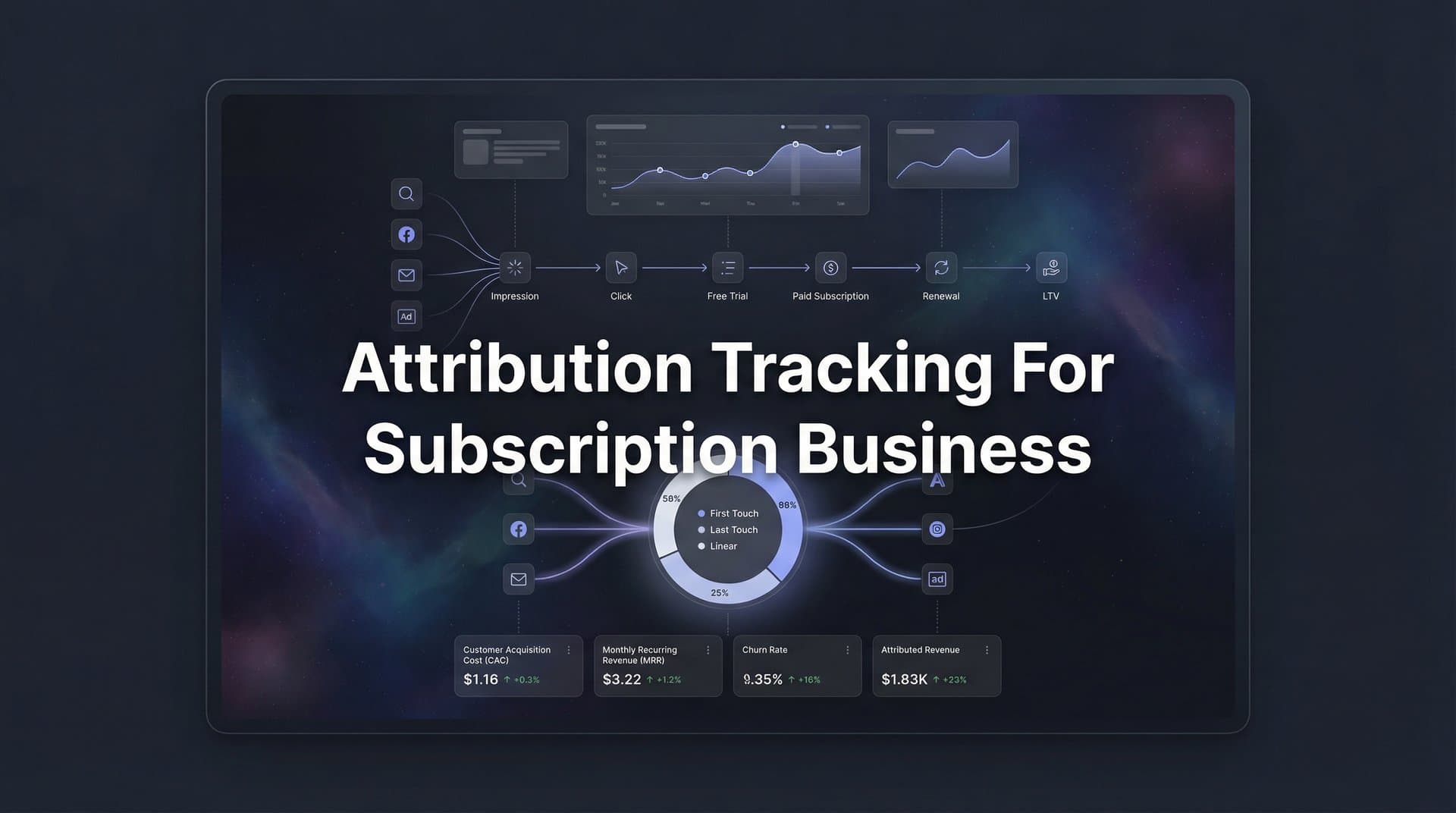
A typical subscription funnel might flow like this: anonymous visitor becomes known lead through content download, lead engages with nurture emails, prospect starts free trial, trial user activates key features, activated user converts to paid, paid customer renews subscription, loyal customer upgrades to higher tier. Each transition represents a conversion event worth tracking and attributing.
Don't skip the post-conversion stages. Renewal decisions and upgrade paths contribute enormously to customer lifetime value, and the marketing touchpoints that influence these decisions deserve attribution credit. A customer who upgrades after reading a feature announcement email should credit that touchpoint, not just the original acquisition channel.
Next, define the specific conversion events that matter for your business model. Generic "conversion" tracking doesn't cut it for subscriptions. You need granular events that capture the decisions customers make at each stage of their journey.
Your event taxonomy might include: trial_started, trial_activated (used core feature), trial_to_paid_conversion, subscription_renewed, plan_upgraded, plan_downgraded, subscription_paused, subscription_cancelled. Each event should pass relevant data like plan tier, monthly value, and predicted lifetime value.
The more specific your events, the better your attribution insights. Instead of just tracking "subscription started," distinguish between annual and monthly plans, different pricing tiers, and whether the customer came through self-service or sales-assisted conversion. Robust marketing analytics for subscription businesses reveals which marketing efforts drive the most valuable customer segments.
Finally, connect your ad platforms, website, and CRM into a unified data layer that tracks customers across their entire journey. This integration creates the infrastructure that makes subscription attribution possible.
Start with your website tracking. Implement server-side tracking that captures visitor behavior and conversion events reliably regardless of browser limitations. Ensure you're collecting first-party data that creates persistent customer identities across sessions and devices.
Connect your CRM to sync customer data bidirectionally. When someone converts from trial to paid in your product, that event should flow into your attribution system. When they upgrade or renew, those events should be attributed to the marketing touchpoints that influenced them. This connection transforms your CRM from a sales tool into a critical piece of your marketing analytics infrastructure.
Integrate your ad platforms through conversion APIs that send enriched event data back to networks like Meta and Google. Instead of relying on browser pixels that miss conversions, send server-side conversion data that includes customer value, subscription tier, and other signals that help ad algorithms optimize for quality.
The technical implementation might involve tools like Google Tag Manager for event tracking, customer data platforms for identity resolution, and attribution platforms that specialize in subscription models. The specific stack matters less than ensuring all your systems communicate and create a complete view of each customer's journey from first touch through ongoing subscription value.
Common Pitfalls and How to Avoid Them
Even with the right infrastructure, subscription businesses often stumble into attribution mistakes that distort their understanding of channel performance. Recognizing these pitfalls helps you build more accurate tracking and make better decisions.
Over-crediting last touch remains the most common trap. Default attribution in most ad platforms credits whichever ad someone clicked immediately before converting. For subscription businesses with long consideration cycles, this systematically undervalues all the touchpoints that built awareness and trust over weeks or months.
Picture this scenario: a prospect discovers your product through an organic blog post, signs up for your email list, engages with a nurture sequence over three weeks, then finally converts after clicking a retargeting ad. Last-click attribution credits the retargeting ad with the entire conversion, ignoring the content and email nurture that actually drove the decision.
This creates a dangerous feedback loop. You see retargeting performing well in your attribution reports, so you invest more heavily in retargeting. But retargeting only works because other channels are creating awareness and consideration. If you shift too much budget to last-touch channels, you starve the top-of-funnel activities that feed your entire pipeline.
The fix is implementing multi-touch attribution that distributes credit across the customer journey. Even a simple linear model that splits credit evenly across all touchpoints provides a more accurate picture than last-click. More sophisticated time-decay or position-based models can better reflect how different touchpoints contribute to subscription decisions.
Ignoring post-acquisition touchpoints creates another blind spot. Most attribution systems stop tracking after the first conversion, but for subscription businesses, that's when the real value creation begins. Renewal decisions and upgrade paths represent enormous revenue opportunities that deserve attribution.
Consider a customer who subscribed at your basic tier, then upgraded to premium after receiving targeted feature emails over three months. Traditional attribution would credit their original acquisition channel with the basic subscription value and completely ignore the email marketing that drove the upgrade. This systematically undervalues retention marketing and product-led growth initiatives.
Extend your attribution model to track post-conversion touchpoints. When customers renew, attribute that decision to the touchpoints that kept them engaged. When they upgrade, credit the marketing that educated them about premium features. Platforms designed for attribution tracking for SaaS companies can help you capture these critical lifecycle events.
This comprehensive approach reveals the full impact of your marketing efforts. You might discover that your content marketing drives modest initial conversions but creates highly engaged customers who consistently upgrade. Or that certain acquisition channels deliver subscribers who need heavy retention marketing to prevent churn. These insights only emerge when you track the complete customer lifecycle.
Siloed data systems fragment your understanding of customer journeys. When your website analytics, ad platforms, CRM, and subscription billing system don't communicate, you're seeing disconnected snapshots rather than the complete story.
This fragmentation creates gaps where customers fall through tracking. Someone might convert on a different device than where they first discovered you. They might start a trial using one email address then subscribe with another. They might interact across multiple channels that don't share customer identity. Each gap creates attribution errors that compound into seriously flawed channel analysis.
The solution requires building unified customer identity across all your systems. Implement identity resolution that connects anonymous website visitors to known email subscribers to CRM contacts to paying customers. Use consistent customer IDs across platforms so you can track individuals as they move through your funnel and across touchpoints.
Modern attribution platforms help solve this by creating a single source of truth that ingests data from all your marketing systems and resolves it to individual customer journeys. This unified view eliminates the gaps that create attribution errors and gives you confidence that your channel analysis reflects reality.
Putting Your Attribution Data to Work
Attribution insights only create value when they change decisions. The goal isn't perfect tracking for its own sake. It's using better data to allocate budgets more effectively, optimize campaigns more intelligently, and forecast revenue more accurately.
Budget allocation becomes dramatically more effective when you understand true channel performance. Instead of optimizing for cost per trial or even cost per conversion, you can shift spend toward channels that deliver high-lifetime-value subscribers at sustainable acquisition costs.
This often means making counterintuitive decisions. A channel with higher upfront CAC might deserve more budget if it consistently delivers customers who stay longer and upgrade more frequently. A source with cheap trials might warrant less investment if those users churn quickly and never convert to paid. Attribution data that connects acquisition sources to lifetime value reveals these patterns.
The practical application means regularly reviewing channel performance not just by acquisition volume but by cohort quality. Track how customers acquired through each channel perform over time. Calculate LTV:CAC ratios by source. Identify which channels have the shortest payback periods. Then systematically shift budget toward sources that deliver the best unit economics, even if they don't show the lowest cost per trial.
Campaign optimization improves when you feed better conversion data back to ad platforms. Modern advertising algorithms optimize toward the conversion events you tell them about. If you only report trial signups, they'll optimize for trial volume. If you send enriched conversion data that includes subscription value and predicted LTV, they'll optimize for quality.
This is where server-side conversion APIs create enormous value. Instead of just telling Meta or Google that someone converted, you can send signals about what kind of customer they are. High predicted LTV, annual subscription, enterprise tier—these signals help ad algorithms identify and target similar high-value prospects. Implementing cross platform attribution tracking ensures these signals flow consistently across all your advertising channels.
The impact compounds over time as algorithms learn from better data. Your campaigns become progressively better at finding prospects who match your best customer profiles. Cost per acquisition might stay flat or even increase slightly, but the quality of customers you acquire improves dramatically, leading to better overall ROI.
Forecasting becomes more reliable when you understand the relationship between current marketing investments and future revenue. Subscription businesses need to predict not just next month's new customer count but the revenue those customers will generate over their lifetime.
Attribution data that connects acquisition sources to retention curves and upgrade patterns lets you build these forecasts. If you know that customers from organic search typically stay for 24 months and upgrade at a 30% rate, you can predict the revenue impact of investing more in content marketing. If paid social delivers customers with 12-month retention and minimal upgrades, you can forecast the ROI of scaling those campaigns.
These forecasts inform strategic decisions about how aggressively to invest in growth. Channels with strong unit economics and predictable customer behavior can support aggressive scaling. Sources with longer payback periods or higher uncertainty require more conservative investment. Attribution data transforms these decisions from guesswork into data-driven planning.
Making Attribution Work for Your Subscription Business
Subscription businesses have a unique advantage that traditional e-commerce companies lack: recurring revenue provides ongoing data about customer quality. Every renewal, every upgrade, every expansion tells you something about which marketing efforts create lasting value. The challenge is building attribution systems that capture and act on these insights.
Effective attribution tracking transforms subscription data into actionable intelligence. It reveals which channels drive not just signups but loyal, long-term subscribers. It connects marketing investments to customer lifetime value, showing true ROI rather than surface-level conversion metrics. It helps you allocate budgets toward sources that deliver sustainable growth rather than vanity metrics.
The businesses that master subscription attribution make fundamentally better marketing decisions. They invest in channels that create compounding value. They optimize campaigns for customer quality, not just volume. They forecast growth with confidence based on real patterns in their customer data.
If your current attribution setup stops at first conversion, you're missing the most valuable part of the story. If you're optimizing for trials without tracking which ones become loyal subscribers, you're leaving money on the table. If your ad platforms, CRM, and analytics systems don't communicate, you're making decisions based on incomplete information.
The path forward starts with evaluating your current tracking infrastructure. Map your actual customer journey from awareness through renewal. Identify the gaps where customers fall out of tracking. Connect your systems to create unified visibility across the entire lifecycle. Then use those insights to shift investment toward the marketing that drives real, sustainable subscription growth.
Ready to elevate your marketing game with precision and confidence? Discover how Cometly's AI-driven recommendations can transform your ad strategy. Get your free demo today and start capturing every touchpoint to maximize your conversions.


