You're running ads on Google, Meta, and LinkedIn. Leads are coming in. The sales team is working deals. But when your CFO asks which campaigns are actually driving revenue, you're left staring at three different dashboards that each claim credit for the same closed deal. Sound familiar?
This is the defining challenge of B2B SaaS marketing. Unlike e-commerce, where someone clicks an ad and buys a product within minutes, B2B SaaS deals unfold over weeks or months. There are demo calls, procurement reviews, multiple stakeholders, and a dozen touchpoints between the first ad impression and the signed contract. By the time a deal closes, the original ad that sparked the buyer's interest is long forgotten by both the platform and the CRM.
B2B SaaS ad performance analytics is the discipline that bridges this gap. It's about building a system that connects every dollar of ad spend to real pipeline and revenue outcomes, not just clicks, impressions, or form fills. It requires thinking beyond platform dashboards and building a full-funnel view that follows the customer journey from first ad click through to closed-won revenue.
This matters more than ever right now. Paid acquisition costs continue to rise across every major platform, and marketing teams are under increasing pressure to prove ROI in terms that finance and leadership actually care about. If you can't connect your ad spend to revenue, you're not just flying blind. You're at risk of cutting the campaigns that are actually working and scaling the ones that aren't.
This guide walks through everything you need to build a B2B SaaS ad analytics system that gives you real answers, from the metrics that matter to the technical infrastructure that makes accurate attribution possible.
Why Standard Ad Metrics Don't Tell the Whole Story
Open any Google Ads or Meta Ads dashboard and you'll find an abundance of data: impressions, clicks, click-through rates, cost-per-click, and conversion counts. These numbers are easy to read and easy to report. They're also dangerously incomplete for B2B SaaS teams trying to understand what's actually driving revenue.
The core problem is timing. Ad platforms are built to measure conversions that happen close to the ad click. When a prospect clicks your LinkedIn ad, downloads a whitepaper, attends a webinar three weeks later, requests a demo the following month, and then closes as a customer six weeks after that, no single platform can see that entire journey. Each platform captures only the slices it's involved in, and each one claims credit for the conversion.
This creates a phenomenon often called "attribution inflation," where the sum of conversions reported across all your platforms is significantly higher than the actual number of deals closed. If you're making budget decisions based on those inflated numbers, you're optimizing toward a fiction. Teams dealing with unreliable marketing analytics data often find themselves misallocating spend across their entire portfolio.
The multi-stakeholder nature of B2B buying adds another layer of complexity. A single deal might involve a marketing manager who clicked your Google ad, a VP of Marketing who later saw your LinkedIn retargeting campaign, and a CFO who never interacted with any ad at all. Platforms track individual cookies and device IDs, not buying committees. So even within a single account, the attribution picture is fragmented.
Free trial and demo funnels create a third layer of complexity. In B2B SaaS, the "conversion" that ad platforms optimize toward is usually a trial signup or demo request, not revenue. This means platforms are getting rewarded for generating leads, regardless of whether those leads ever become paying customers. A campaign that drives a high volume of trial signups from small businesses might look like a winner in your dashboard while actually producing very little qualified pipeline for your enterprise sales team.
The result is misallocated budget. Teams end up scaling campaigns that generate activity but not revenue, while underinvesting in the channels that are quietly influencing the deals that actually close. Breaking out of this pattern requires a fundamentally different approach to measurement, one that starts with defining the metrics that actually matter.
The Metrics That Actually Move the Needle
If clicks and impressions are the wrong metrics to optimize toward, what should B2B SaaS teams measure instead? The answer is a set of revenue-connected metrics that follow the customer journey all the way through the funnel.
Pipeline Generated per Channel: This measures the total value of opportunities created, attributed to each ad channel. It connects your ad spend directly to your sales pipeline, giving you a much clearer picture of which channels are producing real business interest rather than just traffic.
Customer Acquisition Cost by Ad Source: CAC is a familiar metric, but most teams calculate it at a blended level across all marketing spend. Breaking CAC down by ad channel and campaign reveals which sources are acquiring customers efficiently and which are burning budget on leads that never convert. Understanding the nuances of tracking SaaS customer acquisition at this level is essential for accurate budget allocation.
Payback Period by Campaign: How long does it take to recoup the cost of acquiring a customer from a specific campaign? A campaign with a lower CAC but a longer payback period might be less valuable than one with a higher CAC but faster revenue recovery, especially in a cash-flow-conscious business.
LTV to CAC Ratio by Channel: This is one of the most powerful metrics for B2B SaaS teams. If customers acquired through LinkedIn have a significantly higher lifetime value than those acquired through Google Display, that changes how you should allocate budget, even if the CAC looks similar on the surface. For a deeper dive into which numbers deserve your attention, explore essential metrics every SaaS company should track.
Connecting these metrics requires bridging the gap between your ad platforms and your CRM. Every lead that enters your CRM should carry the UTM parameters and ad source data from the original click. As that lead progresses through pipeline stages, that progression should be trackable back to the originating campaign.
Multi-touch attribution models add another dimension to this analysis. First-touch attribution gives all credit to the initial ad that introduced the prospect to your brand. Last-touch gives all credit to the final interaction before conversion. Linear attribution distributes credit equally across all touchpoints. Time-decay models weight recent interactions more heavily.
No single model tells the complete truth. First-touch helps you understand what's generating awareness. Last-touch shows what's closing deals. Linear and time-decay models help you understand the middle of the funnel. The most sophisticated B2B SaaS teams compare multiple models side by side to get a fuller picture of how their campaigns are contributing across the entire buying journey.
Building a Full-Funnel Tracking System
Understanding which metrics matter is only half the battle. The other half is building the technical infrastructure that makes accurate measurement possible. For B2B SaaS teams, this means connecting three systems that are often siloed: your ad platforms, your website, and your CRM.
The traditional approach to this problem was client-side pixel tracking. You'd drop a JavaScript tag on your website, and every time a visitor completed a form, the pixel would fire and send a conversion signal back to the ad platform. Simple in theory, increasingly unreliable in practice.
Apple's App Tracking Transparency framework and ongoing browser-level restrictions have significantly reduced the effectiveness of client-side pixels. Ad blockers intercept pixel fires. Safari's Intelligent Tracking Prevention limits cookie lifespans. The result is that a meaningful portion of conversions simply never get reported back to the platforms, leading to under-reporting and poor algorithmic optimization.
Server-side tracking solves this problem by moving the conversion measurement from the user's browser to your own server. Instead of relying on a JavaScript tag to fire successfully in a user's browser, your server receives the conversion event and sends it directly to the ad platform's API. This approach is far more reliable, far less susceptible to browser restrictions, and gives you much greater control over the data you're sending.
The next layer is CRM integration. When a lead converts on your website, that event should trigger a record creation in your CRM with all the relevant ad attribution data attached. As the deal progresses through pipeline stages, those stage changes should be trackable. When a deal closes, that closed-won event should be available to feed back to your analytics system.
This is where conversion syncing becomes a powerful tool. Rather than just sending form fill events to Meta and Google, you can send enriched conversion signals that include downstream revenue data. When your ad platforms receive signals tied to actual closed deals rather than just leads, their machine learning algorithms can optimize toward the audiences and behaviors that produce your highest-value customers. Implementing robust marketing attribution tracking is what makes this feedback loop possible.
The architecture sounds complex, but the payoff is significant. A properly connected tracking system transforms your ad analytics from a collection of disconnected platform reports into a single source of truth that follows every customer from first impression to closed revenue.
Cross-Platform Analysis: Seeing the Whole Picture
Most B2B SaaS teams run ads across multiple platforms simultaneously. Google Search captures demand from buyers actively researching solutions. LinkedIn reaches specific professional audiences with targeted messaging. Meta retargets website visitors and lookalike audiences. Each platform plays a different role in the buying journey, and each one reports its contribution in isolation.
The problem with reviewing platform dashboards independently is that each one is designed to make itself look as valuable as possible. Every platform's reporting defaults to attribution windows and models that maximize the number of conversions it can claim. When you add up the conversions reported across all your platforms, the total often exceeds the actual number of deals you closed. Exploring cross-platform analytics tools can help you cut through this attribution chaos.
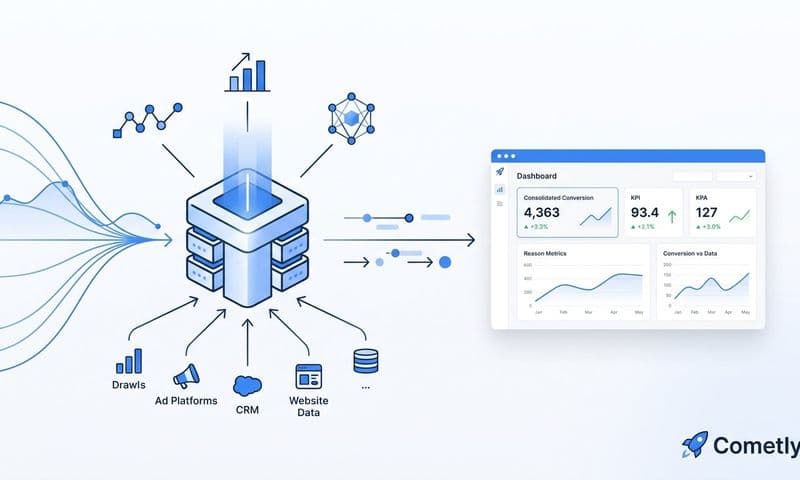
A unified analytics dashboard solves this by pulling data from all your ad channels into a single view and applying consistent attribution logic across all of them. Instead of comparing Google's self-reported CPA against LinkedIn's self-reported CPA, you can compare the true pipeline generated and revenue attributed to each channel using the same measurement methodology.
This unified view makes budget reallocation decisions much clearer. You can see which channels are generating clicks but not qualified pipeline, which campaigns have strong top-of-funnel volume but poor downstream conversion rates, and which channels are quietly influencing deals that close through other channels. A unified marketing analytics platform makes these insights accessible in real time rather than buried across separate reports.
Practical budget reallocation starts with identifying underperformers at the channel and campaign level. A campaign generating a high volume of trial signups from an audience segment that historically churns quickly is a candidate for reduction. A campaign with lower volume but consistently higher pipeline quality is a candidate for scaling. Without cross-platform visibility, these patterns are nearly impossible to spot.
The goal is to shift from managing each channel independently to managing your entire ad portfolio as a coordinated system, where budget flows toward the combinations of channel, creative, and audience that produce the best revenue outcomes.
How AI Is Reshaping Ad Performance Optimization
The volume of data generated by a multi-channel B2B SaaS ad program quickly exceeds what any human analyst can process manually. You're dealing with dozens of campaigns, hundreds of ad sets, thousands of creative variations, and multiple attribution models, all generating data simultaneously. This is exactly the problem AI-powered analytics is designed to solve.
AI can surface patterns across large datasets that would take a human analyst days or weeks to identify. For example, it might detect that a specific combination of ad creative, audience segment, and landing page consistently produces customers with higher lifetime value, even if the initial conversion rate looks average. Without AI surfacing that pattern, you might pause that campaign based on surface-level metrics and miss your best source of high-value customers. Reviewing the latest AI marketing analytics tools can help you find the right solution for your stack.
AI-driven recommendations change the nature of campaign management. Instead of spending hours reviewing performance data and manually identifying what to change, marketers can receive specific, prioritized recommendations: flag this underperforming ad set, consider shifting budget from this campaign to that one, scale this creative combination because it's producing strong downstream results. This compresses the optimization cycle from weeks to days.
The relationship between your analytics AI and the ad platform algorithms is also worth understanding. Meta, Google, and LinkedIn all use machine learning to optimize campaign delivery, but those algorithms are only as good as the signals you feed them. When you send enriched conversion data that includes actual revenue outcomes rather than just lead form completions, the platform algorithms can learn what a high-value conversion actually looks like and optimize toward finding more of them.
This creates a compounding advantage over time. Better conversion signals lead to better algorithmic optimization, which leads to higher-quality traffic, which generates better data, which further improves optimization. Teams that invest in feeding accurate, enriched data to their ad platforms often see meaningful improvements in campaign efficiency over time, not because they changed their creative or targeting manually, but because the algorithms got smarter with better inputs.
A Practical Framework for Putting Analytics Into Action
Understanding the principles of B2B SaaS ad performance analytics is one thing. Implementing them is another. Here's a step-by-step framework for moving from theory to a working system.
Step 1: Audit Your Current Tracking Setup. Before building anything new, understand what you have. Are UTM parameters being applied consistently across all campaigns? Is your CRM capturing ad source data on every lead record? Are there gaps in your conversion tracking where events are being missed or misattributed? A tracking audit often reveals that the data problems are upstream of the analytics, not in the analytics tools themselves.
Step 2: Implement Server-Side Tracking and CRM Integration. Replace or supplement client-side pixels with server-side tracking to improve data reliability. Connect your tracking system to your CRM so that lead source data flows through the entire customer lifecycle, from first touch to closed deal. Understanding SaaS revenue attribution at this level is what separates teams that guess from teams that know.
Step 3: Define Your Core KPIs Tied to Revenue. Align your team around the metrics that matter: pipeline generated per channel, CAC by ad source, payback period, and LTV to CAC ratio. Make sure these metrics are visible and reviewed regularly, not just clicks and impressions.
Step 4: Establish a Weekly Review Cadence. Set a recurring review process that compares performance across attribution models and channels. Look for discrepancies between what platforms report and what your CRM shows. Use this cadence to make incremental budget adjustments based on downstream revenue data rather than top-of-funnel metrics alone.
Step 5: Use AI Insights to Accelerate Decisions. Leverage AI-powered recommendations to compress your optimization cycle. Let AI surface the patterns and prioritize the actions so your team can focus on strategic decisions rather than manual data review.
A few common pitfalls to avoid along the way. Over-optimizing for top-of-funnel metrics is the most common mistake: scaling campaigns because they generate trial signups without checking whether those trials convert to revenue. Properly tracking trial-to-paid conversions is critical for avoiding this trap. Ignoring assisted conversions is another: a channel that rarely gets last-touch credit might be influencing a large share of deals earlier in the journey. And making budget decisions based on a single attribution model will always give you an incomplete picture. Use multiple models together and let the full story guide your decisions.
The mindset shift that makes all of this work is moving from reporting on what happened to using analytics to predict and influence what will happen next. The goal isn't a prettier dashboard. It's a system that helps you make faster, more confident decisions about where to invest your ad budget.
The Bottom Line
B2B SaaS ad performance analytics is not a reporting exercise. It's a revenue system. When built correctly, it connects every ad dollar to real pipeline and closed deals, giving you the clarity to scale what works and stop wasting budget on what doesn't.
The key takeaways from this guide come down to a few core principles. Move beyond vanity metrics and measure what actually matters: pipeline, CAC by source, payback period, and LTV to CAC ratios. Build full-funnel tracking infrastructure with server-side tracking and CRM integration so your data is reliable and complete. Unify your cross-platform data so you can compare channels using consistent methodology rather than each platform's self-serving reports. And leverage AI to surface patterns, generate recommendations, and feed better signals back to ad platform algorithms so they optimize toward your highest-value outcomes.
The B2B SaaS teams that win on paid acquisition are not necessarily the ones with the biggest budgets. They're the ones with the clearest picture of what's actually driving revenue and the systems to act on that insight faster than their competitors.
Ready to build that kind of clarity for your team? Cometly helps B2B SaaS marketers capture every touchpoint across the customer journey, attribute revenue accurately across all ad channels, and get AI-powered recommendations to scale their ad spend with confidence. Get your free demo today and start connecting every ad dollar to the revenue outcomes that actually matter.