Browser-based tracking is quietly falling apart, and most marketers are only seeing part of the damage. You run a campaign, check your attribution dashboard, and the numbers look reasonable. But underneath the surface, a growing share of your conversions are going untracked, your ad platform algorithms are operating on incomplete signals, and the budget decisions you are making every day are based on data that has more holes in it than you realize.
This is not a niche problem. Ad blockers, iOS privacy updates, cookie restrictions, and browser-level tracking limitations have collectively eroded the reliability of traditional client-side tracking. The tools that powered marketing measurement for over a decade are losing their grip, and the gap between what actually happened and what your analytics reports shows you is widening.
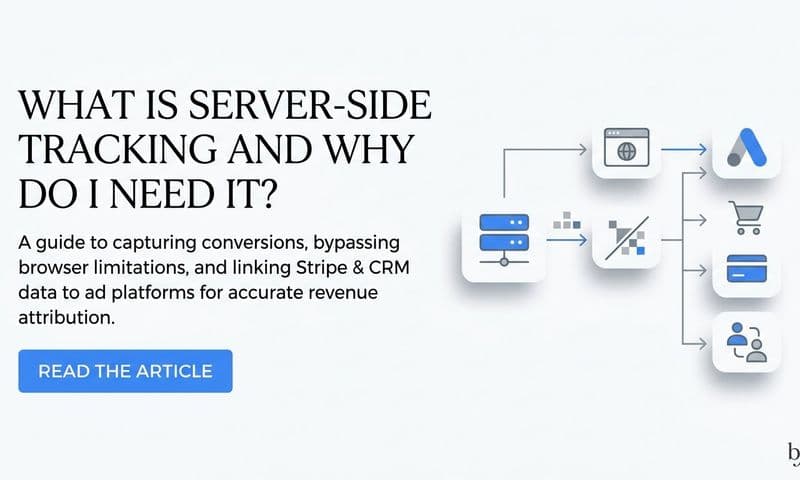
Server side tracking analytics is the response the industry has been building toward. Instead of relying on browser-based scripts and third-party pixels to capture conversion data, server side tracking moves that data collection to a controlled server environment you own. The result is more complete data, better signals for your ad platforms, and a far more accurate picture of what is actually driving revenue. This article breaks down exactly how it works, why it matters for your ad performance, and how to start implementing it in a way that compounds over time.
The Tracking Problem Hiding in Plain Sight
For most of the last two decades, client-side tracking was the default approach to marketing measurement, and for good reason. You drop a JavaScript tag or pixel on your website, a user visits and triggers an action, and the browser sends that event data directly to your analytics tools and ad platforms. It was simple, scalable, and effective enough when browsers and users behaved predictably.
The problem is that browsers and users no longer behave the way they did when these systems were designed. Several converging forces have systematically degraded the reliability of client-side tracking, and the cumulative effect is significant.
Ad blockers: A large and growing share of internet users run browser extensions that block tracking scripts outright. When an ad blocker is active, client-side pixels simply do not fire. The conversion happens, but your analytics platform never sees it. For many websites, this means a meaningful percentage of real conversions are invisible to your tracking setup.
Safari's Intelligent Tracking Prevention (ITP): Apple's Safari browser introduced ITP to limit cross-site tracking, and it has progressively tightened over time. First-party cookies set via JavaScript can be capped at a seven-day lifespan, and in some scenarios just 24 hours. For any customer journey that spans more than a week, which is common in B2B and higher-consideration purchases, attribution chains break down entirely.
iOS App Tracking Transparency (ATT): Apple's ATT framework, introduced with iOS 14.5, requires apps to explicitly ask users for permission before tracking them across other apps and websites. When users opt out, which many do, platforms like Meta receive dramatically fewer mobile conversion signals. The downstream effect on ad platform optimization was significant, and understanding pixel tracking problems on iOS is critical for any marketer running mobile campaigns.
Browser and cookie deprecation trends: Firefox and Brave block third-party cookies by default. Google has moved toward a Privacy Sandbox model that further reduces reliance on traditional cookie-based tracking. The direction of travel across every major browser is toward more restriction, not less.
Connect these dots and the business impact becomes clear. Marketers are making budget allocation decisions based on attribution data that is missing a substantial slice of actual conversions. Ad platform algorithms, which depend on conversion signals to optimize targeting and bidding, are working with degraded inputs. And attribution models that look accurate on the surface are quietly misrepresenting which channels and campaigns are actually driving results. The tracking problem is not theoretical. It is actively costing marketers money every day.
How Server Side Tracking Actually Works
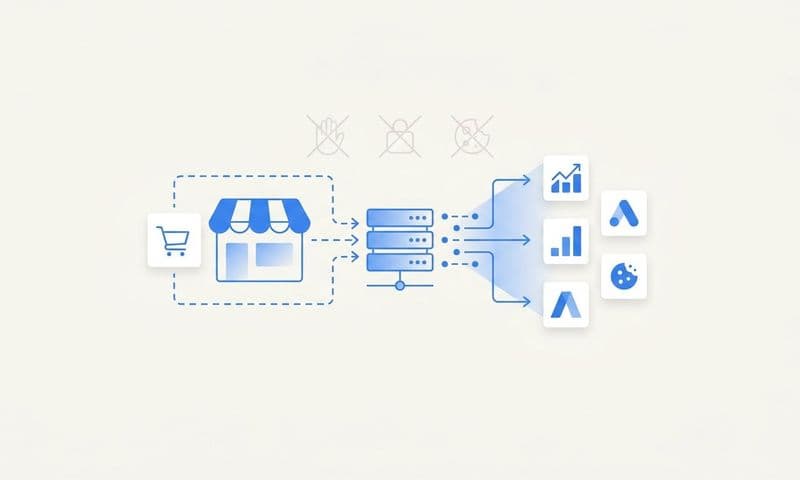
The core idea behind server side tracking is straightforward: instead of the user's browser sending event data directly to third-party analytics and ad platforms, it sends that data to your own server first. Your server then processes the information and forwards it to the relevant platforms. That single architectural shift changes everything about how tracking data survives the modern browser environment.
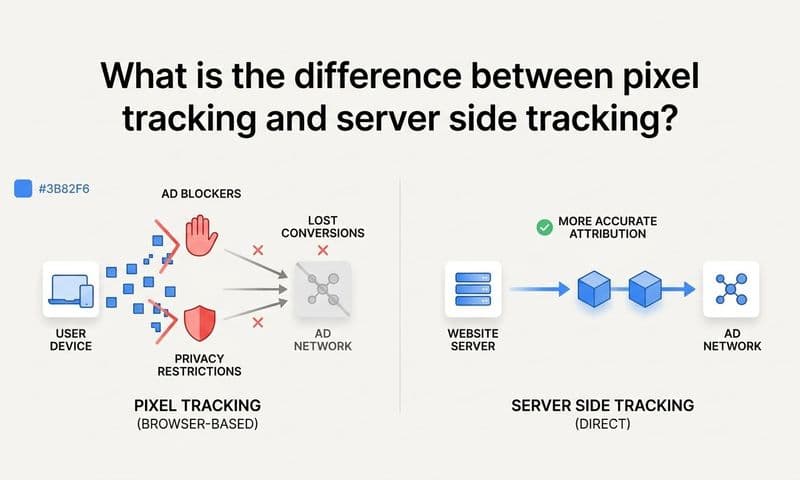
Think of it like this. In a traditional client-side setup, the browser is the messenger. It picks up the conversion event and tries to deliver it directly to Meta, Google, or your analytics tool. But along the way, it runs into ad blockers, browser restrictions, and cookie limitations that intercept or block the message before it arrives. The conversion happened, but the platform never heard about it.
In a server-side setup, the browser sends the event to your own server, which sits behind your own domain. Ad blockers and browser-level restrictions are not looking at traffic going to your first-party server the same way they look at outbound calls to third-party tracking scripts. Your server receives the event reliably, processes it, enriches it with additional data if needed, and then forwards it to the ad platforms and analytics tools you have configured. Understanding why server-side tracking is more accurate comes down to this fundamental architectural difference.
This is the architecture behind tools like Google Tag Manager Server-Side, Meta's Conversions API (CAPI), and TikTok's Events API. Each of these represents a major platform investing in server-side data pipelines precisely because they recognize that client-side signals are degrading. Meta has publicly encouraged advertisers to implement CAPI alongside their pixel to improve event match quality and ad delivery. The signal they want is the server-side signal.
There are a few important clarifications worth making here. Server side tracking dramatically improves your data capture rate and gives you control over what data is sent where and when. It is not, however, a mechanism for bypassing user privacy choices. Proper consent frameworks still apply. If a user has opted out of tracking under your consent management setup, server side tracking does not override that. What it does do is ensure that for users who have not opted out, and whose conversions were previously being lost to ad blockers or browser restrictions, those events are now captured and attributed correctly.
Server side tracking also gives you a meaningful data governance advantage. Because your server sits in the middle of the data flow, you decide exactly what information gets forwarded to each platform. You can strip out personally identifiable information where appropriate, normalize event data for consistency, and maintain a cleaner, more controlled data pipeline than client-side tracking ever allowed.
Why Your Ad Platforms Are Starving for Better Data
Modern ad platforms do not just display your ads. They use machine learning to decide who sees them, when, at what bid, and in what context. Meta's algorithm, Google's Smart Bidding, TikTok's optimization engine: all of them are continuously learning from the conversion signals you send back. The more complete and accurate those signals are, the better these systems can optimize on your behalf.
Here is the problem. When client-side tracking is degraded, the conversion signals flowing back to ad platforms are incomplete. The algorithm sees fewer conversions than actually occurred, which means it has less data to learn from. It cannot accurately identify which audience segments are converting, it cannot optimize bids toward the users most likely to purchase, and it cannot allocate delivery toward the placements and creatives that are actually driving results. You end up paying more for worse outcomes, not because your targeting strategy is wrong, but because the feedback loop your algorithm depends on is broken. Investing in the right ad tracking tools is essential to restoring that feedback loop.
Server side tracking analytics addresses this directly through what is often called conversion syncing. When a conversion event occurs, your server captures it, enriches it with available customer data (such as hashed email addresses or phone numbers that can be matched back to platform user profiles), and sends it back to the ad platform via a server-to-server connection. The platform receives a higher-quality, more complete conversion signal than it would have gotten from a client-side pixel alone.
The downstream effects compound quickly. When Meta receives better event match quality through CAPI, it can match more of your conversions to actual Meta users. When Google receives more complete conversion data, Smart Bidding has more accurate signals to work with. When TikTok's Events API receives enriched purchase events, its algorithm can better identify lookalike audiences worth targeting. Better input data means better algorithmic output, which means stronger return on ad spend across every platform you run.
For marketers running multi-platform campaigns, this benefit multiplies further. A server-side setup can act as a single source of truth that feeds consistent, enriched conversion data to every ad platform simultaneously. Using cross platform analytics alongside server-side tracking ensures that instead of each platform seeing a partial, inconsistent picture of your conversions, they all receive the same high-quality signal. The result is more coherent optimization across your entire media mix.
Server Side vs. Client Side: A Side-by-Side Breakdown
Understanding the difference between these two approaches comes down to a few key dimensions. Let's walk through them directly.
Data accuracy: Client-side tracking is vulnerable to ad blockers, browser restrictions, and cookie limitations, all of which reduce the percentage of actual events that are captured. Server side tracking routes data through your own server, bypassing most of these interception points and capturing a significantly higher share of real conversions.
Vulnerability to ad blockers: Client-side pixels and JavaScript tags are routinely blocked by ad blocker extensions. Server-side requests to your own first-party domain are not subject to the same blocking behavior, making server side tracking far more resilient. If you are experiencing issues with your current setup, understanding common tracking pixel firing issues can help you diagnose the extent of your data loss.
Page load impact: Client-side tags add JavaScript that must load in the browser, which can slow page performance. Server side tracking offloads processing to your server, reducing the number of scripts that need to execute in the browser and often improving page load times as a secondary benefit.
Data control and privacy: With client-side tracking, data flows directly from the browser to third-party platforms with limited control over what is sent. Server side tracking puts you in the middle of that flow, giving you the ability to filter, enrich, or restrict data before it reaches any platform.
Implementation complexity: This is where server side tracking has historically had a reputation for being difficult. That reputation is increasingly outdated. Modern platforms and purpose-built server side tracking tools have simplified implementation substantially. It still requires more setup than dropping a pixel on a page, but it is no longer the exclusive territory of enterprise engineering teams.
Long-term viability: Client-side tracking will continue to erode as privacy regulations tighten and browsers restrict tracking further. Server side tracking is built on first-party data principles that align with where the industry is heading.
One important clarification: server side tracking is not necessarily a wholesale replacement for client-side tracking. Many teams run both in parallel, using client-side tags for real-time user experience functions and server-side tracking to fill the gaps where client-side data is lost. The goal is complementary coverage, not a hard cutover. During any transition period, running both approaches lets you compare data quality and build confidence in your server-side setup before fully committing.
Putting Server Side Tracking Analytics Into Action
Getting started with server side tracking does not require rebuilding your entire marketing stack. It does require a clear implementation plan and an honest audit of where your current tracking setup is falling short.
The natural starting point is an audit. Pull your current conversion data and look for signs of degradation: discrepancies between your CRM's reported conversions and what your ad platforms are showing, unusually low event match quality scores in Meta's Events Manager, or attribution gaps that do not align with your actual sales pipeline. These are the fingerprints of client-side tracking loss, and they tell you where server side tracking will have the biggest immediate impact.
Next, choose a server side tracking solution that integrates with your ad platforms and CRM. Your options range from building on top of Google Tag Manager Server-Side and configuring platform-specific APIs manually, to using a purpose-built attribution and tracking platform that handles the infrastructure for you. Having a solid attribution tracking setup is the foundation everything else builds on.
Once your server-side container or tracking endpoint is in place, configure your conversion events. Start with your highest-value events first: purchases, qualified leads, demo requests, or whatever signals matter most to your business outcomes. Getting these right before expanding to micro-conversions ensures that the data feeding your ad platform algorithms is both accurate and meaningful. Mastering conversion tracking at this stage is essential, because garbage in, garbage out still applies, even with server side tracking.
After your core events are configured, set up conversion syncing back to your ad platforms. This means connecting your server-side pipeline to Meta's Conversions API, Google's enhanced conversions, TikTok's Events API, or whichever platforms you run. The enriched events your server sends back will improve event match quality and give those platforms' algorithms better signals to optimize against.
This is exactly where a platform like Cometly simplifies the process significantly. Cometly's built-in server-side tracking connects your ad platforms, CRM, and website into a unified data pipeline. It automatically captures touchpoints across the customer journey, enriches conversion events, and syncs that data back to Meta, Google, and other channels without requiring you to manually configure each API connection. For marketing teams that want the data quality benefits of server side tracking without building the infrastructure from scratch, it is a substantial shortcut. The AI layer on top of that data then surfaces recommendations about which campaigns and audiences are actually driving results, so you can scale with confidence rather than guesswork.
Measuring What Matters After You Make the Switch
Once server side tracking is live, the work shifts from implementation to measurement. You need to verify that the setup is actually improving your data quality and feeding better signals to your ad platforms.
The first metric to watch is conversion match rate, particularly in Meta's Events Manager. This score reflects how well the conversion events you are sending can be matched to actual Meta users. A meaningful improvement in match rate after implementing CAPI alongside your pixel is a strong signal that your server-side setup is working. Reviewing your Facebook attribution tracking data before and after implementation provides a clear benchmark of improvement.
Beyond platform-specific metrics, look at data completeness across your customer journey. Are you now seeing more conversions attributed to campaigns that previously showed low or zero return? Are the touchpoints in your attribution model filling in gaps that existed before? These qualitative improvements often show up before the quantitative gains do, and they indicate that your data pipeline is capturing events it was previously missing.
Multi-touch attribution becomes substantially more reliable with server side data in place. When you can track the full journey from first ad click through to CRM conversion without losing touchpoints to browser restrictions or ad blockers, your multi touch marketing attribution model reflects what actually happened rather than a filtered approximation of it. This matters enormously for budget allocation decisions. Channels that were previously undervalued because their conversions were being lost may now appear in their true context, and channels that looked strong on incomplete data may reveal themselves as less efficient than they seemed.
The compounding benefit over time is significant. Better data feeds better AI recommendations. Smarter budget allocation follows. And the ability to confidently scale campaigns that are demonstrably driving revenue becomes a real competitive advantage rather than an aspiration. Every improvement in data quality upstream creates better decisions downstream, and those better decisions compound across every campaign cycle.
The Foundation Your Marketing Measurement Needs
Server side tracking analytics is not a technical upgrade for its own sake. It is a response to a fundamental shift in how the web works, and it is quickly becoming the baseline requirement for accurate marketing measurement in a privacy-first world.
The forces degrading client-side tracking are not going to reverse. Browser restrictions will continue to tighten. Ad blocker adoption will keep growing. Privacy regulations will expand. The marketers who build their measurement infrastructure around server-side, first-party data principles now will have a compounding advantage as these trends accelerate. Those who wait will find the gap between their reported data and reality growing wider every quarter.
The core takeaway is this: moving tracking to the server level restores the data visibility you need to optimize spend confidently, feed ad platform algorithms with the quality signals they require, and attribute revenue accurately across every channel and touchpoint. It is the difference between making budget decisions on incomplete information and making them on a clear, reliable picture of what is actually driving results.
If you are ready to close the data gap and build a marketing measurement foundation that works in today's privacy-first environment, Cometly's server-side tracking and attribution platform is built exactly for this. It captures every touchpoint, syncs enriched conversion data back to your ad platforms, and gives your AI-powered recommendations the complete data they need to surface what is actually scaling your campaigns. Get your free demo today and start making decisions with the full picture.