Long sales cycles. Multiple decision-makers. Ad spend scattered across Meta, Google, LinkedIn, and half a dozen other platforms. If you run marketing for a B2B SaaS company, you already know the frustration: your campaigns are generating activity, but connecting that activity to actual closed revenue feels like assembling a puzzle with half the pieces missing.
Marketing attribution platforms promise to solve this problem, and many of them genuinely do. But here is the catch: most B2B teams that sign up for a free trial walk away without meaningful insights. Not because the platform failed them, but because they did not know what to test, how to set it up, or what good results actually look like.
This guide changes that. We will cover what B2B SaaS attribution actually involves, why a free trial is the smartest way to evaluate any platform, and exactly how to structure your trial period so you come away with real data, clear comparisons, and the confidence to make a smart decision. Whether you are evaluating attribution tools for the first time or looking to upgrade from basic last-click reporting, this is your practical playbook.
Why B2B SaaS Companies Struggle With Marketing Attribution
Ask a B2C marketer about attribution and the conversation is relatively straightforward. Someone sees an ad, clicks it, buys a product. The cycle might span hours or days. Attribution is still imperfect, but the timeline is short enough that single-touch models can at least approximate reality.
B2B SaaS is a different world entirely. A prospect might see a LinkedIn ad in January, attend a webinar in February, read three comparison articles in March, and finally book a demo in April after a colleague forwards them a case study. By the time that deal closes, your CRM might show a direct visit or an organic search as the source, while the LinkedIn campaign that first put your brand on their radar gets zero credit.
This is the core problem with last-click attribution in B2B contexts. It rewards the final touchpoint and ignores everything that built the relationship. For SaaS companies with longer sales cycles, this creates a dangerous illusion: channels that do the heavy lifting early in the funnel look like they are underperforming, while bottom-of-funnel touchpoints appear far more powerful than they actually are. Understanding these SaaS marketing attribution challenges is the first step toward solving them.
The multi-platform reality makes this worse. Most B2B marketing teams run paid campaigns on at least three or four platforms simultaneously. Each platform has its own attribution window, its own conversion tracking logic, and its own incentive to claim credit for as many conversions as possible. When you add up the conversions each platform reports, the total often exceeds your actual number of deals closed by a significant margin.
Then there is the CRM disconnect. Your sales team lives in Salesforce, HubSpot, or a similar tool. Your marketing team lives in ad dashboards. These two data sets rarely speak the same language without deliberate integration work. The result is that marketing reports conversions based on platform data, sales reports revenue based on CRM data, and leadership is left trying to reconcile two versions of reality that do not match. This is a key reason attribution data doesn't match across your tools.
Add browser-side tracking limitations from iOS privacy updates, cookie deprecation, and ad blockers, and you have a situation where even the data you do collect is increasingly incomplete. Many B2B SaaS companies are operating on attribution data that is not just misleading but structurally broken, and they are making budget decisions based on it every single month.
The Engine Under the Hood: What Attribution Platforms Actually Do
Understanding what an attribution platform does at a technical level helps you evaluate any free trial with sharper eyes. These are not just dashboards that aggregate your existing data. A proper attribution platform actively connects your disparate data sources and builds a unified picture of how prospects move through your funnel.
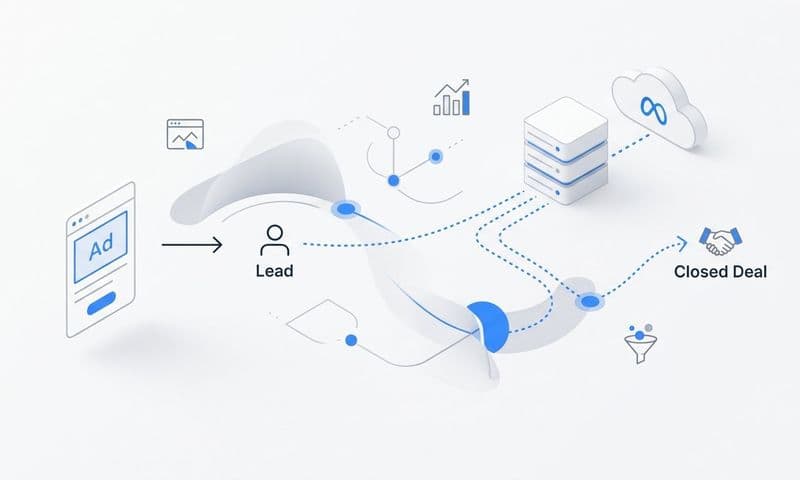
The foundation is integration. A platform like Cometly connects your ad platforms (Meta, Google, LinkedIn, and others), your website, and your CRM into a single data environment. Every touchpoint a prospect has with your brand gets logged and linked to that prospect's journey. When a deal closes in your CRM, the platform can trace that revenue back through every marketing interaction that contributed to it. This is the essence of revenue attribution for B2B SaaS companies.
From there, attribution models determine how credit gets distributed across those touchpoints. Different models tell different stories, and understanding them is essential for B2B marketers.
First-touch attribution gives all credit to the first interaction a prospect had with your brand. This is useful for understanding which channels create awareness and bring new prospects into your funnel.
Last-touch attribution gives all credit to the final interaction before conversion. It overvalues bottom-of-funnel touchpoints and ignores everything that built intent along the way.
Linear attribution distributes credit equally across all touchpoints in the customer journey. It is a more balanced view but does not account for the fact that some touchpoints are more influential than others.
Time-decay attribution gives more credit to touchpoints that occurred closer to the conversion event. This often makes sense for B2B, where late-stage interactions like demos and pricing pages play a meaningful role in closing decisions.
Multi-touch attribution uses data-driven models to assign credit based on actual influence across the entire journey. This is typically the most accurate approach for B2B SaaS, where the path to purchase is complex and non-linear. For a deeper dive, explore the difference between single source and multi-touch attribution models.
Beyond modeling, modern attribution platforms address the tracking gap created by privacy changes. Server-side tracking captures conversion data at the server level rather than relying on browser cookies, making it far more resilient to iOS restrictions and ad blockers. Conversion sync then feeds that enriched data back to platforms like Meta and Google, giving their algorithms better signals to optimize your campaigns and improve targeting over time.
The result is a system that not only shows you what happened, but actively helps the ad platforms do a better job of finding your next customer.
Why a Free Trial Is the Smartest First Move
Buying attribution software without testing it first is like hiring a key employee without an interview. The category is crowded, the pricing varies widely, and the gap between what platforms promise in a sales deck and what they actually deliver in your specific tech environment can be significant.
A free trial solves the most important question first: does this platform actually integrate with your stack? For B2B SaaS teams, that stack typically includes at least one major CRM, multiple ad platforms, and often a payment processor or product analytics tool. If the attribution platform cannot connect cleanly to your CRM, the entire value proposition collapses. You cannot attribute revenue you cannot see.
Testing integrations during a trial costs you nothing except time. Discovering integration gaps after you have signed a 12-month contract costs you significantly more. Knowing where to find marketing attribution tools that offer trials is a critical first step in your evaluation process.
The second strategic advantage of a free trial is the ability to run real campaign data through the attribution engine and compare it against your current reporting. This comparison is where the real value lives. If your current setup says that Google Search is driving most of your conversions, but the attribution platform shows that LinkedIn is actually initiating the majority of journeys that eventually convert, that is an insight worth tens of thousands of dollars in reallocated budget.
You cannot get that insight from a demo. You need your actual data running through the system.
For B2B teams specifically, free trials also serve a procurement function. Enterprise software decisions often require buy-in from multiple stakeholders, including finance, sales leadership, and sometimes IT. Walking into that conversation with two weeks of real attribution data from your own campaigns is far more persuasive than a vendor's case studies. You are presenting evidence from your own business, not someone else's.
A well-run free trial transforms a theoretical pitch into a concrete business case. That is a meaningful advantage in any internal budget conversation.
How to Set Up Your Free Trial for Maximum Insight
The difference between a trial that produces actionable insights and one that produces confusion usually comes down to preparation. Here is how to structure your trial from day one.
Start with integrations, not reports. Before you look at a single dashboard, connect your core data sources: your ad platforms (Meta, Google, LinkedIn at minimum), your CRM, and any payment or event tracking tools you use. The attribution platform needs a complete data picture to give you accurate results. Connecting only your ad platforms while leaving out your CRM means you will see clicks and leads but not revenue, which defeats the purpose for B2B teams focused on pipeline and closed deals.
Define your success metrics before you start. Pick two or three specific campaigns you want to evaluate. Document your current attribution data for those campaigns: what each platform reports as conversions, what your CRM shows as influenced pipeline, and what your current understanding of the customer journey looks like. Reviewing SaaS marketing attribution best practices before you begin will help you set the right benchmarks. This baseline is your comparison point. Without it, you will not know whether the attribution platform is revealing new information or simply showing you what you already knew.
Test multiple attribution models side by side. Do not just accept the default model the platform uses. Run your campaign data through first-touch, multi-touch, and time-decay models and compare how credit shifts. Pay particular attention to which channels gain or lose credit when you move from last-touch to multi-touch. Those shifts often reveal the campaigns that are doing real work in your funnel but not getting recognized for it.
Engage with AI-driven recommendations if the platform offers them. Tools like Cometly include AI-powered analysis that surfaces optimization opportunities based on your actual attribution data. During a trial, these recommendations are a preview of the ongoing value you would get as a subscriber. Evaluate whether the recommendations are genuinely actionable or just generic observations you could have made yourself.
Document everything as you go. Keep a simple log of what you connected, what you tested, what surprised you, and what questions came up. If you are also evaluating how well the platform tracks the journey from SaaS trial to paid conversions, note those findings carefully. This documentation becomes the foundation of your post-trial evaluation and any internal presentation you need to make.
Red Flags and Green Lights: Reading Your Trial Results
By the midpoint of your trial, you should be seeing enough data to form a preliminary judgment. Here is how to interpret what you are finding.
Green light: Hidden touchpoints surface. One of the clearest signs that an attribution platform is delivering real value is when it reveals touchpoints that your current reporting completely missed. If you discover that a particular content campaign or a specific ad creative is consistently appearing early in the journeys of your highest-value customers, that is a genuine insight. It means the platform is doing its job: showing you the full customer journey, not just the last step.
Green light: CRM and ad data finally align. When the revenue figures in your attribution platform match up reasonably well with what your CRM shows for closed deals, you are seeing a sign of solid integration and accurate tracking. Perfect alignment is rare, but meaningful alignment is achievable and important. If the numbers are in the same universe, you can trust the directional insights the platform provides.
Green light: Actionable optimization recommendations. The platform should not just show you what happened. It should help you decide what to do next. If you are receiving specific, data-backed suggestions about which campaigns to scale, which to cut, and where your budget is being wasted, that is the kind of value that justifies a subscription. Comparing platforms against each other using resources like a guide to top multi-touch attribution tools can help you benchmark what good looks like.
Red flag: Excessive manual setup with no guidance. A platform that requires hours of custom configuration before it can show you anything useful is a warning sign. Good attribution tools are designed to get you to insights quickly. If you are spending most of your trial period troubleshooting integrations or manually mapping data fields, that friction will only get worse after you pay for it.
Red flag: Last-click reporting repackaged as multi-touch. Some platforms use multi-touch language in their marketing but default to last-click logic under the hood. Check whether the platform actually distributes credit across multiple touchpoints or whether it consistently assigns the majority of credit to the final interaction. If the attribution model does not change meaningfully when you switch between model types, you are not getting real multi-touch attribution.
Red flag: No ability to sync conversions back to ad platforms. For B2B SaaS teams running paid campaigns, the ability to feed enriched conversion data back to Meta and Google is increasingly important. If the platform captures attribution data but cannot close the loop by sending that data back to the ad platforms, you are missing a significant part of the value equation.
From Trial Data to Long-Term Attribution Success
A strong free trial does not end when the trial period does. The insights you gather become the foundation for a smarter, more confident marketing operation going forward.
Start by building your internal business case. Take the campaigns you evaluated during the trial and document specifically which ones were over-credited and which were under-credited under your previous attribution setup. If your trial data shows that a channel you were underinvesting in was actually driving a meaningful share of your pipeline, estimate what a budget reallocation would look like. Concrete numbers, even directional ones, are far more persuasive to leadership than abstract arguments about attribution accuracy.
Plan your post-trial rollout with intention. Not every integration needs to be live on day one of a paid subscription. Prioritize the connections that delivered the clearest insights during your trial. If CRM integration was the unlock that revealed your true pipeline attribution, make that your anchor. A solid SaaS marketing attribution strategy starts with the integrations that matter most and expands from there.
Establish a regular cadence for reviewing your attribution data. Attribution is not a set-it-and-forget-it system. As your campaigns evolve, your customer journey changes, and your ad spend shifts across platforms, your attribution data needs to be reviewed and acted on consistently. Many teams find that a weekly or biweekly attribution review, focused on which channels are driving pipeline and how conversion sync is performing, becomes one of their most valuable standing meetings. Tracking the right numbers is essential, and understanding the essential metrics every SaaS company should care about will keep your reviews focused.
The long-term payoff is a marketing operation where budget decisions are grounded in revenue reality rather than platform-reported metrics. That shift, from optimizing for clicks and reported conversions to optimizing for actual pipeline and closed deals, is what separates high-performing B2B SaaS marketing teams from the rest.
Your Next Move
A free trial for a B2B SaaS attribution platform is not a casual experiment. Done right, it is a structured evaluation that can fundamentally change how your team allocates budget, reports performance, and scales campaigns. The steps are clear: connect your full tech stack from the start, define your comparison metrics before you begin, test multiple attribution models, and evaluate your results honestly against both green lights and red flags.
The teams that get the most from attribution trials are the ones who treat them like a real project, not a passive software test. They come in with questions, document what they find, and leave with data they can act on immediately.
If you are ready to see exactly which ads and channels are driving revenue for your B2B SaaS business, Cometly gives you multi-touch attribution, server-side tracking, AI-powered recommendations, and conversion sync all in one platform. You will connect your stack, compare attribution models against your current reporting, and walk away knowing which campaigns actually deserve your budget. Get your free demo today and start capturing every touchpoint to maximize your conversions.