You're running paid ads across Google, LinkedIn, and Meta. Leads are coming in. Your ad platforms are reporting conversions. But when you look at your CRM, the numbers tell a completely different story. Closed deals don't match the campaigns you'd expect, and you can't confidently say which channels are actually driving revenue.
This is the central frustration of B2B SaaS conversion tracking. Unlike e-commerce, where a customer clicks an ad and buys a product in the same session, B2B SaaS buying journeys stretch across weeks or months. Multiple stakeholders research independently, attend demos, evaluate competitors, loop in procurement, and eventually sign a contract. That process involves dozens of touchpoints, and most of them happen in ways that traditional tracking simply cannot see.
The result is a dangerous gap between what your ad platforms report and what your revenue data shows. Marketers end up optimizing for the wrong signals, scaling campaigns that generate leads but not customers, and cutting channels that were quietly influencing deals all along.
This guide breaks down what B2B SaaS conversion tracking actually requires, where conventional approaches fall short, and how to build a system that connects your marketing spend to real revenue. By the end, you'll have a clear picture of the tracking infrastructure, attribution models, and data integrations that make it possible to scale with confidence instead of guesswork.
Why B2B SaaS Sales Cycles Break Traditional Tracking
Traditional tracking was built for a world where conversions happen quickly and in a single session. A user sees an ad, clicks it, lands on a page, and buys. The entire journey is captured in one browser session, and attribution is straightforward. B2B SaaS doesn't work that way, and that mismatch creates serious problems for marketers trying to measure what's working.
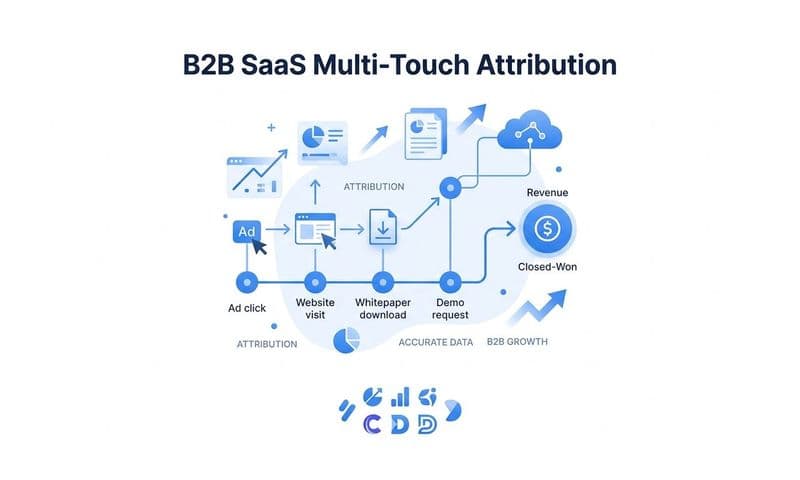
Consider a typical B2B SaaS buying journey. A VP of Marketing sees a LinkedIn ad during a commute on their phone. A week later, a member of their team Googles the product and reads a blog post. Someone else on the team clicks a retargeting ad on Meta and requests a demo. After three sales calls, a legal review, and a pricing negotiation, the deal closes sixty days after that first LinkedIn impression. How many of those touchpoints does your ad platform actually see? Usually just one or two.
Platform-native tracking tools like Google Ads conversion tracking or Meta's pixel are designed to capture surface-level events: clicks, page visits, and form submissions. They work reasonably well for measuring immediate actions, but they have no visibility into what happens after a lead enters your CRM. They don't know whether that demo request turned into a qualified opportunity, whether the deal closed, or how much revenue it generated. Understanding why conversion tracking numbers are wrong is the first step toward fixing this problem.
This creates what's often called the data gap. Your ad platforms optimize for the conversions they can measure, which are typically form fills and demo requests. But those events don't always correlate with revenue. A campaign might generate a high volume of demo requests from small companies that never convert to paying customers, while another campaign quietly drives a handful of high-value enterprise leads that close at a much higher rate. If your tracking stops at the form submission, you'll scale the wrong campaign.
The data gap also leads to budget misallocation at scale. When ad platforms can only see early-funnel events, their machine learning algorithms optimize for the audience most likely to fill out a form, not the audience most likely to become a paying customer. Over time, this trains the algorithm in the wrong direction, pulling spend toward leads that look good on paper but don't convert to revenue.
Fixing this problem requires rethinking what a "conversion" means in a B2B SaaS context and building tracking infrastructure that can follow a customer journey from first impression to closed deal, even when that journey spans multiple devices, multiple stakeholders, and multiple months.
The Conversion Events Worth Tracking Across the Full Funnel
One of the most common mistakes B2B SaaS teams make is treating conversion tracking as a binary exercise: either someone converted or they didn't. In reality, a B2B SaaS conversion is a sequence of events, and tracking each stage of that sequence gives you dramatically more insight into campaign performance and buyer intent.
Think about the full journey a buyer takes before signing a contract. At the top of the funnel, you have awareness-stage interactions: ad clicks, landing page visits, blog post reads, and content downloads. These are micro-conversions that signal early interest. Tracking them helps you understand which campaigns are reaching the right audience and which content is resonating with buyers at the research stage.
Moving deeper into the funnel, you have consideration-stage events: pricing page visits, feature comparison views, demo requests, and webinar registrations. These are stronger signals of buying intent, and they deserve their own tracking events so you can understand which channels are driving high-intent prospects, not just traffic. Teams focused on tracking conversions for lead generation need to distinguish between these stages to avoid optimizing for vanity metrics.
Then come the events that most closely connect to revenue: demo completed, trial signup, trial activation, opportunity created in CRM, proposal sent, and closed-won deal. These are the macro-conversions that actually matter for the business, and they're the ones that traditional tracking most often misses.
Here's a practical way to think about the key events worth tracking:
Top-of-funnel events: Ad click, landing page visit, lead magnet download, email signup. These establish the initial touchpoint and help you measure reach and early engagement by channel.
Mid-funnel events: Demo request, demo completed, trial signup, trial activation. These are the critical handoff points between marketing and sales, and they indicate whether your campaigns are attracting prospects who are genuinely evaluating your product.
Bottom-of-funnel events: Opportunity created, proposal sent, closed-won deal, expansion or upsell. These are the events that tie directly to revenue, and they're where the real ROI calculation happens.
The other critical piece is assigning revenue values to your conversion events. When a closed-won deal is tracked with its actual contract value, you can calculate true cost-per-acquisition and return on ad spend at the deal level rather than the lead level. This changes everything about how you evaluate campaign performance. A campaign with a higher cost-per-lead might still deliver a far better return if the leads it generates close at higher deal values. Implementing SaaS trial to paid conversion tracking is one of the most impactful ways to connect mid-funnel activity to actual revenue.
Micro-conversions also serve as leading indicators. If you notice that visitors from a particular campaign are spending significant time on your pricing page and downloading your security documentation, that's a signal of high buyer intent even before a demo request comes in. Tracking these signals lets you identify high-quality traffic earlier and adjust bids and budgets accordingly.
Server-Side Tracking and Why It Matters for Accurate Data
Even if you've mapped out every conversion event across your funnel, you still face a fundamental technical problem: the tools most marketers rely on to capture those events are increasingly unreliable.
Browser-based tracking, sometimes called client-side tracking, works by placing a pixel or JavaScript tag on your website that fires when a user takes an action. That data is then sent from the user's browser to your ad platform. The problem is that this approach depends entirely on the browser cooperating, and in 2026, browsers are cooperating less and less.
Ad blockers prevent pixels from firing. Safari's Intelligent Tracking Prevention limits how long cookies persist, which is a significant issue for B2B SaaS where buyers might first visit your site weeks before converting. iOS privacy changes have made it harder to track users across apps and websites. Companies struggling with tracking conversions after iOS updates know this pain firsthand. And when a buyer researches your product on their work laptop, then watches a demo on their personal tablet, and signs up from their phone, the browser-based tracking system sees three unrelated sessions instead of one coherent journey.
Server-side tracking solves this by moving the data capture process off the browser entirely. Instead of relying on a pixel in the user's browser to fire and report back, your server directly captures the conversion event and sends it to your ad platforms and analytics tools. Because the data never has to pass through a browser, it isn't subject to cookie restrictions, ad blockers, or device-level privacy settings.
The result is more complete, more accurate conversion data. Events that would have been missed by a browser pixel are captured reliably. This matters enormously for B2B SaaS, where the gap between tracked and actual conversions can be substantial given the length and complexity of the buying journey.
Server-side tracking also enables something called conversion syncing, and this is where the real strategic value comes in. Once you have reliable server-side data flowing from your CRM into your tracking infrastructure, you can send enriched conversion signals back to ad platforms like Meta and Google. Instead of just telling Meta that someone filled out a form, you can tell it that a specific lead from a specific campaign closed as a paying customer with a specific contract value.
When ad platforms receive this enriched data, their machine learning algorithms can optimize for the audience profile that actually converts to revenue, not just the audience profile that fills out forms. Over time, this improves targeting quality, reduces wasted spend, and drives better ROI from your ad budget. It's one of the highest-leverage improvements a B2B SaaS marketing team can make to their tracking infrastructure.
Multi-Touch Attribution: Connecting Every Touchpoint to Revenue
Here's a scenario that plays out constantly in B2B SaaS marketing teams. A deal closes, and the last touchpoint before the closed-won event was a Google search ad. Last-click attribution gives Google all the credit. But if you look at the full journey, you'd see that the buyer first encountered the brand through a LinkedIn thought leadership post, read two blog articles from organic search, attended a webinar, and then clicked a retargeting ad before requesting a demo. Google got the assist, but it certainly didn't score the goal alone.
This is why single-touch attribution models are fundamentally misleading for B2B SaaS. When buyers interact with five, ten, or more touchpoints before converting, crediting only the first or last interaction produces a distorted picture of what's actually driving revenue. Channels that play a critical role in awareness and consideration get defunded, while the channels that happen to be present at the end of the journey get over-credited. Dedicated SaaS marketing attribution tracking is essential for solving this problem.
Multi-touch attribution distributes credit across all the touchpoints in a buyer's journey, giving marketers a much more accurate view of how each channel and campaign contributes to revenue. There are several models worth understanding:
Linear attribution: Distributes credit equally across every touchpoint in the journey. This is a good starting point for teams that want to acknowledge the full funnel without making assumptions about which touchpoints matter most.
Time-decay attribution: Gives more credit to touchpoints that occurred closer to the conversion. This model is useful for B2B SaaS teams with shorter sales cycles or for measuring campaigns that are primarily designed to close deals rather than generate awareness.
Position-based attribution: Assigns a larger share of credit to the first and last touchpoints, with the remaining credit distributed across the middle. This model acknowledges the importance of both initial awareness and final conversion while still recognizing the touchpoints in between.
Data-driven attribution: Uses machine learning to analyze your actual conversion data and assign credit based on which touchpoints statistically contribute most to closed deals. This is the most accurate model for teams with sufficient data volume, because it's based on your specific buyer behavior rather than a predetermined formula.
The practical outcome of implementing multi-touch attribution goes beyond just more accurate reporting. When you can see the full journey from first impression to closed deal, budget allocation decisions become grounded in evidence. You can identify which awareness-stage campaigns are consistently appearing in the journeys of high-value customers. You can see which content pieces are accelerating deals through the funnel. And you can make confident decisions about where to increase spend, rather than guessing based on last-click data that tells only part of the story. Exploring the best marketing attribution tools for B2B SaaS can help you find the right platform to make this a reality.
Building Your B2B SaaS Conversion Tracking Stack
Understanding the principles of B2B SaaS conversion tracking is one thing. Building the infrastructure to make it work is another. A modern B2B SaaS tracking stack requires several interconnected components, and each one plays a specific role in connecting marketing activity to revenue outcomes.
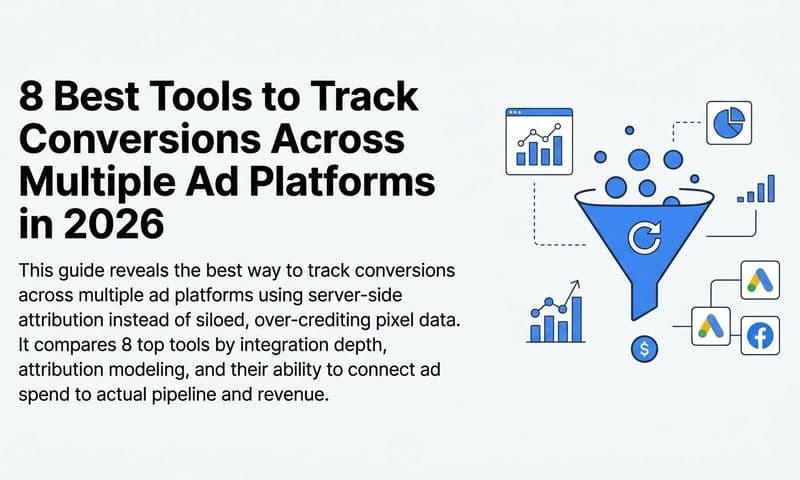
Ad platform integrations: Your tracking stack starts with direct connections to the ad platforms where you're running campaigns: Google Ads, Meta, LinkedIn, and any others relevant to your channels. These integrations allow conversion data to flow back to the platforms that need it for optimization. Without them, your ad platforms are flying blind. For teams running campaigns across multiple networks, tracking conversions across multiple ad platforms is a critical capability to get right from the start.
CRM as the source of truth: Your CRM, whether that's HubSpot, Salesforce, or another platform, is where the most valuable conversion data lives. Deal stages, contract values, close dates, and customer records all live here. The critical step is connecting your CRM to your tracking infrastructure so that offline conversions, such as sales calls, demo completions, and signed contracts, are tied back to the original marketing touchpoints that started the journey.
Server-side tracking infrastructure: As discussed earlier, this is the technical layer that captures conversion data reliably and sends it where it needs to go, without depending on browser cookies or pixels. This infrastructure is what makes it possible to track conversions accurately even as browser privacy restrictions continue to tighten.
Attribution platform: This is the layer that connects everything together, stitching together ad platform data, CRM data, and website behavior into a unified view of the customer journey. A good attribution platform lets you apply different attribution models, compare performance across channels, and drill down into individual campaign and ad-level performance tied to actual revenue.
Reporting and analysis layer: Finally, you need a way to surface insights from all this data in a format that's actionable for your team. This might be a built-in dashboard in your attribution platform or a connected analytics tool that lets you slice and dice performance by channel, campaign, cohort, or deal size.
The integration between your CRM and your ad platforms deserves special attention. When you feed closed-won deal data back to Google or Meta, including the revenue value of each deal, those platforms can use that information to identify the audience characteristics most associated with high-value customers. This is sometimes called offline conversion import, and it's one of the most effective ways to improve ad platform performance for B2B SaaS companies. Robust revenue attribution for B2B SaaS companies depends on getting this data loop right. The ad algorithms get smarter about who to target, bidding becomes more efficient, and over time, the quality of leads coming through your paid channels improves.
From Tracking to Scaling With Confidence
Pulling all of this together, the foundation of effective B2B SaaS conversion tracking comes down to a few core principles. Track the full funnel, not just the top. Use server-side tracking to capture data accurately in a privacy-first environment. Implement multi-touch attribution to understand how every channel contributes to revenue. Integrate your CRM so that offline conversions are connected to the campaigns that started the journey. And feed enriched conversion data back to your ad platforms so their algorithms can optimize for the outcomes that actually matter to your business.
When these pieces are in place, something shifts in how your marketing team operates. Instead of debating which channel deserves credit, you can see the data. Instead of scaling campaigns based on cost-per-lead, you can scale based on cost-per-revenue. Instead of cutting awareness campaigns because they don't show direct conversions, you can see their contribution to deals that closed weeks later.
This is exactly what Cometly is built to deliver. Cometly connects your ad platforms, CRM, and website tracking into a single attribution platform that gives you a complete view of every customer journey. It captures every touchpoint from the first ad click to the closed-won deal, applies multi-touch attribution across all your channels, and syncs enriched conversion data back to Meta, Google, and other ad platforms so their algorithms can find more of your best customers.
Cometly's AI-powered features go further by analyzing your campaign data and surfacing recommendations for which ads and audiences to scale, so you're not just tracking performance but actively improving it. The AI Chat feature lets you ask questions about your data in plain language, making it easier for your whole team to act on insights without needing a data analyst to interpret reports.
For B2B SaaS teams tired of the gap between what their ad platforms report and what their CRM shows, accurate attribution isn't just a nice-to-have. It's the difference between scaling campaigns that drive revenue and wasting budget on campaigns that just drive leads.
Ready to close the gap between your ad spend and your revenue data? Get your free demo today and see how Cometly can help you capture every touchpoint, connect every conversion to revenue, and scale your campaigns with the confidence that comes from knowing exactly what's working.