You've just wrapped up your quarterly marketing review. The numbers look solid: thousands of clicks, hundreds of leads, a healthy pipeline. But when your CFO asks which campaigns actually drove the closed deals this quarter, you hesitate. You know LinkedIn claimed credit. Google claimed credit. So did that retargeting campaign from two months ago. And somewhere in between, your sales team made five follow-up calls and sent a dozen emails.
This is the defining challenge of B2B SaaS marketing. Sales cycles stretch across weeks or months, decisions involve multiple stakeholders, and the journey from first ad click to signed contract winds through so many touchpoints that connecting marketing spend to closed revenue feels like solving a puzzle with half the pieces missing.
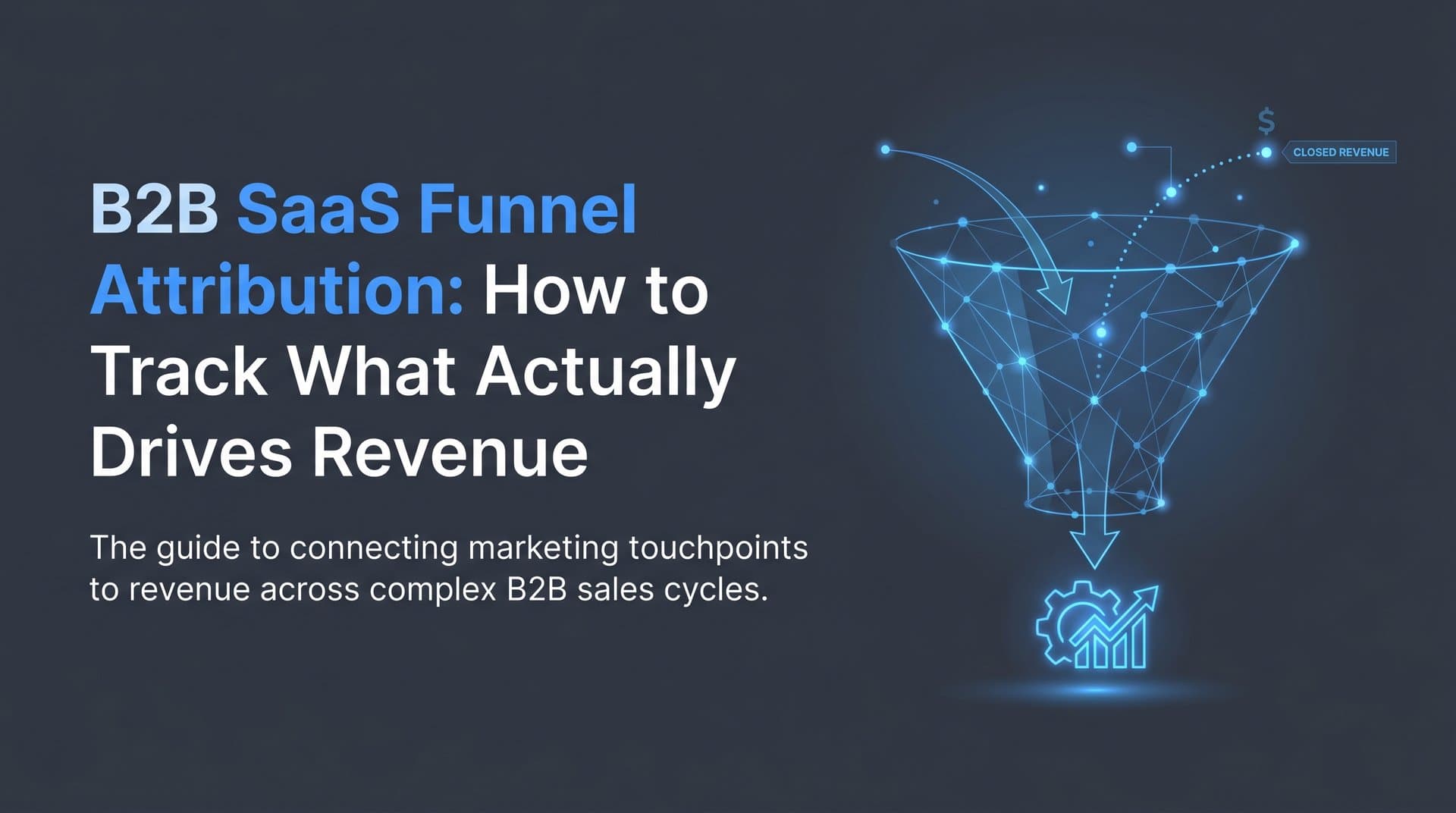
B2B SaaS funnel attribution is the practice of systematically connecting those marketing touchpoints to each stage of your funnel, from initial awareness all the way through trial or demo, qualified opportunity, and closed-won revenue. Done well, it transforms your marketing from a cost center into a measurable growth engine. Done poorly, or not at all, it leaves you guessing where to invest next quarter.
This guide will walk you through why traditional tracking breaks down in B2B SaaS, how to map your funnel for attribution, which models fit long sales cycles, how to solve the data accuracy problem, and how to turn attribution insights into smarter budget decisions.
Why Traditional Tracking Falls Apart in B2B SaaS
Single-touch attribution models were designed for a world where someone clicks an ad and buys something within minutes. That world exists in e-commerce. It does not exist in B2B SaaS.
When a potential customer first encounters your brand through a LinkedIn thought leadership post, then searches for your product two weeks later, then attends a webinar, then requests a demo, then goes through a 45-day procurement review involving three decision-makers, no single touchpoint deserves full credit for that deal. Yet first-click and last-click attribution models do exactly that. They hand all the credit to either the very first interaction or the very last one before conversion, ignoring everything that happened in between. Understanding the difference between single-source and multi-touch attribution is essential for avoiding this trap.
The result is a distorted picture of what's actually working. Campaigns that generate initial awareness get zero credit under last-click models. Channels that show up at the end of a long nurture sequence get all the credit under last-click, even if they were just the final nudge in a journey that started months earlier. Teams end up cutting campaigns that were quietly doing the heavy lifting and doubling down on channels that merely closed deals others started.
Platform-reported metrics compound this problem significantly. Meta, Google, and LinkedIn each report conversions through their own lens, using their own attribution windows and logic. When a prospect clicks a LinkedIn ad on Monday and a Google Search ad on Thursday before filling out a demo request form on Friday, both platforms will often claim full credit for that conversion. This is a core reason attribution data doesn't match across your reporting tools, making it nearly impossible to compare channel performance accurately.
The most damaging gap, though, is the one between marketing-qualified leads and actual closed revenue. Most marketing teams track conversions at the top of the funnel: form fills, demo requests, trial signups. But in B2B SaaS, the deal that matters is the one that closes and generates ARR. A campaign that drives hundreds of MQLs but none of them convert to paying customers is not a success, even if it looks like one in your ad platform dashboards.
This "black hole" between marketing activity and revenue outcomes is where B2B SaaS funnel attribution earns its value. Without visibility into which campaigns contributed to pipeline and bookings, marketers are essentially flying blind at the most critical decision point: where to invest next.
Mapping the B2B SaaS Funnel for Attribution
Before you can attribute revenue to marketing, you need to define what you're attributing it across. B2B SaaS funnels have distinct stages, and each one needs its own attribution data to tell a complete story.
Think of your funnel in five key stages. Each one represents a meaningful transition in the buyer's journey, and each one tells you something different about how your marketing is performing.
Stage 1: Ad Click or Content Engagement. This is the first measurable interaction, whether it's a paid ad click, an organic search visit, a social media post engagement, or a content download. This stage tells you which channels are generating awareness and pulling prospects into your orbit.
Stage 2: Lead Capture. The prospect provides their contact information, typically through a demo request, content offer, newsletter signup, or free trial registration. This is where most marketing teams currently measure success, but it's only the beginning of the attribution story.
Stage 3: Product Demo or Free Trial. The prospect experiences your product. In B2B SaaS, this is often a pivotal moment. Attribution data at this stage reveals which lead sources produce prospects who are genuinely engaged with the product versus those who sign up and disappear. Effectively tracking SaaS trial-to-paid conversions at this stage is critical for understanding true campaign value.
Stage 4: Sales-Qualified Opportunity. Your sales team has qualified the lead, and there's a real deal in play. This is where marketing attribution starts connecting directly to pipeline value. Knowing which campaigns generate SQL-level prospects is far more valuable than knowing which ones generate raw leads.
Stage 5: Closed-Won Revenue. The deal is signed. This is the only stage that directly connects marketing to ARR, and it's the stage most B2B SaaS marketing teams have the least visibility into.
The reason each stage needs its own attribution data is simple: campaigns that excel at one stage often underperform at others. A LinkedIn campaign might generate a high volume of leads at Stage 2 but produce very few SQLs at Stage 4. A paid search campaign might generate fewer leads overall but close at a much higher rate. Without stage-level attribution, you can't see this distinction, and you end up optimizing for the wrong outcomes.
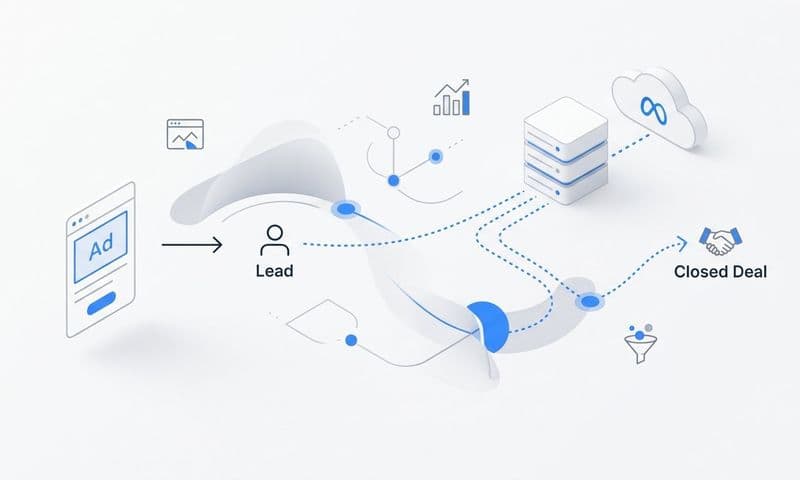
Making this work requires connecting three data systems into a unified layer: your ad platforms (where touchpoints originate), your website tracking (where behavior is captured), and your CRM (where the deal journey lives). A solid SaaS marketing attribution strategy ensures these systems share data so every touchpoint can be mapped to a real person moving through a real funnel. When they operate in silos, you're left stitching together reports manually and hoping the picture they paint is accurate.
Attribution Models That Actually Work for Long Sales Cycles
Choosing an attribution model is not about finding the "correct" answer. It's about choosing the lens that best answers the questions your marketing team needs to answer. In B2B SaaS, where deals involve multiple stakeholders and span months, some models are simply better equipped than others.
First-Touch Attribution assigns all credit to the very first interaction a prospect had with your brand. It's useful for understanding which channels are best at generating initial awareness, but it completely ignores everything that happened between that first touch and the closed deal. For long sales cycles, this creates a misleading picture of what actually drove revenue.
Last-Touch Attribution does the opposite, crediting the final touchpoint before conversion. This model is easy to implement and understand, but in a multi-month B2B deal, the last touchpoint is often a sales email or a direct visit, not the campaign that originally brought the prospect into the funnel. Optimizing purely on last-touch often means underfunding awareness and nurture channels that are doing critical work.
Linear Attribution distributes credit equally across all touchpoints in the customer journey. It's more fair than single-touch models and gives visibility into the full journey, but it treats a casual blog visit the same as a product demo, which may not reflect the actual influence each touchpoint had.
Time-Decay Attribution gives more credit to touchpoints that occurred closer to the conversion event. This makes intuitive sense for short sales cycles, but in a 90-day B2B deal, it can systematically undervalue the early-stage campaigns that first generated awareness and interest. Understanding which attribution model approach is mainly used in marketing can help you benchmark your own strategy.
Position-Based Models like U-shaped (which emphasizes first touch and lead creation) and W-shaped (which also weights the opportunity creation moment) are specifically designed for B2B funnels. They acknowledge that certain moments in the journey are more pivotal than others while still distributing credit across the full journey.
For most B2B SaaS teams, multi-touch attribution is the right direction. It captures the reality that multiple campaigns and channels contribute to a single closed deal, and it allows you to see which touchpoints appear consistently in the journeys of your best customers. The specific model you choose within that framework should reflect your funnel's complexity and the questions you're trying to answer.
If your primary question is "which channels generate awareness that eventually converts," lean toward a model that weights early touchpoints. If you want to understand the full nurture journey, linear or time-decay may serve you better. The key is consistency: pick a model, apply it uniformly, and compare results over time rather than switching models whenever the numbers look uncomfortable.
Server-Side Tracking and Data Accuracy Challenges
Here's the problem that undermines even the best attribution strategy: your tracking data may not be accurate in the first place.
Client-side tracking, the kind that relies on JavaScript pixels firing in a user's browser, has become increasingly unreliable. Safari's Intelligent Tracking Prevention (ITP) limits how long cookies can persist. iOS App Tracking Transparency requires users to opt in to tracking, and most don't. Ad blockers prevent pixels from firing entirely. Third-party cookie deprecation in Chrome has been an ongoing shift that continues to erode cross-site tracking capabilities. These are among the most pressing SaaS marketing attribution challenges teams face today.
For B2B SaaS, where sales cycles are long and every lead matters, this degradation is especially damaging. If your pixel fails to fire when a key decision-maker visits your pricing page or completes a demo request, that touchpoint disappears from your attribution data entirely. You're left making budget decisions based on an incomplete record of what actually happened.
Server-side tracking addresses this by moving data capture away from the browser and onto your server or CRM. Instead of relying on a pixel in a user's browser to fire correctly, your server directly sends conversion events to your analytics and ad platforms. This approach bypasses browser-level restrictions, is unaffected by ad blockers, and produces a more complete and reliable record of customer interactions.
The benefits extend beyond just fixing broken tracking. Server-side setups also allow you to enrich conversion events with CRM data before sending them to ad platforms. Instead of sending a raw "form submitted" event, you can send "demo request from a director at a 200-person SaaS company who later became a closed-won deal." That level of signal quality changes what ad platform algorithms can do with the data. Comparing UTM tracking versus attribution software reveals just how much richer server-side approaches can be.
This is where conversion sync becomes a critical piece of the B2B SaaS attribution puzzle. Ad platforms like Meta and Google use machine learning algorithms (Meta's Advantage+, Google's Smart Bidding) to optimize campaign delivery based on the conversion signals they receive. If you only feed them top-of-funnel form fills, they optimize for form fills. If you send them enriched signals tied to actual closed revenue, they can begin optimizing for the types of prospects who actually become customers.
The practical implication is significant. Accurate, enriched conversion data fed back to ad platforms improves targeting quality over time, which means your campaigns get better at finding prospects who resemble your best customers rather than just your most frequent form-fillers. For B2B SaaS teams spending significant budget on paid channels, this feedback loop can meaningfully improve lead quality without requiring a budget increase.
Turning Attribution Data Into Smarter Budget Decisions
Attribution data is only valuable if it changes how you allocate resources. The goal isn't to build a beautiful dashboard. It's to make smarter decisions about where your next dollar of marketing budget should go.
The most immediate insight funnel attribution provides is the distinction between channels that drive pipeline and revenue versus channels that generate top-of-funnel volume that never converts. This is a distinction that platform-reported metrics will never reveal, because platforms only see what happens within their own ecosystem. Dedicated revenue attribution for B2B SaaS companies bridges this gap by connecting marketing activity directly to closed deals.
With stage-level attribution in place, you can start asking the questions that actually matter. Which channels produce SQLs, not just MQLs? Which campaigns appear consistently in the journeys of closed-won deals? Which lead sources have the shortest average sales cycle? These questions point directly to where budget should be concentrated.
The reallocation process typically follows a clear pattern. Campaigns tied to closed deals and strong pipeline receive increased investment. Channels that produce high lead volume but weak downstream conversion get scrutinized and often reduced. Budget shifts from vanity metrics toward revenue metrics, and the marketing team can defend those decisions with data rather than intuition.
This is where AI-powered analysis adds real leverage. Manually reviewing attribution data across dozens of campaigns, multiple channels, and months of deal cycles is time-consuming work. AI can surface patterns across that data in a fraction of the time, identifying which campaign combinations appear most frequently in high-value customer journeys, which audience segments convert fastest, and where diminishing returns are setting in before you've already overspent. Exploring the latest SaaS marketing analytics tools can help you find the right platform for this kind of analysis.
The result is a faster optimization cycle. Instead of waiting until the end of the quarter to review performance and adjust, AI-driven attribution tools can flag underperforming campaigns and highlight scaling opportunities in near real time, giving marketing teams the agility to respond while the data is still actionable.
Putting It All Together: Building Your Attribution Stack
B2B SaaS funnel attribution is not a single tool or a one-time setup. It's a connected system of components that work together to give you a clear, accurate view of how marketing drives revenue.
The essential components are straightforward. You need unified tracking that connects your ad platforms, website, and CRM so every touchpoint maps to a real person in a real deal. You need a multi-touch attribution model that reflects the complexity of your sales cycle and distributes credit across the full customer journey. You need server-side data capture to ensure your tracking is accurate and not degraded by browser restrictions. And you need conversion syncing to feed enriched, revenue-quality signals back to the ad platforms so their algorithms can optimize for the outcomes that actually matter to your business.
When these components are in place, B2B SaaS funnel attribution stops being a reporting exercise and becomes a competitive advantage. Marketing teams that can prove which campaigns drive closed revenue operate with a confidence that teams relying on platform-reported metrics simply cannot match. They make faster decisions, defend their budgets with evidence, and scale the campaigns that work rather than the ones that merely look like they work.
If you're ready to move beyond last-click guesswork and platform-reported vanity metrics, Cometly is built for exactly this use case. It connects your ad platforms, CRM, and website into a single attribution layer, applies multi-touch modeling across your full funnel, and uses AI to surface the insights that drive smarter budget decisions. From server-side tracking to conversion sync and AI-powered recommendations, Cometly gives B2B SaaS marketing teams the visibility they need to invest with confidence.
Get your free demo today and start capturing every touchpoint so you always know what's actually driving your revenue.