Browser-based tracking used to be simple. You dropped a pixel on your website, it fired when someone converted, and your ad platforms knew what was working. For B2B SaaS marketers, that era is effectively over.
Apple's Intelligent Tracking Prevention (ITP) limits cookie lifespans to as little as 24 hours for JavaScript-set cookies in Safari. Firefox ships with Enhanced Tracking Protection enabled by default. Ad blockers are installed on a growing share of browsers across every audience segment. The result? A significant and growing portion of your conversion events are simply disappearing before they ever reach your ad platforms or analytics tools.
For B2B SaaS companies, this is not just a tracking inconvenience. It is a revenue visibility problem. When your sales cycles run weeks or months, involve multiple decision-makers, and depend on CRM data to connect marketing activity to closed deals, losing even a fraction of your tracking data creates attribution gaps that compound over time. You end up with ad platforms optimizing on incomplete signals, budgets allocated to channels that look efficient but may not be, and leadership asking questions you cannot confidently answer.
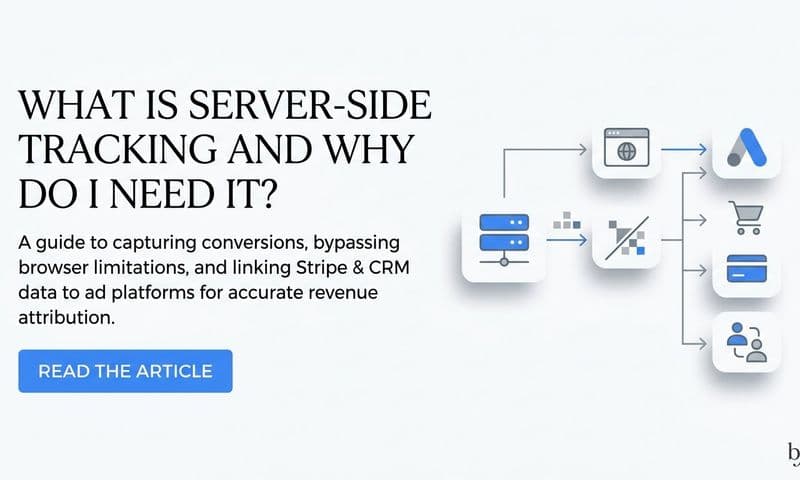
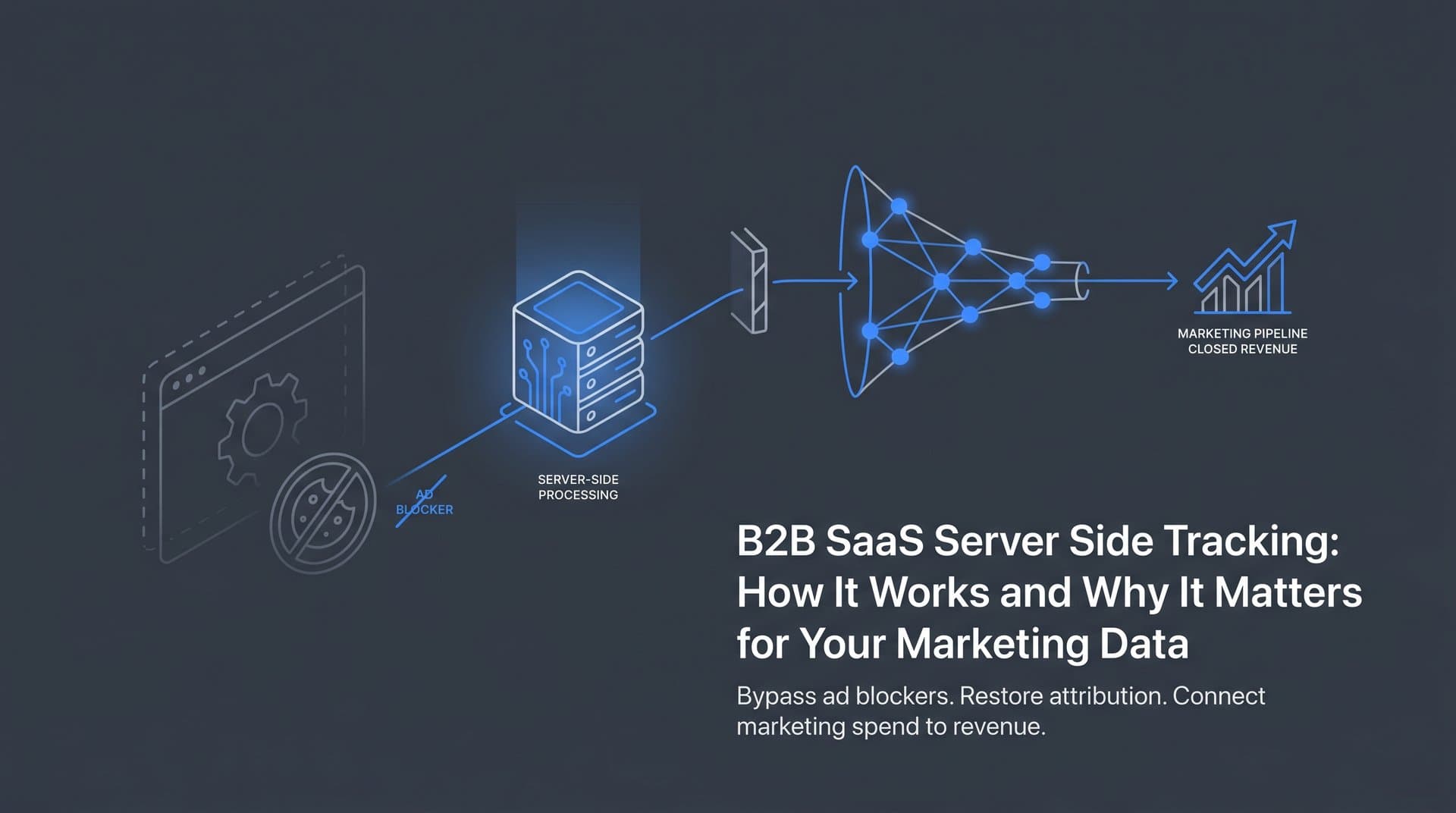
Server side tracking is the modern solution to this problem. Instead of relying on a browser pixel to transmit data, server side tracking routes events through a secure server environment before forwarding them to your ad platforms, CRM, and analytics tools. It operates outside the browser entirely, which means cookie restrictions, ad blockers, and JavaScript errors cannot interfere with your data collection.
This guide breaks down exactly how B2B SaaS server side tracking works, why it matters more for SaaS companies than almost any other business model, and what a practical implementation looks like from end to end.
Why Browser-Based Tracking Is Failing B2B SaaS Marketers
Traditional client-side tracking works like this: a visitor lands on your website, their browser loads a JavaScript pixel from an ad platform like Meta or Google, and when they complete an action such as submitting a demo request form, that pixel fires and sends conversion data back to the platform. For years, this approach worked reasonably well. The data was not perfect, but it was consistent enough to make sound optimization decisions.
That consistency has eroded dramatically. Here is what is happening at the browser level today.
ITP and cookie restrictions: Apple's Safari browser, which commands a substantial share of traffic in many B2B markets, now limits the lifespan of cookies set by JavaScript to as little as 24 hours. Even cookies set server-side through HTTP headers are capped at seven days under ITP. For a B2B SaaS prospect who clicks a LinkedIn ad today but does not convert for three weeks, that attribution is simply lost.
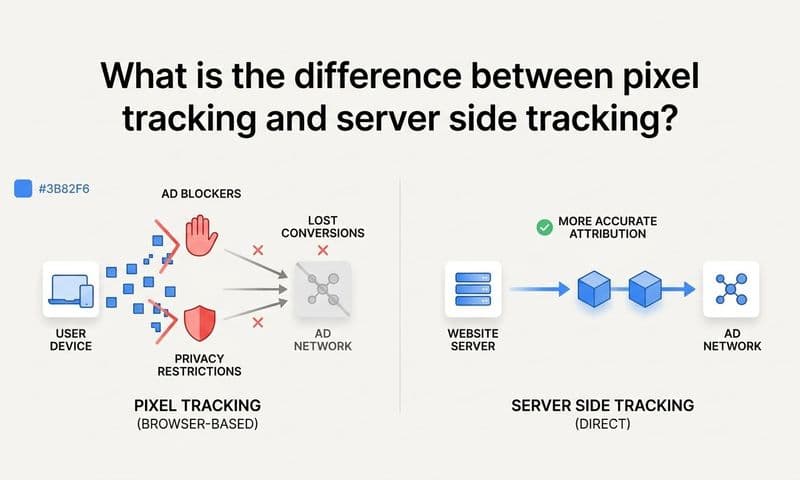
Ad blockers: A growing and significant share of internet users have ad blockers installed. Many of these tools block not just ads but also the tracking pixels associated with ad platforms. If your pixel cannot fire, your conversion does not get recorded, regardless of how clearly that campaign drove the result. Understanding the difference between server side tracking vs pixel tracking is essential in this environment.
Browser privacy defaults: Firefox blocks third-party trackers by default through Enhanced Tracking Protection. Google's Privacy Sandbox model is reshaping how Chrome handles cross-site tracking. The direction across every major browser is toward less data, not more.
For B2B SaaS companies specifically, these challenges are amplified by the nature of the buying process. A typical B2B SaaS deal involves multiple stakeholders across different devices and browsers, a sales cycle that can span weeks or months, and a conversion that often happens in a CRM, not on a webpage. When browser cookies expire or get blocked mid-cycle, the thread connecting a top-of-funnel ad impression to a bottom-of-funnel closed deal breaks entirely.
The downstream effects are significant. Ad platform algorithms rely on conversion signals to learn which audiences, creatives, and placements drive results. When those signals are incomplete, the algorithms optimize toward whatever data they do receive, which is often a biased, top-of-funnel subset of your actual outcomes. This leads to inflated cost-per-acquisition estimates, undervalued campaigns that are actually driving pipeline, and difficulty making a credible case for marketing ROI when leadership asks where the budget is going.
The problem is not that your campaigns are underperforming. It is that your tracking infrastructure can no longer see the full picture.
The Technical Flow Behind Server Side Tracking
Understanding how server side tracking works does not require a computer science degree. The concept is straightforward once you see how it differs from the traditional approach. For a deeper dive, read our guide on server side tracking explained.
In a client-side setup, the data flow looks like this: a user takes an action in their browser, a JavaScript pixel detects it, and the pixel sends data directly from the browser to the ad platform's servers. Every step of that chain is vulnerable to browser-level interference.
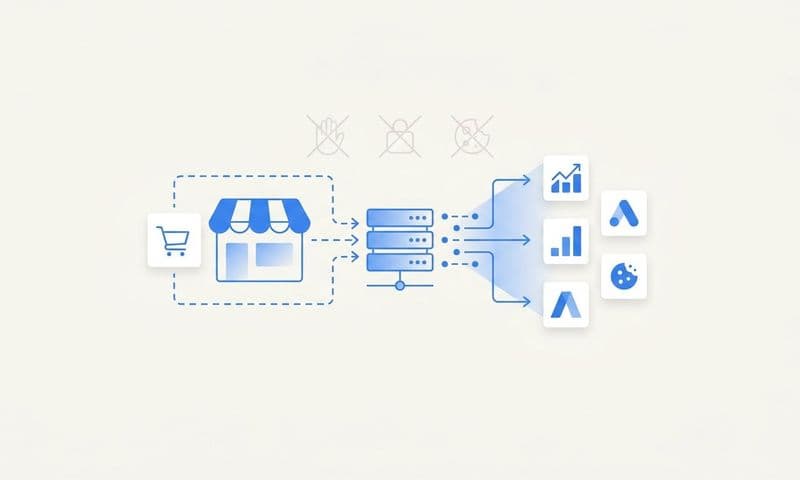
In a server-side setup, the flow is different. When a user takes an action, the event data is sent to your own server (or a tracking partner's server) first. That server then processes, enriches, and forwards the data to your destinations: Meta via the Conversions API, Google via Enhanced Conversions or Measurement Protocol, your CRM, your analytics platform, and anywhere else you need it to go. The browser is no longer the transmission mechanism. It is just the trigger.
Because the data transmission happens at the server level, ad blockers cannot intercept it. Browser cookie restrictions do not apply. JavaScript errors on the page do not cause events to drop. The data gets through because it is traveling through a channel that browser privacy features were never designed to affect.
Major ad platforms have built their infrastructure to receive this kind of data. Meta's Conversions API (CAPI) accepts server-side event data directly. Google supports server-side signals through Enhanced Conversions and the Measurement Protocol. TikTok has its Events API. These are not workarounds. They are purpose-built endpoints that platforms actively encourage advertisers to use because better data improves their algorithms' ability to deliver results.
One important clarification: server side tracking does not mean you eliminate all client-side tracking. The most effective implementations use both. Client-side scripts still play a role in capturing real-time in-browser interactions, supporting consent management, and enabling features like dynamic content personalization. Server side tracking works alongside these scripts to fill the gaps, catch the events that get blocked or missed, and ensure that your data layer is as complete as possible.
Think of it as a redundancy system. Your client-side pixel tries to fire. If it succeeds, great. If it gets blocked, the server-side event catches it. The result is a much more complete and reliable data set than either approach could achieve alone.
The Real-World Benefits for B2B SaaS Companies
The technical advantages of server side tracking translate into concrete business outcomes that matter to B2B SaaS marketing teams.
More accurate attribution across long sales cycles: Server side tracking captures touchpoints that browser tracking misses, including mid-funnel interactions that happen weeks after the initial ad click. For B2B SaaS, where a prospect might engage with your brand a dozen times before requesting a demo, this completeness is critical. You get a clearer, more honest picture of which campaigns and channels are actually influencing pipeline and revenue, not just generating clicks. Learn more about revenue attribution for B2B SaaS companies to see how this works in practice.
Better ad platform performance: When you send more complete and accurate conversion data back to Meta, Google, and other platforms, their machine learning algorithms have better signals to work with. They can identify which audience segments, creative approaches, and bidding strategies are actually driving qualified conversions. This typically leads to improved targeting efficiency over time. The algorithms are only as good as the data you feed them, and server side tracking gives them substantially better data.
Reliable data for budget decisions: One of the most underrated benefits of server side tracking is what it does for internal decision-making. When marketing teams trust their numbers, they can make confident budget allocation decisions, build credible ROI reports for leadership, and scale campaigns without the nagging uncertainty that comes with incomplete data. Confidence in your data is not a soft benefit. It directly affects the quality of every decision downstream.
Extended attribution windows: Because server side tracking is not subject to cookie expiration limits in the same way client-side tracking is, you can maintain attribution across longer time windows. For B2B SaaS companies with 60 or 90-day sales cycles, this means you can actually connect a closed deal back to the campaign that started the conversation, even when the browser cookie would have expired long before the deal closed. Our article on why server side tracking is more accurate covers this in detail.
Server Side Tracking vs. Client Side Tracking: A Direct Comparison
Let's put both approaches side by side so you can see exactly where the differences lie and why a hybrid model is the right answer for most B2B SaaS teams. For a comprehensive breakdown, see our guide on server side vs client side tracking.
Data accuracy: Client-side tracking is inherently incomplete in today's browser environment. Events get blocked, cookies expire, and JavaScript errors cause silent failures. Server side tracking operates outside these constraints, resulting in a more complete and reliable data set.
Resilience to ad blockers: Client-side pixels are frequently blocked by ad blockers, which target the known domains and scripts associated with ad platforms. Server-side events route through your own domain or a trusted server, making them far more difficult for blockers to intercept.
Impact of browser privacy updates: ITP, Enhanced Tracking Protection, and similar features directly degrade client-side tracking by limiting cookie lifespans and blocking third-party scripts. Server side tracking is largely unaffected by these browser-level policies because it does not depend on the browser to transmit data.
Implementation complexity: Client-side tracking is simpler to set up. You paste a pixel, configure a tag manager, and you are running. Server side tracking requires more infrastructure: a server-side endpoint, event mapping, and integration with your CRM and ad platforms. This complexity is manageable, especially with purpose-built platforms, but it is a real consideration.
Data enrichment capabilities: Server side tracking opens the door to event enrichment that client-side tracking cannot support. You can append CRM data to conversion events, include revenue values from closed deals, and send downstream funnel signals like opportunity created or closed-won back to ad platforms. This kind of enrichment is simply not possible when the browser is doing the heavy lifting.
Client-side tracking still has a legitimate role. It captures in-browser interactions in real time, supports consent management flows, and enables user experience features that depend on immediate browser-level data. But as a standalone attribution approach for B2B SaaS, it is no longer sufficient. The hybrid model, where server side tracking serves as the backbone and client-side scripts handle real-time UX functions, is the standard that leading marketing teams are moving toward.
Implementing Server Side Tracking in Your B2B SaaS Stack
Getting server side tracking up and running requires thinking through a few core components. Here is how to approach the implementation in a way that makes sense for B2B SaaS specifically.
Start with your server-side endpoint: You need a place for events to land before they get forwarded to your destinations. This can be a self-hosted server-side container using something like Google Tag Manager Server-Side, or it can be a purpose-built tracking platform that manages the infrastructure for you. The DIY route gives you more control but requires engineering resources and ongoing maintenance. Purpose-built platforms handle the infrastructure automatically, which is often the right trade-off for marketing teams that want to move quickly without a heavy technical lift. Our server side tracking implementation guide walks through this in more detail.
Map your events carefully: For B2B SaaS, your event map should cover the full funnel, not just website conversions. At the top, you want to capture actions like ad clicks, landing page visits, and content downloads. In the middle, demo requests, trial signups, and product activations. At the bottom, and this is where B2B SaaS tracking gets uniquely powerful, you want CRM events like MQL created, SQL created, opportunity opened, and closed-won.
Connect your CRM: The ability to send CRM-level events back to ad platforms is one of the most valuable capabilities server side tracking unlocks for B2B SaaS. When Meta or Google receives a closed-won event with an associated revenue value, their algorithms can optimize toward the audience and creative patterns that drive actual revenue, not just form fills. This requires a direct integration between your CRM (whether that is Salesforce, HubSpot, or another platform) and your server-side tracking layer.
Define your data destinations: Once events are captured server-side, they need to go somewhere useful. Typically this means your ad platforms via their server-side APIs, your analytics platform, and your CRM if you are enriching records with behavioral data. Setting up these destination integrations correctly is critical because it determines whether your data actually reaches the systems that need it.
Validate your setup: After implementation, test every event in your map to confirm it fires correctly, arrives at each destination with the right parameters, and is being attributed properly. Gaps in validation often show up weeks later as mysterious drops in reported conversions, and by then the data loss has already affected your optimization. Be aware of common server side tracking setup challenges so you can address them proactively.
Feeding Better Data Back to Ad Platforms with Conversion Sync
Server side tracking solves the data collection problem. Conversion syncing is what turns that better data into better ad performance.
The concept is straightforward. Once you have enriched, server-side tracked conversion events, you send them back to your ad platforms through their native server-side APIs. Meta receives them through the Conversions API. Google receives them through Enhanced Conversions and the Measurement Protocol. TikTok receives them through its Events API. These platforms are designed to ingest this kind of data and use it to improve their optimization models. Understanding server side tracking benefits for advertisers helps clarify why this approach delivers such strong results.
Here is why this matters so much for B2B SaaS. If you only send top-of-funnel signals, like form submissions or trial signups, ad platform algorithms optimize toward generating more of those events. But form submissions are not revenue. When you close the loop by sending downstream CRM events, including opportunity created, closed-won, and associated deal values, the algorithms learn what a high-value conversion actually looks like. They can then find more of the right people, not just more people.
This creates a compounding feedback loop. Better data leads to better optimization. Better optimization leads to better results. Better results generate more high-quality conversion events to feed back into the system. Over time, this loop meaningfully improves campaign efficiency in ways that top-of-funnel signal optimization simply cannot achieve.
This is exactly the problem that Cometly's server-side tracking and Conversion Sync capabilities are built to solve. Cometly connects your ad platforms, website, and CRM to track the full customer journey in real time, from the first ad click through every touchpoint to closed revenue. Its server-side tracking infrastructure captures events that browser-based pixels miss, and its Conversion Sync feature sends enriched, conversion-ready events back to Meta, Google, and other platforms so their algorithms can optimize toward the outcomes that actually matter to your business.
With Cometly, you also get AI-powered analysis on top of that data foundation. The AI Ads Manager identifies which campaigns and creatives are driving real pipeline, not just clicks, and surfaces recommendations for where to scale and where to pull back. The AI Chat feature lets you query your attribution data in plain language, so you spend less time building reports and more time acting on insights.
Putting It All Together
B2B SaaS server side tracking is not a technical nice-to-have. It is the foundation that accurate attribution, efficient ad spend, and confident marketing decisions are built on. Browser-based tracking has been degraded by privacy updates, cookie restrictions, and ad blockers to the point where relying on it as your primary data collection method means making major decisions with incomplete information.
Moving tracking to the server level protects your data from browser-level disruptions, gives you a complete view of the customer journey across long and complex sales cycles, and enables ad platforms to optimize with the kind of enriched, downstream signals that actually drive revenue outcomes. The hybrid approach, combining server side tracking as your backbone with lightweight client-side scripts for real-time browser functions, is where modern B2B SaaS marketing teams are landing.
The companies that get this right will have a compounding advantage: better data feeding better algorithms, producing better results, generating more useful data. The companies that do not will keep optimizing on a fraction of their actual conversions and wondering why their CPAs are climbing.
If you are ready to build that foundation, Get your free demo of Cometly today. See how its server-side tracking, multi-touch attribution, and Conversion Sync capabilities can help you capture every touchpoint, understand what truly drives revenue, and scale your campaigns with the confidence that comes from knowing your numbers are right.