

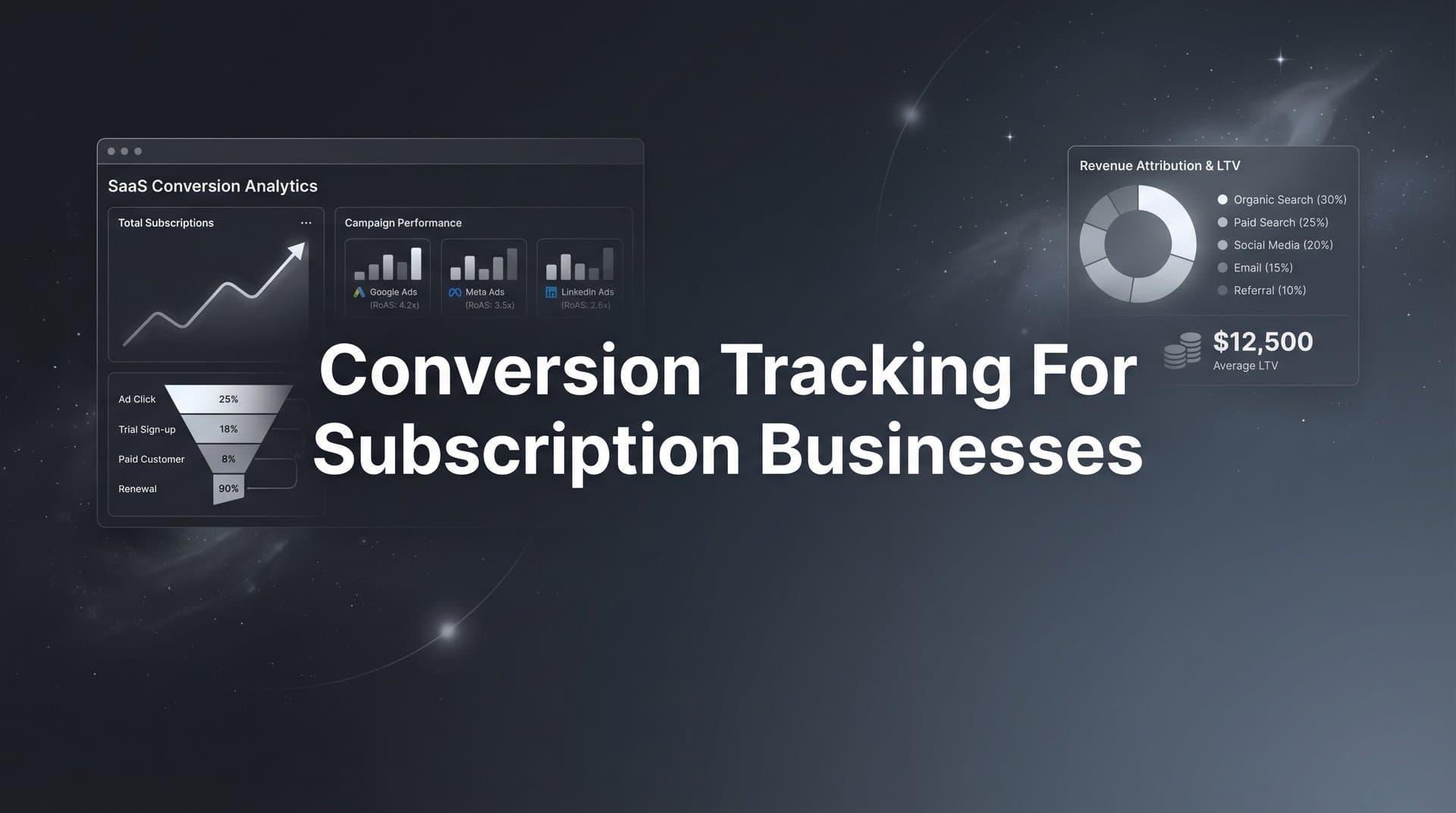
Subscription businesses face a unique tracking challenge that most marketers overlook: the conversion that matters most happens long after the initial click. When a customer signs up for a free trial, that click might not turn into real revenue for 7, 14, or even 30 days. And if they churn after month one? Your 'successful conversion' was actually a loss.
This disconnect between ad platform data and actual subscription revenue creates a massive blind spot. You end up optimizing campaigns based on trial signups while your most profitable customer acquisition channels remain hidden. The result? You scale the wrong campaigns, waste budget on low-quality signups, and wonder why your customer acquisition costs keep climbing while retention stays flat.
Think of it like judging a restaurant by how many people walk through the door instead of how many become regulars. The initial visit tells you almost nothing about profitability.
This guide walks you through setting up conversion tracking that captures the full subscription lifecycle, from first touch to recurring revenue. You will learn how to track trial starts, paid conversions, and ongoing subscription value so you can finally see which campaigns drive customers who stick around. Whether you are running ads on Meta, Google, or multiple platforms, these steps will help you build a tracking foundation that reflects your true business performance.
Step 1: Map Your Subscription Funnel and Define Key Conversion Events
Before you set up any tracking code, you need to understand exactly what you are measuring. Subscription businesses operate on a fundamentally different model than one-time purchase companies, and your conversion tracking needs to reflect that reality.
Start by documenting every stage in your subscription journey. A typical flow might look like this: someone clicks your ad, lands on your website, browses your pricing page, signs up for a free trial, adds a payment method, completes their first payment after the trial ends, and then continues paying month after month. Each of these stages represents a distinct conversion event that tells you something different about campaign performance.
The critical mistake most subscription businesses make is treating all conversions equally. A trial signup feels like success, so marketers optimize for it. But here's the reality: if 100 people start trials and only 10 convert to paid subscribers, you are celebrating 90 failures as wins.
Create a conversion hierarchy that prioritizes revenue-generating actions over top-of-funnel signals. At the top of your hierarchy sits recurring revenue. These are customers who have paid for multiple months and demonstrated real commitment to your product. Next comes first payment conversions, which represent actual revenue but not yet proven retention. Below that sits payment method added, which shows intent but not commitment. At the bottom is trial signups, which merely indicate curiosity.
Document the typical time delays between each stage. This step matters more than you might think. If your average customer takes 14 days to convert from trial to paid, but your ad platform attribution window is set to 7 days, you are missing half your conversions. Most subscription businesses discover their trial-to-paid window ranges from 7 to 30 days depending on trial length and onboarding effectiveness. Understanding attribution for subscription businesses helps you set these windows correctly.
Map out secondary conversion events that indicate engagement quality. Did the user complete your onboarding checklist? Did they invite team members? Did they integrate with other tools? These micro-conversions predict paid conversion likelihood and help you identify high-intent users early in the journey.
The output of this step should be a clear document listing every conversion event you will track, its business value, and the typical timeframe in which it occurs. This becomes your tracking blueprint for the remaining steps.
Step 2: Configure Server-Side Tracking for Accurate Data Capture
Browser-based tracking is dying, and subscription businesses feel the pain more acutely than most. When iOS introduced App Tracking Transparency, many subscription companies watched their conversion visibility drop by 30 to 50 percent overnight. Ad blockers, privacy-focused browsers, and cross-device journeys create additional blind spots that make pixel-based tracking increasingly unreliable.
Server-side tracking solves this by capturing conversion events directly from your backend systems rather than relying on browser pixels. When a customer completes their first payment, your payment processor knows about it with 100 percent certainty. That event happens on your server, not in a browser that might have blocked your tracking script.
Setting up server-side tracking starts with identifying the systems that hold your most important conversion data. For subscription businesses, this typically includes your payment processor, your CRM, and your subscription management platform. These systems know when trials start, when payments process, when subscriptions renew, and when customers churn. Implementing advanced conversion tracking for SaaS companies requires connecting all these data sources.
Connect these systems to your tracking infrastructure so conversion events fire in real time as they happen. Modern attribution platforms provide APIs that receive events from your backend and route them to the appropriate ad platforms. When a customer converts from trial to paid, your payment processor sends that event to your attribution system, which then forwards it to Meta, Google, and any other platforms you are using.
The technical implementation varies depending on your stack, but the concept remains consistent: capture events where they actually occur rather than hoping a browser pixel catches them. If you use Stripe for payments, set up webhooks that fire when subscription events occur. If you use HubSpot or Salesforce, configure automation that sends conversion data when deals close or contact properties change.
Verify data accuracy by comparing tracked events against your actual subscription database. Pull a report of all paid conversions from your billing system for the past month, then compare it against the conversions your tracking system recorded. The numbers should match within a small margin of error. If you see significant discrepancies, you have a data integrity problem that will undermine every optimization decision you make.
Server-side tracking also captures conversions that happen across devices. A customer might click your Instagram ad on mobile, research on their laptop, and finally sign up on their tablet three days later. Browser pixels struggle with this journey, but server-side tracking connects it all because the conversion happens when they enter their email and create an account in your system.
Step 3: Implement Revenue-Based Conversion Values
Counting conversions tells you quantity. Tracking revenue tells you quality. For subscription businesses, this distinction determines whether you scale profitably or burn cash acquiring customers who never pay.
Move beyond simple conversion counting by attaching actual dollar values to each subscription event. When someone starts a trial, that event might have a predicted value of $50 based on your historical trial-to-paid conversion rate and average subscription value. When they convert to paid, update that value to reflect their actual subscription tier. When they renew for month three, the value increases to reflect proven retention.
Calculate customer lifetime value estimates based on your historical retention data. If your average customer stays for 12 months at $99 per month, each new paid subscriber represents approximately $1,188 in lifetime value. Use this figure to assign conversion values that reflect long-term business impact rather than just initial transaction size. Proper revenue tracking for subscription businesses makes this calculation possible.
Set up dynamic value passing that adjusts based on subscription tier, billing frequency, and customer segment. A customer who chooses annual billing represents more immediate cash flow and higher retention likelihood than a monthly subscriber. Your conversion values should reflect this difference. An enterprise customer who signs up for your $499 per month plan deserves a higher conversion value than someone on your $29 starter tier.
Configure different values for trial conversions versus first payments versus recurring revenue milestones. This creates a graduated value system that rewards campaigns for driving customers through each stage of the subscription lifecycle. A trial signup might carry a $20 predicted value, the first payment increases it to $100, and hitting the six-month retention mark adds another $300.
The key insight is this: two campaigns might drive the same number of conversions, but if one brings customers who subscribe to higher tiers and stay longer, it delivers far more business value. Revenue-based conversion values surface this difference in your reporting, allowing you to optimize for profit rather than volume.
Implement this technically by passing dynamic values through your conversion events. When your server fires a conversion event to your attribution platform, include a value parameter that reflects the actual or predicted revenue associated with that conversion. Most modern attribution systems support dynamic value passing through their APIs.
Step 4: Connect Ad Platforms with Enriched Conversion Data
Your ad platforms want to help you find customers who convert, but they can only optimize based on the data you send them. When you feed Meta or Google generic conversion events without revenue context, their algorithms optimize for volume. When you send enriched data that includes subscription tier, revenue value, and customer quality signals, they optimize for profit.
Send conversion events back to Meta, Google, and other ad platforms with full revenue data attached. This means every conversion event includes not just the fact that someone converted, but how much they are worth to your business. Meta's algorithm learns that conversions from certain audiences generate higher revenue, and it automatically shifts budget toward those segments.
Configure conversion APIs to pass subscription-specific parameters that improve algorithm optimization. Beyond basic revenue values, include parameters like subscription tier, billing frequency, and trial length. These data points help ad platforms identify patterns in high-value customer acquisition that you might miss manually. Using conversion tracking software for multiple ad platforms simplifies this process significantly.
Set appropriate attribution windows that match your typical trial-to-paid conversion timeline. If your average customer takes 14 days to convert from trial to paid subscription, configure your attribution windows to at least 14 days, preferably longer to capture outliers. Standard 7-day windows miss conversions that occur during extended trial periods or after email nurture sequences.
Most ad platforms default to 7-day click and 1-day view attribution windows. For subscription businesses with trial periods, these windows are far too short. Extend your click attribution window to match your longest trial period plus a few days for decision-making time. If you offer a 30-day trial, use a 35 to 40-day attribution window.
Test that conversion data flows correctly by running small campaigns and verifying event receipt in your ad platform dashboards. Create a test campaign with minimal budget, drive a few conversions, and confirm that the events appear in your Meta Events Manager or Google Ads conversion tracking with the correct revenue values attached. This validation step catches integration issues before they corrupt your optimization data.
The enriched data you send back to ad platforms creates a feedback loop that improves targeting over time. As platforms learn which user characteristics correlate with high-value subscriptions, they automatically find more people who match those patterns. This is how you move from manual audience testing to algorithm-driven customer acquisition.
Step 5: Build Multi-Touch Attribution for the Subscription Journey
Last-click attribution misleads subscription businesses more than almost any other business model. The problem is simple: the ad that gets credit for the conversion is rarely the ad that started the relationship. Someone might discover your product through a YouTube ad, research it after seeing a retargeting campaign, and finally convert after receiving an email with a limited-time offer. Last-click attribution gives all the credit to the email, ignoring the YouTube ad that created awareness and the retargeting that built consideration.
This creates a dangerous optimization trap. You scale the email campaigns and retargeting because they show strong last-click conversions, while cutting budget from top-of-funnel channels that actually introduce new customers to your brand. Over time, your pipeline dries up because you are over-investing in closing tactics and under-investing in awareness.
Set up multi-touch attribution that distributes credit across awareness, consideration, and conversion touchpoints. Several models exist, each with different philosophies about credit distribution. Linear attribution splits credit equally across all touchpoints. Time-decay attribution gives more credit to recent interactions. Position-based attribution emphasizes first and last touch while acknowledging middle interactions. Reviewing best software for tracking marketing attribution can help you choose the right solution.
For subscription businesses, position-based attribution often provides the most actionable insights. It recognizes that the first touchpoint deserves credit for creating awareness, the last touchpoint deserves credit for closing the deal, and the middle touchpoints deserve credit for nurturing consideration. A typical position-based model might assign 30 percent credit to first touch, 30 percent to last touch, and distribute the remaining 40 percent across middle touchpoints.
Track the full journey from first ad exposure through trial, onboarding emails, and eventual paid conversion. This requires connecting data across multiple systems. Your ad platforms track initial clicks, your website analytics track browsing behavior, your email platform tracks message engagement, and your subscription system tracks conversion events. Multi-touch attribution stitches these data points together into a complete customer journey.
Compare attribution models to identify which channels truly drive high-value subscribers. Run reports that show the same conversion data under different attribution models. You might discover that your Facebook campaigns look mediocre under last-click attribution but excellent under first-click attribution, indicating they excel at creating awareness but need support from other channels to close deals.
The insight that matters most is this: subscription customer journeys are long and complex. Customers rarely see one ad and immediately subscribe. They research, compare, read reviews, start trials, and evaluate your product before committing to recurring payments. Multi-touch attribution reveals the true contribution of each marketing channel across this extended journey.
Step 6: Track Retention and Churn as Conversion Quality Indicators
Getting someone to convert is only half the battle for subscription businesses. The real question is whether they stick around. A campaign that drives 100 trial signups with a 5 percent paid conversion rate and 80 percent monthly retention delivers far more value than a campaign that drives 200 signups with a 10 percent conversion rate and 40 percent retention.
Extend tracking beyond initial conversion to monitor subscriber retention by acquisition source. This means tagging each new subscriber with the campaign, ad set, and creative that brought them in, then tracking how long they remain a paying customer. Modern attribution platforms make this possible by maintaining the connection between acquisition source and customer record throughout the entire lifecycle. Robust marketing analytics for subscription businesses provides this visibility.
Set up churn event tracking to identify which campaigns bring customers who cancel quickly. When a subscription cancels, fire a churn event back to your attribution system that includes the original acquisition source. Over time, you build a dataset showing churn rates by campaign, revealing which marketing channels bring customers with staying power versus those who cancel after one month.
Calculate true customer acquisition cost by factoring in refunds, chargebacks, and early cancellations. The advertised CAC number that most marketers track divides ad spend by conversion count. But if 30 percent of those conversions request refunds or churn in month one, your true CAC is significantly higher. Track these negative events and adjust your CAC calculations accordingly.
Create cohort analysis views that show 30, 60, and 90-day retention rates by campaign. This reveals patterns that single-point conversion tracking misses entirely. You might discover that customers acquired through educational content have lower immediate conversion rates but dramatically higher long-term retention compared to customers acquired through aggressive discount offers.
The retention data fundamentally changes how you evaluate campaign performance. That expensive brand awareness campaign that drives fewer immediate conversions might actually be your most profitable channel when you factor in customer lifetime value. The discount-heavy promotion that floods your trial funnel might look successful until you realize most of those customers cancel before their second payment.
Implement this by connecting your subscription management system to your attribution platform. When customers churn, downgrade, or upgrade their subscriptions, those events should flow into your marketing analytics alongside acquisition data. This creates a complete picture of customer value by acquisition source.
Step 7: Validate Your Setup and Optimize Based on Real Revenue Data
Tracking systems drift over time. Integrations break, tracking codes get removed during website updates, and data discrepancies creep in. The difference between accurate tracking and flawed tracking is the difference between profitable growth and expensive mistakes.
Run validation tests comparing tracked conversions against your billing system records. Pull a report from your payment processor showing all new subscriptions for the past 30 days. Pull a matching report from your attribution system showing tracked conversions for the same period. The numbers should align within a small margin of error, typically under 5 percent.
If you see larger discrepancies, investigate immediately. Common causes include tracking codes that fire inconsistently, server-side integrations that fail silently, or attribution windows that miss delayed conversions. Each percentage point of tracking inaccuracy translates directly into optimization errors that compound over time. Following best practices for tracking conversions accurately helps prevent these issues.
Set up dashboards that show revenue attribution alongside standard ad platform metrics. Your primary optimization dashboard should display metrics like cost per trial, cost per paid conversion, revenue per campaign, customer lifetime value by source, and retention rates by acquisition channel. This creates a complete picture that prevents you from optimizing for vanity metrics while ignoring profitability.
Identify discrepancies between ad platform reported conversions and actual subscription revenue. Ad platforms often report more conversions than actually occurred due to view-through attribution, modeled conversions, or delayed event processing. Your source of truth should always be your billing system. If Meta reports 100 conversions but your payment processor only recorded 75, trust the payment processor and investigate why Meta is over-reporting.
Use accurate data to reallocate budget toward campaigns that drive retained subscribers, not just signups. This is where the entire tracking infrastructure pays off. You now have visibility into which campaigns drive customers who actually pay and stick around versus those who start trials and disappear. Shift budget aggressively toward proven winners and cut spending on campaigns that drive low-quality signups. Exploring best conversion tracking for SaaS solutions can help you find the right tools for this optimization.
The optimization process becomes fundamentally different when you track the full subscription lifecycle. Instead of asking which campaign drives the most conversions, you ask which campaign drives the highest lifetime value customers at the lowest acquisition cost. This question leads to dramatically different strategic decisions.
Turning Data Into Sustainable Growth
Setting up conversion tracking for subscription businesses requires looking beyond the initial signup to capture the full revenue picture. By following these seven steps, you now have a framework for tracking trial starts, paid conversions, revenue values, and retention metrics all connected back to your ad campaigns.
Quick implementation checklist: Map your subscription funnel stages and define conversion hierarchy. Implement server-side tracking for backend events that browsers miss. Assign revenue values to each conversion type based on lifetime value data. Connect enriched data back to ad platforms with proper attribution windows. Configure multi-touch attribution to understand the full customer journey. Track retention by acquisition source to identify quality differences. Validate against actual billing data and optimize based on real revenue performance.
The payoff is substantial. Instead of optimizing for trial volume, you can now optimize for customers who actually pay and stick around. This shifts your entire advertising strategy from chasing vanity metrics to driving sustainable subscription growth. You stop scaling campaigns that flood your funnel with tire-kickers and start investing in channels that bring committed customers.
Think about what this means for your business. Every dollar you currently spend acquiring customers who churn in month one is a dollar that could go toward acquiring customers who stay for years. Every campaign you currently scale based on trial signup volume might be the wrong campaign entirely when evaluated on retention and lifetime value. The tracking infrastructure you build following these steps reveals these hidden truths.
Start with Step 1 today. Map your subscription funnel and identify the conversion events that truly matter for your business. Within a few weeks of implementing this complete tracking system, you will have visibility into which campaigns truly drive your subscription revenue. That visibility becomes the foundation for every smart growth decision you make going forward.
Ready to elevate your marketing game with precision and confidence? Discover how Cometly's AI-driven recommendations can transform your ad strategy. Get your free demo today and start capturing every touchpoint to maximize your conversions.



