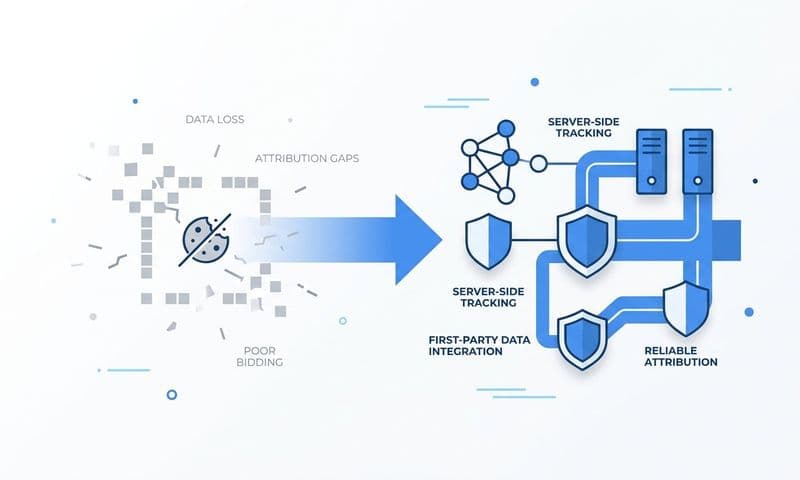
Cookie tracking is breaking down fast. Safari's Intelligent Tracking Prevention, iOS privacy updates, and the gradual phase-out of third-party cookies across major browsers have created a growing blind spot for marketers who depend on pixel-based attribution. If your team is running paid campaigns across Meta, Google, and LinkedIn, you are likely seeing gaps in your conversion data that make it harder to optimize spend and prove ROI.
The good news is that a new generation of tools has emerged to fill those gaps. Server-side event tracking, Conversion APIs, first-party data pipelines, and multi-touch attribution platforms are now the standard approach for teams that need reliable visibility into what is actually driving revenue.
Here are the top solutions for overcoming cookie tracking limitations in 2026, evaluated on their ability to restore conversion visibility, improve ad platform data quality, and give marketing teams a dependable source of truth.
1. Cometly
Best for: B2B SaaS teams that need full-funnel attribution from ad click to closed-won revenue
Cometly is a marketing attribution platform built specifically for B2B SaaS companies that replaces cookie-dependent tracking with server-side conversion tracking, Conversion API integration, and multi-touch attribution across the entire customer journey.
 9 Best Attribution Platforms for Agencies in 2026
Where This Tool Shines
Most attribution tools stop at the lead. Cometly connects your ad spend all the way through to pipeline and closed-won revenue by integrating directly with your CRM, Stripe, and ad platforms. This means you can see which campaigns are generating actual customers, not just form fills.
The server-side tracking architecture bypasses browser restrictions entirely. Instead of relying on a browser pixel that can be blocked by ad blockers or invalidated by ITP, Cometly sends conversion events directly from the server to Meta CAPI, Google Enhanced Conversions, and other ad platforms. The result is higher match rates and more accurate optimization signals.
Key Features
Server-Side Conversion Tracking: Sends conversion events from the server rather than the browser, bypassing cookie restrictions and ad blockers entirely.
Conversion API Integration: Native CAPI support for Meta, Google, and other ad platforms to improve event match quality and feed ad algorithms better data.
Multi-Touch Attribution: Tracks every touchpoint across the full customer journey from the first ad click through to closed revenue, with multiple attribution model options.
AI-Powered Ad Recommendations: Uses AI to surface which campaigns, ad sets, and creatives are driving the highest-quality pipeline so you can scale what works.
Pipeline and Revenue Attribution: Connects marketing data directly to CRM events and Stripe revenue data, giving you a clear view of marketing's contribution to the business.
70+ Native Integrations: Connects with CRMs, Stripe, and all major ad platforms without custom development work.
Best For
Growth leaders and performance marketers at B2B SaaS companies who need attribution that goes beyond lead volume. If you are tired of optimizing campaigns based on cost-per-lead when what you actually care about is cost-per-revenue, Cometly is built for that exact problem.
Pricing
Contact for pricing. Plans are available for growing SaaS teams and agencies, with options that scale based on data volume and team size.
2. Segment
Best for: SaaS and tech teams that need a centralized first-party data foundation to power downstream tools
Segment is a customer data platform by Twilio that collects first-party events from web, mobile, and server sources and routes them to hundreds of downstream marketing and analytics destinations.
 9 Best Conversion Tracking Alternatives to Pixels in 2026
Where This Tool Shines
Segment is not an attribution tool in the traditional sense. It is the data infrastructure layer that makes everything else work. By collecting first-party events server-side and routing them to your ad platforms, CRM, and analytics tools, Segment removes your dependence on browser-based tracking entirely.
For engineering and marketing teams that want full control over their data pipeline, Segment provides a clean, structured event schema that keeps data consistent across every tool in the stack. This makes it particularly powerful when paired with a dedicated attribution platform.
Key Features
First-Party Event Collection: Captures events from web, mobile, and server-side sources without relying on third-party cookies.
400+ Destination Integrations: Routes data to ad platforms, analytics tools, CRMs, and data warehouses from a single source.
Server-Side SDKs: Enables backend event tracking that completely avoids browser-level restrictions.
Identity Resolution: Unifies user profiles across multiple touchpoints and sessions into a single customer record.
Reverse ETL: Syncs warehouse data back to marketing and sales tools so your downstream platforms stay current.
Best For
Technical marketing and data engineering teams at SaaS companies that want a structured, scalable event pipeline. Segment works best as a foundational layer rather than a standalone attribution solution, so plan to pair it with reporting and attribution tools.
Pricing
Free tier available for up to 1,000 monthly tracked users. Paid plans start at $120/month and scale based on data volume and team size.
3. Stape
Best for: Agencies and performance marketers deploying server-side GTM without managing cloud infrastructure
Stape is a managed server-side tagging infrastructure provider that makes it easy to deploy and run Google Tag Manager server containers without handling your own cloud hosting setup.
 9 Best Cookie Tracking Limitations Solutions for B2B SaaS in 2026
Where This Tool Shines
Server-side Google Tag Manager is one of the most effective ways to improve first-party data collection and bypass browser tracking limitations. The challenge is that running your own GTM server container requires cloud infrastructure knowledge. Stape removes that barrier entirely by managing the hosting layer for you.
For agencies managing multiple client accounts, Stape is particularly valuable. You can spin up server containers for clients quickly, configure event forwarding to Meta CAPI and Google Ads, and maintain consistent tracking quality across your entire portfolio without deep DevOps involvement.
Key Features
Managed GTM Server Hosting: Runs Google Tag Manager server containers on Google Cloud without requiring you to manage infrastructure directly.
Server-Side Event Forwarding: Sends events to Meta CAPI, Google Ads, TikTok, and other ad platforms from the server layer.
Custom Domain Setup: Configures first-party domains to improve cookie persistence and data collection quality.
Pre-Built Server Tags: Includes templates for common ad platforms and analytics tools to accelerate deployment.
Event Deduplication: Manages deduplication between browser-fired and server-fired events to avoid inflated conversion counts.
Best For
Digital marketing agencies and performance marketers who want the benefits of server-side tagging without the overhead of managing cloud infrastructure. Also useful for in-house teams that are comfortable with GTM but want a simpler path to server-side deployment.
Pricing
Starts at approximately $19/month depending on server usage and request volume. Pricing scales with traffic and the number of server containers.
4. Triple Whale
Best for: DTC and ecommerce brands on Shopify that need cookie-independent ad attribution
Triple Whale is an ecommerce analytics and attribution platform that uses a first-party pixel and blended attribution to give direct-to-consumer brands a reliable view of ad performance without relying on browser cookies.
 9 Best Cookie Tracking Limitations Solutions for B2B SaaS in 2026
Where This Tool Shines
Triple Whale was built in direct response to the iOS 14 attribution crisis that hit ecommerce brands hard. Its first-party pixel collects data directly on the merchant's domain, which means it is not subject to the same third-party cookie restrictions that make platform-reported data unreliable.
The blended attribution dashboard pulls together data from Meta, Google, TikTok, and other channels into a single view, giving brands a more complete picture of how their ad spend is performing across the full mix. The creative analytics layer adds another dimension by helping teams understand which ad creatives are actually driving revenue.
Key Features
First-Party Pixel: Collects conversion data directly without third-party cookie dependency, improving attribution accuracy post-iOS 14.
Blended Attribution Dashboard: Unifies ad performance data across Meta, Google, TikTok, and other channels in a single view.
Creative Analytics: Identifies which ad creatives are driving the highest revenue and return on ad spend.
Cohort Analysis and LTV Reporting: Tracks customer lifetime value and purchase behavior over time.
Shopify-Native Integration: Connects directly to Shopify order data for real-time revenue attribution.
Best For
DTC brands and ecommerce marketers running Shopify stores with significant paid social spend. Triple Whale is less suited for B2B SaaS companies with longer sales cycles, but it is a strong fit for brands where purchase happens quickly and creative performance matters.
Pricing
Starts at $129/month. Pricing scales based on monthly order volume and the features included in each plan tier.
5. Northbeam
Best for: Scaling performance marketing teams that need ML-based attribution without cookie dependency
Northbeam is a multi-touch attribution and media mix modeling platform that uses first-party data and machine learning to give performance marketing teams accurate channel-level attribution independent of browser cookies.
 9 Best Cookie Tracking Limitations Solutions for B2B SaaS in 2026
Where This Tool Shines
Northbeam takes a modeling-first approach to attribution. Rather than relying purely on deterministic cookie-based tracking, it uses machine learning to model attribution across channels, which makes it more resilient to browser privacy restrictions and data gaps. This is particularly valuable for teams running complex, multi-channel campaigns where last-click attribution consistently misrepresents performance.
The media mix modeling layer gives Northbeam an edge for teams managing significant ad budgets. It helps answer the harder question of how much each channel is contributing to overall growth, not just which touchpoint was last before a conversion.
Key Features
ML-Based Attribution Modeling: Uses machine learning to model channel contribution without relying on browser cookies or deterministic tracking.
First-Party Server-Side Pixel: Collects conversion data directly from the server to avoid browser-level tracking gaps.
Media Mix Modeling: Quantifies channel-level contribution to overall growth at a macro level, beyond individual conversion paths.
Custom Attribution Windows: Allows teams to configure and compare different attribution windows and models side by side.
Cross-Channel Reporting: Covers paid, organic, and direct traffic in a unified view for complete channel visibility.
Best For
Performance marketing teams at scaling DTC and ecommerce brands that are managing large ad budgets across multiple channels and need attribution that holds up as privacy restrictions tighten. Northbeam is best suited for teams with the budget and sophistication to act on media mix insights.
Pricing
Custom pricing based on ad spend and data volume. Contact Northbeam directly for a quote.
6. RudderStack
Best for: Data engineering teams that want a warehouse-native, open-source event pipeline
RudderStack is an open-source customer data pipeline with a warehouse-native architecture that routes server-side events to your data warehouse and downstream tools, bypassing browser tracking limitations entirely.
 9 Best Cookie Tracking Limitations Solutions for B2B SaaS in 2026
Where This Tool Shines
RudderStack is built for teams that want to own their data infrastructure. By routing events directly to Snowflake, BigQuery, or Redshift as the primary destination, RudderStack keeps your data in your warehouse first, then activates it in downstream tools through Reverse ETL. This architecture makes it inherently more privacy-resilient than browser-based tracking because the entire pipeline runs server-side.
For engineering-led organizations, the open-source nature of RudderStack is a significant advantage. You can inspect the code, self-host if needed, and customize the pipeline to fit your exact data model without being locked into a proprietary system.
Key Features
Open-Source Event Streaming: Server-side SDKs for web, mobile, and backend event collection with full code transparency.
Warehouse-Native Architecture: Sends data to Snowflake, BigQuery, or Redshift as the primary destination, keeping your team in control.
Reverse ETL: Activates warehouse data in ad platforms, CRMs, and marketing tools to close the loop between data and action.
200+ Destination Integrations: Routes events to ad platforms, analytics tools, and marketing automation systems.
Identity Stitching: Unifies user profiles across sessions and devices using deterministic and probabilistic matching.
Best For
Data engineering and analytics teams at SaaS companies and mid-market to enterprise organizations that want full ownership of their event pipeline. RudderStack requires more technical setup than plug-and-play tools but offers far more flexibility in return.
Pricing
Free open-source tier available for self-hosted deployments. Cloud-managed plans start at $750/month.
7. Elevar
Best for: Shopify merchants and agencies that need automated server-side tracking and CAPI integrations
Elevar is a server-side tracking and Conversion API solution built specifically for Shopify merchants that automates event collection and forwarding to Meta, Google, TikTok, and other ad platforms without requiring custom development.
Where This Tool Shines
Elevar has become one of the most widely adopted server-side tracking solutions in the Shopify ecosystem because it handles the complexity of CAPI integrations without requiring engineering resources. You get pre-built integrations for all major ad platforms, automatic event deduplication, and user identity enrichment out of the box.
The real-time data quality monitoring is a standout feature. Elevar alerts you when events are failing or match rates drop, which means you can catch tracking issues before they affect campaign optimization rather than discovering them weeks later in a post-mortem.
Key Features
Automated Server-Side Tracking: Sets up and manages server-side event collection for Shopify without custom development work.
Pre-Built CAPI Integrations: Native Conversion API connections for Meta, Google, TikTok, and Pinterest, configured and maintained automatically.
Event Deduplication: Manages deduplication between browser pixel events and server-side events to prevent inflated conversion counts.
User Identity Enrichment: Improves event match rates on ad platforms by enriching events with available user identifiers.
Real-Time Data Quality Monitoring: Alerts teams when events fail or match rates decline so tracking issues are caught immediately.
Best For
Shopify merchants running paid social campaigns who want reliable server-side tracking without engineering involvement. Elevar is also popular with Shopify-focused agencies managing tracking for multiple client stores.
Pricing
Starts at $50/month. Pricing scales based on monthly order volume and the number of integrations included.
8. Rockerbox
Best for: Mid-market marketing teams managing complex, multi-channel mixes that need unified attribution
Rockerbox is a marketing attribution and data unification platform that normalizes performance data across paid, organic, email, and direct channels into a single source of truth for marketing teams with complex channel mixes.
Where This Tool Shines
Rockerbox addresses one of the most common frustrations in modern marketing: every platform reports its own numbers, and none of them agree. By pulling data from all channels into a normalized view, Rockerbox gives marketing teams a consistent baseline for comparing performance across channels without being misled by platform-reported attribution.
The combination of multi-touch attribution and media mix modeling gives teams both the granular view of individual conversion paths and the macro view of channel contribution over time. This dual perspective is particularly valuable for teams managing budgets across a wide mix of paid and organic channels.
Key Features
Unified Marketing Data: Normalizes performance data across paid, organic, email, and direct channels into a single, consistent view.
Multi-Touch Attribution: Offers multiple attribution model options so teams can compare how different models tell different stories about performance.
Media Mix Modeling: Provides a macro view of how each channel contributes to overall growth beyond individual conversion paths.
First-Party Data Collection: Collects conversion data via pixel and server-side integration to reduce cookie dependency.
BI Tool Exports: Supports custom reporting and data exports to tools like Looker, Tableau, and other business intelligence platforms.
Best For
Mid-market marketing teams with significant budgets spread across multiple channels who need a single source of truth for performance data. Rockerbox is well suited for teams that have outgrown platform-reported attribution but are not yet ready to build a fully custom data stack.
Pricing
Custom pricing based on ad spend and data volume. Contact Rockerbox for a demo and quote.
9. Littledata
Best for: Shopify and WooCommerce stores that need accurate GA4 and CAPI tracking without custom code
Littledata is a server-side tracking solution for Shopify and WooCommerce stores that fixes attribution gaps by sending accurate conversion events to GA4, Meta CAPI, and other ad platforms without requiring custom development.
Where This Tool Shines
Littledata focuses on a specific and common problem: ecommerce stores using Shopify or WooCommerce often have significant gaps between what their analytics tools report and what actually happened. Browser-based tracking misses events due to ad blockers, cookie restrictions, and checkout flow interruptions. Littledata fills those gaps by capturing events server-side and forwarding them to GA4 and ad platforms with proper deduplication.
Its strength in subscription and recurring revenue tracking sets it apart from many other server-side tools. For brands running subscription models on platforms like ReCharge, Littledata can track renewal events, churn signals, and lifetime value in a way that standard pixel-based tracking simply cannot.
Key Features
Server-Side Event Tracking: Captures conversion events from the server for Shopify and WooCommerce without custom code requirements.
GA4 and CAPI Forwarding: Sends accurate, deduplicated events to Google Analytics 4, Meta CAPI, and Google Ads.
Subscription Revenue Tracking: Tracks recurring revenue events, renewals, and subscription lifecycle data for subscription-based brands.
Automatic Deduplication: Handles deduplication between browser-fired and server-fired events automatically to maintain data accuracy.
Pre-Built Integrations: Connects with Klaviyo, ReCharge, and other popular ecommerce tools without custom configuration.
Best For
Shopify and WooCommerce stores, particularly those running subscription models, that need accurate server-side tracking for GA4 and paid ad platforms. Littledata is a strong fit for brands that rely on GA4 as their primary analytics tool and need their ecommerce data to be reliable.
Pricing
Starts at $99/month. Pricing scales based on monthly order volume.
Which Tool Is Right for Your Stack
The right solution depends on your business model, your technical resources, and how deeply you need attribution to connect to revenue outcomes.
If you are running a B2B SaaS company and need attribution that goes all the way from the first ad click to closed-won revenue, Cometly is the clearest fit. It is purpose-built for SaaS teams, handles server-side tracking and Conversion API integration natively, and connects your marketing data directly to pipeline and revenue. You are not just seeing which campaigns drove leads. You are seeing which campaigns drove customers.
For ecommerce and DTC brands on Shopify, Triple Whale and Elevar are both strong options depending on your priorities. Triple Whale excels at blended attribution and creative analytics. Elevar is the better choice if your primary need is reliable server-side CAPI integration without engineering involvement. Littledata is worth evaluating if GA4 accuracy and subscription tracking are priorities.
If you are building or scaling a first-party data infrastructure, Segment and RudderStack are the foundational tools to consider. Segment is the more accessible option for most teams. RudderStack is better suited for engineering-led organizations that want warehouse-native data ownership and open-source flexibility. Stape is the right choice if you are already invested in the Google Tag Manager ecosystem and want a simple path to server-side deployment.
Rockerbox and Northbeam both serve performance marketing teams that need a more sophisticated view of channel contribution, particularly when managing large budgets across complex channel mixes. Both require more investment to implement and interpret, but they offer modeling capabilities that go well beyond what standard attribution tools provide.
The common thread across all of these tools is a move away from browser-based cookie tracking toward server-side data collection and first-party event pipelines. The teams that get ahead of this shift now will have cleaner data, better ad optimization, and more accurate attribution as privacy restrictions continue to tighten.
If you are a B2B SaaS team ready to connect your ad spend directly to revenue and stop flying blind on attribution, start with Cometly. Get your free demo and see exactly which campaigns are driving pipeline and closed-won revenue.