
You're staring at three different dashboards on a Tuesday morning. Meta Ads Manager shows 47 conversions. Google Analytics reports 31. Your CRM recorded 28 actual sales. Each platform is claiming credit for revenue that doesn't add up, and you're supposed to decide where to allocate next month's budget based on this mess.
Sound familiar?
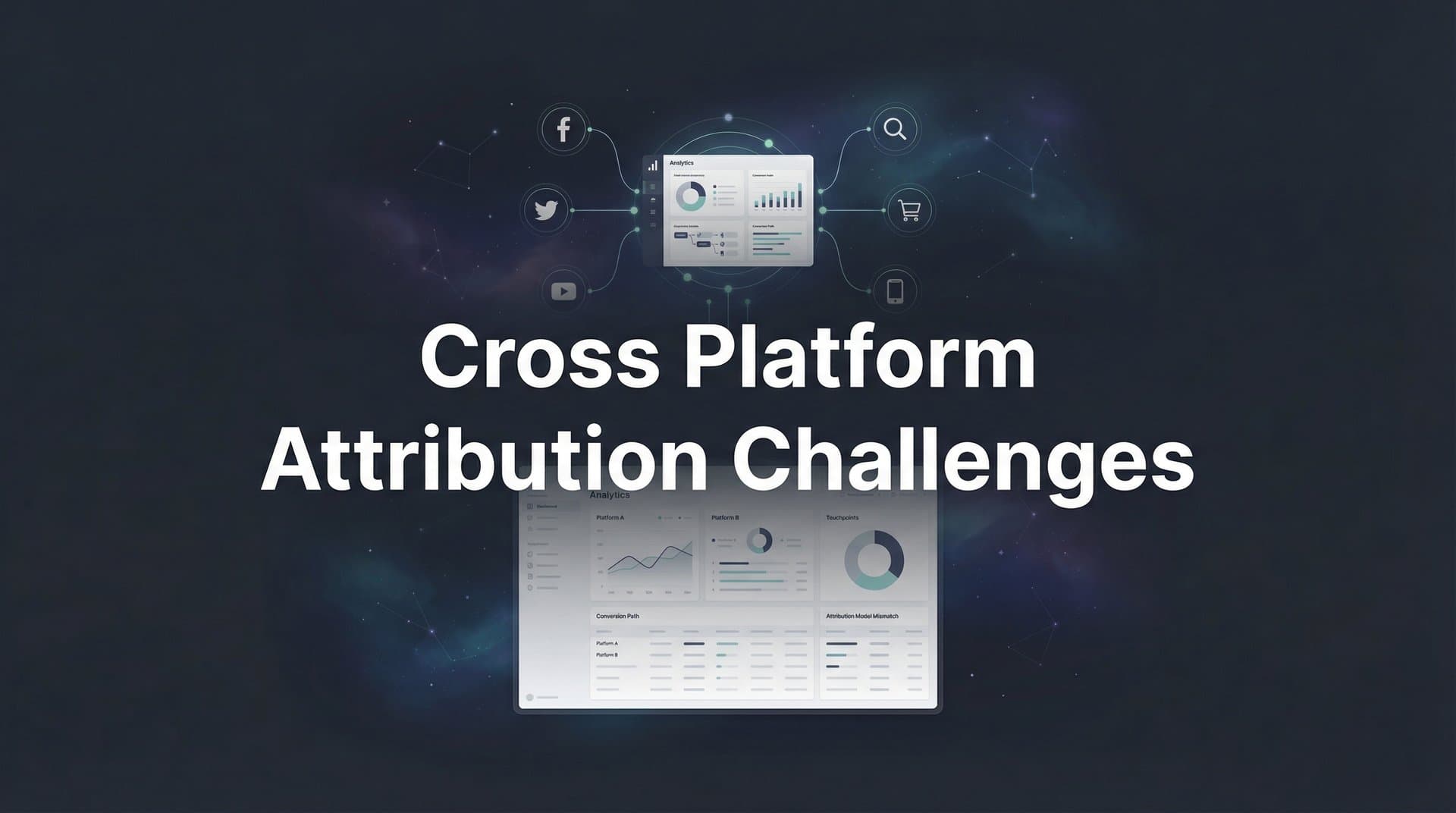
This isn't a data glitch or a setup error. It's the reality of modern marketing attribution. Your customers don't live in a single platform—they discover your brand on Instagram, research on Google, read your email newsletter, watch a YouTube video, then finally convert three days later after clicking a retargeting ad. Every platform they touch claims the win, but none of them can see the full story.
The problem runs deeper than conflicting reports. Modern customer journeys span multiple devices, platforms, and weeks of consideration. Meanwhile, the tracking technology that's supposed to connect these dots is fragmenting further every year. Privacy regulations have tightened. Cookies are disappearing. Ad platforms are building higher walls around their data. And marketers are left trying to make confident decisions with incomplete information.
This article breaks down exactly why cross platform attribution challenges exist, how they're sabotaging your marketing decisions right now, and what you can actually do about it. Because understanding the problem is the first step toward fixing it.
The Fragmented Reality of Modern Customer Journeys
The average B2C buyer now interacts with 6 to 8 touchpoints before making a purchase decision. For B2B buyers, that number climbs to 10 or more. They might first see your brand in a Facebook ad during their morning scroll, search for your product category on Google later that day, read a comparison article from an organic search result, sign up for your email list, ignore three nurture emails, watch a demo video on YouTube, and finally convert after clicking a retargeting ad two weeks later.
Here's the challenge: each platform in that journey operates in its own silo.
Meta tracks what happens within its ecosystem—Facebook, Instagram, Messenger. Google tracks search clicks and YouTube views separately. Your email platform knows about opens and clicks but has no idea what ads someone saw before subscribing. Your CRM records the final conversion but can't see the awareness-stage touchpoints that made that person ready to buy.
Each platform uses different tracking methods. Meta relies on the Meta Pixel. Google uses Google Analytics and conversion tags. Your email platform tracks through embedded tracking pixels. None of these systems talk to each other natively. They can't share user-level data across platforms, even if you wanted them to. Understanding how to implement ad tracking across multiple platforms becomes essential for bridging these gaps.
The attribution windows don't match either. Meta might use a 7-day click, 1-day view window. Google Ads defaults to 30-day click. Your CRM might attribute everything to the last touchpoint within 90 days. When the same conversion falls within multiple windows across different platforms, everyone claims credit.
This creates the Tuesday morning dashboard problem. Three platforms, three different conversion counts, and zero clarity about what actually drove the sale. The conversion didn't happen three times—it happened once. But your data says otherwise.
The fragmentation extends to how conversions are defined. One platform might count a conversion when someone adds to cart. Another counts only completed purchases. A third counts any form submission. You're not just comparing different attribution models—you're comparing fundamentally different definitions of success.
The result is marketing reports that don't reconcile with actual business results. Your ad platforms collectively claim 120 conversions. Your payment processor recorded 45 transactions. The math doesn't work, and you're supposed to make budget decisions based on these numbers.
Five Core Challenges Breaking Your Cross-Platform Data
Walled Gardens and Data Silos: The biggest ad platforms operate as walled gardens by design. Meta doesn't share user-level data with Google. Google doesn't share with TikTok. LinkedIn keeps its data locked down. This isn't an oversight—it's a competitive strategy. Each platform wants to be your single source of truth because that increases their perceived value and makes you more dependent on their reporting.
The technical reality makes cross-platform tracking even harder. When someone clicks a Meta ad, Meta assigns them an identifier within its system. When that same person later searches on Google, Google assigns a completely different identifier. Unless you have a way to connect those identifiers to the same actual human, you can't stitch together their journey. Browser cookies used to help with this, but that bridge is crumbling.
Privacy Regulations and Tracking Limitations: Apple's App Tracking Transparency framework, introduced in 2021, fundamentally changed mobile advertising. Users now see a prompt asking if they want to allow apps to track them across other companies' apps and websites. Most users tap "Ask App Not to Track." For advertisers, this means losing visibility into a massive portion of iOS traffic—and iOS users tend to be higher-value customers.
Third-party cookies are disappearing. Firefox and Safari already block them by default. Google has delayed its Chrome deprecation timeline multiple times, but the direction is clear—browser-based tracking that relies on third-party cookies is dying. When cookies go away, so does your ability to track users across different websites and platforms using traditional pixel-based methods. These common attribution challenges in digital marketing affect businesses of every size.
GDPR in Europe and CCPA in California have added compliance requirements that further limit what data you can collect and how you can use it. You need explicit consent to track users. You need to honor opt-outs. You need to delete data on request. These are good regulations that protect consumer privacy, but they create legitimate challenges for marketers trying to understand what's working.
Inconsistent Attribution Models: Every platform uses different logic to assign credit for conversions. Meta might default to last-click attribution within a 7-day window. Google Ads uses data-driven attribution that spreads credit across multiple touchpoints. Google Analytics 4 uses a different data-driven model than Google Ads. Your CRM might use first-touch attribution to credit the original source.
None of these models are "wrong"—they're just different ways of answering the question "what caused this conversion?" But when you're trying to compare performance across platforms, these different models make apples-to-apples comparisons impossible. A channel might look amazing in last-click attribution and mediocre in first-touch, or vice versa.
Cross-Device Tracking Gaps: Your customer researches on mobile during lunch, continues on desktop at work, and converts on tablet at home. Unless you can connect those three devices to the same person, you see three separate user journeys that never convert instead of one journey that does. Most platforms struggle with cross-device attribution because they can't reliably identify the same user across devices without third-party cookies or logged-in states. Implementing cross-device attribution tracking solves this visibility problem.
Platform Incentives to Over-Report: Ad platforms have a built-in incentive to claim as much credit as possible. They get paid when you spend more on their platform. If their reporting shows strong performance, you allocate more budget their way. This doesn't mean platforms are lying, but it does mean their attribution methodology tends toward generosity when assigning credit to their own touchpoints.
How These Challenges Sabotage Your Marketing Decisions
The most expensive consequence of broken attribution is budget misallocation. When you can't see the full customer journey, you make decisions based on incomplete data. Last-click attribution makes bottom-funnel retargeting campaigns look like heroes while the awareness campaigns that actually created demand appear to underperform.
Picture this scenario: You run awareness campaigns on Meta and YouTube, consideration-stage content marketing, and retargeting through Google Ads. In a last-click attribution model, Google retargeting gets credit for nearly every conversion. The data tells you to shift more budget to retargeting and cut the "underperforming" awareness campaigns.
So you do. And for a few weeks, your retargeting ROAS stays strong. Then it starts declining. Why? Because you've cut off the top-of-funnel campaigns that were feeding warm prospects into your retargeting pool. You were optimizing for the last touchpoint while starving the earlier touchpoints that made that last click valuable.
False confidence in platform-reported ROAS creates another dangerous trap. When Meta reports 4.5x ROAS and Google reports 3.8x ROAS, both numbers might be inflated because they're claiming overlapping conversions. Your actual blended ROAS might be 2.1x when you reconcile against real revenue. If you scale budget based on the inflated numbers, you'll be disappointed when the business results don't match the dashboard metrics.
This happens constantly. Marketers celebrate platform-reported performance that looks incredible, then get confused when the CFO points out that marketing spend increased 40% but revenue only grew 15%. The disconnect isn't in the revenue numbers—it's in the attribution data you used to make scaling decisions. Understanding cross-channel attribution and marketing ROI helps prevent these costly miscalculations.
The inability to identify what's truly working prevents you from doubling down on winners. When you can't accurately attribute conversions to their real sources, you can't confidently scale the campaigns that are actually driving results. You might be running a brilliant top-of-funnel campaign that's generating massive long-term value, but if your attribution system only sees last-click conversions, that campaign looks like a money pit.
This creates organizational tension too. The performance marketing team optimizes for what the dashboards show—last-click conversions and platform-reported ROAS. The brand team invests in awareness campaigns that don't show immediate attribution. Finance sees total marketing spend going up without proportional revenue increases. Everyone's working with different data, and nobody can prove what's actually working.
The worst part? You know the data is wrong. You can see the discrepancies. But you don't have a better alternative, so you make decisions anyway and hope for the best. That's not strategy—that's guessing with extra steps.
Server-Side Tracking: The Foundation of Accurate Attribution
Browser-based tracking is failing because it relies on technology that users and regulators are actively dismantling. Traditional tracking pixels load in the user's browser, drop cookies, and send data back to your analytics platform. This approach worked well for years, but it's breaking down in the privacy-first era.
Ad blockers strip out tracking scripts before they can fire. Privacy-focused browsers block third-party cookies by default. iOS App Tracking Transparency prevents apps from tracking users across other companies' properties. The browser-based tracking infrastructure that powered digital marketing for two decades is crumbling, and browser-based pixels are increasingly unable to capture accurate conversion data.
Cross-device tracking becomes nearly impossible with browser-based methods. When someone switches from mobile to desktop, browser-based tracking sees two different users because the cookies don't transfer across devices. You lose visibility into the complete journey and can't connect the awareness touchpoint on mobile to the conversion on desktop. These cross-device attribution challenges require modern solutions beyond traditional pixels.
Server-side tracking solves these problems by moving the tracking logic from the user's browser to your server. Instead of relying on a pixel that loads in the browser and can be blocked, your server captures conversion events directly from your backend systems and sends that data to your analytics platform and ad platforms.
Here's how it works: When someone completes a purchase on your site, your server knows about it immediately because it processed the transaction. Server-side tracking captures that conversion event at the server level—along with all the rich data your system knows about that customer—and sends it to your attribution platform. No browser pixel required. No cookie dependency. No ad blocker can stop it.
This approach captures conversions that browser-based tracking misses entirely. When 30% to 40% of browser-based events are blocked by privacy tools, server-side tracking recovers that lost data because it's happening on your infrastructure, not in the user's browser.
Server-side tracking also enables you to send enriched conversion data back to ad platforms. Instead of just telling Meta "a conversion happened," you can send the actual purchase value, the products bought, the customer's lifetime value, and other signals that help Meta's algorithm optimize for the conversions you actually care about. This feeds better data into the ad platform's machine learning systems, improving targeting and optimization over time.
The technical implementation requires more setup than dropping a pixel on your site, but the data quality improvement is substantial. You're building tracking infrastructure that works regardless of browser restrictions, privacy regulations, or user tracking preferences. Following a comprehensive cross-platform tracking setup guide ensures you implement this correctly from the start.
Building a Unified View: From Chaos to Clarity
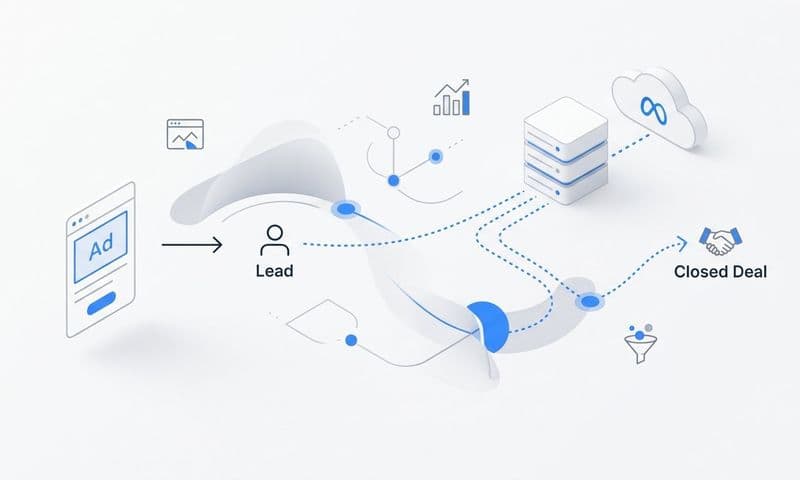
The solution to cross platform attribution challenges isn't trying to force each platform to play nice with the others. It's building a layer above all of them that connects your ad platforms, CRM, and website into a single source of truth. A dedicated cross-platform attribution tool captures every touchpoint across the entire customer journey—from first impression to final conversion—regardless of which platform delivered it.
When someone interacts with your brand, that touchpoint gets recorded in your unified system with a consistent identifier. Click a Meta ad? Tracked. Search on Google? Tracked. Open an email? Tracked. Visit your website directly? Tracked. Every interaction gets stitched together into a complete journey map for that individual customer.
This is where multi-touch attribution becomes possible. Instead of giving 100% credit to the last click, you can analyze how different touchpoints contributed to the conversion. Did the awareness campaign on Meta introduce them to your brand? Did the Google search indicate buying intent? Did the email nurture sequence keep them engaged? A multi-touch marketing attribution platform shows the role each touchpoint played.
Different attribution models tell different stories, and you need to understand what each one reveals. First-touch attribution shows what's driving new customer acquisition. Last-touch shows what's closing deals. Linear attribution spreads credit evenly across all touchpoints. Time-decay gives more credit to recent interactions. Position-based (U-shaped) emphasizes the first and last touch while acknowledging middle touchpoints.
The power isn't in choosing the "right" model—it's in comparing multiple models side-by-side to understand the full picture. A channel that looks weak in last-click might be your top performer in first-touch, revealing that it's excellent at generating new demand even if it doesn't close deals directly. That's actionable insight you can't get from platform-reported data alone.
Real-time analytics let you see this data as it happens, not days or weeks later. When you launch a new campaign, you can immediately see how it's affecting the customer journey. When you adjust budget allocation, you can track the impact across all touchpoints. A cross-platform marketing analytics dashboard enables you to make optimization decisions with confidence instead of waiting for monthly reports to tell you what happened last month.
The unified view also reconciles your marketing data with actual business results. When your attribution platform connects to your CRM and payment systems, you can see exactly how many conversions happened and what revenue they generated. No more wondering why ad platforms report 120 conversions but you only processed 45 sales. Marketing attribution platforms with revenue tracking show the truth.
This infrastructure captures every touchpoint—from ad clicks to CRM events—providing a complete, enriched view of every customer journey. You can finally answer questions like "What's the typical journey for customers who spend over $1,000?" or "Which awareness campaigns are feeding our highest-value conversions?" The data is there, connected, and actionable.
Moving Forward with Confidence
Cross platform attribution challenges aren't going away. Privacy regulations will continue tightening. Customer journeys will keep getting more complex as new platforms and channels emerge. The marketers who thrive in this environment won't be the ones hoping for simpler times—they'll be the ones who invested in infrastructure that captures accurate data regardless of external changes.
The gap between marketers with accurate attribution and those relying on platform-reported metrics will widen. Teams with unified tracking can confidently scale what works, optimize across the full funnel, and prove marketing's impact on revenue. Teams stuck with fragmented data will keep making decisions based on incomplete information and wondering why their results don't match their dashboards.
This isn't about having perfect data—that's impossible. It's about having data that's accurate enough to make confident decisions. When you can see which campaigns are actually driving conversions, which channels work together to move customers through the journey, and how your marketing spend connects to real revenue, you can allocate budget strategically instead of guessing.
The technical solutions exist today. Server-side tracking bypasses browser limitations. Unified attribution platforms stitch together cross-platform journeys. Multi-touch attribution models reveal what each touchpoint contributes. The question isn't whether these solutions work—it's whether you're ready to implement them.
For teams ready to stop guessing and start scaling based on accurate attribution data, the path forward is clear. Build tracking infrastructure that captures every touchpoint. Connect your ad platforms, CRM, and website into a unified system. Use multi-touch attribution to understand the full customer journey. Feed enriched conversion data back to ad platforms to improve their optimization algorithms.
Ready to elevate your marketing game with precision and confidence? Discover how Cometly's AI-driven recommendations can transform your ad strategy—Get your free demo today and start capturing every touchpoint to maximize your conversions.