

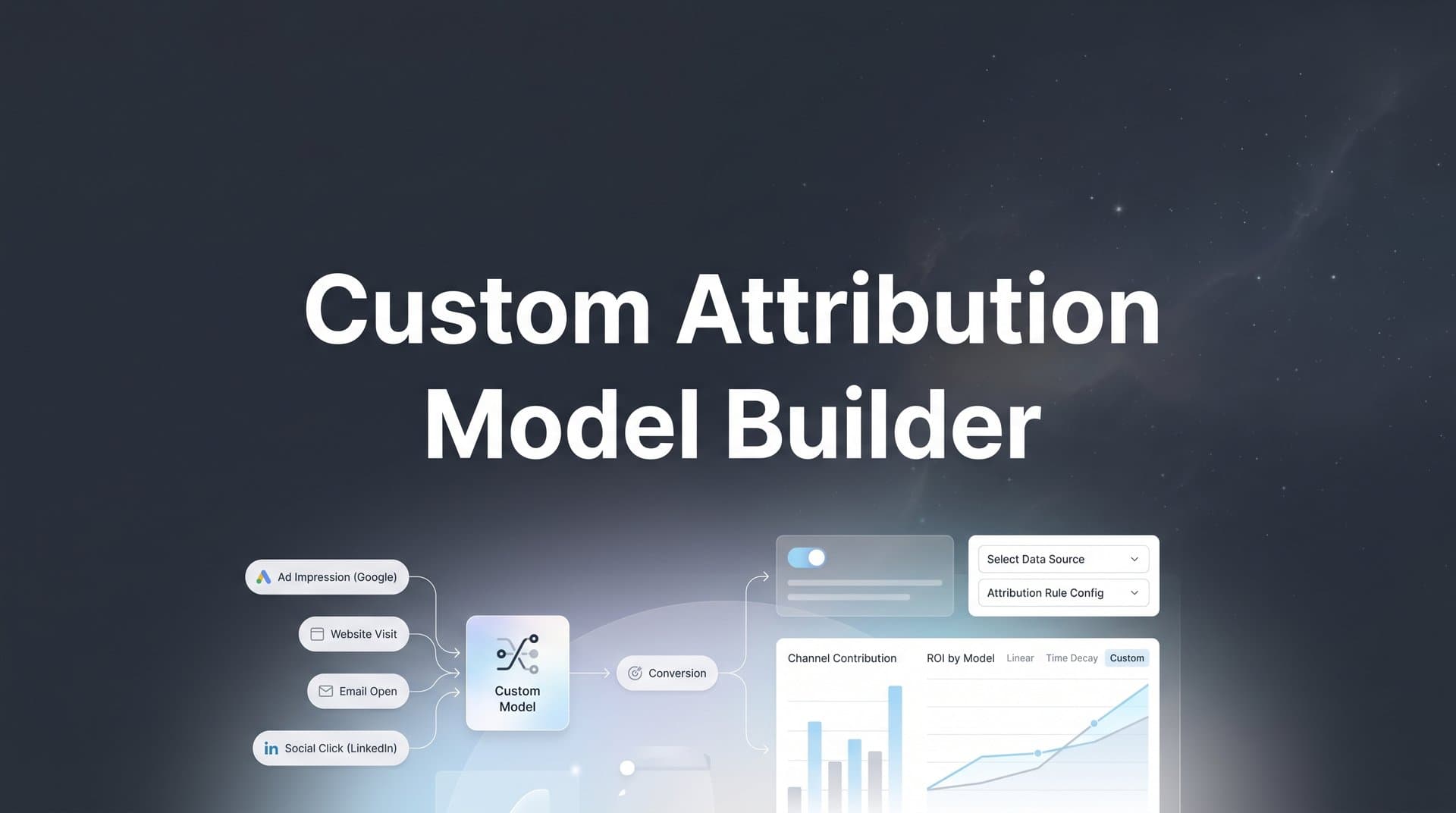
Standard attribution models rarely match how your customers actually buy. First-touch ignores the nurturing process, last-touch discounts awareness efforts, and linear models treat every touchpoint as equally important when they clearly are not.
Custom attribution model builders let you define exactly how credit flows across your customer journey based on your business reality, not generic assumptions. Whether you need drag-and-drop simplicity or advanced algorithmic customization, these tools help you finally see which marketing efforts truly drive revenue.
Here are the top platforms that let marketers build, test, and deploy attribution models tailored to their specific sales cycles and channel mix.
1. Cometly
Best for: Multi-platform advertisers who want AI-powered attribution with server-side tracking accuracy.
Cometly is a marketing attribution platform that connects ad platforms, CRM systems, and website data to track complete customer journeys in real time.
 9 Best Custom Attribution Model Builders for Marketing Teams in 2026
Where This Tool Shines
Cometly stands out by combining accurate attribution with actionable AI recommendations. The platform captures every touchpoint from initial ad click through CRM events, giving you a complete view of what's actually driving conversions.
The server-side tracking approach solves the accuracy problems that plague browser-based attribution as privacy restrictions tighten. This means you get reliable data even as tracking pixels become less effective.
Key Features
Multi-Touch Attribution Models: Build custom models that reflect your actual sales process, or use pre-built options like first-touch, last-touch, linear, and time-decay.
AI-Powered Recommendations: Get specific suggestions on which campaigns to scale based on performance patterns across all your ad channels.
Server-Side Tracking: Capture conversion data directly from your server, bypassing browser limitations for more accurate attribution.
Conversion Sync: Feed enriched conversion data back to Meta, Google, and other ad platforms to improve their targeting algorithms and campaign optimization.
Real-Time Analytics Dashboard: Monitor campaign performance across all channels in one unified view with instant updates as conversions happen.
Best For
Marketing teams running paid campaigns across multiple platforms who need accurate cross-channel attribution. Particularly valuable for agencies managing client budgets and ecommerce brands dealing with complex customer journeys that span several touchpoints before conversion.
Pricing
Custom pricing based on monthly ad spend. Demo available to explore features and discuss specific business needs.
2. Northbeam
Best for: DTC brands needing machine learning attribution without relying on tracking pixels.
Northbeam is a machine learning attribution platform designed specifically for direct-to-consumer brands facing tracking challenges.
 9 Best Affordable Marketing Attribution Platforms in 2026
Where This Tool Shines
Northbeam uses machine learning to model attribution rather than depending entirely on pixel-based tracking. This approach helps DTC brands maintain attribution accuracy even as iOS privacy changes and ad blockers limit traditional tracking methods.
The platform excels at creative performance analysis, showing you which specific ad creatives drive results across channels. This granular insight helps brands optimize their creative strategy alongside their media buying.
Key Features
ML-Based Attribution: Machine learning algorithms model customer journeys and assign credit based on behavior patterns rather than just tracking pixels.
Customizable Lookback Windows: Set different attribution windows for different channels to match how customers actually interact with each platform.
First-Party Data Infrastructure: Build a foundation of first-party data that you control, reducing dependence on third-party tracking.
Creative Performance Analysis: Track which specific ad creatives drive conversions, not just which campaigns or ad sets perform well.
Media Mix Modeling: Understand how different channels work together and influence each other's performance over time.
Best For
DTC ecommerce brands spending significant amounts on paid social and search advertising. Best suited for companies with monthly ad spend above $50,000 who need sophisticated attribution to justify their marketing investments.
Pricing
Starts around $1,000 per month and scales based on ad spend volume. Higher pricing tiers unlock additional features and support.
3. Triple Whale
Best for: Shopify merchants who want attribution combined with real-time profitability tracking.
Triple Whale is an ecommerce analytics platform that combines custom attribution with profit-per-order tracking built specifically for Shopify stores.
 7 Best Funnel.io Alternatives for Marketing Data Analytics in 2026
Where This Tool Shines
Triple Whale connects attribution directly to profitability metrics. You don't just see which channels drive sales, you see which ones drive profitable sales after accounting for product costs, shipping, and other expenses.
The Shopify-native integration means setup is straightforward and data flows automatically without complex technical implementation. The platform updates in real time, giving you immediate visibility into campaign performance as orders come in.
Key Features
Flexible Attribution Windows: Adjust lookback periods for different channels to match customer behavior patterns on each platform.
Profit-Per-Order Tracking: See actual profit margins for every order, factoring in product costs, shipping, discounts, and other expenses.
Customer Journey Visualization: View the complete path customers take from first touch to purchase with visual journey maps.
Shopify-Native Integration: Seamless connection to your Shopify store with automatic data syncing and minimal technical setup required.
Creative Analytics Dashboard: Track performance of specific ad creatives across Meta, TikTok, and Google to identify winning content.
Best For
Shopify store owners and ecommerce marketers who need both attribution accuracy and profitability insights. Particularly useful for brands with thin margins who need to optimize for profit, not just revenue.
Pricing
Starts at $129 per month for basic features. Higher tiers unlock advanced attribution models, more integrations, and additional team seats.
4. Rockerbox
Best for: Enterprise brands requiring granular cross-channel measurement with custom touchpoint weighting.
Rockerbox is an enterprise attribution platform offering sophisticated cross-channel measurement with highly customizable attribution model building capabilities.
 9 Best Attribution Software for Marketplace Platforms in 2026
Where This Tool Shines
Rockerbox excels at unifying complex customer journeys that span online and offline channels. The platform connects digital touchpoints with offline conversions like in-store purchases or phone sales, giving enterprise brands complete visibility.
The custom model builder lets you assign specific weights to different touchpoint types based on your business knowledge. You can test multiple models side-by-side to see how different approaches affect credit distribution across your marketing mix.
Key Features
Cross-Channel Journey Unification: Connect touchpoints across paid media, organic channels, email, direct mail, TV, and offline conversions into unified customer journeys.
Custom Attribution Model Builder: Create models with granular touchpoint weighting based on channel, position in journey, time decay, or custom business rules.
Offline Conversion Tracking: Integrate in-store purchases, call center conversions, and other offline events into your attribution model.
Incrementality Testing: Run controlled experiments to measure the true incremental impact of marketing channels beyond correlation-based attribution.
Marketing Mix Modeling: Combine attribution data with MMM to understand both individual journey impact and aggregate channel effectiveness.
Best For
Enterprise marketing teams with complex channel mixes that include both digital and traditional media. Companies with significant offline sales components or those needing to justify large marketing budgets with rigorous measurement.
Pricing
Enterprise pricing model typically starting around $2,000 per month. Final cost depends on data volume, number of channels tracked, and specific feature requirements.
5. Ruler Analytics
Best for: B2B companies connecting marketing touchpoints to closed revenue in their CRM.
Ruler Analytics is a B2B-focused attribution platform that tracks the complete journey from anonymous visitor to closed deal by connecting marketing data with CRM revenue.
 8 Best Attribution Tools with Onboarding Support in 2026
Where This Tool Shines
Ruler Analytics solves the B2B attribution challenge of connecting early-stage marketing touchpoints to revenue that closes weeks or months later. The platform tracks anonymous website visitors through lead conversion and into your CRM, then attributes closed revenue back to the marketing sources that influenced the deal.
Call tracking integration is particularly strong, capturing phone conversations as attribution touchpoints. This matters for B2B companies where phone calls often play a crucial role in the sales process.
Key Features
CRM Revenue Attribution: Connect closed revenue from Salesforce, HubSpot, or other CRMs back to the marketing touchpoints that influenced each deal.
Call Tracking Integration: Capture phone calls as attribution touchpoints with dynamic number insertion and conversation recording.
Customizable Attribution Models: Build models that reflect B2B buying cycles with appropriate credit distribution across long, multi-touch journeys.
Lead Journey Tracking: Follow individual leads from first website visit through all marketing interactions to final conversion and revenue.
Closed-Loop Reporting: See which marketing channels and campaigns generate not just leads, but actual closed revenue and pipeline value.
Best For
B2B marketing teams who need to prove marketing's impact on revenue rather than just lead generation. Companies with longer sales cycles where multiple touchpoints influence deals over weeks or months.
Pricing
Starts at $199 per month for basic features. Pricing scales based on number of leads tracked, call tracking volume, and CRM integration requirements.
6. Dreamdata
Best for: B2B companies running account-based marketing with complex buying committees.
Dreamdata is a B2B revenue attribution platform built specifically for account-based marketing strategies with customizable journey mapping at the account level.
 9 Best Cross Channel Attribution Tools to Track Your Full Marketing Journey in 2026
Where This Tool Shines
Dreamdata operates at the account level rather than the individual level, which matches how B2B companies actually sell. Multiple people from the same company interact with your marketing before a deal closes, and Dreamdata connects all those touchpoints to the account.
The platform excels at showing which content influences pipeline. You can see which blog posts, whitepapers, or webinars play a role in moving accounts through your funnel, helping you optimize content strategy based on revenue impact.
Key Features
Account-Level Attribution: Track all touchpoints from multiple contacts within the same account and attribute revenue at the company level.
Custom Touchpoint Weighting: Assign different importance to various interaction types based on your understanding of what drives deals.
Pipeline Influence Tracking: See which marketing activities influence pipeline creation and movement through sales stages.
Content Attribution: Understand which specific content pieces play a role in converting accounts and closing deals.
Revenue Forecasting: Predict future revenue based on current pipeline and historical attribution patterns.
Best For
B2B SaaS companies and other businesses with account-based sales motions. Particularly valuable for companies with buying committees where multiple stakeholders engage with marketing before a purchase decision.
Pricing
Free tier available for basic features. Paid plans start at $999 per month with pricing scaling based on account volume and feature access.
7. Attribution App
Best for: Mid-market teams wanting intuitive custom model building without enterprise complexity.
Attribution App is a straightforward multi-touch attribution platform with an intuitive drag-and-drop interface for building custom attribution models.
 9 Best Marketing Attribution Consultant Services in 2026
Where This Tool Shines
Attribution App makes custom model building accessible to marketers without data science backgrounds. The drag-and-drop interface lets you visually construct attribution logic, adjust touchpoint weights, and see how changes affect credit distribution in real time.
The platform balances simplicity with flexibility. You get enough customization options to build models that match your business without drowning in technical complexity that requires a dedicated analyst to manage.
Key Features
Drag-and-Drop Model Builder: Visual interface for constructing custom attribution models without writing code or complex formulas.
Custom Weighting Options: Adjust how much credit different touchpoint types receive based on channel, position, time, or custom business rules.
Cross-Device Tracking: Follow customers across devices to maintain accurate attribution when users switch between mobile and desktop.
Integration Marketplace: Connect to popular ad platforms, analytics tools, and CRM systems through pre-built integrations.
Real-Time Reporting: View attribution results immediately as conversions happen with live dashboard updates.
Best For
Marketing teams at mid-market companies who have outgrown basic attribution but don't need enterprise-level complexity. Teams that want to experiment with custom models without heavy technical implementation.
Pricing
Starts at $79 per month for basic features. Higher tiers add more integrations, additional users, and advanced customization options.
8. Segment (Twilio)
Best for: Technical teams building fully custom attribution from raw event data.
Segment is a customer data platform that enables completely custom attribution by collecting raw event data and routing it to your analytics infrastructure.
Where This Tool Shines
Segment doesn't provide attribution models out of the box. Instead, it gives you the data infrastructure to build exactly the attribution system you need. You define what events to track, how to structure the data, and where to send it for analysis.
This approach offers maximum flexibility for companies with unique attribution requirements that off-the-shelf tools can't accommodate. If your business model or customer journey doesn't fit standard patterns, Segment lets you build custom solutions.
Key Features
Complete Event Data Collection: Track any user action or system event with custom event definitions that match your specific needs.
Custom Schema Definition: Define exactly what data to capture for each event type and how to structure it for your analysis.
Warehouse Integration: Route event data to your data warehouse for custom attribution modeling with SQL or BI tools.
Identity Resolution: Unify user identities across devices and sessions to maintain accurate customer journey tracking.
Real-Time Data Streaming: Send event data to multiple destinations simultaneously as events occur for real-time processing.
Best For
Companies with technical teams capable of building custom attribution models from raw event data. Organizations with unique business models or complex requirements that standard attribution tools can't handle effectively.
Pricing
Free tier available for up to 1,000 monthly tracked users. Team plan starts at $120 per month with pricing scaling based on data volume and number of sources.
9. Google Analytics 4
Best for: Teams just starting with attribution who need a free platform with basic customization.
Google Analytics 4 is Google's free analytics platform with data-driven attribution and adjustable conversion windows for basic custom modeling.
Where This Tool Shines
GA4 provides data-driven attribution at no cost, making it accessible for any team to start measuring cross-channel impact. The data-driven model uses machine learning to assign credit based on actual conversion patterns in your data rather than arbitrary rules.
For teams just beginning to explore attribution beyond last-click, GA4 offers a low-risk entry point. You can test attribution concepts, understand how different models affect credit distribution, and build the business case for more sophisticated tools.
Key Features
Data-Driven Attribution Model: Machine learning model that assigns credit based on how different touchpoints actually contribute to conversions in your data.
Adjustable Lookback Windows: Set custom attribution windows for different conversion types to match your typical customer journey length.
Cross-Platform Tracking: Track users across web and app properties with unified measurement and identity resolution.
BigQuery Export: Export raw event data to BigQuery for custom attribution modeling with SQL if you outgrow GA4's built-in capabilities.
Custom Channel Groupings: Define how traffic sources are grouped into channels to match your marketing organization structure.
Best For
Small to mid-sized marketing teams starting their attribution journey or operating with limited budgets. Companies that primarily use Google's advertising platforms and want integrated attribution reporting.
Pricing
Free for standard features with generous data limits. GA4 360 available for enterprise organizations requiring higher data limits, service level agreements, and advanced features.
Finding Your Attribution Solution
The right custom attribution model builder depends on your business model, technical resources, and how you sell.
For multi-platform advertisers who want accurate tracking combined with AI-powered optimization recommendations, Cometly delivers server-side accuracy with actionable insights that help you scale what's working. The conversion sync feature also improves your ad platform algorithms by feeding them better data.
DTC ecommerce brands typically benefit most from Northbeam or Triple Whale. Northbeam's machine learning approach handles tracking limitations well, while Triple Whale combines attribution with profitability tracking that Shopify merchants need.
B2B companies should look at Ruler Analytics for lead-to-revenue tracking or Dreamdata for account-based marketing attribution. Both platforms handle long sales cycles and connect marketing touchpoints to closed revenue in your CRM.
Enterprise organizations with complex channel mixes spanning online and offline need Rockerbox's sophisticated cross-channel unification and incrementality testing capabilities.
Teams just starting out can begin with GA4 to understand attribution concepts before investing in specialized platforms. As your needs grow, tools like Attribution App offer mid-market simplicity, while Segment provides maximum flexibility for technical teams building custom solutions.
The most important factor is choosing a platform that matches your actual customer journey. A sophisticated tool won't help if it doesn't track the channels where your customers actually engage, and a simple tool won't work if your business requires complex multi-touch modeling across long sales cycles.
Ready to elevate your marketing game with precision and confidence? Discover how Cometly's AI-driven recommendations can transform your ad strategy. Get your free demo today and start capturing every touchpoint to maximize your conversions.


