

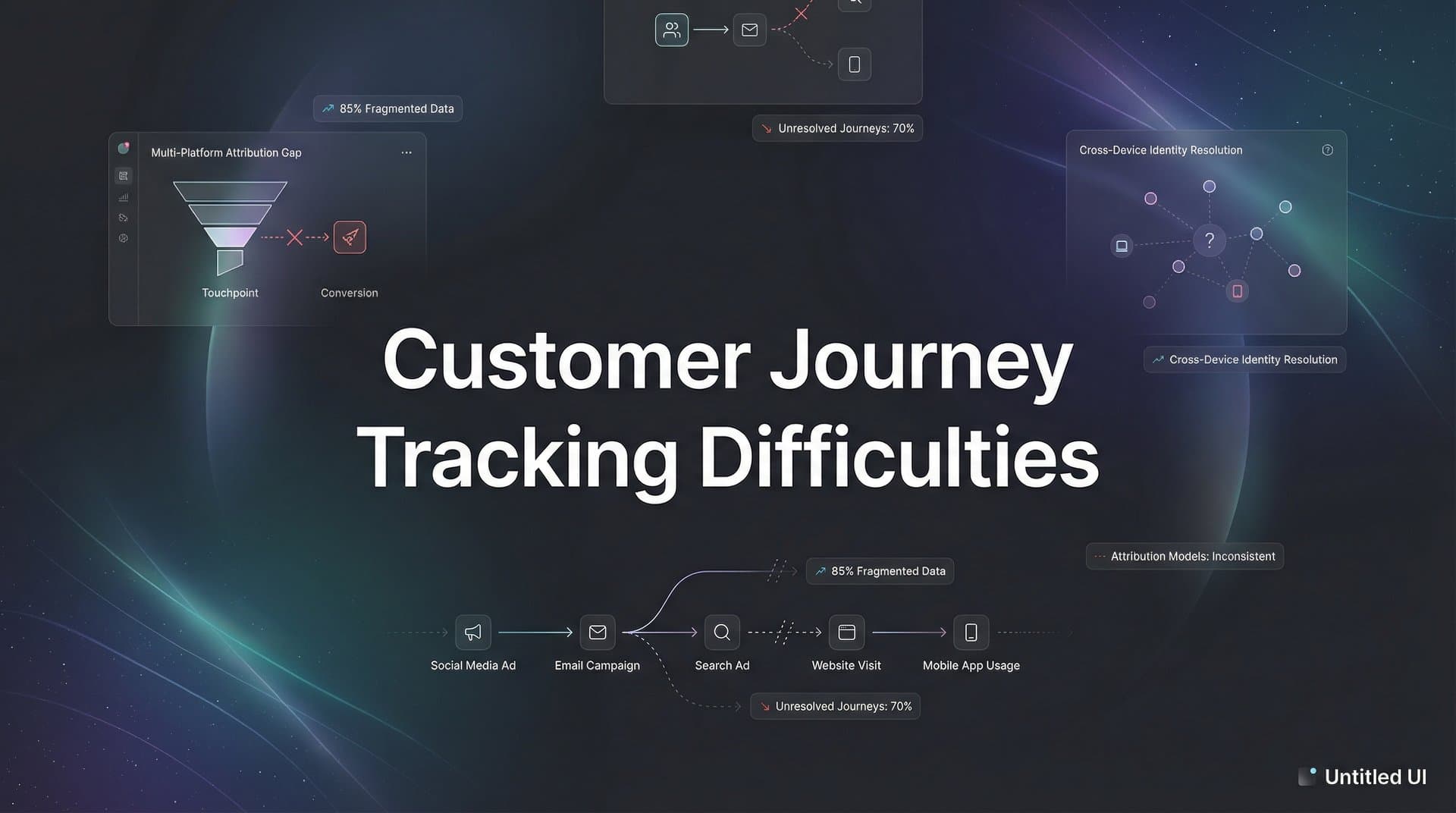
You refresh your dashboard for the third time this morning. Google Analytics shows 127 conversions from last week's campaign. Meta Ads Manager claims 184. Google Ads reports 96. Your CRM? It recorded 73 actual sales.
Someone is lying to you. Or maybe everyone is telling a version of the truth that just happens to be completely different from everyone else's version.
This is the daily reality for marketers in 2026. Customer journey tracking has transformed from a straightforward measurement challenge into a fragmented puzzle where the pieces don't quite fit together anymore. Privacy changes, cross-device behavior, and disconnected data sources have conspired to make accurate attribution feel like chasing shadows.
The good news? These difficulties aren't insurmountable. Understanding why tracking has become so complex is the first step toward fixing it. Let's break down exactly what's making customer journey tracking so difficult and explore the practical solutions that can restore clarity to your marketing data.
The Modern Customer Journey Is Anything But Linear
Remember when marketing attribution was simple? A customer clicked an ad, landed on your website, and converted. One device, one session, one clear path from awareness to purchase.
Those days are gone.
Today's buyers interact with brands across a constellation of touchpoints before making a decision. They might discover your brand through a LinkedIn post on their phone during their morning commute, research your product on their work laptop during lunch, compare pricing on their tablet that evening, and finally convert on their desktop three days later after clicking a retargeting ad.
That's four devices, multiple sessions, several different channels, and at least three days between first touch and conversion. And that's a relatively straightforward example.
B2B purchases add layers of complexity that make consumer journeys look simple by comparison. The average B2B buying decision involves multiple stakeholders who each conduct their own research. Marketing teams might engage with your content through organic search, while the CFO clicks a LinkedIn ad, and the CEO reads a case study forwarded by a colleague. These interactions can span weeks or months, crossing dozens of customer journey touchpoints before a sales conversation even begins.
Traditional analytics tools were built for a different era. They assume linear paths and single-device journeys. When a customer bounces between mobile and desktop, between social media and search, between your website and your competitors' sites, these tools lose the thread.
The result is a fragmented view where each interaction exists in isolation. Your analytics platform sees anonymous sessions but cannot connect them to the same person. Your ad platforms track clicks but cannot see what happened after the user switched devices. Your CRM knows who converted but has no visibility into the marketing touchpoints that preceded the sale.
This fragmentation is not a minor inconvenience. It fundamentally breaks your ability to understand what's working. When you cannot connect the dots across devices and sessions, you cannot accurately attribute revenue to marketing activities. You end up making optimization decisions based on incomplete data, which means you're essentially guessing about where to invest your budget.
Privacy Changes That Broke Your Tracking
If device fragmentation cracked the foundation of customer journey tracking, privacy changes brought the whole structure crashing down.
Apple's iOS 14.5 update in April 2021 introduced App Tracking Transparency, a feature that requires apps to explicitly ask permission before tracking users across other apps and websites. The prompt is stark: "Allow [App] to track your activity across other companies' apps and websites?"
Most users tap "Ask App Not to Track." Can you blame them?
This single change created massive blind spots for advertisers running campaigns on Meta, TikTok, Snapchat, and other platforms that rely on mobile app engagement. Suddenly, a significant portion of conversions became invisible to the tracking pixels that marketers had depended on for years. The data didn't disappear entirely, but it became delayed, modeled, and fundamentally less reliable.
Meta responded with Aggregated Event Measurement, a system that limits the number of conversion events you can track and introduces delays in reporting. Instead of seeing conversions in real time, marketers now wait hours or even days for modeled data that represents an estimate rather than a precise count.
But iOS restrictions are just one piece of the privacy puzzle.
Third-party cookies, the invisible trackers that followed users across websites for decades, are being systematically eliminated. Safari and Firefox already block them by default. Google Chrome, which still commands the majority of browser market share, has been gradually phasing them out, with full deprecation on the horizon.
Third-party cookies powered much of the tracking infrastructure that marketers took for granted. They enabled retargeting, cross-site attribution, and audience building based on browsing behavior across multiple domains. Without them, advertisers lose the ability to track users beyond their own properties. These cross-device tracking difficulties have become a defining challenge for modern marketers.
Privacy regulations add another layer of complexity. GDPR in Europe and CCPA in California require explicit consent before tracking users. Consent management platforms display cookie banners asking visitors to opt in to tracking. Many users decline or simply close the banner, which legally means no tracking.
The cumulative effect of these changes is that marketers now operate with significantly reduced visibility into customer behavior. A substantial portion of your audience browses with tracking protection enabled, refuses cookie consent, or uses devices where tracking is restricted by default. Your analytics tools can only measure the subset of users who both can be tracked technically and have consented to tracking legally.
This creates a paradox. Your marketing reaches more people than ever before, but you can measure fewer of them than at any point in digital marketing history. The gap between actual performance and measurable performance has never been wider.
Why Ad Platforms Tell You Different Stories
Open your Meta Ads Manager and check your conversion count. Now open Google Ads and check theirs. Add them together and compare to your actual sales.
The numbers don't match. They never do.
This is not a bug. It's a fundamental consequence of how ad platforms approach attribution. Each platform operates as its own walled garden with its own tracking pixel, its own attribution model, and its own definition of what counts as a conversion.
Meta uses a default attribution window that credits conversions to ad clicks within seven days and ad views within one day. Google Ads uses different windows depending on your campaign type. TikTok has its own methodology. LinkedIn uses yet another approach. When a customer interacts with ads across multiple platforms before converting, each platform can legitimately claim credit for that same conversion.
Think about it from the platforms' perspective. A user sees your Meta ad on Monday, clicks it, browses your site but doesn't convert. Tuesday, they see your Google search ad, click it, and still don't buy. Wednesday, they click a TikTok ad and finally make a purchase.
Meta's pixel fired on Monday and can still see the conversion within its attribution window, so Meta reports a conversion. Google's tag fired on Tuesday and also sees the conversion, so Google reports it too. TikTok's pixel fired immediately before the purchase, so TikTok definitely reports it. You just got credited with three conversions from three different platforms for a single sale.
The over-counting problem gets worse when you consider view-through attribution. If someone merely saw your ad without clicking, some platforms still take partial credit when that person later converts through a different channel. This creates attribution inflation where your reported conversions far exceed your actual sales.
Platform pixels have another inherent limitation. They only see their own touchpoints. Meta's pixel knows when someone clicked your Meta ad but has no visibility into whether that person also clicked your Google ad, engaged with your email campaign, or visited your site through organic search. Each platform operates in isolation, unable to see the broader context of how channels work together. Understanding these customer journey attribution problems is essential for accurate measurement.
This creates a self-serving bias in platform reporting. Every ad platform is incentivized to demonstrate its value to advertisers. When attribution is ambiguous, platforms err on the side of crediting themselves. The result is data that consistently overstates the impact of paid advertising while understating the contribution of organic channels, brand awareness, and multi-touch journeys.
For marketers trying to optimize across platforms, this fragmentation is paralyzing. How do you allocate budget between Meta and Google when both platforms claim credit for the same conversions? How do you measure incrementality when you cannot see which touchpoints actually influenced the decision versus which ones just happened to be present in the journey?
You cannot make data-driven decisions when your data sources fundamentally disagree about reality.
The CRM and Website Data Disconnect
Your website analytics and your CRM should tell the same story. They almost never do.
This disconnect happens because these systems track fundamentally different things. Website analytics platforms track anonymous sessions. They see visitors as a series of pageviews, clicks, and events, but they don't inherently know who those visitors are until someone fills out a form or logs in.
Your CRM tracks identified contacts. It knows names, email addresses, company information, and purchase history. It sees the person, not just the session.
The gap between these two views creates a massive blind spot in the middle of your funnel. A prospect might visit your site five times through different channels before finally submitting a contact form. Your analytics platform sees five separate anonymous sessions. Your CRM only sees the contact creation event and whatever source was present at the moment of form submission.
All the preceding touchpoints that nurtured that prospect toward conversion? Lost in the gap between anonymous and identified data. These customer journey tracking gaps plague organizations of every size.
This problem intensifies when you factor in offline conversions. A prospect clicks your ad, browses your site, downloads a whitepaper, and then calls your sales team to schedule a demo. Your website analytics tracked the digital journey. Your CRM records the phone call and eventual sale. But unless you have sophisticated tracking in place, these two data streams never connect.
The sales team closes the deal three weeks later. Your CRM attributes the revenue to the sales rep. Your analytics platform has no idea that this conversion even happened, let alone which marketing touchpoints influenced it. When you try to calculate ROI on your ad spend, you're working with incomplete information about which campaigns actually drive revenue.
B2B marketers face an even more complex version of this challenge. Multiple stakeholders from the same company might interact with your content using different devices and email addresses. Your analytics sees them as separate visitors. Your CRM might have them as separate contacts. The actual buying committee includes people who never directly engaged with your marketing at all but were influenced by colleagues who did.
Without proper integration between your website tracking and your CRM, you cannot answer fundamental questions. Which ad campaigns drive the highest quality leads? Which content assets move prospects through the funnel most effectively? What is the actual customer acquisition cost when you account for all touchpoints?
Marketing and sales teams end up operating from different versions of reality. Marketing reports lead volume based on form submissions. Sales reports that half those leads were unqualified or never responded. Marketing cannot prove which campaigns drove actual revenue. Sales cannot see the marketing touchpoints that warmed up prospects before the first sales call.
This disconnect does not just make reporting difficult. It makes optimization impossible. You cannot improve what you cannot measure, and you cannot measure what exists in disconnected silos.
Server-Side Tracking: A Path Through the Chaos
While privacy changes and platform fragmentation have made browser-based tracking increasingly unreliable, a different approach has emerged that bypasses many of these limitations entirely.
Server-side tracking flips the traditional model on its head. Instead of relying on JavaScript pixels that fire in the user's browser, server-side tracking sends conversion data directly from your server to ad platforms and analytics tools.
Here's why this matters.
Browser-based pixels are vulnerable to ad blockers, cookie restrictions, and privacy features that users enable to prevent tracking. When someone visits your site with an ad blocker installed or tracking protection enabled, your pixels might not fire at all. The conversion happens, but your analytics platform never sees it.
Server-side tracking eliminates this vulnerability. The conversion data originates from your server, which cannot be blocked by browser extensions or privacy settings. Ad blockers can prevent a pixel from loading in the browser, but they cannot stop your server from sending data to Meta's Conversions API or Google's Enhanced Conversions.
This approach also addresses iOS tracking limitations. When a user opts out of tracking through App Tracking Transparency, browser-based pixels lose visibility into their behavior. But server-side tracking can still send conversion events using hashed first-party data like email addresses, which platforms can match back to user profiles without relying on tracking cookies or device identifiers. Learn more about first-party data tracking for ads to understand this approach.
The result is significantly improved data accuracy. Marketers who implement server-side tracking typically recover visibility into conversions that were previously lost to privacy restrictions. This means more complete data for attribution, better signal for ad platform algorithms, and more reliable reporting for optimization decisions.
Server-side tracking also enables enrichment of conversion data with information that only exists on your server. You can send not just that a purchase occurred, but the customer's lifetime value, their subscription tier, or custom parameters that help ad platforms optimize for the outcomes you actually care about.
Platforms like Meta have explicitly recommended server-side tracking through their Conversions API as a way to improve data quality and campaign performance. The platform algorithms work better when they receive more complete conversion signals, which leads to improved targeting and optimization.
Implementation does require technical setup. You need to configure your server to capture conversion events and send them to ad platforms using their APIs. For many businesses, this means working with developers or using a platform that handles the server-side integration for you.
But the investment pays off in restored visibility and improved attribution accuracy. Server-side tracking does not solve every customer journey tracking challenge, but it eliminates many of the technical barriers that have made measurement so difficult in the privacy-first era.
Building a Unified View of Every Touchpoint
Server-side tracking solves the technical limitations, but it does not solve the fundamental problem of fragmented data living in disconnected systems. To truly understand customer journeys, you need to connect all your data sources into a single, coherent view.
This is where marketing attribution platforms come in. These tools integrate with your ad platforms, website analytics, CRM, and other data sources to create a unified tracking system that sees the complete customer journey across every touchpoint.
Think of it as building a central nervous system for your marketing data. Instead of checking five different dashboards that each tell a partial story, you see one dashboard that shows how all your channels work together. You can trace a conversion back through every interaction, from first touch to final purchase, across devices and platforms. A dedicated customer journey tracking platform makes this possible.
This unified view eliminates the conflicting narratives that make optimization so difficult. When Meta and Google both claim credit for the same conversion, a unified attribution system can see both touchpoints and distribute credit appropriately based on the role each played in the journey.
Multi-touch attribution models take this further by moving beyond simplistic first-click or last-click attribution. These models recognize that customer journeys involve multiple influences and distribute credit across touchpoints based on their contribution to the conversion.
A customer might discover your brand through a Facebook ad, research your product through organic search, engage with your email campaign, and finally convert through a Google retargeting ad. Last-click attribution would give all the credit to Google. First-click would credit Facebook. Multi-touch attribution recognizes that all these touchpoints played a role and distributes credit accordingly.
Different multi-touch models distribute credit in different ways. Linear attribution splits credit evenly across all touchpoints. Time-decay gives more credit to recent interactions. Position-based models emphasize first and last touches while still crediting middle interactions. The right model depends on your business and sales cycle, but any multi-touch approach provides a more accurate picture than single-touch attribution. Explore understanding customer journey attribution to find the right model for your needs.
Real-time tracking is another crucial advantage of unified attribution systems. Instead of waiting for delayed or modeled data from ad platforms, you see conversions as they happen. This enables immediate optimization rather than making decisions based on yesterday's data.
When you can see which campaigns, ads, and keywords are driving conversions in real time, you can shift budget toward what's working and away from what's not. This responsiveness compounds over time into significantly better performance than marketers who optimize based on delayed or incomplete data.
Unified tracking also connects the dots between marketing spend and actual revenue. By integrating CRM data with marketing touchpoints, you can see not just which campaigns drive conversions, but which ones drive high-value customers who stick around and generate long-term revenue.
This changes the optimization equation entirely. Instead of optimizing for cost per lead or cost per acquisition, you can optimize for customer lifetime value. You might discover that a campaign with a higher cost per lead actually drives customers who are worth three times more over their lifetime. That's insight you simply cannot get from platform-level reporting alone.
Cometly captures every touchpoint across your entire marketing ecosystem, from ad clicks to CRM events. The platform connects your ad platforms, website analytics, and sales data into a single source of truth, eliminating the conflicting conversion counts that make optimization feel like guesswork. With multi-touch attribution models and real-time tracking, you can see which campaigns actually drive revenue and make optimization decisions with confidence.
Moving Forward With Clarity
Customer journey tracking difficulties are not going away. Privacy regulations will continue to evolve. Consumer behavior will keep fragmenting across devices and channels. Ad platforms will maintain their walled gardens and self-serving attribution models.
But these challenges are solvable. The solution is not to return to a simpler past that no longer exists. It's to build infrastructure that works with the reality of modern marketing.
First-party data has become the foundation of accurate tracking. When you own the relationship with your customers and collect data directly through your properties, you maintain visibility that third-party tracking can no longer provide. This means investing in systems that capture and connect first-party data across every touchpoint.
Server-side tracking bypasses the browser-level restrictions that have made traditional pixels unreliable. By sending conversion data from your server rather than relying on JavaScript tags, you recover visibility lost to ad blockers, iOS restrictions, and cookie limitations. This is not optional anymore. It's essential for maintaining data accuracy.
Unified attribution connects fragmented data sources into a coherent view of customer journeys. Instead of reconciling conflicting reports from different platforms, you build a single source of truth that sees every touchpoint and distributes credit appropriately. This clarity transforms optimization from educated guessing into data-driven decision-making.
The marketers who thrive in this environment are not the ones hoping for a return to simpler times. They're the ones who embrace the complexity, invest in the right infrastructure, and build systems that capture accurate data despite the challenges.
Your competitors are struggling with the same tracking difficulties you are. The ones who solve these problems first will have a decisive advantage in understanding what drives results and optimizing accordingly.
Ready to elevate your marketing game with precision and confidence? Discover how Cometly's AI-driven recommendations can transform your ad strategy. Get your free demo today and start capturing every touchpoint to maximize your conversions.


