Facebook's algorithm is only as smart as the data you give it. When you run ads on Meta, the platform's machine learning system relies on conversion signals to figure out who to show your ads to, when to show them, and how much to bid. If you are feeding it incomplete, delayed, or inaccurate data, the algorithm is essentially flying blind.
It will waste your budget targeting the wrong people and optimizing toward low-quality conversions that never turn into revenue. Sound familiar? You are not alone. Many advertisers are unknowingly starving their campaigns of the very signals that would make them perform better.
The good news is that you can take control of this. By improving the quality, completeness, and speed of the conversion data you send back to Facebook, you give the algorithm what it needs to find more of your best customers. The result is a lower cost per acquisition, stronger ROAS, and campaigns that actually scale.
This guide walks you through a clear, actionable process to feed better data to the Facebook algorithm. Whether you are dealing with tracking gaps from iOS privacy changes, relying on pixel-only tracking that misses conversions, or simply not sending the right events back to Meta, each step below addresses a specific part of the data pipeline.
By the end, you will have a complete system that captures every meaningful touchpoint, enriches that data with real revenue outcomes, and sends it back to Facebook in a way that supercharges its optimization engine. Let's get into it.
Step 1: Audit Your Current Conversion Tracking Setup
Before you can improve your data quality, you need to know exactly what you are working with. Most advertisers assume their tracking is working because conversions are showing up in Ads Manager. But showing up and being accurate are two very different things.
Start inside Meta Events Manager. This is your command center for understanding what conversion signals Facebook is currently receiving. Look at which events are firing, such as PageView, Lead, Purchase, or custom events, and check for any errors, warnings, or deduplication issues flagged by Meta.
Pay close attention to the event types you are tracking. Are you only sending top-of-funnel micro-conversions like page views and button clicks? Or are you sending revenue-level events like completed purchases, subscription starts, or qualified leads? The algorithm needs high-value signals to optimize for high-value outcomes. If you are only sending page views, that is exactly what it will optimize for.
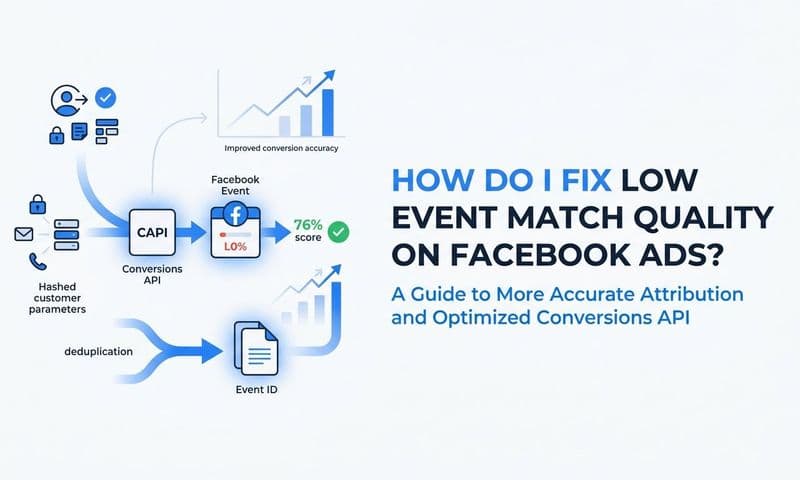
Next, look at your Event Match Quality scores. This is a score from 1 to 10 that indicates how well Facebook can match your conversion events to actual user accounts. A higher score means better attribution and better optimization. Low scores, typically below 6.0, signal that Facebook is receiving events but cannot reliably connect them to the people who triggered them. This directly limits how well the algorithm can learn and improve your targeting.
Also check whether you are tracking offline conversions or CRM outcomes. Many businesses generate leads online but close deals offline, days or weeks later. If those downstream outcomes never make it back to Facebook, the algorithm has no idea which campaigns actually drove revenue. This is a common reason Facebook ads show wrong data in your reporting.
Common pitfalls to look for: Relying solely on the Meta Pixel without any server-side backup. Tracking too many low-value events that dilute your signal. Sending Purchase events without passing the value and currency parameters. And missing deduplication logic that causes the same conversion to be counted twice.
Your success indicator for this step is a clear map of what is being tracked, what is missing, and where your data quality scores fall below Meta's recommended thresholds. This audit becomes the foundation for every improvement you make in the steps that follow.
Step 2: Implement Server-Side Tracking with the Conversions API
Here is the reality of browser-based pixel tracking in 2026: it is no longer enough on its own. Since Apple introduced App Tracking Transparency with iOS 14.5, many users have opted out of cross-app tracking. Add ad blockers, browser cookie restrictions, and Safari's Intelligent Tracking Prevention into the mix, and a significant portion of your conversions are simply never making it back to Facebook through the pixel alone. Understanding why Facebook ads stopped working after iOS 14 is critical context for this step.
This is where Meta's Conversions API, commonly called CAPI, becomes essential. Unlike the Meta Pixel, which fires from a user's browser and is subject to all of those client-side limitations, the Conversions API sends events directly from your server to Facebook. Browser restrictions cannot block it. User privacy settings do not interfere with it. It is a direct, reliable channel for sending conversion data.
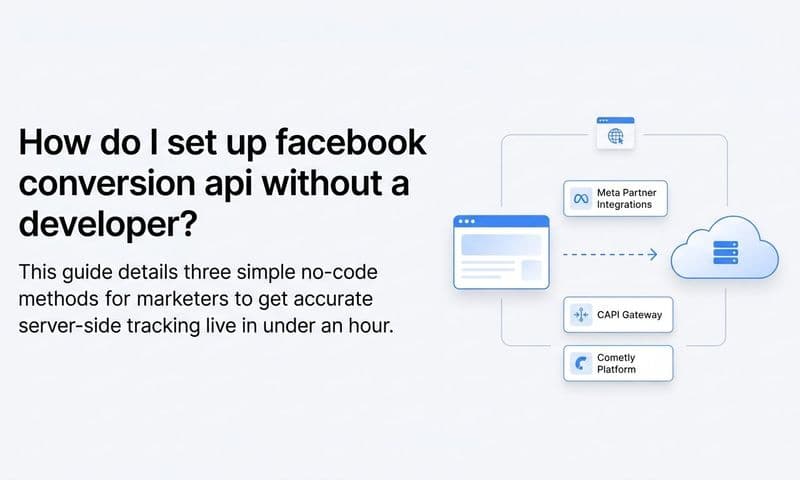
To set up CAPI, you have a few options. Meta offers a native integration through partner platforms like Shopify, WooCommerce, and others. You can also implement it manually through Meta's API documentation if you have developer resources. For a detailed walkthrough, check out this Conversion API implementation tutorial that covers the full setup process. Alternatively, platforms like Cometly handle the entire server-side tracking setup for you, automatically syncing enriched conversion data back to Meta without requiring deep technical work on your end.
One critical detail when running both the Meta Pixel and CAPI simultaneously: deduplication. When both your pixel and your server fire for the same conversion event, Facebook could count it twice, which would inflate your reported conversions and confuse the algorithm. Meta recommends passing a unique event_id parameter with every event so the platform can identify and deduplicate matching events from both sources.
Getting deduplication right is not optional. It is what allows you to run both tracking methods in parallel without corrupting your data. The pixel captures fast, browser-level signals. CAPI captures the conversions the pixel misses. Together, they give you the most complete picture possible.
What to watch for as you implement: Make sure server events appear in Events Manager alongside your pixel events. Check that your match quality scores improve after CAPI is live. And look for a reduction in delayed or missing event warnings, which are a common sign of pixel-only tracking gaps.
Your success indicator here is seeing server events populate in Events Manager, improved match quality scores, and fewer tracking warnings. When CAPI is working correctly alongside your pixel, you are already sending Facebook significantly better data than most advertisers.
Step 3: Connect Your CRM and Revenue Data to Close the Loop
Implementing CAPI is a major improvement, but there is still a critical gap that most advertisers leave open: they never tell Facebook what happened after the lead came in.
Think about how most ad campaigns are set up. You drive traffic, someone fills out a form or starts a trial, and Facebook records a Lead event. The algorithm celebrates. But what about the 80 percent of those leads who never become customers? Facebook has no idea. It keeps optimizing for lead volume because that is the only signal it has received. It has no visibility into which leads actually turned into revenue.
This is the core problem that closed-loop attribution solves. Closed-loop attribution means connecting every ad click all the way through to the final revenue outcome, whether that is a closed deal in your CRM, a completed purchase in Stripe, or a renewed subscription. When Facebook can see which clicks actually generated business value, it can optimize for those outcomes instead of just conversion volume. Understanding Facebook ads attribution is essential to making this work effectively.
To close this loop, you need to connect your CRM and payment platforms to your attribution system. Tools like HubSpot, Salesforce, and Stripe hold the downstream data that Facebook needs. The challenge is getting that data to flow back to Meta in a format it can use.
This is where an attribution platform like Cometly becomes particularly valuable. Cometly integrates with CRMs and payment platforms like Stripe to automatically connect ad clicks to real revenue events. When a lead closes in your CRM or a payment processes in Stripe, Cometly maps that outcome back to the original ad click and syncs the enriched conversion data back to Meta. Facebook now knows that this specific campaign, ad set, and creative drove actual revenue, not just a form fill.
The practical impact of this is significant. Instead of the algorithm chasing lead volume, it starts chasing revenue. It learns which audiences, placements, and creatives attract people who actually buy. Over time, this shifts your entire campaign performance in a direction that matters to your business.
Your success indicator for this step is straightforward: Facebook receives conversion events that include actual revenue values tied to real customer outcomes, not just top-of-funnel submissions. When you can see revenue-level data flowing into Events Manager, you have closed the loop.
Step 4: Optimize Your Event Structure and Pass High-Quality Parameters
Even with server-side tracking live and your CRM connected, the quality of the individual events you send matters enormously. Sending an event is not enough. Sending a rich, well-structured event is what actually moves the needle.
Start by reviewing which events you are currently sending and asking whether they align with your actual business goals. Default events are a starting point, not a finish line. If your highest-value action is a demo booking, a free trial start, or a contract signature, make sure those events are explicitly tracked and prioritized. Facebook will optimize for what you tell it to optimize for, so be intentional.
Always pass value and currency parameters with Purchase and Lead events. This is one of the most commonly missed optimizations. When you send a Purchase event without a value parameter, Facebook knows a conversion happened but has no idea what it was worth. It treats a ten-dollar sale the same as a ten-thousand-dollar sale. By passing the actual revenue value, you enable value-based bidding, which allows Facebook to optimize for your highest-value customers rather than just your most frequent converters.
Send customer information parameters with every event. These include hashed email addresses, phone numbers, names, and location data. Meta uses these parameters to match your server events to user accounts, which is exactly what drives your Event Match Quality score. Leveraging first-party data tracking ensures you are capturing these parameters reliably across your entire funnel.
Prioritize your highest-value signals. A closed deal is exponentially more valuable as a training signal than a page view. A completed purchase tells the algorithm far more than an add-to-cart. Structure your event hierarchy so the events that matter most to your business are the ones getting the most attention and the richest parameters.
Your success indicator for this step is an Event Match Quality score above 6.0 in Events Manager for your key conversion events, combined with confirmed value data flowing alongside all purchase and lead events. When both of those are in place, you are sending Facebook the kind of structured, high-quality signals its algorithm is built to learn from.
Step 5: Use Conversion Sync to Continuously Feed Enriched Data Back to Meta
Everything you have built so far creates a strong foundation. But there is one more layer that separates good data quality from exceptional data quality: continuous conversion sync.
Most advertisers think of conversion tracking as a one-time event. The pixel fires, the event is sent, and the job is done. But many of your most valuable conversions do not happen in real time. A lead might take two weeks to close. A trial user might convert to a paid plan thirty days after signing up. A customer might make a second purchase months later. If Facebook only ever receives the initial click event, it misses all of that downstream value entirely. This is a major reason behind underreporting conversions in Facebook ads.
Conversion sync is the process of continuously sending verified, enriched conversion events back to Meta as they happen, even when they occur days or weeks after the original ad interaction. This is fundamentally different from a basic CAPI setup. CAPI handles the technical channel. Conversion sync handles the ongoing flow of downstream outcomes through that channel.
Cometly's Conversion Sync feature is built specifically for this. It automatically sends enriched, conversion-ready events back to Meta, Google, and other ad platforms on an ongoing basis. When a deal closes in your CRM three weeks after a lead came in from a Facebook ad, Cometly maps that outcome to the original click and syncs it back to Meta with the full revenue value attached. The algorithm learns from the complete picture of that customer journey, not just the first touchpoint.
The downstream effects of this are significant for your campaign performance. Facebook's Advantage+ campaigns and automated bidding strategies are entirely dependent on the quality and completeness of the conversion signals they receive. When those signals include real revenue data from across the full customer lifecycle, the algorithm's ability to find and target high-value customers improves substantially. This approach helps you reduce wasted ad spend with better data flowing into the platform.
The result is a compounding improvement over time. The more high-quality data flows back to Facebook, the smarter the algorithm gets, and the better your campaigns perform. This is not a one-time optimization. It is a system that continuously improves as more data accumulates.
Your success indicator here is improved delivery and performance metrics in Ads Manager within one to two weeks of enabling continuous conversion sync. Watch for lower CPAs, improving ROAS trends, and better audience reach as the algorithm begins learning from richer signals.
Step 6: Validate, Monitor, and Iterate on Your Data Quality
Building the system is step one. Keeping it healthy is the ongoing work that separates advertisers who scale from those who plateau.
Set up a weekly review cadence focused on data quality. Inside Events Manager, check event health status, monitor your match quality scores, and look for any new warnings or errors that have appeared. Tracking setups can break. Integrations can drift. A CRM field that stops populating can silently degrade the quality of your conversion sync without any obvious alert. Regular checks catch these issues before they compound into weeks of degraded campaign performance.
Compare Facebook-reported conversions against your CRM or attribution platform data on a regular basis. If Facebook is reporting fifty purchases but your Stripe dashboard shows thirty, that discrepancy needs investigation. It could indicate a deduplication issue, a pixel misfiring, or an event being triggered by bot traffic. Learning how to approach solving attribution data discrepancies is essential for maintaining a trustworthy tracking setup.
Use multi-touch attribution reporting to go beyond last-click data. Not every conversion that Facebook claims credit for came exclusively from a Facebook ad. An attribution platform like Cometly gives you a cross-channel view of how campaigns interact across the full customer journey, so you can see which ads are genuinely driving revenue versus which ones are simply appearing in the attribution window.
Cometly's analytics dashboard and AI-powered recommendations make this process more actionable. Rather than manually digging through raw data, you get clear visibility into which campaigns and creatives are performing across channels, along with recommendations for where to reallocate budget. Investing in marketing data accuracy matters for ROI and turns your weekly data review from a reporting exercise into a genuine optimization session.
What to look for in your weekly review: Event match quality scores holding above 6.0. No new errors or warnings in Events Manager. Conversion counts that align reasonably with your CRM and payment data. And ROAS trends that reflect the improvements you are making to your data pipeline.
Your success indicator is consistent alignment between Facebook-reported data and your actual revenue, paired with improving ROAS trends over time. When those two things are moving in the right direction together, your data system is working.
Putting It All Together: Your Data Quality Checklist
Feeding better data to the Facebook algorithm is not a one-time fix. It is an ongoing system that compounds in value the longer it runs. Here is a quick checklist to confirm you have everything in place.
1. You have audited Events Manager and identified tracking gaps, low match quality scores, and missing revenue events.
2. Server-side tracking via the Conversions API is live and properly deduplicated with your pixel events using unique event IDs.
3. Your CRM and payment data are connected so downstream revenue outcomes flow back to Facebook, not just top-of-funnel lead events.
4. You are passing value, currency, and customer information parameters with all key conversion events to maximize match quality and enable value-based optimization.
5. Conversion sync is running automatically to feed enriched, revenue-level data back to Meta on an ongoing basis as deals close and customers convert.
6. You review data quality weekly and use multi-touch attribution insights to validate accuracy and optimize budget allocation.
When Facebook's algorithm has access to complete, accurate, and timely data, it can do what it does best: find more of your highest-value customers at a lower cost. The advertisers who win on Meta are not necessarily the ones with the biggest budgets. They are the ones giving the algorithm the best information to work with.
Platforms like Cometly make this entire system simpler by handling server-side tracking, CRM integration, and conversion sync in one place. You get a complete view of every customer journey, AI-powered recommendations for where to scale, and the confidence that the data flowing back to Meta is accurate and enriched. Ready to build a smarter data pipeline for your Facebook campaigns? Get your free demo today and start capturing every touchpoint to maximize your conversions.