
Most B2B SaaS buyers do not convert on their first interaction with your brand. A prospect might discover you through a LinkedIn ad, spend a few weeks reading your blog, attend a webinar, click a retargeting ad, and finally book a demo after a follow-up email. That is five distinct touchpoints across multiple channels, each playing a role in moving the deal forward.
First touch attribution credits the LinkedIn ad for everything.
This is the central tension with first touch attribution: it is simple to implement, easy to explain in a board meeting, and genuinely useful for understanding awareness. But simplicity has a price. When your budget decisions, campaign optimizations, and revenue reporting all rest on a model that ignores the majority of your customer journey, the consequences compound quietly until something breaks. This article is a clear-eyed breakdown of where first touch attribution falls short, why it leads growth teams astray, and what smarter alternatives look like for B2B SaaS companies operating with complex sales cycles.
How First Touch Attribution Actually Works
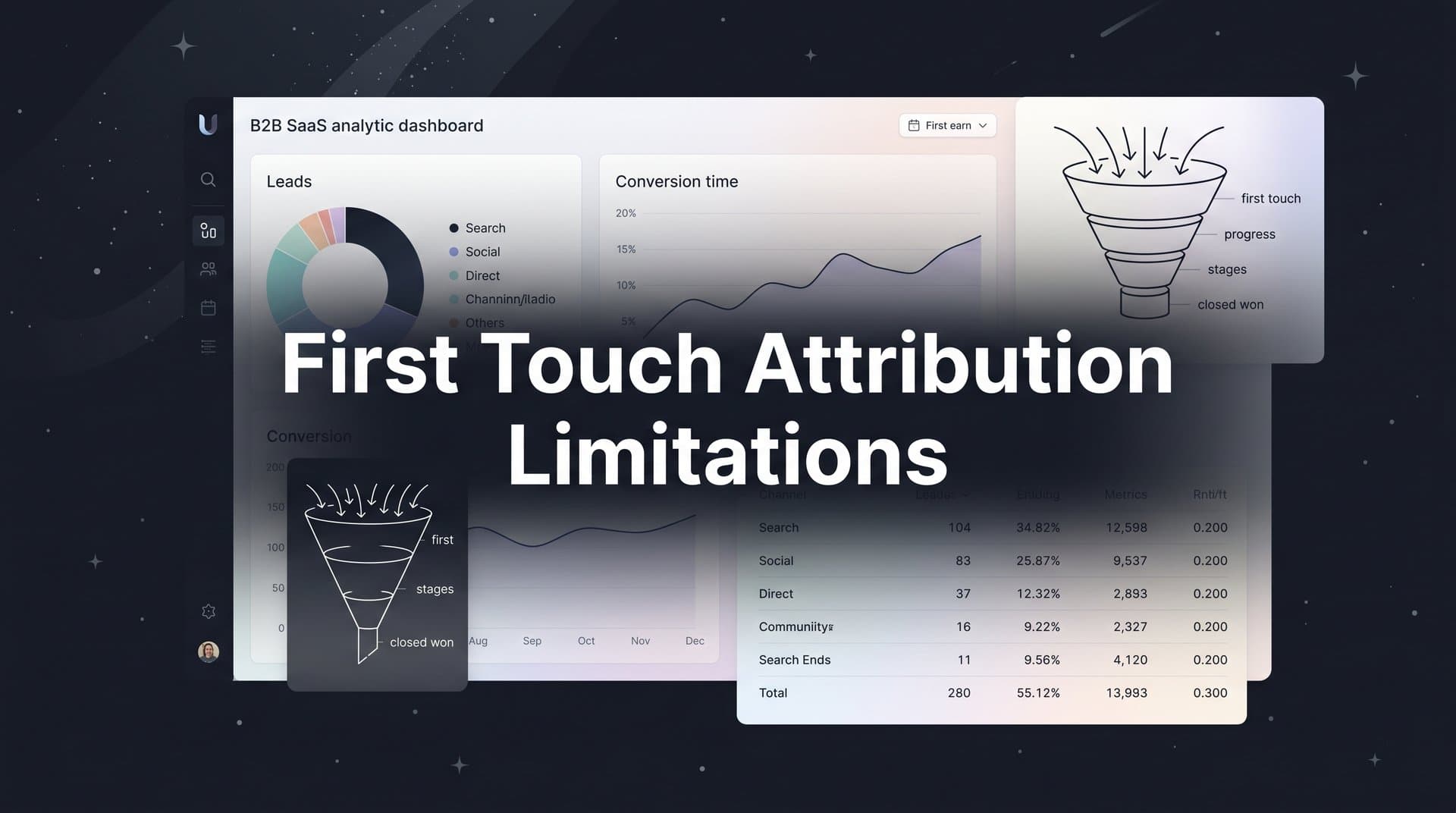
First touch attribution is one of the oldest models in digital marketing. The concept is straightforward: when a prospect converts, 100% of the conversion credit goes to the very first marketing touchpoint they interacted with, regardless of everything that happened afterward in the customer journey.
Think of it like giving a movie's entire box office credit to the trailer, ignoring the reviews, the word-of-mouth buzz, and the actor's press tour that actually convinced people to buy tickets.
The model became popular for good reasons. It is easy to configure in basic analytics setups and CRM platforms. It gives leadership a clean, intuitive answer to the question "how did this lead find us?" And for measuring top-of-funnel performance, it does provide genuine signal. If you want to understand which channels are best at generating initial awareness and bringing new names into your funnel, first touch attribution delivers that information clearly.
For short sales cycles or single-session purchases, the model can even be reasonably accurate. If someone searches for your product, clicks an ad, and buys within the same session, first touch and last touch tell the same story.
That brings up an important distinction. Last touch attribution assigns 100% of credit to the final interaction before conversion, making it the mirror image of first touch. Both are single-touch models, meaning they reduce the entire customer journey to a single data point. Last touch tends to favor bottom-funnel channels like branded search and direct traffic. First touch tends to favor top-of-funnel awareness channels like paid social and organic search.
Neither model accounts for what happens in between. For B2B SaaS companies, that middle ground is often where deals are actually won or lost. Understanding this gap is the starting point for recognizing why single-touch attribution models matter so much in practice.
The Core Problem: A Single Touchpoint Cannot Tell the Full Story
B2B SaaS buying decisions are not made in a single moment. They unfold over weeks or months, involve multiple stakeholders, and require a prospect to move through distinct stages of awareness, consideration, and decision-making before they are ready to commit. Along the way, they interact with a range of channels and content types, each serving a different function in the journey.
First touch attribution captures the entry point and nothing else.
This matters because the touchpoints that generate initial awareness are rarely the same touchpoints that close deals. A LinkedIn ad might introduce your brand to a VP of Marketing who had never heard of you. But what actually moves that VP toward a demo request might be a case study they downloaded two weeks later, a retargeting ad that reminded them of your product, and a nurture email that arrived at exactly the right moment. Under first touch attribution, the LinkedIn ad gets full credit. The case study, the retargeting campaign, and the email get nothing.
This creates a systematic distortion in how channels appear to perform. Awareness channels look like revenue drivers because they are always the first interaction. Mid-funnel nurture content, retargeting campaigns, and bottom-funnel conversion drivers look like poor performers because they never receive credit, even when they are doing the heavy lifting of actually moving prospects through the pipeline.
The problem compounds in B2B environments because buying committees often include multiple decision-makers. A champion at the working level might discover your product through organic search, but a director or CFO who has to approve the purchase might first encounter your brand through a completely different channel. First touch attribution picks one entry point and ignores the others, giving you an incomplete picture of how influence actually flows through a buying group.
The result is a view of channel performance that feels accurate because it is grounded in real data, but is actually deeply misleading because it only reflects one dimension of a multi-dimensional process. For teams trying to make serious budget decisions based on this data, the risks are significant. Understanding B2B revenue attribution in full context is essential for any SaaS company navigating complex buying journeys.
Budget Decisions That Go Wrong Because of First Touch Data
Here is where first touch attribution limitations move from being a theoretical problem to a practical one with real financial consequences.
When first touch is your primary reporting model, channels that appear later in the customer journey receive zero credit in your attribution reports. Email nurture sequences, paid retargeting campaigns, demo request ads, and bottom-funnel content all look like they are contributing nothing, even when conversion data tells a different story. The model makes them invisible.
Growth teams working from this data face a predictable set of wrong decisions. The channels that look strongest under first touch attribution are the ones generating initial awareness, so those receive budget increases. The channels that look weakest are often the ones doing the conversion work, so those get cut or deprioritized. Over time, you end up with a funnel that is well-stocked at the top and starved in the middle and bottom, which is exactly the wrong configuration for a B2B SaaS company trying to improve pipeline efficiency.
The downstream impact compounds. Lower conversion rates across mid-funnel touchpoints mean your cost per acquisition rises, because more prospects are entering the funnel but fewer are making it to a closed deal. Optimization decisions fed by first touch data push ad platforms to target audiences that are good at generating first clicks but not necessarily good at generating revenue. Campaigns that should be scaled get paused. Campaigns that should be paused get scaled.
What makes this particularly difficult to catch is that the data looks clean and actionable. You have clear attribution numbers, clear channel rankings, and a clear narrative about what is driving performance. The problem is that the narrative is built on an incomplete foundation. Teams often do not realize the damage until they notice that their top-of-funnel investment is growing but their pipeline is not keeping pace.
Auditing your attribution model is not just a data hygiene exercise. It is a business-critical step for any growth team that wants to allocate budget with confidence and optimize campaigns toward outcomes that actually matter: pipeline, revenue, and closed-won deals. Reviewing attribution challenges in marketing analytics can help teams identify exactly where their current model is creating blind spots.
Where First Touch Attribution Breaks Down in Practice
Beyond the conceptual limitations, first touch attribution faces a set of practical challenges that make its data increasingly unreliable, particularly in today's privacy-restricted tracking environment.
Cross-device and cross-session gaps: B2B buyers rarely stay on a single device throughout their research process. A prospect might discover your brand on their phone while scrolling LinkedIn during a commute, then return to your website on their work laptop a week later to read documentation and eventually request a demo. Standard pixel-based first touch attribution often fails to stitch these sessions together. The result is either a misattributed conversion, where the desktop session gets credited as the first touch because the mobile visit was never connected, or a lost conversion that appears to have come from direct traffic because the original source was dropped.
Dark social and offline discovery: A significant portion of B2B buying decisions are influenced by channels that first touch attribution cannot see at all. Word-of-mouth recommendations from peers, conversations at industry conferences, mentions in Slack communities, podcast episodes, and LinkedIn posts that get shared without tracking links all fall into the category of dark social. These touchpoints are often highly influential in B2B contexts precisely because they come from trusted sources. But because they leave no trackable footprint, first touch models treat them as if they do not exist.
Privacy changes and cookie limitations: Browser-level privacy restrictions have significantly reduced the reliability of pixel-based tracking across the industry. Safari's Intelligent Tracking Prevention, Firefox's enhanced privacy defaults, and iOS privacy updates have all shortened the window in which first-party cookies remain active and limited the cross-site tracking that many attribution systems depend on. For teams running first touch attribution through standard analytics configurations, this means a growing percentage of touchpoints are being dropped or misattributed, quietly degrading data quality over time. Understanding how to fix attribution discrepancies is a critical skill for any team operating in this environment.
Each of these gaps individually would be a problem. Together, they create an attribution picture that is not just incomplete but actively misleading in ways that are difficult to detect without a more robust tracking infrastructure in place.
Multi-Touch Attribution: The Practical Alternative
The natural response to first touch attribution limitations is to distribute credit across multiple touchpoints rather than concentrating it on one. Multi-touch attribution models do exactly that, giving marketing teams a far more accurate picture of how different channels and campaigns contribute to revenue across the full customer journey.
The key is understanding that there is not a single multi-touch model. Several approaches exist, each reflecting a different assumption about how touchpoints contribute to conversion.
Linear attribution distributes credit equally across every touchpoint in the customer journey. If a prospect interacted with five channels before converting, each channel receives 20% of the credit. This model is easy to understand and ensures that no touchpoint is completely invisible, though it treats all interactions as equally important regardless of their actual influence.
Time decay attribution gives more credit to touchpoints that occurred closer to the conversion event, based on the logic that recent interactions had more influence on the final decision. This model tends to favor bottom-funnel channels, which can be useful for teams focused on conversion optimization but may undervalue the awareness channels that started the journey.
Position-based attribution, sometimes called U-shaped attribution, emphasizes the first and last touchpoints while still distributing some credit to the interactions in between. This approach acknowledges that both the initial discovery moment and the final conversion trigger are important, while not completely ignoring the middle of the funnel.
Data-driven attribution uses algorithmic analysis to assign credit based on actual conversion patterns across your dataset. Rather than applying a fixed rule, it learns from your specific customer journeys to determine which touchpoints have the most influence on outcomes. For B2B SaaS companies with sufficient data volume, this model tends to produce the most accurate results.
For teams with long, complex sales cycles, multi-touch attribution paired with pipeline and revenue data provides the clearest signal for budget allocation and campaign optimization. Instead of asking "which channel generated the first click," you can ask "which combination of channels produces the highest-value closed-won deals," which is a much more useful question for a growth team.
Moving Beyond Single-Touch Models with the Right Tools
Understanding the limitations of first touch attribution is one thing. Having the infrastructure to move beyond it is another. The gap between knowing you need better attribution and actually implementing it is where many B2B SaaS teams get stuck.
Platforms like Cometly are built specifically to close that gap. Rather than capturing a single entry point and stopping there, Cometly tracks every touchpoint across the customer journey, from the first ad click through CRM events, giving your team a complete and connected view of how prospects move from initial awareness to closed-won revenue. That completeness is what makes attribution data actually useful for decision-making.
One of the most significant technical advances in modern attribution is server-side tracking. Rather than relying on browser-based pixels that are subject to cookie restrictions, ad blockers, and privacy-driven degradation, server-side tracking captures conversion events at the server level. Cometly's Conversion API integrations, including support for Meta Conversion API and Google Enhanced Conversions, ensure that conversion events are recorded accurately even in environments where pixel-based tracking would fail. This directly addresses one of the most persistent first touch attribution limitations: the data gaps created by privacy changes and cross-device tracking failures.
AI-powered attribution analysis adds another layer of value. Rather than requiring your team to manually interpret attribution reports and make judgment calls about which channels deserve more investment, Cometly's AI surfaces the patterns that matter. It identifies which channels and campaigns are actually driving pipeline and revenue, flags underperforming spend, and gives growth teams the confidence to scale what works and cut what does not. This is the kind of analysis that becomes possible when your attribution data is complete, accurate, and connected to real revenue outcomes. Exploring the best marketing attribution tools for B2B SaaS can help teams identify the right platform for their specific needs.
For B2B SaaS teams, connecting ad platform data to CRM pipeline and revenue data is the critical step that first touch attribution can never take. Cometly's Stripe revenue integration makes it possible to see not just which channels generate leads but which channels generate revenue, giving you a single source of truth that bridges the gap between marketing activity and business outcomes.
Putting It All Together
First touch attribution is not without value. It tells you something real about which channels are generating initial awareness and bringing new prospects into your funnel. For simple buying journeys or early-stage teams that are just getting started with attribution, it offers a useful starting point.
But it is not a reliable foundation for budget decisions, campaign optimization, or revenue reporting in B2B SaaS. The model ignores the majority of the customer journey, systematically over-credits awareness channels, creates perverse budget incentives, and produces data that becomes less reliable as privacy restrictions tighten and buying journeys grow more complex.
The practical path forward is to audit your current attribution setup and honestly assess whether the data you are using to make decisions reflects the full customer journey or just the first step of it. If you are relying primarily on first touch attribution, there is a good chance your highest-performing channels are invisible in your reports, and your budget allocation reflects that blind spot.
Multi-touch attribution, paired with server-side tracking and revenue-level data, gives B2B SaaS marketers the complete picture they need to invest confidently and optimize toward outcomes that matter. The tools to do this well exist, and the cost of not using them is measured in misallocated budget and missed pipeline.
Ready to see every touchpoint from first click to closed-won revenue? Get your free demo and discover how Cometly gives your team the attribution accuracy to scale with confidence.