If you're running paid ads across multiple channels and still relying on last-click data to make budget decisions, you're likely misattributing revenue and scaling the wrong campaigns. Funnel attribution software solves this by mapping every touchpoint a prospect hits before converting, from the first ad impression to the closed deal. The result is a clearer picture of what's actually driving pipeline and revenue.
This list covers the best funnel attribution software tools available in 2026, evaluated on attribution model depth, cross-channel tracking capability, ease of integration, and how well each tool serves performance-driven marketing teams. Whether you're a growth marketer at a SaaS company, an agency managing multiple ad accounts, or an e-commerce brand trying to decode a complex buyer journey, there's a tool here built for your situation.
For context on how attribution fits into your broader analytics strategy, see our guide on 20 ways marketing attribution software can improve digital marketing efforts.
1. Cometly
Best for: Performance marketers who need AI-powered attribution, server-side tracking, and actionable optimization recommendations.
Cometly is an AI-powered marketing attribution platform that connects ad platforms, CRM data, and website activity into a single, real-time view of the customer journey.
 9 Best Marketing Attribution Platforms to Compare in 2026
Where This Tool Shines
Cometly stands out because it doesn't stop at showing you attribution data. It actively helps you act on it. The AI Ads Manager surfaces recommendations for which campaigns to scale, pause, or reallocate budget toward, based on actual revenue attribution rather than platform-reported metrics.
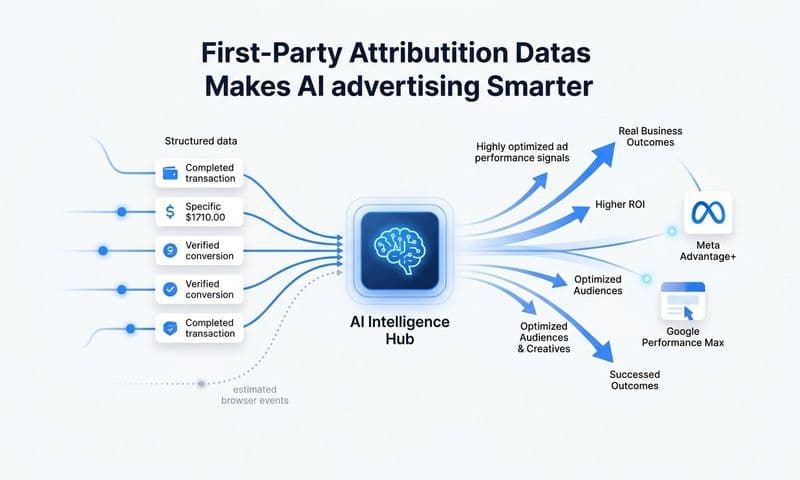
The Conversion Sync feature is particularly valuable in a post-iOS world. By sending enriched conversion events back to Meta, Google, and other ad platforms, Cometly improves the signal quality those platforms use for targeting and optimization. Better data in means better algorithmic performance out.
Key Features
Server-Side Tracking: Captures conversion data beyond browser limitations, improving accuracy across all channels and reducing data loss from ad blockers or cookie restrictions.
Multi-Touch Attribution: Maps every paid and organic touchpoint across the full customer journey, letting you compare models side by side.
Conversion Sync: Sends enriched, conversion-ready events back to Meta, Google, and other ad platforms to improve algorithmic targeting and bidding.
AI Ads Manager: Identifies high-performing and underperforming campaigns across every ad channel and surfaces specific optimization recommendations.
AI Chat: Lets you query your attribution data in plain language, making it accessible to marketers who don't want to build custom reports from scratch.
Real-Time Analytics Dashboard: Connects ad platforms, CRM, and website data in one place for a unified view of campaign performance.
Best For
Cometly is built for digital marketing teams, growth marketers, and agencies running paid campaigns across multiple platforms who want attribution data paired with AI-driven guidance. It's especially useful for teams that have struggled with inaccurate pixel data or want to improve ad platform performance through better conversion signals.
Pricing
Pricing is available on request via the Cometly website. Teams can book a demo to get a quote tailored to their data volume and use case.
2. Rockerbox
Best for: DTC and e-commerce brands that need multi-touch attribution combined with marketing mix modeling and incrementality testing.
Rockerbox is a unified marketing measurement platform that brings together multiple attribution methodologies under one roof.
 8 Best Triple Whale Alternatives and Attribution Software in 2026
Where This Tool Shines
Rockerbox is one of the few tools in this space that combines multi-touch attribution, marketing mix modeling, and incrementality testing in a single platform. That combination is valuable for teams that need to evaluate both lower-funnel, click-based performance and upper-funnel brand spend in a consistent way.
Its cross-channel data normalization is also a practical strength. Rather than toggling between ad platform dashboards that each claim credit for the same conversion, Rockerbox gives you a deduplicated view of performance across all channels.
Key Features
Multi-Touch Attribution: Supports customizable attribution models so teams can apply the framework that fits their business logic.
Marketing Mix Modeling: Evaluates upper-funnel and offline channel contributions that click-based attribution can't capture on its own.
Incrementality Testing: Helps validate whether a channel is actually driving incremental conversions or just claiming credit for organic behavior.
Cross-Channel Data Normalization: Deduplicates and standardizes conversion data across all connected ad platforms.
Integrations: Connects with major ad platforms, e-commerce tools, and data warehouses.
Best For
Rockerbox works well for mid-market to enterprise DTC and e-commerce brands that are spending meaningfully across both performance and brand channels and need a measurement framework that covers both. It's a strong fit for teams that have outgrown single-model attribution.
Pricing
Custom pricing based on ad spend and data volume. Contact Rockerbox directly for a quote.
3. Triple Whale
Best for: Shopify brands running paid social campaigns who want order-level attribution and creative performance analytics.
Triple Whale is a Shopify-native attribution and analytics platform built specifically for e-commerce brands, with a strong focus on creative-level performance data.
 9 Best Funnel Attribution Software Tools in 2026
Where This Tool Shines
Triple Whale's Shopify-native pixel gives it an edge for e-commerce brands because it ties attribution directly to order-level data rather than relying on platform-reported conversions. That connection between ad spend and actual orders makes ROAS calculations more reliable.
The creative analytics layer is another differentiator. For brands running heavy Meta or TikTok spend, being able to see which specific creatives are driving revenue (not just clicks) is genuinely useful for creative strategy decisions.
Key Features
Shopify-Native Pixel: Tracks conversions at the order level, improving attribution accuracy for Shopify stores.
Creative Analytics: Breaks down performance by individual ad creative, helping teams identify what content is actually converting.
Blended ROAS Reporting: Provides a holistic view of return on ad spend across all channels, including contribution margin.
Post-Purchase Survey: Adds a qualitative attribution layer by asking customers directly how they heard about the brand.
Summary Dashboard: Consolidates key e-commerce metrics in a single daily overview.
Best For
Triple Whale is purpose-built for Shopify brands, particularly those spending heavily on Meta and TikTok. It's less suited for non-Shopify businesses or B2B companies with longer sales cycles.
Pricing
Plans start at approximately $129/month, with pricing scaling based on store revenue. Higher tiers unlock additional analytics features.
4. Northbeam
Best for: High-spend e-commerce advertisers who need granular creative-level and channel-level attribution powered by machine learning.
Northbeam is a machine learning attribution platform designed for e-commerce brands managing significant ad budgets across multiple channels.
 9 Best Attribution Tools for Paid Advertising in 2026
Where This Tool Shines
Northbeam's ML-powered attribution models are built to handle the complexity that comes with high-volume, multi-channel ad programs. Rather than applying a fixed rule-based model, Northbeam uses machine learning to assign credit in a way that reflects actual conversion influence across channels.
The creative-level attribution reporting is a standout feature for brands running large creative libraries across Meta, TikTok, and YouTube. Being able to trace revenue back to a specific ad creative, rather than just a campaign or channel, gives creative and media teams a shared language for performance decisions.
Key Features
ML-Powered Attribution: Uses machine learning to assign conversion credit based on actual influence, moving beyond rule-based models.
Creative-Level Reporting: Attributes revenue to individual ad creatives, not just campaigns or channels.
Custom Attribution Windows: Lets teams configure lookback windows to match their specific sales cycle.
Cross-Channel Reconciliation: Aligns spend and revenue data across all connected platforms for a deduplicated view.
Media Mix Modeling: Adds an upper-funnel measurement layer for evaluating brand-level channel contributions.
Best For
Northbeam is best suited for e-commerce advertisers with substantial monthly ad spend who need detailed, model-level attribution data to guide both media buying and creative decisions. It's more advanced than most teams need at early stages.
Pricing
Custom pricing based on ad spend volume. Contact Northbeam for a quote.
5. HockeyStack
Best for: B2B SaaS and tech companies that need to connect marketing touchpoints to CRM pipeline and closed revenue without engineering support.
HockeyStack is a B2B attribution and analytics platform that links marketing activity to pipeline and revenue using no-code integrations.
 9 Best Funnel Attribution Software Tools in 2026
Where This Tool Shines
HockeyStack is designed specifically for the B2B funnel, where the path from first touch to closed deal often spans months and involves multiple stakeholders. Its account-level and contact-level journey tracking reflects how B2B buying actually works, rather than forcing a B2C attribution model onto a fundamentally different sales process.
The no-code setup is a meaningful advantage for marketing teams that don't have dedicated engineering resources. Most integrations can be configured by a marketer, which reduces the time between implementation and actionable data.
Key Features
Pipeline and Revenue Attribution: Connects marketing touchpoints directly to CRM stages and closed-won revenue for a full-funnel view.
No-Code Integrations: Connects to CRMs and ad platforms without requiring developer involvement.
Account and Contact Journey Tracking: Maps touchpoints at both the account level and individual contact level within a buying committee.
Custom Attribution Model Builder: Allows teams to configure attribution logic that matches their specific funnel and sales cycle.
Revenue Influence Reporting: Shows which channels and campaigns are influencing pipeline and revenue, not just generating leads.
Best For
HockeyStack is a strong fit for B2B SaaS companies, tech startups, and any business with a longer, multi-touch sales cycle that wants to move beyond MQL-level reporting and understand actual revenue influence by channel.
Pricing
Custom pricing based on company size and data volume. Contact HockeyStack for details.
6. Ruler Analytics
Best for: Lead-generation businesses and agencies that need to attribute offline conversions, calls, and form submissions back to originating marketing sources.
Ruler Analytics is a marketing attribution platform specializing in offline conversion tracking, call tracking, and form attribution for lead-gen funnels.
 8 Best Attribution Tools with Onboarding Support in 2026
Where This Tool Shines
Ruler Analytics fills a gap that most attribution tools leave open: offline and phone-based conversions. For businesses where a significant portion of leads come in via phone calls or contact forms rather than direct online purchases, standard pixel-based attribution breaks down. Ruler connects those offline touchpoints back to the specific ad, keyword, or channel that initiated the journey.
The ability to import offline conversions back into ad platforms is particularly useful for agencies managing Google Ads or Meta campaigns for service-based clients. It closes the loop between what the ad platform sees and what actually happened in the real world.
Key Features
Call Tracking: Ties inbound phone calls to the originating marketing source, keyword, or ad.
Form and Live Chat Attribution: Attributes form submissions and chat interactions to the campaign or channel that drove them.
Offline Conversion Import: Sends offline conversion data back to Google Ads, Meta, and other platforms to improve bidding and optimization.
Multi-Touch Attribution for Lead Gen: Applies attribution models across the full lead journey, not just the final click.
CRM and Analytics Integrations: Connects with popular CRM platforms and analytics tools to unify lead and revenue data.
Best For
Ruler Analytics is ideal for lead-generation businesses, service companies, and agencies managing clients in industries where calls and form submissions are the primary conversion events rather than online transactions.
Pricing
Plans start at approximately $199/month. Higher tiers include additional tracking volumes and features.
7. Dreamdata
Best for: B2B companies with complex, multi-stakeholder sales cycles that need account-level attribution tied to pipeline and closed revenue.
Dreamdata is a B2B revenue attribution platform designed for organizations where multiple contacts within a single account influence the buying decision over an extended period.
 9 Best B2B SaaS Attribution Platforms Reviewed for 2026
Where This Tool Shines
Dreamdata's account-level attribution model is built for the reality of enterprise and mid-market B2B sales, where a single deal might involve a marketing director, a VP of operations, and a CFO all touching different content over a six-month window. Mapping all of those touchpoints to a single account and ultimately to closed revenue requires a different architecture than standard contact-level attribution.
The buying committee journey mapping feature gives revenue and marketing teams a shared view of how influence accumulates across stakeholders before a deal closes. That visibility is hard to find in most attribution tools.
Key Features
Account-Level Multi-Touch Attribution: Aggregates all touchpoints across an account, not just individual contacts, to attribute revenue accurately.
Buying Committee Journey Mapping: Visualizes how different stakeholders within a single account engage with marketing and sales content.
Pipeline and Revenue Influence Reporting: Shows which channels and campaigns are contributing to pipeline creation and deal closure.
Funnel Velocity Analysis: Measures time-to-close and identifies where deals slow down in the funnel.
CRM and Marketing Automation Integrations: Connects with Salesforce, HubSpot, and major ad platforms for a complete data picture.
Best For
Dreamdata is best suited for B2B companies with longer sales cycles, larger deal sizes, and multiple stakeholders involved in the purchase decision. It's particularly valuable for revenue operations and demand generation teams that need to justify marketing spend in terms of pipeline and revenue.
Pricing
A free tier is available for smaller teams. Paid plans start at approximately $999/month, reflecting its positioning as an enterprise-grade B2B attribution solution.
8. Attribution (Attribution.com)
Best for: Teams that want to move beyond rule-based attribution models and apply algorithmic, data-driven credit assignment across all marketing touchpoints.
Attribution is an algorithmic multi-touch attribution platform that uses data-driven models to assign conversion credit based on actual influence rather than fixed rules.
Where This Tool Shines
The core differentiator for Attribution.com is its focus on moving teams away from arbitrary rule-based models like last-click or linear attribution and toward models that reflect how each touchpoint actually contributes to conversion. That shift matters because rule-based models systematically over-credit or under-credit certain channels, leading to budget misallocation over time.
The media mix and channel comparison reporting makes it straightforward to evaluate how different channels are performing relative to each other, using a consistent attribution methodology rather than each platform's self-reported numbers.
Key Features
Algorithmic Attribution: Assigns conversion credit based on data-driven influence modeling rather than fixed rules.
Media Mix and Channel Comparison: Provides a side-by-side view of channel performance under a unified attribution framework.
Cross-Device and Cross-Channel Tracking: Follows users across devices and channels to build a complete conversion path.
Custom Funnel Stage Configuration: Allows teams to define funnel stages that match their specific conversion flow.
Ad Platform and Analytics Integrations: Connects with major ad platforms and analytics tools for centralized reporting.
Best For
Attribution.com is a good fit for marketing teams that have become skeptical of their current attribution model and want a more rigorous, data-driven approach to credit assignment. It works across industries but is particularly useful for teams managing diverse channel mixes where rule-based models produce misleading results.
Pricing
Custom pricing based on data volume and team size. Contact Attribution.com directly for a quote.
9. Google Analytics 4
Best for: Teams looking for a free, entry-level attribution solution with native Google Ads integration and basic funnel analysis capabilities.
Google Analytics 4 is Google's free web analytics platform, offering built-in data-driven attribution and deep integration with Google Ads and other Google products.
Where This Tool Shines
GA4's biggest advantage is its price point combined with the depth of its Google ecosystem integration. For teams running primarily Google Ads campaigns, the native conversion import and attribution integration removes a significant amount of manual work. The data-driven attribution model included at no cost is genuinely useful for teams that previously relied on last-click defaults.
The funnel exploration and path analysis reports give marketers a way to visualize the steps users take before converting, which is a meaningful step up from basic session-level analytics. For teams just beginning to think about attribution beyond last-click, GA4 is a reasonable starting point.
Key Features
Data-Driven Attribution Model: Included at no cost, using machine learning to distribute conversion credit across touchpoints within the Google ecosystem.
Native Google Ads Integration: Imports conversions directly into Google Ads for bidding optimization without additional setup.
Funnel Exploration Reports: Lets teams build custom funnel visualizations to analyze drop-off and conversion rates at each stage.
Event-Based Tracking Architecture: Tracks a wide range of user interactions as events, providing more granular data than session-based models.
Audience and Conversion Sync: Shares audiences and conversion data across Google Ads, Display, and YouTube campaigns.
Best For
GA4 is best for teams with limited budgets who are primarily invested in the Google advertising ecosystem. It's a solid starting point, but teams running significant spend across Meta, TikTok, LinkedIn, or other non-Google channels will quickly find its cross-channel attribution capabilities limited compared to dedicated attribution platforms.
Pricing
Free for standard use. Google Analytics 360, the enterprise version, is available at custom pricing for organizations with higher data volumes and support requirements.
Which Funnel Attribution Tool Is Right for You?
The best funnel attribution software depends on your business model, your channel mix, and how deep into the data you need to go. Here's a quick breakdown to help you narrow it down.
If you're running paid campaigns across multiple channels and want AI-driven attribution with actionable optimization recommendations, Cometly is the strongest all-around choice. Its combination of server-side tracking, Conversion Sync, and AI-powered guidance makes it particularly valuable for performance marketing teams who want attribution data they can act on immediately.
For e-commerce brands on Shopify, Triple Whale and Northbeam are purpose-built options. Triple Whale is the better fit for brands focused on creative performance and social spend; Northbeam is better suited for higher-budget advertisers who need ML-powered attribution at scale.
B2B teams with complex, multi-stakeholder sales cycles should look at HockeyStack or Dreamdata. HockeyStack is more accessible and marketer-friendly; Dreamdata goes deeper on account-level attribution and buying committee mapping for enterprise sales environments.
Agencies and lead-gen businesses dealing with offline conversions and phone calls will find Ruler Analytics fills a gap that most other tools don't address. And for teams that are just getting started or running exclusively within the Google ecosystem, GA4 provides a free foundation worth building on before investing in a dedicated platform.
Ready to see exactly which ads and channels are driving your revenue? Get your free demo of Cometly and start capturing every touchpoint across your funnel. You can also explore our guides on how attribution software improves digital marketing performance to build a stronger foundation before you choose.