

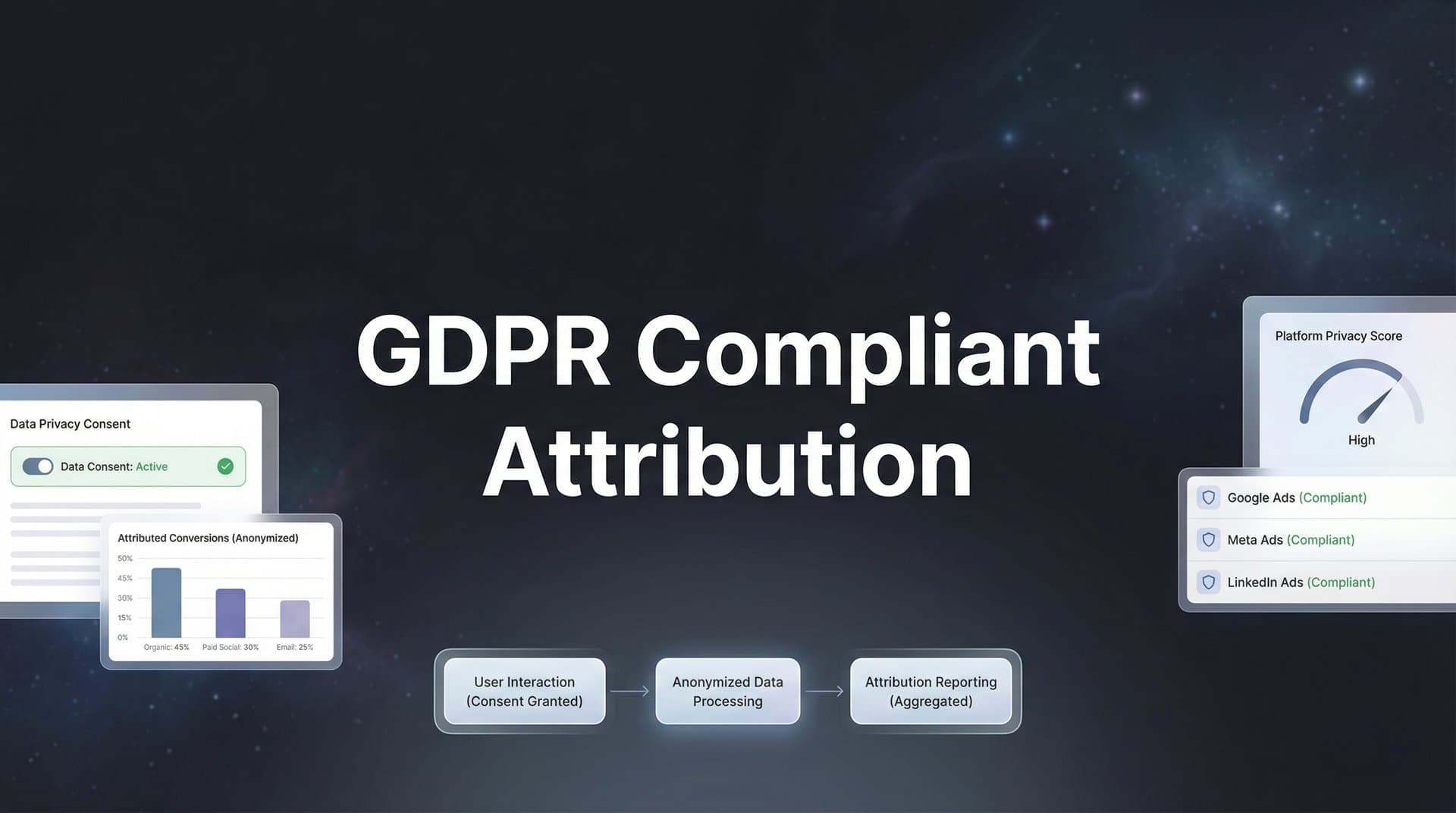
Every marketing team faces the same dilemma: you need accurate attribution data to understand which campaigns drive revenue, but GDPR regulations demand explicit consent and careful data handling. The stakes couldn't be higher. Get it wrong, and you risk fines up to 4% of global revenue. Get it right, and you build a sustainable foundation for data-driven marketing decisions that respect user privacy.
The challenge isn't choosing between compliance and performance. It's building an attribution system that delivers both.
GDPR compliant attribution is absolutely achievable. It requires rethinking how you collect, process, and store marketing data. Instead of relying on aggressive tracking that ignores user preferences, you implement consent-based systems, server-side processing, and privacy-first data collection methods. The result: meaningful conversion insights without the regulatory risk.
This guide walks you through the exact steps to transform your attribution setup. You'll learn how to audit your current data flows, implement proper consent mechanisms, configure server-side tracking, adjust attribution models for consent gaps, establish data rights workflows, and validate ongoing compliance. Each step builds on the previous, creating a complete system that captures marketing performance while fully respecting user privacy rights.
By the end, you'll have a clear roadmap to track marketing performance confidently and legally. Let's start with understanding exactly what data you're currently collecting.
Step 1: Audit Your Current Attribution Setup and Data Flows
Before you can fix compliance gaps, you need to see the complete picture of your data collection. Most marketing teams underestimate how many tracking points they've accumulated across campaigns, platforms, and tools. This audit reveals exactly what personal data you collect, where it flows, and which areas create the highest regulatory risk.
Start by mapping every data collection point across your marketing stack. This includes tracking pixels on your website, conversion tags in ad platforms, analytics scripts, form submissions, CRM integrations, email tracking, and any third-party marketing tools. Open your website's source code and use browser developer tools to identify every script that fires. Check your tag manager to see all active tags. Review your ad platform pixel implementations across Meta, Google, LinkedIn, and other channels.
Next, identify what personal data each collection point captures. Common data types include email addresses, phone numbers, IP addresses, device identifiers, browsing behavior, purchase history, and location data. GDPR considers all of this personal data when it can identify an individual. Document not just what you collect, but where it goes. Does your analytics platform send data to ad networks? Does your CRM sync customer information with email platforms? Does your attribution tool share conversion data with multiple ad platforms?
Create a data inventory spreadsheet to track this information systematically. Your spreadsheet should include columns for: data collection point, type of personal data collected, legal basis for processing, where data is stored, third parties who receive data, retention period, and compliance status. This becomes your master reference for identifying gaps and tracking remediation efforts. Understanding your marketing attribution dataset structure is essential for this documentation process.
Document your legal basis for each data processing activity. Under GDPR, you need a lawful basis to process personal data. For marketing attribution, consent is typically the most appropriate basis. Review each tracking point and ask: do we have explicit consent to collect this data? Is the consent granular enough to cover this specific use? Can users easily withdraw consent?
Flag high-risk areas that need immediate attention. Cross-border data transfers outside the EU require additional safeguards. Third-party sharing agreements must include data processing clauses. Lack of consent records creates liability if you can't prove users agreed to tracking. Excessive data retention beyond what's necessary for attribution violates data minimization principles.
This audit typically reveals uncomfortable truths. Many teams discover they're collecting far more data than needed, sharing it with vendors they forgot about, or relying on outdated consent mechanisms. That's exactly why this step matters. You can't build compliant attribution on a shaky foundation.
Step 2: Implement a Compliant Consent Management System
Your consent management platform becomes the gatekeeper for all marketing tracking. It ensures no data collection happens until users explicitly agree, provides granular control over different tracking categories, and creates the audit trail you need to prove compliance. Getting this right protects both your users and your organization.
Choose a consent management platform that integrates seamlessly with your attribution tools. Leading options include OneTrust, Cookiebot, Usercentrics, and Termly. The key requirement: your CMP must generate consent signals that your attribution platform can read and respect. Look for platforms that support the IAB Transparency and Consent Framework, which provides standardized consent communication across marketing tools.
Configure granular consent options that give users meaningful control. GDPR requires unbundled consent, meaning users must be able to accept necessary cookies while rejecting marketing or analytics tracking. Set up at least three categories: necessary cookies for basic site functionality, analytics cookies for understanding site usage, and marketing cookies for attribution and advertising. Never bundle these together in an all-or-nothing choice.
Your consent banner should clearly explain what each category does in plain language. Avoid legal jargon. Instead of "We process personal data for legitimate interests," say "We track which ads bring visitors to our site so we can improve our marketing." Make the reject option as easy as the accept option. Pre-checked boxes violate GDPR consent requirements.
Set up consent signals that your attribution platform can read before firing any tracking. Modern CMPs use consent mode APIs that communicate user choices to Google Analytics, Meta Pixel, and other platforms. When a user rejects marketing cookies, these signals tell your tracking tags to remain dormant. Configure your tag manager to check consent status before firing attribution pixels. Many teams struggle with losing attribution data due to privacy updates, making proper consent configuration critical.
Ensure consent records are stored with timestamps, version tracking, and user identifiers. You must be able to prove when a specific user consented, what they consented to, and which version of your privacy policy applied at that time. Your CMP should automatically create these records. Set retention periods for consent logs that extend beyond your marketing data retention to maintain proof of lawful processing.
Test consent flows across devices and browsers to verify proper blocking. Mobile browsers, Safari with ITP, and Firefox with Enhanced Tracking Protection all handle cookies differently. Your consent system must work correctly in every environment. Check that consent persists appropriately when users return to your site. Verify that consent withdrawal immediately stops data collection.
The consent system creates friction in your data collection. Some users will reject tracking. That's the entire point of GDPR: giving users real choice. Your attribution strategy must account for this reality, which we'll address in the next steps.
Step 3: Configure Server-Side Tracking for Privacy-First Data Collection
Server-side tracking fundamentally changes how you collect attribution data. Instead of relying on client-side cookies that browsers increasingly block, you process data on your own servers before sending it to ad platforms. This approach improves compliance, increases data accuracy, and gives you complete control over what information you share with third parties.
The privacy advantage is clear: server-side tracking allows you to filter, anonymize, and minimize data before it leaves your infrastructure. When a conversion happens, your server receives the event, checks the user's consent status, applies appropriate data handling, and only then forwards compliant information to attribution platforms. Users who rejected marketing cookies never have their data sent to ad networks.
Set up first-party data collection through your own domain. Instead of loading tracking scripts directly from Facebook or Google domains, you implement a server-side tag manager on your infrastructure. Google Tag Manager Server-Side is a popular option. Configure it to run on a subdomain you control, like tracking.yourdomain.com. This setup means cookies are set as first-party cookies from your domain, which browsers treat more favorably and users perceive as less invasive. Implementing cross-device attribution tracking becomes more reliable with server-side infrastructure.
Configure your attribution platform to process data server-side before sending to ad platforms. Modern attribution tools like Cometly support server-side conversion tracking that respects consent signals. When a conversion occurs, the event data flows to your attribution platform's servers. The platform checks consent status, enriches the data with attribution touchpoints, applies any necessary anonymization, and forwards the processed conversion to ad platforms for optimization.
Implement data minimization throughout your server-side setup. GDPR requires collecting only the data necessary for your stated purpose. For attribution, you need conversion events, source information, and value data. You don't need full email addresses, detailed browsing histories, or excessive personal information. Configure your server-side tracking to strip unnecessary data fields before storage or transmission.
Hash or anonymize personal identifiers before storage and transmission. Email addresses can be hashed using SHA-256 before sending to ad platforms. IP addresses can be truncated to remove the last octet. Device identifiers can be anonymized or aggregated. Your server-side setup gives you the control to apply these transformations consistently. Ad platforms can still use hashed identifiers for matching and optimization without receiving raw personal data.
The technical implementation requires coordination between your development team, marketing team, and attribution platform. You'll need to modify how conversion events are captured on your website, configure server endpoints to receive and process these events, set up authentication and security for server-to-server communication, and test thoroughly to ensure conversion data flows correctly through the new architecture.
Server-side tracking isn't just a compliance checkbox. It improves data quality by reducing reliance on browser cookies that ad blockers and privacy features increasingly restrict. You capture more conversions, attribute them more accurately, and maintain complete control over data handling. This foundation supports compliant attribution that actually works.
Step 4: Adjust Attribution Models for Consent-Based Data Gaps
Consent-based tracking creates inevitable gaps in your attribution data. Some users reject cookies. Others use ad blockers. Privacy-focused browsers limit tracking capabilities. Your attribution models must account for these gaps while still providing actionable insights for campaign optimization. The solution: combining consented data with modeled estimates and aggregated reporting.
Start by understanding how consent rejection impacts your attribution visibility. When users decline marketing cookies, you lose the ability to track their individual journey across touchpoints. You can't see which ads they clicked, which channels they visited, or how they moved through your funnel. For these users, you only see the final conversion event when they complete a purchase or submit a form. This creates attribution blind spots that make campaigns appear less effective than they actually are. Learning how to fix attribution data gaps becomes essential in consent-heavy environments.
Configure modeled conversions to estimate performance from consented users. Ad platforms like Google and Meta offer conversion modeling that uses aggregated data from consented users to estimate total conversions including those you can't directly track. Enable these features in your attribution setup. The platforms analyze patterns from users who did consent, then apply statistical modeling to estimate how many additional conversions likely occurred from similar audiences who didn't consent to tracking.
Use aggregated or cohort-based attribution approaches where individual tracking isn't consented. Instead of tracking individual user journeys, you can analyze aggregate patterns: how many conversions came from users who saw a specific ad campaign, what percentage of website visitors from a particular source converted, how cohorts of users who entered through different channels perform over time. These approaches provide directional insights without requiring individual-level tracking of non-consenting users.
Set up conversion sync to feed compliant data back to ad platforms for optimization. Platforms like Cometly allow you to send server-side conversion events that respect consent choices while still providing ad platforms with the signals they need to optimize delivery. When a consented user converts, the complete attribution data flows back to improve targeting. When a non-consented user converts, only aggregated or anonymized signals are shared. This maintains ad platform performance without violating user privacy preferences.
Compare attributed versus modeled data to understand your consent rate impact. Create dashboards that show: total conversions from direct attribution, estimated conversions from modeling, the gap between the two, and your overall consent acceptance rate. Exploring multi-touch attribution models helps you understand how different approaches handle consent gaps differently.
Adjust your campaign optimization strategy based on data confidence levels. Campaigns with high consent rates in their audience provide more reliable attribution data for optimization decisions. Campaigns targeting privacy-conscious audiences require more reliance on modeled data and aggregate metrics. Factor this into your decision-making: don't over-optimize based on incomplete data, use broader trends and patterns when individual attribution is limited, and test changes at a larger scale to account for measurement uncertainty.
The goal isn't perfect attribution of every conversion. It's building a measurement approach that provides reliable directional insights while respecting user choices. With proper modeling and aggregation, you can still make confident optimization decisions even with consent-based data gaps.
Step 5: Establish Data Subject Rights Workflows
GDPR grants users specific rights over their personal data: access, rectification, erasure, portability, and objection. Your attribution system must support these rights with documented processes and technical capabilities. When a user requests data deletion, you need to remove their information from every connected system, including attribution records, ad platform audiences, and backup archives.
Create processes for handling each type of data subject request. Access requests require you to provide users with a copy of all personal data you hold about them, including attribution touchpoints, conversion events, and any profile information. Deletion requests require removing all personal data from active systems and backups within 30 days. Portability requests require exporting data in a structured, machine-readable format. Document each process with step-by-step procedures, responsible team members, and timeline requirements.
Configure your attribution platform to support data deletion across connected systems. Modern platforms provide user deletion APIs that remove data not just from the attribution database but also from synced ad platforms and analytics tools. When you process a deletion request, the attribution platform should automatically trigger deletion in Meta, Google Ads, your CRM, email platform, and any other connected tools. Understanding the common attribution challenges in marketing analytics helps you anticipate where data rights workflows may encounter obstacles.
Set up automated data retention policies to delete attribution data after defined periods. GDPR requires keeping personal data only as long as necessary for the purpose it was collected. For marketing attribution, you don't need conversion data from five years ago. Configure automatic deletion of attribution records older than your defined retention period, typically 12 to 24 months for marketing data. This reduces your data footprint and minimizes risk.
Document response procedures and train team members on handling requests. Create templates for responding to access requests, deletion confirmations, and objection acknowledgments. Designate specific team members responsible for processing requests and set up a tracking system to ensure requests are handled within GDPR's 30-day requirement. Train customer service, marketing, and technical teams on recognizing data subject requests and escalating them properly.
Test your deletion workflow to ensure data is removed from all systems including backups. Submit a test deletion request for a known user identifier. Verify the data is removed from your attribution platform, ad platform audiences, analytics tools, and CRM. Check backup systems to confirm deletion policies extend to archived data. Query databases directly to verify no records remain. This testing reveals gaps in your deletion process before a real user request exposes them.
Build a request tracking system to maintain compliance records. Log every data subject request with: request date, request type, user identifier, completion date, and systems where data was deleted. This audit trail proves you're honoring user rights and meeting regulatory timelines. If a regulatory authority investigates, you can demonstrate a functioning process with documented fulfillment.
Step 6: Validate Compliance and Set Up Ongoing Monitoring
Compliance isn't a one-time project. Your marketing stack evolves constantly with new campaigns, platforms, and tools. Each change introduces potential compliance gaps. Ongoing monitoring and regular audits ensure your attribution system remains compliant as your marketing operations grow and regulations evolve.
Run a comprehensive compliance checklist against your new attribution setup. Verify every requirement: consent management system is live and blocking tracking before consent, server-side tracking is configured and processing data correctly, attribution models account for consent gaps, data subject rights workflows are documented and tested, retention policies are automated and running, and consent records are stored with proper timestamps and versioning. Work through each item systematically, documenting evidence of compliance.
Test consent flows with browser developer tools to verify no tracking fires before consent. Open your website in incognito mode across different browsers. Reject marketing cookies. Open the browser's network tab and watch for outbound requests to ad platforms and analytics tools. You should see no attribution pixels firing, no conversion events being sent, and no personal data being collected. If you spot any tracking before consent, identify the source and fix it immediately. Comparing your setup against Google Analytics attribution limitations helps identify where additional compliance measures may be needed.
Set up alerts for consent rate changes or unusual data collection patterns. Configure monitoring in your consent management platform to alert you when consent acceptance rates drop significantly, which might indicate a broken consent flow or user experience issues. Set up data volume alerts in your attribution platform to flag unusual spikes in data collection that could indicate a misconfigured tracking tag bypassing consent checks.
Schedule quarterly audits to review data flows as your marketing stack evolves. Every quarter, repeat the initial audit process: review all active tracking points, verify consent mechanisms are working correctly, check that new marketing tools have been integrated compliantly, update your data inventory spreadsheet, and test data subject rights workflows. This regular cadence catches compliance drift before it becomes a serious issue. Reviewing your digital marketing attribution measurement approach quarterly ensures ongoing alignment with regulations.
Document your compliance measures for accountability and potential regulatory inquiries. Maintain a compliance folder with: your data inventory spreadsheet, consent management configuration, server-side tracking architecture documentation, data processing agreements with vendors, data retention policies, data subject rights procedures, and audit reports. If a regulatory authority requests information about your data practices, you can quickly demonstrate your compliance approach.
Stay informed about evolving GDPR guidance and enforcement trends. Regulatory authorities regularly publish guidance on specific topics like cookie consent, legitimate interests, and cross-border transfers. Subscribe to updates from your data protection authority. Join industry groups that share compliance best practices. Review enforcement actions against other companies to understand what regulators consider violations. Adjust your practices proactively based on emerging standards.
Assign ongoing compliance responsibility to specific team members. Don't let compliance become everyone's responsibility and therefore no one's responsibility. Designate a privacy lead who owns compliance monitoring, coordinates quarterly audits, stays current on regulatory changes, and escalates issues to leadership. This ensures consistent attention to compliance as your team and marketing operations evolve.
Moving Forward with Compliant Attribution
Building GDPR compliant attribution requires upfront effort, but it creates a sustainable foundation for accurate marketing measurement. You've now learned the complete process: auditing your current setup to identify gaps, implementing consent management to give users real choice, configuring server-side tracking for privacy-first data collection, adjusting attribution models to handle consent gaps, establishing data rights workflows to honor user requests, and validating compliance with ongoing monitoring.
Here's your quick compliance checklist to verify your setup: audit completed and data inventory documented, consent management system live and tested across browsers, server-side tracking configured with data minimization, attribution models adjusted for consent-based gaps with modeling enabled, data subject rights workflows established and tested, automated retention policies running, and quarterly audit schedule in place.
Start with step one today by mapping your current data flows. Block out two hours to identify every tracking point across your marketing stack. Build that data inventory spreadsheet. The insights will reveal exactly where your compliance gaps exist and what needs immediate attention. Each subsequent step builds on this foundation, so work through them sequentially rather than jumping ahead.
The investment pays off in multiple ways. You eliminate regulatory risk and potential fines. You build trust with users who increasingly value privacy. You create more accurate attribution by reducing reliance on degrading cookie-based tracking. You gain complete control over your marketing data instead of depending on third-party platforms. Most importantly, you can confidently optimize campaigns knowing your data practices respect user privacy and meet regulatory requirements.
GDPR compliance and marketing performance aren't opposing forces. They're complementary goals that both benefit from thoughtful data practices, transparent user communication, and privacy-respecting technology. With compliant attribution in place, you capture meaningful insights about what drives revenue while honoring the privacy choices users make.
Ready to elevate your marketing game with precision and confidence? Discover how Cometly's AI-driven recommendations can transform your ad strategy. Get your free demo today and start capturing every touchpoint to maximize your conversions.


