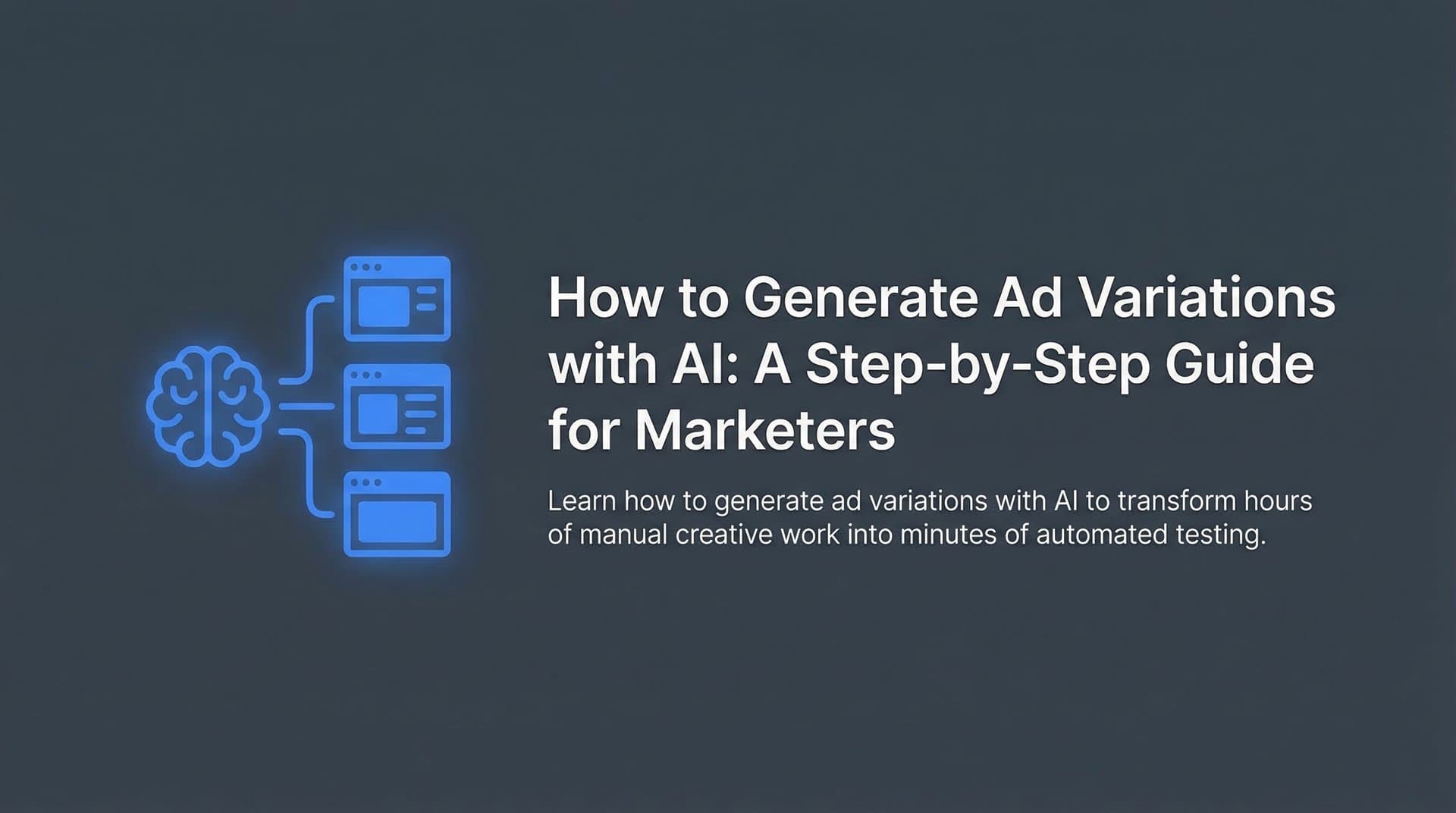
Creating multiple ad variations used to mean hours of manual work—writing dozens of headlines, designing different visuals, and testing endless combinations. For marketing teams running campaigns across Meta, Google, and other platforms, this process often becomes a bottleneck that limits how quickly you can find winning ads.
AI-powered ad generation changes this equation entirely.
Instead of manually creating each variation, you can now generate dozens of scroll-stopping creatives in minutes, launch them with optimized audiences, and let data reveal your top performers. This guide walks you through the complete process of using AI to generate ad variations—from setting up your inputs to analyzing which creatives actually drive conversions.
Whether you're a solo marketer or part of an agency managing multiple accounts, you'll learn how to scale your creative testing without scaling your workload.
Step 1: Define Your Campaign Foundation and Creative Inputs
Before you generate a single ad variation, you need a solid foundation. Think of this step as creating the blueprint that guides your AI—the clearer your inputs, the better your outputs.
Start by gathering your brand assets. This includes your logo files, product images, brand color codes, and any existing top-performing creatives. If you've run successful campaigns before, those winning ads contain valuable patterns your AI variations should build upon. Don't skip this step—AI works best when it understands your visual identity.
Next, document your core value propositions and messaging angles. What makes your product different? What pain points does it solve? For most campaigns, you'll want to test 3-5 distinct messaging angles. One angle might focus on time savings, another on cost reduction, and a third on ease of use.
Example messaging angles: If you're selling a project management tool, your angles might include "Stop missing deadlines," "Get your team on the same page," and "Automate repetitive tasks."
Now identify your target audience segments and the specific pain points each ad should address. A campaign targeting startup founders will emphasize different benefits than one targeting enterprise IT managers. The more specific you can be about who you're talking to and what keeps them up at night, the more relevant your AI-generated variations will be.
Create a simple creative brief that answers these questions: Who is this for? What's the main benefit? What action do we want them to take? What tone should we use?
Success indicator: You have a clear creative brief with 3-5 distinct messaging angles, organized brand assets, and documented audience segments. This foundation ensures your AI generates variations that align with your strategy, not just random combinations of words and images.
Step 2: Choose Your AI Ad Generation Platform
Not all AI ad platforms are created equal. Your choice depends on what types of creatives you need and how much friction you're willing to tolerate in your workflow.
First, evaluate platforms based on the output types you need. Do you primarily run static image ads? Video ads? UGC-style content that looks like organic social posts? Some platforms excel at one format but struggle with others. If your strategy requires testing across multiple formats, choose a platform that handles all of them well.
We compare the leading options in our UGC ads roundup.
Integration capabilities matter more than most marketers realize. Platforms that connect directly with your ad channels—Meta, Google, TikTok—let you launch campaigns without downloading files, uploading them manually, and copying ad copy between systems. This seamless workflow saves hours per campaign and reduces the chance of errors.
Consider AdStellar AI, which generates ad creatives, launches them directly to platforms, and surfaces your winners all in one place. You can create scroll-stopping image ads, video ads, and UGC-style creatives with AI, then launch campaigns directly to Meta with AI-optimized audiences, headlines, and ad copy without ever leaving the platform. AdStellar automatically tests every combination and surfaces top performers with real-time insights across every creative, audience, and campaign.
If you're evaluating vendors, our AI UGC ads breakdown can help.
Look for platforms that offer variation control. You want the ability to specify which elements vary—headlines, images, calls-to-action—and which stay constant. This structured variation helps you understand what's actually driving performance differences.
Budget is obviously a factor, but think in terms of time saved rather than just subscription cost. A platform that costs more but reduces your creative production time by 80% often delivers better ROI than a cheaper tool that still requires significant manual work. Explore the best building ads tools to find solutions that match your workflow needs.
Success indicator: You've selected a tool that matches your creative format needs, integrates with your ad platforms, and fits your workflow. You should feel confident you can generate variations and launch campaigns without jumping between multiple systems.
Step 3: Generate Your First Batch of Ad Variations
Now comes the exciting part—actually generating your variations. This is where you'll see the speed advantage of AI become obvious.
Input your brand assets, product details, and messaging angles into your chosen platform. Most AI tools will ask for your logo, primary product images, brand colors, and a description of what you're selling. The more context you provide, the more on-brand your variations will be.
Generate variations across multiple formats simultaneously. Create image ads for feed placements, video ads for stories and reels, and UGC-style creatives that look like organic content. Each format performs differently depending on placement and audience, so testing across formats reveals which creative style resonates most. If you're wondering whether AI can generate UGC content effectively, the answer is yes—modern tools create authentic-looking creator-style ads at scale.
We compare the leading options in our AI UGC ad maker roundup.
Don't stop at visual variations. Create variations of headlines, ad copy, and calls-to-action to test alongside your visual changes. A winning image paired with weak copy won't perform as well as it could. Testing both elements together helps you find the complete winning combination.
Volume matters for statistical significance. Start with 10-15 variations per messaging angle. If you're testing three messaging angles, that's 30-45 total variations. This might sound like a lot, but AI can generate this volume in minutes—and you need enough variations to identify patterns with confidence.
As you generate, think about the testing structure. You want variations that differ enough to reveal preferences but aren't so wildly different that you can't identify what's working. If one ad features a product shot and another shows a lifestyle scene, you're testing image style. If they both use product shots but different headlines, you're testing messaging.
Many platforms let you specify variation parameters—how much the AI should deviate from your inputs. Start conservative for your first batch. You can always generate more adventurous variations once you understand the platform's output quality.
Success indicator: You have 30+ unique ad variations ready for review, organized by messaging angle and format. Each variation should feel on-brand while offering enough difference to make testing meaningful. If your variations all look too similar, generate another batch with more variation parameters enabled.
Step 4: Review, Refine, and Organize Your Creatives
AI-generated content is powerful, but it's not perfect. This review step ensures everything meets your standards before it goes live.
Audit each variation for brand consistency first. Does it match your visual identity? Is the tone appropriate? Are product claims accurate? AI occasionally produces creatives that look great but contain subtle brand inconsistencies—a slightly wrong shade of your brand color, or phrasing that doesn't match your voice.
Check for compliance with platform policies. Meta and Google have strict rules about what you can claim, what images you can use, and how much text can appear on image ads. AI doesn't always know these rules. A quick review now prevents disapproved ads later.
Make minor edits to strengthen weak variations rather than discarding them entirely. If a headline is 90% there but needs a small tweak, fix it. The goal is volume and speed—you don't need every variation to be perfect. Many marketers over-edit at this stage, which defeats the purpose of using AI for speed.
Organize your creatives by messaging angle and format for structured testing. Create folders or naming conventions that make it obvious which variations test which hypothesis. When you're analyzing results later, this organization makes it easy to spot patterns across similar variations. Following an accelerated testing strategy helps you move through this phase quickly without sacrificing quality.
Common pitfall: Don't over-edit. If you find yourself rewriting most of the AI-generated copy or heavily modifying images, you're working against the tool's purpose. Either adjust your inputs and regenerate, or accept that AI-generated variations won't be as polished as hand-crafted ads—but the volume advantage more than compensates.
Success indicator: All variations are brand-approved, compliant with platform policies, and organized into testable groups. You should be able to look at your organized creatives and immediately understand what each group is testing.
Step 5: Launch Campaigns with AI-Optimized Audiences
With your variations ready, it's time to launch. How you structure your campaigns determines how well you can analyze performance later.
Use AI-suggested audience targeting to pair creatives with relevant segments. Many modern platforms analyze your creative content and suggest audiences likely to respond. A variation emphasizing "time savings" might get paired with busy professionals, while one focusing on "team collaboration" targets managers.
Set up structured tests that isolate creative performance from audience performance. If you test new creatives and new audiences simultaneously, you won't know which drove your results. Best practice: test new creative variations against proven audiences first, then test audience variations once you've identified winning creatives.
Platforms like AdStellar let you launch directly to Meta or Google without the manual upload process. You select your variations, choose your audiences, set your budget, and launch—all from one interface. This streamlined workflow means you can go from idea to live campaign in under an hour.
Let AI optimize headline and copy combinations automatically during launch. Instead of manually creating every possible combination of headline A with image B and CTA C, AI can test these combinations dynamically and surface the winners. This exponentially increases your testing volume without increasing your workload.
Set appropriate budgets for testing. You need enough spend to generate statistically significant results, but not so much that poor performers waste budget. Learning how to optimize ad spend with data ensures you allocate resources efficiently during the testing phase. A common approach: allocate smaller budgets across all variations initially, then increase spend on winners as they emerge.
Success indicator: Campaigns are live with clear testing structure across variations. You can easily identify which ads are testing which hypothesis, and your tracking is set up to capture performance data for analysis.
Step 6: Analyze Results and Identify Winning Variations
Data without analysis is just noise. This step transforms your campaign data into actionable insights.
Monitor real-time performance data to spot early winners and underperformers. Most platforms show initial results within hours. While you shouldn't make final decisions based on early data, obvious patterns often emerge quickly—certain variations get significantly higher engagement or lower cost per click.
Look beyond surface metrics. Click-through rate and engagement matter, but they don't pay the bills. Connect ad performance to actual conversions and revenue. A variation with a lower CTR but higher conversion rate is the real winner, even if it looks less impressive in your ad dashboard. Understanding how to improve campaign performance with analytics helps you focus on metrics that actually matter.
This is where attribution tools become essential. You need to understand which variations drive results across the full customer journey, not just immediate conversions. Someone might click your ad, browse your site, leave, then return days later through a different channel and convert. Attribution software with AI shows you which initial ad actually started that journey.
Kill underperforming ads quickly and reallocate budget to winners. There's no prize for giving every variation equal time. Once you have enough data to identify clear losers—typically a few days to a week depending on your traffic volume—pause them and shift that budget to variations showing promise.
Analyze patterns across winning variations. Do all your top performers use a specific messaging angle? A particular image style? A certain call-to-action? These patterns inform your next round of generation. If "time savings" messaging consistently outperforms "cost reduction," double down on time savings in your next batch.
Success indicator: You've identified your top 3-5 performing variations with clear performance data connecting them to conversions and revenue, not just vanity metrics. You understand why these variations won and can articulate the patterns you're seeing.
Step 7: Scale Winners and Iterate on Your Creative Strategy
Finding winners is only valuable if you scale them intelligently and use those insights to improve your ongoing strategy.
Increase budget on proven winners while maintaining performance monitoring. Scaling isn't just about throwing more money at an ad—you need to watch for performance degradation as you increase spend. Sometimes an ad performs brilliantly at $50/day but struggles at $500/day as it exhausts its ideal audience.
Use insights from winning ads to inform your next round of AI-generated variations. If you discovered that UGC-style video ads outperform polished product shots, generate more UGC variations. If a specific headline structure consistently wins, use that structure as a template for new headlines. Learn how to make UGC ads with AI to scale this winning format efficiently.
Feed conversion data back to ad platforms to improve their optimization algorithms. When you send conversion events back to Meta or Google, their AI learns what a valuable customer looks like and finds more people like them. Understanding how to sync conversions with ad platforms creates a virtuous cycle where your ads get smarter over time.
Build a continuous testing cycle: generate, test, analyze, scale, repeat. The marketers who win aren't running one big test and calling it done—they're constantly generating new variations, testing them against current winners, and evolving their creative strategy based on data.
Document your learnings in a creative playbook. When you discover that certain messaging angles, image styles, or CTAs consistently perform well for your audience, write it down. This institutional knowledge makes each subsequent testing round more effective because you're building on proven patterns rather than starting from scratch.
Success indicator: You have a repeatable process for ongoing creative testing at scale. New variations are generated weekly or monthly, performance is monitored continuously, and your creative strategy evolves based on data rather than gut feel.
Your Path to Scalable Creative Testing
Generating ad variations with AI transforms creative testing from a time-consuming bottleneck into a scalable competitive advantage. By following these seven steps—from defining your creative inputs to scaling your winners—you can test more variations, find winning ads faster, and make data-driven decisions about where to invest your ad budget.
Quick checklist before you start: Brand assets and messaging angles documented, AI platform selected (consider AdStellar for end-to-end creative generation and launching), testing structure planned, attribution tracking in place to measure true performance.
The marketers who win aren't necessarily the most creative—they're the ones who test the most variations and let data guide their decisions. When you can generate 30 ad variations in the time it used to take to create three, you fundamentally change what's possible in your campaigns.
But generating variations is only half the equation. Understanding which variations actually drive revenue requires accurate attribution that connects every touchpoint in your customer journey. Without this visibility, you're optimizing for platform metrics that might not align with business outcomes.
Ready to elevate your marketing game with precision and confidence? Discover how Cometly's AI-driven recommendations can transform your ad strategy—Get your free demo today and start capturing every touchpoint to maximize your conversions.
Start generating your first batch of AI ad variations today. The sooner you begin testing, the sooner you'll discover what truly resonates with your audience.