Picture this: your marketing team sits down to review last month's ad spend across Meta, Google, TikTok, and LinkedIn. Each platform's dashboard is glowing with impressive conversion numbers. The problem? When you add them all up, they're claiming credit for three times the actual sales you closed. Budget decisions for next month feel less like strategy and more like a coin flip.
Sound familiar? This is the daily reality for most marketing teams, and it points to a deeper problem. Most marketers are still guessing which ads drive revenue because they're relying on fragmented, self-reported data from platforms that have every incentive to show you their best numbers. The result is a fog of conflicting metrics that makes confident budget allocation nearly impossible.
The good news is that guessing is not your only option. There is a better way, one built on tracking real customer journeys from the first ad click all the way to a closed deal in your CRM. This article breaks down exactly why the guessing problem exists, what it's quietly costing your business, and how to replace gut instinct with accurate attribution data that you can actually act on.
Why Most Marketing Teams Are Flying Blind on Ad Performance
The guessing problem doesn't start with bad intentions. It starts with a fundamentally broken system. Every major ad platform operates as its own walled garden, using its own attribution windows, its own conversion models, and its own definition of what counts as a successful outcome. Meta might claim a conversion if someone saw your ad within seven days of purchasing. Google might claim the same conversion because the customer clicked a search ad the day before. TikTok might take credit because they clicked a video ad two weeks prior.
Nobody is lying, exactly. But nobody is telling you the whole truth either.
This problem got significantly worse when Apple introduced its App Tracking Transparency framework with iOS 14.5, which required apps to ask users for permission before tracking them across other apps and websites. A large share of users opted out, effectively blinding Meta and other platforms to a substantial portion of conversion activity. Google's evolving approach to third-party cookies has added further uncertainty. Browser-based tracking pixels, which most teams still rely on, have become increasingly unreliable as privacy changes accumulate.
Then there's the customer journey itself. Think about how your customers actually behave. Someone might click a Google search ad while researching your product category. They don't convert, but a week later they see your Meta retargeting ad and click through to read a case study. They still don't buy. Then they receive a nurture email, click through, and finally sign up for a demo. This Google Ads and Facebook Ads attribution conflict is one of the most common challenges marketing teams face.
Last-click attribution, which remains the default for many tools, would give 100% of the credit to email. That answer is technically accurate and practically misleading at the same time. It tells you nothing about the role Google or Meta played in building awareness and consideration across the journey.
The deeper issue is that most marketing dashboards are built around vanity metrics: impressions, clicks, click-through rates, and cost per click. These numbers are easy to track and easy to report, but they have a weak connection to actual revenue. A channel can generate thousands of clicks and zero closed deals. A channel can generate ten clicks and five high-value customers. Without connecting ad activity to real revenue outcomes in your CRM, you're optimizing for the wrong signals entirely.
The result is a team that works hard, pulls reports constantly, and still can't track which ads are working.
The Real Cost of Guessing Your Way Through Ad Spend
Guessing feels harmless when budgets are small and growth is steady. It becomes expensive the moment you try to scale. The business consequences of operating without accurate attribution are concrete and compounding.
The most obvious cost is wasted budget. When you can't reliably identify which channels and campaigns are generating revenue, you inevitably fund underperforming ones. A channel that looks good on its own dashboard might be taking credit for conversions that were actually driven by a different touchpoint. You keep spending on it because the reported numbers look strong, while the channel that's quietly doing the heavy lifting stays underfunded. Many teams end up losing money on ads because they can't find winning campaigns.
The flip side is equally damaging. Underinvestment in channels that actually convert is a growth problem that's invisible until you fix your attribution. Many teams discover, after implementing proper multi-touch tracking, that one channel was consistently contributing to high-value conversions but never getting credit because it rarely appeared as the final touchpoint.
Here's where the problem gets more insidious. The data you send back to ad platforms directly shapes how their algorithms behave. Meta's machine learning, Google's Smart Bidding, and similar systems rely on conversion signals to understand which users and behaviors lead to valuable outcomes. When those signals are based on inaccurate pixel fires, incomplete data, or the wrong conversion events entirely, the algorithm learns the wrong lessons.
This is the garbage-in, garbage-out cycle that quietly destroys campaign performance over time. You feed Meta inaccurate conversion data. Meta's algorithm optimizes toward the wrong audience. Your cost per acquisition rises. Your conversion rate drops. You assume the channel is getting more competitive or that your creative has gone stale, when the real problem is that you've been training the algorithm on bad data from the start.
The strategic cost is harder to quantify but just as real. Teams that are guessing cannot scale with confidence. Every budget increase feels like a risk because there's no reliable model connecting spend to revenue. So teams stay conservative, running the same campaigns at the same budgets, never pushing into new channels or testing aggressively, because they lack the data to justify it. Growth gets left on the table not because the opportunity isn't there, but because the information needed to pursue it confidently doesn't exist.
Guessing isn't just inefficient. It actively works against you at every level of the marketing operation.
What Accurate Attribution Actually Looks Like
Accurate attribution starts with a simple but powerful idea: every interaction a customer has with your brand, across every channel, should be tracked, connected, and tied back to a revenue outcome. Not just the last click. Not just what one platform reports. Every touchpoint, mapped to a real deal in your CRM.
Multi-touch attribution is the framework that makes this possible. Instead of giving all the credit to a single interaction, multi-touch models distribute credit across the full customer journey based on how much each touchpoint contributed to the final conversion. There are several common models worth understanding.
Linear attribution distributes credit equally across every touchpoint in the journey, giving each interaction the same weight regardless of when it occurred or what role it played.
Time-decay attribution gives more credit to touchpoints that occurred closer to the conversion, operating on the logic that recent interactions had more influence on the final decision.
Position-based attribution (sometimes called U-shaped) gives the most credit to the first and last touchpoints, with the remaining credit distributed across the middle interactions. This model recognizes both the awareness-creating first touch and the conversion-driving final touch as especially important.
Data-driven attribution uses machine learning to assign credit based on patterns in your actual conversion data, rather than a predetermined rule. It's the most sophisticated model and requires enough conversion volume to produce reliable results.
No single model is universally correct. The right choice depends on your sales cycle, your channel mix, and how you want to think about the value of different interactions. The important thing is moving away from last-click as your default, because it systematically distorts your understanding of the full journey. Learning how to attribute revenue to marketing channels is a critical step for any team serious about growth.
Server-side tracking is the technical foundation that makes modern attribution work. Traditional browser-based pixels are increasingly blocked by ad blockers, restricted by browser privacy settings, and degraded by the iOS changes described earlier. Server-side tracking solves this by sending conversion data directly from your server to ad platforms, bypassing browser limitations entirely. The result is significantly more complete and accurate data, which flows into every layer of your attribution model.
The combination of server-side tracking and multi-touch attribution transforms what attribution can tell you. Instead of a fragmented picture assembled from self-reported platform data, you get a unified view of the customer journey grounded in actual behavior and actual revenue outcomes. That's the foundation for making decisions you can defend with data rather than gut instinct.
From Clicks to Closed Deals: Mapping the Full Customer Journey
Let's make this concrete. Consider a B2B software buyer going through a typical purchase journey. It might look something like this.
Week one: the buyer searches for a solution to a specific problem and clicks a Google search ad. They read a few pages on your website, don't convert, and leave. Week two: they see a LinkedIn sponsored post from your company and click through to a thought leadership article. Still no conversion. Week three: a Meta retargeting ad surfaces while they're scrolling. They click, watch a short product video, and sign up for your email list. Over the next few days, they open two nurture emails and click through to your pricing page. Finally, they request a demo. Three weeks later, they sign a contract.
We cover this in more depth in our guide to AI product video ad generator.
In that journey, six or seven distinct interactions preceded the closed deal. Last-click attribution would credit the demo request form or the final email click. The Google search ad that started everything would receive zero credit. LinkedIn's role in building credibility would be invisible. Meta's retargeting ad that re-engaged a cold prospect would go unrecognized.
Now imagine making budget decisions based on that incomplete picture. You'd cut Google because it never shows as the converting touchpoint. You'd undervalue LinkedIn because its contribution doesn't show up in any platform's conversion window. You'd over-credit email because it's often the last interaction before the demo request. The ability to track leads to revenue is what prevents these costly misallocations.
Connecting ad platform data with CRM data is what closes this gap. When your attribution system can see not just the ad clicks but also the pipeline stages, the deal value, and the closed-won outcome in your CRM, attribution transforms from a marketing exercise into a genuine business intelligence tool. You're no longer asking which ad got the last click. You're asking which combination of touchpoints produces customers with the highest lifetime value, the shortest sales cycle, and the strongest retention.
This is where capturing every touchpoint becomes especially powerful for AI-driven systems. When an attribution platform has a complete, enriched view of the customer journey, including ad clicks, on-site behavior, email engagement, and CRM events, it has the raw material to surface genuinely useful recommendations. Which campaigns consistently appear in the journeys of your best customers? Which channels are most effective at re-engaging prospects who went cold? These are questions that only become answerable when the full journey is mapped and connected to revenue.
The shift from click-level data to journey-level data is the shift from measuring marketing activity to understanding marketing impact.
How to Feed Better Data Back to Ad Platforms
Understanding your customer journey internally is valuable. But there's another dimension to accurate attribution that many teams overlook: the data you send back to the platforms you're advertising on.
Conversion syncing is the practice of taking your verified, enriched conversion data and sending it back to Meta, Google, and other ad platforms so their algorithms can learn from it. Instead of relying on a browser pixel that fires when someone lands on a thank-you page, you're sending the platform a signal that says: this user completed a purchase worth this much, or this lead became a closed deal of this value. That's a fundamentally different quality of signal.
Ad platform algorithms are only as good as the data they're trained on. Meta's Advantage+ campaigns, Google's Smart Bidding strategies, and similar AI-powered systems use conversion data to identify patterns in the users who take valuable actions. When you feed them accurate, revenue-connected conversion events, they can identify and target more people who share the characteristics of your actual best customers. Understanding how to improve Facebook Ads conversion data is a great starting point for teams running Meta campaigns.
When you feed them incomplete or inaccurate data, the opposite happens. The algorithm optimizes toward people who trigger your pixel, which might include a lot of poor quality leads from ads, accidental clicks, or users who converted on paper but never actually paid. Over time, your targeting drifts away from high-value prospects and toward noise.
Better conversion data improves targeting quality. Better targeting quality improves conversion rates. Better conversion rates lower your cost per acquisition over time. This is the feedback loop that separates teams that scale efficiently from teams that keep throwing budget at campaigns and wondering why results plateau.
Conversion syncing is the mechanism that closes this loop. It takes the insight generated by accurate attribution and turns it into a direct performance input for the platforms you're paying. The result is a system where your ad spend gets smarter over time, rather than staying static or degrading as the algorithm drifts on bad data.
This is the key differentiator between teams that guess and teams that scale: not just knowing what's working, but actively using that knowledge to make the platforms themselves perform better.
Building a Framework to Replace Guesswork for Good
Knowing that guessing is a problem is the easy part. Building the system to replace it requires a clear sequence of steps. Here's a practical framework for moving from fragmented data to confident, revenue-connected attribution.
Step 1: Audit your current tracking gaps. Start by identifying where your data breaks down. Are your pixels firing inconsistently? Are you missing conversion events for key actions like demo requests or form submissions? Is there a disconnect between what your ad platforms report and what your CRM shows? This audit tells you the scope of the problem before you try to fix it.
Step 2: Implement server-side tracking. Replace or supplement browser-based pixels with server-side event tracking. This immediately improves data completeness and accuracy, especially for users on iOS devices or those using ad blockers. Server-side tracking is the technical foundation everything else depends on.
Step 3: Connect your ad platforms to your CRM. This is the step that transforms attribution from a marketing metric into a business metric. When ad click data flows into the same system as pipeline stages and closed deals, you can trace revenue back to the specific campaigns and touchpoints that initiated or influenced each customer relationship. Teams that want a deeper dive into this process can explore how to attribute revenue to specific campaigns using a structured framework.
Step 4: Adopt a multi-touch attribution model. Choose an attribution model that reflects your sales cycle and channel mix. Start with something straightforward like linear or position-based attribution if you're new to multi-touch, and move toward data-driven models as your conversion volume grows.
Step 5: Establish a conversion sync workflow. Set up the process for sending enriched, verified conversion events back to Meta, Google, and any other platforms you're running paid campaigns on. Prioritize sending revenue-connected events, not just top-of-funnel actions.
Once this infrastructure is in place, AI-powered recommendations become genuinely useful. With a complete picture of the customer journey and reliable revenue data, an AI system can identify which ads and campaigns consistently appear in the journeys of your highest-value customers, which channels are underperforming relative to their spend, and where budget reallocation would have the most impact. Discover how ad tracking tools can help you scale ads using this kind of accurate data.
The mindset shift that underpins all of this is moving from "which platform should I trust?" to "what does the full data tell me?" That reframe is the foundation for budget allocation that compounds over time rather than spinning in place.
Putting It All Together
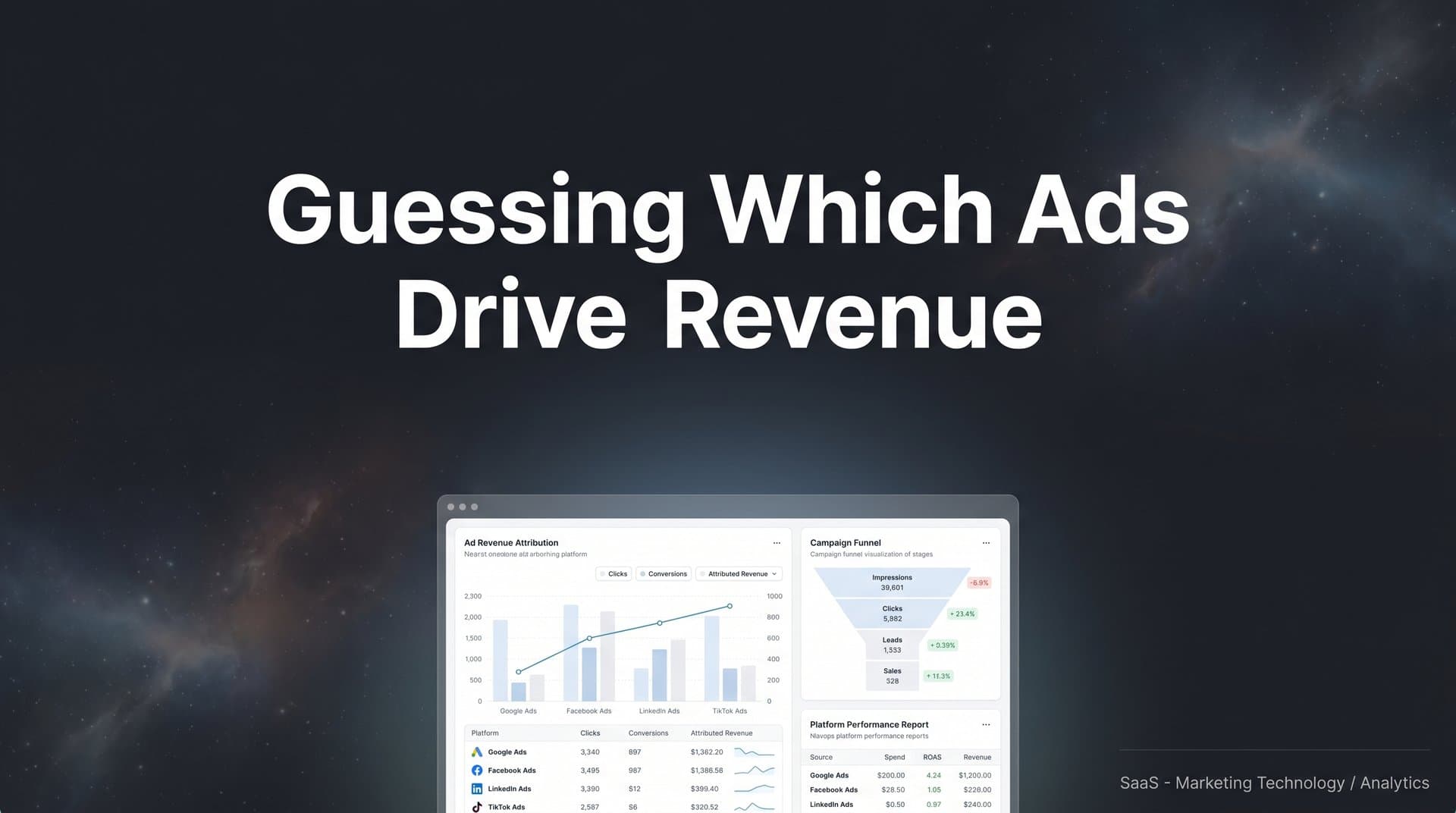
Guessing which ads drive revenue isn't just an inefficiency. It's a compounding problem that wastes budget, trains ad algorithms on bad data, and prevents teams from scaling with the confidence their results deserve. The cost accumulates quietly until it becomes impossible to ignore.
The path forward is clear: accurate tracking that captures every touchpoint, multi-touch attribution that connects those touchpoints to real revenue outcomes, and conversion syncing that feeds better data back to the platforms you're paying. Each piece reinforces the others, creating a system where your marketing intelligence grows over time instead of staying fragmented.
This is exactly the problem Cometly was built to solve. Cometly connects your ad platforms, CRM, and website to track the entire customer journey in real time, so you can see exactly which ads and channels are producing revenue. With server-side tracking, multi-touch attribution, AI-powered recommendations, and conversion sync built into one platform, Cometly gives marketing teams the complete picture they need to stop guessing and start scaling with confidence.
Ready to elevate your marketing game with precision and confidence? Discover how Cometly's AI-driven recommendations can transform your ad strategy. Get your free demo today and start capturing every touchpoint to maximize your conversions.