

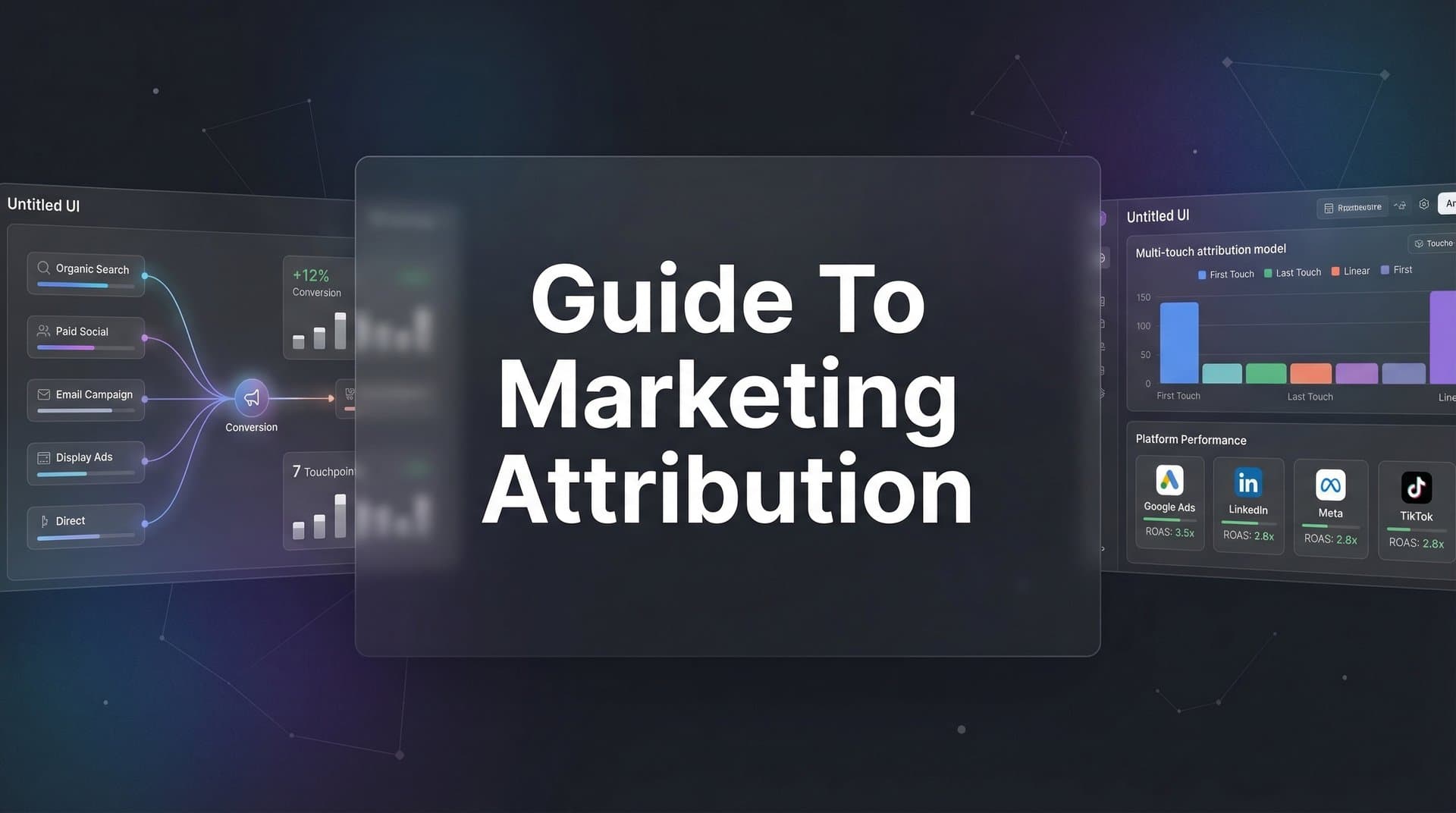
You're running campaigns across Meta, Google, LinkedIn, and email. Leads are coming in. Revenue is growing. But when someone asks which channel is actually driving results, you freeze. Was it the Facebook ad they clicked last week? The Google search that brought them to your site three weeks ago? The email sequence that kept them engaged? Without proper marketing attribution, you're flying blind—making budget decisions based on incomplete data and missing opportunities to scale what's actually working.
Marketing attribution solves this by connecting every touchpoint in the customer journey to revenue outcomes. It shows you which ads, channels, and campaigns deserve credit for conversions, enabling you to allocate budget with confidence and optimize toward what truly drives growth.
This guide walks you through the complete process of implementing marketing attribution from the ground up. You'll learn how to define clear goals, map customer journeys, implement tracking infrastructure, select the right attribution model, and use insights to optimize your campaigns. By the end, you'll have a clear roadmap to track exactly which marketing efforts drive your leads and revenue.
Let's get started.
Step 1: Define Your Attribution Goals and Success Metrics
Before you implement any tracking or choose attribution models, you need to know what questions you're trying to answer. Without clear goals, you'll end up with data you can't act on.
Start by identifying the specific business questions your attribution system must answer. These might include: Which channels convert prospects into customers, not just clicks? What's the true customer acquisition cost when accounting for all touchpoints? Where should we increase spend to maximize revenue? Which campaigns assist conversions even if they don't get the last click?
Write these questions down. Be specific. "Which channel is best?" is too vague. "Which channel drives the highest revenue per dollar spent when accounting for all touchpoints in the customer journey?" gives you a clear target.
Next, establish baseline metrics you'll measure against. Look at your current ROAS estimates by channel, conversion rates, and cost per acquisition. These numbers are probably incomplete—that's exactly why you're implementing attribution—but they give you a starting point to measure improvement.
Your attribution goals must align with your business model. Lead generation businesses need to track from first click through sales qualification. Ecommerce companies can focus on purchase events but should account for research behavior across devices. SaaS companies with longer sales cycles must connect early touchpoints to downstream events like trial signups, demos, and closed deals.
The difference matters. A B2C ecommerce brand might prioritize last-touch attribution for quick purchase decisions, while a B2B SaaS company needs multi-touch attribution to understand the weeks or months of nurturing that precede a conversion.
Success indicator: You have a documented list of 3-5 specific questions your attribution system must answer, along with baseline metrics for comparison. If you can't articulate exactly what you're trying to learn, you're not ready to move forward.
Step 2: Map Your Customer Journey and Identify All Touchpoints
You can't attribute what you don't track. This step requires documenting every channel and interaction where prospects engage with your brand before converting.
Start with the obvious digital channels: paid social ads on Meta and LinkedIn, Google Search and Display campaigns, organic search traffic, email marketing, and direct website visits. Then dig deeper. What about retargeting campaigns that re-engage visitors who didn't convert initially? Content downloads that indicate buying intent? Webinars that educate prospects? Referral traffic from partner sites or affiliates?
Don't limit yourself to online touchpoints. Many B2B companies find that offline interactions like sales calls, demos, or conference meetings play crucial roles in the buyer journey. If these touchpoints influence purchasing decisions, they belong in your attribution model.
Map the typical path length in your buyer journey. How many touchpoints does the average customer interact with before converting? For ecommerce, it might be 2-3 touchpoints over a few days. For enterprise SaaS, it could be 10+ touchpoints over several months. Understanding this helps you choose the right attribution window and model later.
Identify common sequences. Do prospects typically discover you through organic search, then engage with retargeting ads, then convert via email? Or do they click a paid ad, visit multiple times directly, then convert through a different channel? These patterns reveal which touchpoints work together to drive conversions.
Common pitfall: Overlooking touchpoints that don't generate immediate clicks but influence decisions. Email nurture sequences, content engagement, and brand awareness campaigns all contribute to conversions even when they're not the last interaction before purchase.
Create a visual map showing all touchpoints from first awareness through conversion. This doesn't need to be fancy—a simple flowchart works. The goal is to see the complete picture of how prospects become customers. For a deeper dive into channel attribution in digital marketing, understanding these journey patterns is essential.
Success indicator: You have a comprehensive visual map showing all touchpoints, typical path lengths, and common customer journey sequences. If you're discovering touchpoints you weren't tracking, that's exactly why this exercise matters.
Step 3: Implement Tracking Infrastructure Across All Channels
Now comes the technical work: ensuring every touchpoint you mapped actually gets tracked accurately. This is where many attribution implementations fail, so pay close attention to the details.
Start with UTM parameters. These small additions to your campaign URLs tell analytics platforms which campaign, source, medium, and content drove each visit. The key is consistency. Establish naming conventions now and enforce them religiously. Use lowercase, separate words with hyphens or underscores, and document your standards so everyone on your team follows the same rules.
For example: utm_source=facebook, utm_medium=paid_social, utm_campaign=q1-lead-gen, utm_content=carousel-ad-v2. When everyone uses the same format, your data stays clean and comparable across campaigns.
Install tracking pixels on your website and configure conversion events. This typically means implementing the Meta Pixel, Google Analytics, and any platform-specific pixels for channels you advertise on. Configure these pixels to fire on key events: page views, form submissions, purchases, trial signups, or whatever constitutes a conversion for your business.
Here's where it gets critical: Browser-based tracking faces serious limitations in 2026. iOS privacy features, browser cookie restrictions, and ad blockers mean pixel-based tracking misses significant conversion data. The solution is server-side tracking, which sends conversion data directly from your server to ad platforms, bypassing browser limitations entirely.
Server-side tracking captures conversions that pixels miss, provides more accurate attribution data, and extends your attribution window beyond the typical 7-day cookie window. It requires more technical setup, but the data quality improvement is substantial—many businesses discover they were missing 20-30% of conversions when relying solely on browser pixels. Explore the best software for tracking marketing attribution to find solutions that support server-side implementation.
Connect your ad platforms to your CRM to capture the full funnel from click to closed deal. This integration is especially important for B2B and SaaS companies where the conversion that matters most—a closed deal or subscription—happens days or weeks after the initial ad click. When your CRM sends closed deal data back to your attribution platform, you can optimize toward revenue, not just leads.
Test everything before calling this step complete. Run test conversions through each channel and verify that data flows correctly into your attribution platform. Check that UTM parameters are captured, conversion events fire properly, and data appears in a unified view across all touchpoints.
Success indicator: Test conversions fire correctly across all channels, data flows into a unified attribution view, and you're capturing both browser-based and server-side events. If you're seeing gaps in your data, troubleshoot now before moving forward.
Step 4: Select and Configure Your Attribution Model
With tracking infrastructure in place, it's time to choose how you'll distribute credit for conversions across touchpoints. This is where attribution models come in, and your choice significantly impacts which channels appear to perform best.
First-touch attribution gives all credit to the initial touchpoint that brought a prospect to your site. It's simple but ignores everything that happened afterward. Last-touch attribution does the opposite, crediting only the final interaction before conversion. Both are easy to understand but provide an incomplete picture of the customer journey.
Linear attribution distributes credit equally across all touchpoints. If a customer interacted with five touchpoints before converting, each gets 20% of the credit. This approach values every interaction but doesn't account for the reality that some touchpoints matter more than others.
Time-decay attribution gives more credit to touchpoints closer to the conversion. The logic: recent interactions influenced the purchase decision more than early awareness touchpoints. Position-based attribution (also called U-shaped) assigns 40% credit to the first touch, 40% to the last touch, and splits the remaining 20% among middle interactions.
Data-driven attribution uses machine learning to analyze your actual conversion data and assign credit based on which touchpoints statistically correlate with conversions. This is the most sophisticated approach but requires significant data volume to work effectively. For a comprehensive breakdown of these options, review this guide on marketing attribution models.
Match your model to your sales cycle. Shorter B2C purchase cycles often work well with last-touch or position-based models. Longer B2B cycles benefit from multi-touch models that credit the nurturing and education that happens over weeks or months. SaaS companies with free trials might use different models for trial signups versus paid conversions.
Start with one model, but plan to compare results across different models. The goal isn't to find the "right" model—it's to gain insights about how your marketing channels work together. Comparing attribution models often reveals which channels drive awareness versus which close deals.
Configure your attribution platform to apply your chosen model consistently across all channels. Set your attribution window—the timeframe during which touchpoints receive credit. A 30-day window means touchpoints within 30 days of conversion get credit. Shorter cycles might use 7-14 days, while longer B2B cycles might extend to 60-90 days.
Success indicator: Attribution data populates your dashboard with credit distributed according to your chosen model, and you understand why you selected this model for your business. If you can't explain why you chose a particular model, revisit your goals from Step 1.
Step 5: Connect Attribution Data to Ad Platform Optimization
Attribution isn't just about reporting—it's about feeding better data to ad platforms so their algorithms optimize toward what actually drives revenue. This step closes the loop between attribution insights and campaign performance.
Feed enriched conversion data back to Meta, Google, and other platforms via server-side events. When these platforms receive accurate, comprehensive conversion data, their machine learning algorithms can identify patterns in who converts and optimize targeting accordingly. Without this feedback loop, platforms optimize based on incomplete data, often favoring cheap clicks over valuable conversions.
The technical implementation varies by platform, but the concept is consistent: send conversion events from your server to the ad platform's conversion API. These events include not just that a conversion happened, but details like conversion value, user information that helps with matching, and which ad interaction preceded the conversion.
Enable ad platform algorithms to optimize toward your actual revenue events, not just pixel fires. This distinction matters enormously. If you only send "form submitted" events, platforms optimize for form submissions. But if you send "trial started," "demo completed," and "subscription purchased" events with their respective values, platforms can optimize for the outcomes that actually drive revenue.
Set up conversion value tracking so platforms can optimize for revenue, not just volume. A $10 product purchase and a $1,000 enterprise contract shouldn't receive equal weight. When you send conversion values, platform algorithms learn to prioritize high-value conversions and adjust bidding accordingly. Understanding marketing revenue attribution helps you implement this effectively.
Common pitfall: Only sending top-of-funnel conversions and starving algorithms of true purchase signals. Many businesses send "lead captured" events but never inform ad platforms which leads actually became customers. This trains algorithms to find more leads like the ones that didn't convert, not more leads like the ones that became valuable customers.
The solution is connecting your CRM or backend system to your ad platforms. When a lead becomes a customer, send that conversion event back to the platform. Even if the purchase happens weeks after the initial click, this feedback improves targeting over time.
Success indicator: Ad platforms receive conversion data within 24-48 hours of the actual event, including conversion values and downstream revenue events. Check your platform dashboards to verify events are being received and attributed correctly.
Step 6: Analyze Results and Optimize Budget Allocation
With attribution data flowing, you can finally answer the questions you defined in Step 1. This is where attribution transforms from a tracking exercise into a competitive advantage.
Review attribution reports weekly to identify top-performing campaigns and underperformers. Look beyond surface-level metrics like click-through rates and cost per click. Focus on attributed revenue, customer acquisition cost, and return on ad spend calculated with full journey visibility.
You'll likely discover surprises. Channels that appeared to perform well based on last-click attribution might show weaker performance when you account for their actual role in the customer journey. Conversely, awareness channels that seemed expensive might prove their value when you see how often they assist conversions even without getting the last click. Understanding common attribution challenges helps you interpret these findings correctly.
Compare attributed revenue against ad spend to calculate true ROAS by channel and campaign. This isn't the ROAS reported by individual platforms—it's the ROAS that accounts for how channels work together. A Facebook campaign might show 3x ROAS in Ads Manager, but when you account for all the touchpoints that contributed to those conversions, the true ROAS might be 2x or 4x depending on whether it's primarily driving new customers or assisting conversions from other channels.
Shift budget toward channels showing strong attributed revenue and away from those inflating metrics. This doesn't mean immediately cutting underperformers—it means testing budget reallocations and measuring the impact. Sometimes a channel performs poorly because it's underfunded, not because it's ineffective.
Use AI-powered recommendations to surface optimization opportunities you might miss manually. Modern attribution platforms analyze patterns across thousands of data points to identify which campaigns are trending up, which audiences are becoming more expensive, and where you have room to scale before hitting diminishing returns. Learn how marketing attribution AI can automate these insights for your team.
The key is making this analysis routine. Attribution data becomes more valuable over time as you collect more conversions and identify patterns. Weekly reviews keep you responsive to performance changes and prevent you from wasting budget on campaigns that stopped working.
Success indicator: You make your first data-driven budget reallocation based on attribution insights, and you can articulate exactly why you made that decision. If you're still making budget decisions based on gut feel or platform-reported metrics, you're not using attribution effectively yet.
Putting It All Together
Marketing attribution transforms how you understand and optimize your campaigns, but only if you implement it systematically. Let's recap the essential steps.
First, define 3-5 specific business questions your attribution system must answer. Without clear goals, you'll collect data you can't act on. Second, map all customer touchpoints visually, including both online and offline interactions that influence purchasing decisions. Third, implement tracking infrastructure with consistent UTM parameters and server-side events to capture accurate data despite browser limitations.
Fourth, choose and configure your attribution model based on your sales cycle and business model. Fifth, connect conversion data back to ad platforms so their algorithms can optimize toward actual revenue events. Sixth, review attribution reports weekly and reallocate budget based on insights, not assumptions. For additional guidance, explore our comprehensive marketing attribution setup guide.
Marketing attribution isn't a set-it-and-forget-it system. It's an ongoing practice that gets more valuable as you collect data, refine your approach, and build organizational muscle around data-driven decision making. The businesses that win are the ones that consistently review attribution data, test budget reallocations, and optimize based on what the data reveals about customer behavior.
Start with the fundamentals outlined in this guide. You don't need perfect attribution on day one—you need to begin tracking, learning, and improving. As your data accumulates and your team develops attribution literacy, you'll move from guessing which campaigns work to knowing exactly where your revenue comes from and how to scale what's working.
Ready to elevate your marketing game with precision and confidence? Discover how Cometly's AI-driven recommendations can transform your ad strategy—Get your free demo today and start capturing every touchpoint to maximize your conversions.


