Picture this: you're running campaigns across Meta, Google, TikTok, and email at the same time. The month ends, and you pull reports from each platform. Meta says it drove 120 conversions. Google claims 95. TikTok shows another 60. But your CRM only recorded 150 total sales. Every channel is taking full credit, the numbers don't add up, and your CEO is asking one simple question: what is actually driving our revenue?
This is not a niche problem. It's the daily reality for most marketing teams running multi-channel campaigns. And it's the exact problem that attribution software was built to solve.
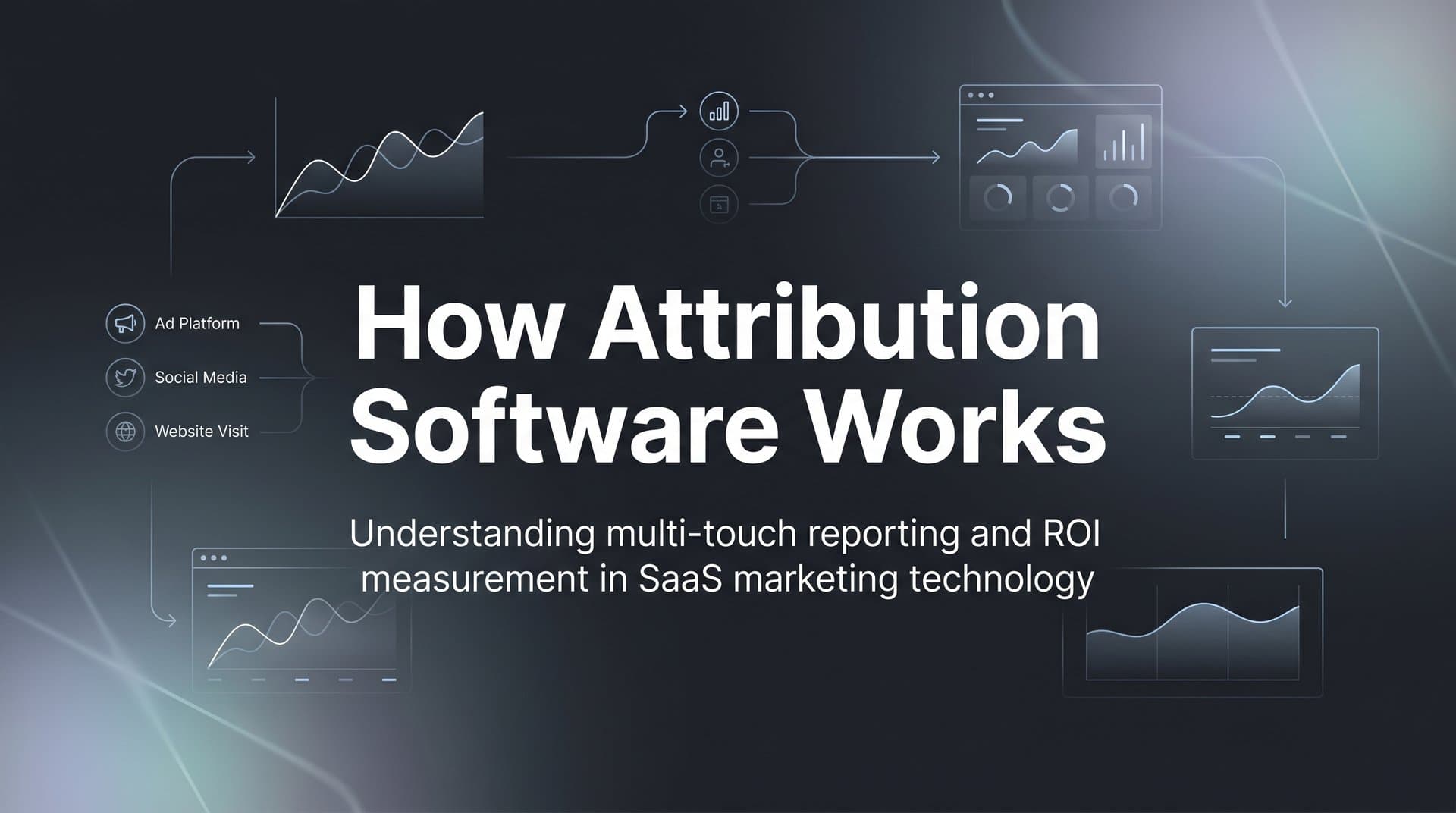
Understanding how attribution software works goes well beyond knowing that it "tracks conversions." The real value is in the mechanics: how it collects data across every channel, how it stitches fragmented user interactions into a single coherent journey, how it applies models to assign credit accurately, and how it turns all of that into insights you can actually act on. Whether you're new to attribution or looking to go deeper on the technology, this guide walks you through the full picture from the ground up.
The Data Collection Engine: Where It All Starts
Before attribution software can tell you anything useful, it needs data. A lot of it, from a lot of places. The data collection layer is the foundation of the entire system, and how well it works determines the accuracy of everything downstream.
Attribution platforms pull data from three primary sources: ad platforms like Meta, Google, and TikTok; your website, through tracking mechanisms embedded in the page or on your server; and your CRM or backend systems, where actual pipeline and revenue events live. The goal is to capture every meaningful interaction a prospect has with your brand, from the first ad impression to the final purchase.
This is where touchpoint capture becomes critical. Every click, page visit, form submission, video view, and purchase event gets logged and associated with a user or session. Think of it as building a timeline for each prospect. The attribution software is essentially asking: what did this person see or do before they converted, and in what order?
Historically, this data collection happened through client-side tracking, meaning JavaScript pixels that fire in a user's browser when they land on your site. The browser pixel captures the visit, sends the data to your analytics or attribution tool, and connects it back to the ad that brought them there. It works reasonably well under ideal conditions.
The problem is that conditions are rarely ideal anymore. Apple's App Tracking Transparency framework significantly limited the ability of browser-based pixels to track users across apps and websites on iOS devices. Ad blockers prevent pixels from firing altogether for a meaningful portion of web traffic. And with Google's ongoing movement away from third-party cookies in Chrome, browser-based tracking is becoming progressively less reliable.
This is why server-side tracking has become a critical component of modern attribution software. Instead of relying on a pixel that fires in the user's browser, server-side tracking sends event data directly from your web server to the attribution platform. The data never passes through the browser, which means it isn't blocked by ad blockers, isn't affected by iOS restrictions, and isn't subject to the same cookie limitations.
The result is a more complete and accurate data set. When you're making budget decisions based on attribution data, the quality of that underlying data matters enormously. Server-side tracking is no longer a nice-to-have feature. For teams serious about accuracy, it's the baseline.
Stitching the Customer Journey Together
Collecting raw data is only half the challenge. The harder part is making sense of it. A modern customer journey is rarely linear. Someone might see your TikTok ad on their phone during their commute, search for your brand on Google a few days later from their laptop, open an email on their tablet, and finally click through to purchase from a retargeting ad on Facebook. From a raw data perspective, these look like four completely separate interactions from potentially different devices and sessions.
Attribution software solves this through identity resolution: the process of connecting fragmented data points across devices, sessions, and channels into a single unified customer journey. Instead of treating each interaction as isolated, the software maps them all to one person, giving you a complete picture of the path to conversion. Tools like customer journey software are specifically designed to handle this complexity at scale.
Several mechanisms work together to make this possible. UTM parameters are the building blocks. When you tag your ad URLs with UTM source, medium, campaign, and content parameters, every click carries metadata that tells your attribution platform exactly where the visitor came from. This is the most basic layer of tracking and the starting point for most attribution setups.
Click IDs go a step further. Platforms like Meta and Google append their own unique identifiers to ad clicks (fbclid for Meta, gclid for Google). Attribution software captures these IDs and uses them to match the click back to a specific ad, ad set, and campaign in the platform's own data. This deterministic matching is highly accurate when it works, because it's based on a unique identifier rather than probabilistic inference.
First-party cookies store user identifiers on your domain, allowing the attribution platform to recognize returning visitors within the same browser. Combined with CRM integrations, this is where attribution software extends its reach beyond anonymous web sessions into actual identified contacts and customers. When a lead fills out a form and enters your CRM, the attribution platform can tie their previous anonymous touchpoints to their now-known identity, creating a complete pre- and post-conversion journey.
Cross-device tracking remains one of the harder problems to solve. Deterministic matching works when a user logs into an account on multiple devices, providing a shared identifier. Probabilistic matching uses signals like IP address, device type, and behavioral patterns to infer that two sessions likely belong to the same person. Modern attribution tools use a combination of both, along with first-party data from CRM integrations, to build the most complete picture possible.
Platforms like Cometly are built to handle this complexity directly, integrating with ad platforms, CRMs, and websites to pull all of these signals together and connect every touchpoint to real revenue outcomes rather than just website events.
Attribution Models: Assigning Credit Where It Counts
Once the customer journey is assembled, attribution software needs to answer a deceptively complex question: which touchpoints deserve credit for the conversion? This is where attribution models come in, and choosing the right attribution model has real implications for how you allocate budget and evaluate channel performance.
Here's a breakdown of the major models in practice:
First-Touch Attribution: All credit goes to the first interaction in the journey. If a prospect first discovered you through a Google search ad, that ad gets 100% of the credit regardless of what came after. This model is useful for understanding what drives awareness and brings new prospects into your funnel, but it ignores everything that helped close the deal.
Last-Touch Attribution: The opposite approach. All credit goes to the final touchpoint before conversion. This is the default in many native ad platforms and in tools like Google Analytics. It's simple to understand, but it systematically undervalues upper-funnel channels that generate awareness and interest without being the last click.
Linear Attribution: Credit is distributed equally across every touchpoint in the journey. If a prospect had five interactions before converting, each one gets 20% of the credit. This model acknowledges the full journey but treats all touchpoints as equally important, which is rarely true in practice.
Time-Decay Attribution: Touchpoints closer to the conversion receive more credit than earlier ones. The logic is that recent interactions had more influence on the final decision. This works well for shorter sales cycles where recency genuinely matters, but can undervalue early-stage content and awareness campaigns.
Position-Based (U-Shaped) Attribution: The first and last touchpoints each receive a larger share of credit (often 40% each), with the remaining 20% distributed across the middle interactions. This model recognizes that both the discovery moment and the closing interaction are particularly important, while still acknowledging the journey in between.
Data-Driven Attribution: Rather than applying a fixed rule, algorithmic models use machine learning to analyze your actual conversion data and determine how much each touchpoint contributed based on observed patterns. This is the most sophisticated approach and tends to reflect reality most accurately, but it requires sufficient data volume to produce reliable results.
No single model is universally correct. The right choice depends on your sales cycle length, channel mix, and business objectives. A B2B company with a six-month sales cycle will get very different insights from a time-decay model than an e-commerce brand with a two-day consideration window. This is why the ability to compare models side by side is one of the most valuable features in a modern attribution platform. Seeing how credit shifts across channels when you switch from last-touch to multi-touch attribution models can reveal which channels are being systematically undervalued in your current reporting.
Multi-touch attribution has become the preferred standard for sophisticated marketing teams precisely because it reflects how customers actually behave. Conversions rarely happen in a single interaction. Distributing credit across the full journey gives you a more honest view of what's working, which leads to smarter budget decisions.
From Raw Data to Real-Time Insights
Data collection and journey mapping happen in the background. What marketers actually see is the reporting layer: dashboards and analytics that translate all of that raw data into decisions. This is where attribution software earns its keep on a day-to-day basis.
A well-built attribution dashboard lets you analyze performance at any level of granularity. You can look at overall revenue by channel, drill down into individual campaigns, break it out by ad set, and go all the way down to specific ad creatives. Critically, all of this is tied to actual revenue rather than proxy metrics like clicks or impressions. The question shifts from "which ad got the most clicks?" to "which ad drove the most pipeline and closed revenue?" Platforms focused on revenue attribution are specifically designed to answer that question with precision.
This is where AI and machine learning begin to add a layer of intelligence that goes beyond what any dashboard can surface manually. Attribution platforms with AI capabilities can identify patterns across thousands of data points simultaneously. Which combinations of ad creative and audience tend to accelerate conversion velocity? Which channels perform best at the top of the funnel versus the bottom? Which campaigns are showing early signs of fatigue before the performance drop becomes obvious in the numbers?
Rather than requiring a data analyst to dig through reports to find these patterns, AI-powered tools can surface optimization recommendations automatically. Think of it as having a data scientist embedded in your attribution platform, one that's constantly scanning your performance data and flagging opportunities you might otherwise miss.
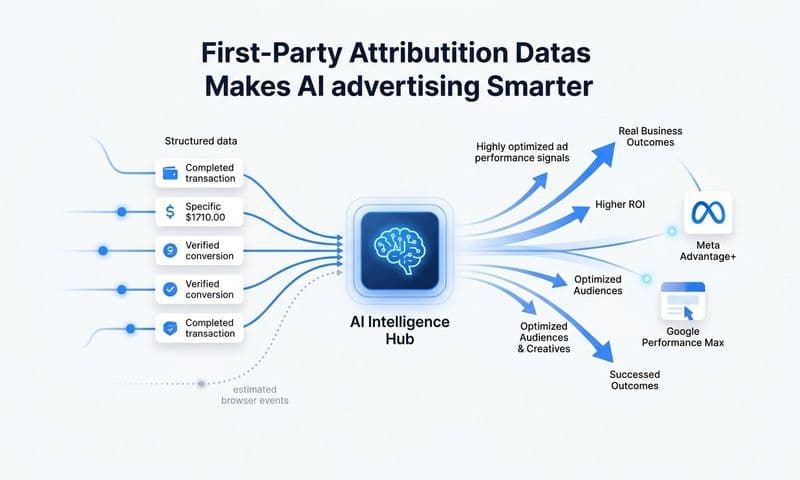
Conversion syncing is another capability that has become increasingly important, and it's worth understanding how it works. Once your attribution platform has identified which conversions are real and which channels drove them, it can send that enriched conversion data back to the ad platforms themselves. The best conversion attribution software makes this process seamless, ensuring platforms receive accurate signals rather than incomplete pixel data.
This matters because ad platform algorithms are only as good as the data you feed them. When Meta's algorithm receives conversion events that are enriched with real purchase data and matched back to the correct ad interactions, it can optimize targeting and bidding with far greater precision. The result is better ad performance over time, because the platform's AI is learning from accurate signals rather than noisy, incomplete ones.
Cometly's conversion sync capability is built specifically for this purpose: feeding enriched, conversion-ready events back to Meta, Google, and other platforms so their algorithms can do their jobs more effectively.
Why Traditional Tracking Falls Short
If you've been relying on native ad platform reporting or Google Analytics to understand your marketing performance, you're likely working with an incomplete and potentially misleading picture. Understanding the specific limitations helps clarify why dedicated attribution software exists in the first place.
The most fundamental problem with native platform reporting is that every platform grades its own homework. Meta attributes conversions to Meta ads. Google attributes conversions to Google ads. TikTok attributes conversions to TikTok ads. Each platform uses its own attribution window and its own logic, and none of them account for what the other platforms contributed. When a customer clicked a Meta ad, then a Google ad, then converted, both platforms record a conversion. Your actual conversion count is 1. Your reported conversion count is 2. This double-counting is systematic and gets worse as you add more channels to your mix. Learning how to fix attribution discrepancies in data is essential for any team dealing with this problem.
Google Analytics addresses some of this by providing a unified view across channels, but it comes with its own limitations. The default attribution model in Google Analytics is last-click, which means it gives all credit to the final touchpoint before the session that included the conversion. Upper-funnel channels that drove awareness and early consideration get zero credit. For teams investing in content, social, or display advertising, this creates a persistently distorted view of what's actually working. A detailed Google Analytics vs attribution platform comparison reveals just how significant these gaps can be.
Session-based tracking creates additional blind spots. Google Analytics tracks sessions, not people. If the same user visits your site in three different sessions before converting, those sessions may or may not be connected depending on whether cookies persist. Cross-device journeys are particularly difficult to track accurately in this model.
Then there are the data gaps created by iOS privacy changes and cookie deprecation. Browser-based tracking misses a growing share of traffic and conversions, and the missing data is not random. iOS users tend to skew toward higher-value demographics, meaning the gaps in your data are often concentrated in your most valuable audience segments.
Dedicated attribution software addresses all of these gaps by unifying data from every source, applying server-side tracking to capture what browser pixels miss, using sophisticated models to assign credit accurately across all channels, and connecting marketing activity directly to revenue rather than to proxy metrics.
Putting Attribution Software to Work for Your Team
Understanding how attribution software works mechanically is valuable. But the real question for most marketing teams is: what does this look like in practice, day to day?
In a typical workflow, a marketing team starts the week by reviewing their attribution dashboard to understand which campaigns are driving the most revenue, not just the most clicks. They can see, for example, that a particular Google search campaign is generating a high volume of first-touch interactions but rarely appears as the final touchpoint, suggesting it plays a strong awareness role. Meanwhile, a retargeting campaign on Meta is consistently appearing as the last touch before conversion. This insight informs budget allocation: invest more in what's driving awareness, protect the retargeting budget that's closing deals.
When the AI surfaces a recommendation, such as a specific ad creative that's outperforming others in the mid-funnel, the team can act on it quickly. Scale the budget toward that creative, pause the underperformers, and let the data guide the decision rather than gut instinct. Understanding how to measure marketing attribution effectively is what separates teams that optimize from those that guess.
Choosing the right attribution software for your team means looking for a few key capabilities. Integration depth matters: the platform needs to connect cleanly with your ad platforms, CRM, and website. Flexible attribution models matter: you should be able to compare first-touch, last-touch, and multi-touch models side by side rather than being locked into one view. And server-side tracking matters: as browser-based tracking continues to degrade, you need a solution that can capture data accurately regardless of browser restrictions. Reviewing a thorough marketing attribution software comparison can help you evaluate which platform best fits your needs.
Cometly is built to address exactly these needs. It captures every touchpoint from ad click to CRM event, giving the AI a complete and enriched view of every customer journey. It connects those touchpoints to real revenue so you can see which sources actually convert, not just which ones generate traffic. Its AI-powered recommendations identify high-performing ads and campaigns across every channel so you can scale with confidence. And its conversion sync capability sends enriched data back to Meta, Google, and other platforms to improve their targeting and optimization.
For marketing teams running paid campaigns across multiple channels, this combination of capabilities closes the loop between ad spend and revenue in a way that native platform reporting simply cannot.
The Bottom Line on Attribution
Attribution software works by doing four things well: collecting data across every marketing touchpoint, stitching fragmented interactions into a unified customer journey, applying models to assign conversion credit accurately, and turning all of that into insights and actions that improve campaign performance.
In a world where customers interact with your brand across multiple devices and channels before converting, and where privacy changes are steadily eroding the reliability of traditional tracking, having a dedicated attribution platform is no longer a luxury for large teams with big budgets. It's the infrastructure that serious marketing teams need to make confident, data-driven decisions about where to invest and where to cut.
The alternative is making budget decisions based on conflicting reports, double-counted conversions, and incomplete data. Most marketing teams already know something is off when the numbers don't add up. Attribution software is what fixes it.
Ready to get a clear, accurate picture of what's actually driving your revenue? Get your free demo of Cometly today and see how AI-driven attribution can help you capture every touchpoint, make smarter budget decisions, and scale your campaigns with confidence.