

Your ad campaigns are running. The clicks are coming in. But when you check your Facebook Ads Manager or Google Ads dashboard, the conversion numbers don't match what you're seeing in your analytics. Sound familiar?
This disconnect isn't just frustrating—it's costing you money. When ad platforms can't see your conversions accurately, their algorithms optimize blindly. You're essentially asking AI to improve performance while wearing a blindfold.
The culprit? Browser-based tracking is breaking down. iOS privacy updates block tracking. Cookie restrictions prevent data collection. Ad blockers intercept pixels. What used to work reliably now captures only a fraction of your actual conversions.
Enter Conversion API—the server-side solution that's changing how modern marketers track performance. Instead of relying on browser pixels that can be blocked, CAPI sends conversion data directly from your server to ad platforms. No browser involvement. No privacy restrictions. Just clean, accurate conversion signals that help ad algorithms do their job.
This guide breaks down exactly how Conversion API works, why it delivers better data than traditional pixels, and what you need to know to implement it effectively. Whether you're managing campaigns for a growing e-commerce brand or scaling ad spend for SaaS clients, understanding CAPI is now essential for accurate attribution and confident optimization.
The Shift From Browser Pixels to Server-Side Tracking
For years, tracking conversions was straightforward. You'd install a pixel—a snippet of JavaScript code—on your website. When someone completed a purchase or filled out a form, that pixel would fire in their browser and send conversion data to your ad platform. Simple, effective, and universally adopted.
But that simplicity relied on an assumption: browsers would allow unrestricted data collection. That assumption no longer holds.
Traditional pixel tracking depends entirely on the user's browser. When someone visits your site after clicking an ad, the pixel JavaScript executes in their browser environment. It captures conversion events, attaches identifying information like cookies, and transmits everything to the ad platform's servers. The entire process happens client-side, which means it's vulnerable to anything that interferes with browser functionality. Understanding what a tracking pixel is and how it works helps clarify why these limitations exist.
And plenty interferes. Ad blockers prevent pixel scripts from loading entirely. Browser privacy features like Intelligent Tracking Prevention limit cookie lifespan to just days. iOS App Tracking Transparency requires explicit user permission before tracking can occur—and most users decline. The result? Your pixels are blind to a growing percentage of actual conversions.
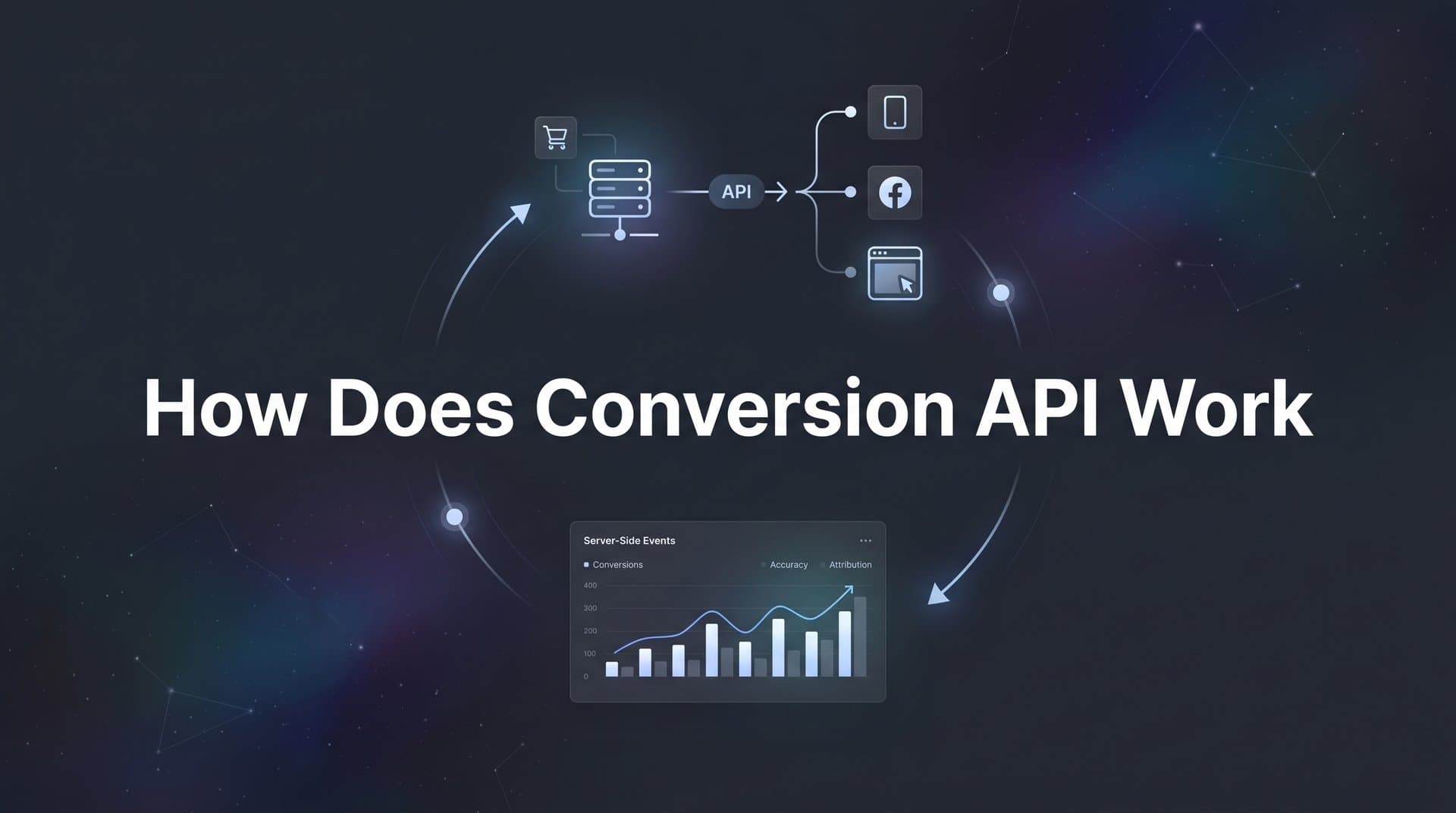
This is where Conversion API fundamentally differs. CAPI establishes a direct server-to-server connection between your backend systems and ad platforms. When a conversion happens on your site, your server captures that event data and transmits it via API directly to Meta, Google, TikTok, or whichever platform you're using.
The critical distinction: no browser involvement. The data transmission happens entirely on the server side, which means it operates independently of whatever privacy tools, ad blockers, or browser restrictions your users have enabled. If someone completes a purchase with an ad blocker active, your pixel might miss it—but your Conversion API won't.
Think of it like the difference between shouting across a crowded room versus making a direct phone call. The pixel approach broadcasts data through the browser environment, hoping it reaches the destination without interference. CAPI makes a direct connection, ensuring the message gets through regardless of environmental obstacles.
Major ad platforms now offer their own Conversion API implementations. Meta has the Facebook Conversions API. Google provides Enhanced Conversions. TikTok, Snapchat, and Pinterest all have server-side tracking options. The terminology varies, but the concept remains consistent: send conversion data directly from your server to bypass browser limitations.
This shift represents more than a technical upgrade. It's a fundamental change in how conversion tracking operates in a privacy-conscious digital landscape. Browser-based tracking worked when unrestricted data collection was the norm. Server-side tracking acknowledges that reality has changed—and provides a solution that respects privacy restrictions while maintaining data accuracy.
The Technical Flow: From Customer Action to Ad Platform
Understanding how Conversion API actually works requires walking through the complete data journey. Let's break down what happens from the moment a customer converts to when that conversion appears in your ad platform reporting.
Step one begins when a user takes action on your site. They complete a purchase, submit a lead form, or trigger whatever event you're tracking as a conversion. This happens in their browser, just like always. The difference is what happens next.
Instead of relying solely on a browser pixel to capture and transmit this data, your server also records the conversion event. Your backend systems—whether that's your e-commerce platform, CRM, or custom application—log the conversion details: what happened, when it happened, and who did it.
This is where data enrichment becomes possible. Because the event is captured server-side, you can append additional information from your backend systems before transmission. You might add customer lifetime value from your CRM, product margin data from your inventory system, or subscription tier information from your billing platform. This enriched data provides ad platforms with a fuller picture of conversion quality.
Step two involves packaging this data according to the ad platform's API specifications. Each platform requires specific parameters formatted in specific ways. The core elements typically include:
The event name identifies what happened—Purchase, Lead, AddToCart, CompleteRegistration, or custom events you've defined. This tells the ad platform which conversion goal was achieved.
The event time captures exactly when the conversion occurred, usually as a Unix timestamp. Precision matters here because ad platforms use timing to attribute conversions to specific ad interactions.
User identifiers enable the platform to match this server event to a specific person who saw or clicked your ads. This typically includes hashed email addresses (using SHA-256 encryption), hashed phone numbers, IP addresses, and user agent strings. The platform uses these identifiers to connect the conversion back to ad exposure. For a deeper dive into this process, explore what conversion API tracking entails.
Custom data adds conversion-specific details. For purchases, this includes currency, total value, product IDs, and order numbers. For leads, it might include form submission details or qualification scores. This data helps ad platforms optimize not just for conversions, but for high-value conversions.
Step three is the actual transmission. Your server makes an HTTPS POST request to the ad platform's API endpoint, sending the formatted conversion data. This happens server-to-server, completely independent of the user's browser. The request includes authentication credentials to verify the data is coming from your authorized systems.
The ad platform receives this data and immediately begins processing. First, it attempts to match the conversion to a user in its system using the identifiers you provided. When someone clicked your Facebook ad yesterday, Meta stored identifying information about that click. Now, when your server sends a conversion with matching identifiers, Meta can connect the two events.
This matching process relies on deterministic identifiers when possible—primarily hashed email addresses and phone numbers. If the email address associated with the conversion matches the email address of a Facebook user who clicked your ad, that's a confident match. When deterministic matching isn't possible, platforms use probabilistic matching based on IP addresses, user agents, and behavioral patterns.
Once matched, the conversion is attributed to the appropriate ad campaign, ad set, and creative. This attribution updates your reporting dashboards and, critically, feeds back into the platform's optimization algorithms. The machine learning systems now understand that showing ads to users similar to this converter produces results.
The entire flow—from customer action to ad platform attribution—can happen in seconds. Real-time or near-real-time transmission is preferred because it enables faster optimization cycles. The sooner ad algorithms receive conversion signals, the sooner they can adjust targeting and bidding strategies.
One important technical consideration: event deduplication. Many marketers run both browser pixels and Conversion API simultaneously for maximum coverage. When both fire for the same conversion, you need a way to prevent double-counting. This is typically handled by sending a unique event ID with both the pixel and API events. Ad platforms recognize matching IDs and count the conversion only once.
Why Server-Side Tracking Delivers Better Data Quality
The technical mechanics matter, but the real question is: does Conversion API actually improve your data? The answer is yes, and the improvement comes from three fundamental advantages: completeness, control, and reliability.
Data completeness addresses the most obvious problem with browser-based tracking—it misses conversions. When someone uses an ad blocker, your pixel never loads. When iOS users decline tracking permission, your pixel can't transmit data. When browser privacy features restrict cookies, your pixel loses the ability to connect conversions to ad clicks. Each gap represents revenue you generated but can't measure.
Server-side tracking captures these invisible conversions. Because the data transmission happens independently of browser restrictions, you see the complete picture. A customer can block every tracker, disable every cookie, and decline every permission—but when they complete a purchase, your server knows. That conversion gets reported to your ad platforms regardless of the user's privacy settings. Learn more about how to track conversions without cookies in a privacy-first world.
This matters more than you might think. Privacy-conscious users aren't random—they often skew toward higher income, greater digital literacy, and stronger purchase intent. When your tracking systematically misses these converters, you're not just losing data volume. You're losing signal about some of your best customers, which skews your optimization toward lower-quality audiences.
Data control represents the second major advantage. With browser pixels, you're limited to whatever information exists in the browser at the moment the pixel fires. With server-side tracking, you control exactly what data gets sent and when.
This enables sophisticated data enrichment strategies. Before transmitting a conversion to ad platforms, you can query your CRM to append customer lifetime value. You can check your inventory system to include product margin data. You can reference your subscription database to indicate whether this is a monthly or annual plan signup. This enriched data helps ad platforms optimize not just for conversions, but for profitable conversions.
You also control data freshness. Browser pixels fire when the conversion page loads—but what if additional information becomes available later? Maybe a lead qualifies after a sales call, or a trial user converts to paid after a week. With server-side tracking, you can send updated conversion values or new conversion events as your understanding of customer value evolves.
Data reliability completes the quality trifecta. Browser-based tracking depends on successful page loads, stable internet connections, and users staying on the confirmation page long enough for the pixel to fire. Any disruption breaks the chain.
Server connections are inherently more reliable. They're not affected by users closing tabs, navigating away quickly, or experiencing spotty mobile connections. Your server doesn't abandon the page before the request completes. The transmission either succeeds or fails—and if it fails, your server can retry until it succeeds.
This reliability becomes particularly important for high-value conversions. Missing a newsletter signup might not matter much. Missing a $5,000 purchase absolutely matters. Server-side tracking ensures your most important conversions don't slip through the cracks due to technical hiccups.
The combined effect of these advantages is data you can actually trust. When you look at your ad platform reporting, you're seeing something closer to reality—not just the subset of conversions that happened to fire a pixel successfully. This confidence enables better decisions about budget allocation, creative testing, and campaign scaling.
Implementation Approaches: DIY vs. Platform Solutions
Understanding how Conversion API works is one thing. Actually implementing it is another. You have two primary paths: build it yourself or use a platform that handles the complexity for you. Each approach has distinct trade-offs worth considering.
The manual implementation path requires developer resources and technical expertise. You'll need to build API connections for each ad platform you use—Meta, Google, TikTok, and so on. Each platform has its own API specifications, authentication requirements, and data formatting standards. Your development team must learn these specifications and write code that correctly packages and transmits conversion data. A comprehensive conversion API implementation guide can help navigate these requirements.
This isn't a one-time project. Ad platforms update their APIs regularly, adding new parameters, deprecating old ones, and changing authentication methods. Your team needs to monitor these changes and update your implementation accordingly. Miss an update, and your tracking breaks until someone notices and fixes it.
Event schema management adds another layer of complexity. You need to maintain consistent naming conventions and parameter structures across all platforms. When your marketing team wants to track a new conversion type, that requires development work to implement. When you need to modify what data gets sent, that's a code change that needs testing and deployment.
Authentication and security can't be overlooked. You're transmitting customer data from your servers to external platforms, which means handling API keys securely, implementing proper error handling, and ensuring data privacy compliance. These aren't trivial concerns—they require ongoing attention and expertise.
The advantage of manual implementation is complete control. You decide exactly how data flows, what gets transmitted, and when transmission occurs. For companies with substantial development resources and unique tracking requirements, this control might justify the investment.
Platform-based solutions take a different approach. Attribution tools like Cometly handle the technical complexity by connecting your ad platforms, CRM, and website in a unified system. Instead of building and maintaining API connections yourself, you configure integrations through a dashboard interface. Explore the best conversion API tools available to find the right fit for your needs.
These platforms abstract away the technical details. You don't need to understand Meta's API specifications or Google's authentication requirements. You connect your accounts, define your conversion events, and the platform handles data transmission automatically. When ad platforms update their APIs, the platform updates its integration—no action required from your team.
The real advantage goes beyond convenience. Comprehensive attribution platforms don't just transmit conversion data—they track the entire customer journey across all touchpoints. They capture ad clicks, website visits, form submissions, and CRM events, then connect these touchpoints to provide complete attribution visibility. This enriched view enables sending better data back to ad platforms.
Consider what happens when Cometly tracks a customer's journey. It sees the initial Facebook ad click, the website visit, the email signup, the retargeting ad interaction, and finally the purchase. When transmitting that purchase conversion back to Facebook via Conversion API, it can include enriched context about the entire journey. This gives Facebook's algorithms better signal about what actually drives conversions.
Platform solutions also simplify multi-platform management. Instead of building separate API integrations for Meta, Google, TikTok, and others, you configure all your platforms in one place. Conversion data flows automatically to each platform according to your specifications. Add a new ad platform to your mix, and you're enabling server-side tracking with a few clicks rather than weeks of development work.
The trade-off is less granular control and ongoing platform costs. You're working within the platform's framework rather than building exactly what you want. For most marketing teams, this trade-off makes sense—the time saved and complexity avoided far outweigh the limitations.
When deciding between approaches, consider your resources and requirements honestly. Do you have dedicated developers who can build and maintain API integrations? Do you have unique tracking needs that off-the-shelf solutions can't accommodate? If yes to both, manual implementation might work. If not, platform solutions deliver better results with far less overhead.
Maximizing Ad Platform Performance With Enriched Conversion Data
Implementing Conversion API isn't just about fixing broken tracking—it's about fundamentally improving how ad platforms optimize your campaigns. When platforms receive accurate, complete conversion signals, their machine learning algorithms can do what they're designed to do: find more customers like your best customers.
Ad platform algorithms optimize based on the conversion data they receive. When Facebook's algorithm sees that someone converted after clicking your ad, it analyzes that person's characteristics, interests, and behaviors. Then it looks for other users with similar profiles to show your ads to. The more accurate and detailed your conversion data, the better the algorithm understands what "good" looks like.
This is where server-side tracking creates a competitive advantage. You're not just sending more conversions—you're sending better conversion data. When your Conversion API includes enriched information from your CRM and backend systems, ad platforms gain deeper insight into conversion quality.
Think about two conversion signals. The first says "someone purchased." The second says "someone purchased, spent $500, bought premium products, has a customer lifetime value of $2,000, and came from your target geographic market." Which signal helps the algorithm optimize more effectively? The enriched data provides context that enables smarter optimization decisions.
This creates a powerful feedback loop. Better data leads to better targeting. Better targeting leads to more high-quality conversions. More high-quality conversions provide even better data. The loop compounds over time, progressively improving campaign performance as algorithms learn from increasingly accurate signals.
The business impact extends beyond algorithmic optimization. When you send complete, accurate conversion data back to ad platforms, you're also improving your own attribution visibility. You can see which campaigns, ad sets, and creatives actually drive revenue—not just which ones appear to drive revenue based on incomplete tracking. Understanding how to track conversions across multiple platforms becomes essential for this holistic view.
This visibility enables confident scaling decisions. When your data shows that a particular campaign consistently drives profitable conversions, you can increase budget aggressively. When another campaign looks good in ad platform reporting but your server-side data reveals poor conversion quality, you can cut spending before wasting budget. Accurate data removes the guesswork from optimization.
The conversion sync capability becomes particularly powerful when you're tracking beyond immediate purchases. Many businesses have multi-step conversion funnels where initial conversions lead to higher-value outcomes later. Someone might start with a free trial, then convert to a paid subscription, then upgrade to a premium tier months later.
Server-side tracking enables sending these downstream conversions back to ad platforms as additional signals. When that trial user upgrades to premium, you can transmit an updated conversion value to Facebook. The algorithm learns that the original ad interaction led to substantial long-term value, which influences future optimization toward similar high-value users. Discover how to sync conversions to Facebook Ads effectively for maximum impact.
This approach works across industries. E-commerce brands can send repeat purchase data. SaaS companies can send subscription upgrades. Service businesses can send lifetime value updates as customer relationships deepen. Each signal helps ad platforms understand true conversion quality beyond the initial transaction.
The cumulative effect is ad campaigns that actually improve over time rather than plateauing. When algorithms receive continuous, accurate feedback about what drives real business value, they keep optimizing toward better outcomes. Your cost per acquisition stabilizes or decreases even as you scale spend. Your return on ad spend improves as targeting becomes more precise.
Putting It All Together: Your Path to Accurate Tracking
Conversion API represents a fundamental shift in how modern marketers track and optimize campaigns. By sending conversion data directly from your server to ad platforms, you bypass the browser limitations that increasingly compromise traditional pixel tracking. The result is more complete, more reliable, and more actionable data about campaign performance.
The mechanics are straightforward: your server captures conversion events, packages the data according to platform specifications, and transmits it via API to Meta, Google, TikTok, or other ad platforms. These platforms match conversions to ad interactions using hashed user identifiers, then feed that signal back into their optimization algorithms. The entire process happens server-to-server, immune to ad blockers, cookie restrictions, and privacy controls that break browser-based tracking.
The strategic value extends beyond technical implementation. Server-side tracking enables data enrichment that improves algorithmic optimization. It captures conversions from privacy-conscious users who represent some of your best customers. It provides reliable data transmission that ensures high-value conversions don't slip through technical cracks. Most importantly, it gives you accurate attribution visibility that enables confident decisions about budget allocation and campaign scaling.
Implementation doesn't have to be overwhelming. While manual API integration is possible for teams with substantial development resources, platform solutions handle the complexity for most marketers. The key is choosing an approach that matches your technical capabilities and tracking requirements.
As browser-based tracking continues degrading, server-side solutions aren't optional—they're essential for maintaining accurate campaign measurement. The marketers who adopt Conversion API now gain a competitive advantage through better data quality and more effective ad spend. Those who delay face increasingly blind optimization as traditional pixels capture less of the conversion picture.
Your current tracking setup likely has gaps you don't see. Conversions happening without attribution. High-value customers invisible to your ad algorithms. Optimization decisions based on incomplete data. Server-side tracking closes these gaps and reveals what's actually driving revenue across your marketing channels.
The Competitive Advantage of Complete Attribution
The digital advertising landscape has fundamentally changed. Privacy updates aren't temporary disruptions—they're the new reality. Browser restrictions will continue tightening. User privacy expectations will keep rising. The tracking methods that worked for the past decade won't work for the next one.
Conversion API isn't just a technical upgrade—it's a strategic necessity for maintaining competitive campaign performance. When your competitors are optimizing based on incomplete data while you're working with accurate, enriched conversion signals, you're playing a different game. Their algorithms optimize blindly. Yours optimize with clarity.
This advantage compounds over time. Better data leads to better targeting. Better targeting leads to lower acquisition costs. Lower acquisition costs enable more aggressive scaling. More aggressive scaling drives faster growth. The gap between marketers with accurate attribution and those without widens with every campaign iteration.
The question isn't whether to implement server-side tracking—it's how quickly you can get it running. Every day without complete conversion visibility is a day of suboptimal campaign performance. Every conversion your pixels miss is signal your algorithms need but aren't receiving. Every attribution gap is a decision made with incomplete information.
Cometly simplifies this transition by handling the technical complexity of server-side implementation while providing comprehensive attribution across all your marketing touchpoints. From ad clicks to CRM events, the platform tracks the entire customer journey and automatically syncs enriched conversion data back to your ad platforms. You get complete visibility into what drives revenue and the confidence to scale what works.
Ready to elevate your marketing game with precision and confidence? Discover how Cometly's AI-driven recommendations can transform your ad strategy—Get your free demo today and start capturing every touchpoint to maximize your conversions.


