

Your Meta ads were driving consistent conversions last quarter. This quarter? The data shows a 30% drop, but your actual sales haven't changed. What happened? The answer often lies in what your tracking can't see anymore.
Browser-based tracking is breaking down. iOS privacy updates have made it harder to track mobile users. Safari and Firefox block third-party cookies by default. Ad blockers are more popular than ever. The result? Your pixel-based tracking is missing conversions, and your ad platforms are optimizing with incomplete data.
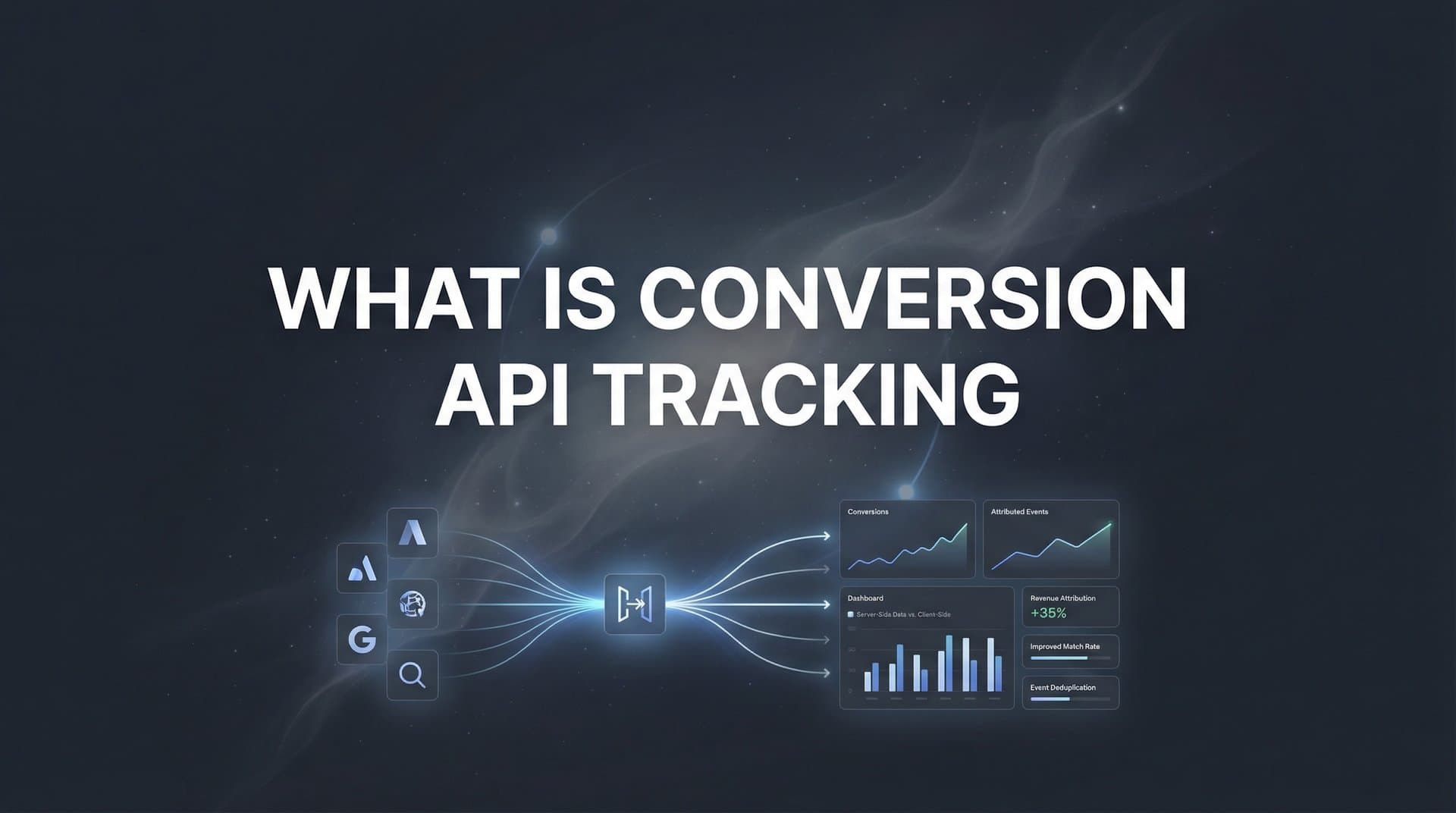
Conversion API tracking offers a way out. Instead of relying on browser cookies that users can block, CAPI sends conversion data directly from your server to ad platforms. It's a server-side solution that bypasses browser restrictions entirely, giving you more complete attribution data and helping ad algorithms find the right audiences.
This guide will walk you through what Conversion API tracking actually is, why it's become essential for modern marketers, and how you can implement it to maintain accurate tracking in an increasingly privacy-focused digital landscape.
The Server-Side Solution to Tracking Blind Spots
Conversion API tracking is a server-to-server data transfer method. When a user completes a conversion on your website, your server sends that event data directly to the advertising platform's API. No browser involvement. No cookies required.
Traditional pixel-based tracking works differently. A pixel is a small piece of JavaScript code on your website that fires when someone takes an action. It drops a cookie in the user's browser, then sends conversion data to the ad platform through that browser. This approach has worked for years, but it has a critical weakness: it depends entirely on the browser cooperating.
Here's the problem. When Apple released iOS 14.5 in April 2021, they introduced App Tracking Transparency. Apps now have to ask permission before tracking users across other apps and websites. Most users say no. Safari's Intelligent Tracking Prevention already limits cookie lifespan to seven days for first-party cookies and blocks third-party cookies entirely. Firefox does the same. Google Chrome has announced plans to phase out third-party cookies, though the timeline keeps shifting.
Add ad blockers to the mix, and you're looking at a significant portion of your audience that your pixel simply can't track. Studies show that ad blocker usage has grown steadily, particularly among younger, tech-savvy demographics who often represent high-value customer segments. Understanding what is server-side conversion tracking becomes essential in this environment.
This is where Conversion API tracking becomes essential. Because the data flows from your server directly to the ad platform's server, it completely bypasses browser restrictions. An ad blocker can't stop it. iOS privacy settings don't affect it. Cookie limitations don't matter.
The technical term for this is "server-side tracking," and it represents a fundamental shift in how marketers capture conversion data. Instead of hoping the user's browser will cooperate, you're taking control of the data transmission yourself.
For marketers running campaigns across Meta, Google, TikTok, or LinkedIn, this means more complete conversion data. When your ad platforms receive accurate information about which ads drive conversions, their algorithms can optimize more effectively. You get better targeting, more efficient spend, and clearer attribution.
The shift to Conversion API isn't just about fixing broken tracking. It's about future-proofing your marketing measurement as privacy regulations tighten and browser restrictions expand.
How Conversion API Tracking Actually Works
Let's walk through what happens when someone converts on your website using Conversion API tracking.
A user clicks your Meta ad, lands on your website, and completes a purchase. Your website's backend server captures this conversion event along with relevant details: what they bought, the purchase value, timestamp, and available user identifiers like their email address or phone number.
Your server then sends this data directly to Meta's Conversions API endpoint via a POST request. The data packet includes the event name (like "Purchase"), the timestamp, the hashed user identifiers, and the conversion value. Meta receives this information on their servers, completely independent of what's happening in the user's browser. This is fundamentally different from conversion API vs pixel tracking approaches.
The key data points transmitted through CAPI include event names that describe the action taken, precise timestamps showing when the conversion occurred, user identifiers such as hashed email addresses and phone numbers, and event parameters like purchase value, product category, or lead quality score.
Here's where event matching comes in. Ad platforms need to connect these server-side conversion events to the original ad interactions. They do this using the user identifiers you send. When you transmit a hashed email address along with the conversion event, Meta can match it against the hashed email they have on file for that user's account. If they clicked your ad while logged into Facebook, Meta can connect the dots: this conversion came from that ad click.
The matching process uses multiple identifiers to increase accuracy. Email addresses, phone numbers, browser user agents, IP addresses, and click IDs all help platforms match conversion events to ad interactions. The more identifiers you can provide, the better the match rate.
This is fundamentally different from pixel tracking, where the browser cookie creates a direct link between the ad click and the conversion. With CAPI, you're relying on probabilistic matching based on user identifiers. When implemented correctly, match rates can be quite high, but the quality of your data matters significantly.
One important technical detail: all personal identifiers must be hashed before transmission. Meta requires SHA-256 hashing for emails and phone numbers. This means you're not sending raw personal data across the internet. You're sending a one-way encrypted version that platforms can use for matching but can't reverse-engineer to reveal the original information.
The entire process happens in milliseconds. From the moment someone completes a purchase to the moment Meta receives the conversion data, the server-to-server communication is nearly instantaneous. This speed allows ad platforms to incorporate fresh conversion data into their optimization algorithms quickly.
Why Marketers Are Prioritizing CAPI Implementation
The most immediate benefit of Conversion API tracking is data completeness. When you rely solely on pixel-based tracking, you're missing conversions from users with ad blockers, strict privacy settings, or browsers that limit cookie functionality. Those missed conversions represent real customers who bought from you, but your ad platform has no idea which ads drove them.
This creates a dangerous optimization problem. If Meta thinks an ad generated 70 conversions when it actually generated 100, the algorithm undervalues that ad. It might reduce spend on a winning campaign or shift budget to ads that appear more successful but are simply better at tracking, not better at converting. Many marketers struggle with Facebook pixel not tracking all conversions for exactly this reason.
CAPI solves this by capturing events that pixels miss. Your server knows about every transaction, every lead form submission, every sign-up. By sending this complete dataset to your ad platforms, you're giving their algorithms the full picture.
Better data leads to better optimization. Ad platforms use conversion data to train their machine learning models. When Facebook's algorithm sees that users who engage with video ads tend to convert at higher rates, it shows your video ads to more similar users. But this only works if the algorithm receives accurate conversion signals.
With incomplete pixel data, the algorithm is essentially learning from a biased sample. It's like trying to understand customer preferences by only surveying people who answer phone calls. You're missing everyone who screens their calls, and those people might have completely different preferences.
CAPI provides a more representative dataset. The algorithm sees conversions from privacy-conscious users, ad blocker users, and Safari users. It can identify patterns across your entire customer base, not just the subset that allows browser tracking.
You also gain greater control over data quality. With pixel tracking, you're at the mercy of browser behavior and user settings. With server-side tracking, you can validate events before sending them. Did this purchase actually complete, or did the payment fail? Is this email address formatted correctly? Does this conversion value make sense? Addressing poor conversion API data quality starts with proper validation.
This validation layer prevents garbage data from reaching your ad platforms. You can filter out test purchases, exclude internal team conversions, and ensure that only legitimate customer events get counted. Some marketers even enrich their CAPI data with additional customer information from their CRM, providing ad platforms with richer signals about customer lifetime value or lead quality.
For businesses with complex customer journeys, CAPI enables tracking of offline conversions and post-purchase events. If someone requests a demo online but converts during a sales call three weeks later, your server can send that conversion event to Meta with the appropriate timestamp and attribution details. This helps platforms understand the full value of their ad delivery, not just immediate online conversions.
Platform-Specific CAPI Options You Should Know
Meta Conversions API is the most widely adopted server-side tracking solution. Meta has been pushing marketers toward CAPI since 2020, positioning it as essential for maintaining campaign performance post-iOS 14. The Meta CAPI supports web conversions, app events, and offline conversions, making it versatile for businesses with multiple conversion touchpoints.
Setting up Meta CAPI requires generating an access token in your Events Manager, then configuring your server to send POST requests to Meta's API endpoint. You can send events in real-time as they occur or batch them for efficiency. Meta recommends using both pixel and CAPI together, with proper deduplication to avoid double-counting. For a deeper dive, explore our guide on accurate Facebook conversion tracking.
Google takes a slightly different approach with enhanced conversions. Rather than a separate API like Meta, Google integrates server-side data through their existing tracking infrastructure. You can implement enhanced conversions via gtag.js on your website or through Google Tag Manager's server-side tagging.
Google's server-side tagging deserves special attention. It involves setting up a server-side Google Tag Manager container that acts as a middleman between your website and Google's servers. Your website sends data to your GTM server container, which then forwards it to Google Ads, Analytics, and other platforms. This approach provides more control over data transmission and can improve website performance by reducing client-side JavaScript. Our Google conversion tracking complete guide covers this in detail.
Enhanced conversions specifically focus on sending hashed first-party data alongside conversion events. When someone converts, Google receives their hashed email address or phone number, which helps match the conversion to their Google account and improve attribution accuracy.
TikTok Events API has become increasingly important as more marketers diversify beyond Meta and Google. TikTok's server-side tracking works similarly to Meta's approach: you send conversion events from your server to TikTok's API endpoint with hashed user identifiers and event parameters.
For brands targeting younger demographics or testing creative-first advertising strategies, TikTok CAPI helps maintain accurate tracking as the platform grows. The implementation process mirrors Meta's approach, making it relatively straightforward if you've already set up CAPI for Facebook and Instagram.
LinkedIn Conversions API is newer but valuable for B2B marketers. LinkedIn's server-side tracking lets you send conversion events with company-level data and lead quality signals. Since LinkedIn ads often drive longer sales cycles with multiple touchpoints, CAPI helps capture conversions that occur days or weeks after the initial ad interaction.
Each platform has its own API documentation and requirements, but the core concepts remain consistent: send conversion events from your server with hashed user identifiers and relevant event parameters. The technical implementation varies, but the strategic goal is the same: more complete, accurate conversion data.
Common Implementation Challenges and How to Solve Them
The biggest hurdle most marketers face is technical complexity. Setting up Conversion API tracking isn't as simple as dropping a pixel code on your website. It requires server-side development work, API integrations, and ongoing maintenance.
If you have an in-house development team, they'll need to build the integration between your website backend and each ad platform's API. This means writing code to capture conversion events, format the data correctly, hash user identifiers, and send POST requests to the right endpoints. For companies running ads on multiple platforms, this multiplies the development effort.
Many businesses solve this by using third-party tools. E-commerce platforms like Shopify and WooCommerce offer native CAPI integrations that handle the technical setup automatically. If you're on Shopify, check out our guide on Shopify conversion tracking setup. Attribution platforms and customer data platforms can also manage server-side tracking across multiple ad platforms, reducing the burden on your development team.
Event deduplication is another critical challenge. If you're using both pixel tracking and CAPI (which Meta recommends), you need to prevent the same conversion from being counted twice. Without proper deduplication, your conversion metrics will be inflated, making it impossible to accurately measure campaign performance. This is one of the most common duplicate conversion tracking issues marketers encounter.
The solution is event IDs. When your pixel fires a conversion event, it generates a unique event ID. Your server-side code should capture this same event ID and include it when sending the conversion via CAPI. Ad platforms use these matching event IDs to recognize that the pixel event and the server event represent the same conversion, counting it only once.
Implementing this requires coordination between your client-side pixel code and your server-side CAPI code. Your frontend needs to pass the event ID to your backend when a conversion occurs, and your backend needs to include it in the API request. It's a technical detail that's easy to overlook but essential for accurate measurement.
Data privacy compliance adds another layer of complexity. Just because CAPI is server-side doesn't mean you can ignore privacy regulations. You still need proper consent before collecting and transmitting user data. GDPR requires explicit consent for tracking. CCPA gives users the right to opt out. You need systems in place to respect these preferences. Understanding privacy compliant conversion tracking methods is crucial for staying compliant.
Hashing personal identifiers before transmission is mandatory, but it's not sufficient for compliance. You need to ensure you have legal permission to collect the email addresses and phone numbers you're hashing. You need to honor opt-out requests. You need to maintain records of consent.
Many marketers solve this by integrating their consent management platform with their CAPI implementation. When a user opts out of tracking, that preference should prevent both pixel firing and server-side event transmission. The technical architecture needs to respect user privacy choices across all tracking methods.
Testing and validation present their own challenges. How do you know your CAPI implementation is working correctly? Meta provides a Test Events tool in Events Manager where you can send test conversions and verify they're being received properly. Google has similar debugging tools in their Tag Assistant.
Regular monitoring is essential. Check your event match rates to ensure user identifiers are being matched successfully. Review your conversion counts to confirm deduplication is working. Set up alerts for API errors or failed requests. CAPI isn't a set-it-and-forget-it solution; it requires ongoing attention to maintain data quality.
Putting It All Together: Your CAPI Action Plan
Conversion API tracking solves the fundamental problem of incomplete conversion data in an era of browser restrictions and privacy controls. By sending events directly from your server to ad platforms, you bypass the limitations that plague pixel-based tracking. You capture more conversions, provide better data to optimization algorithms, and maintain measurement accuracy as privacy regulations evolve.
The benefits are clear: more reliable attribution, improved ad platform optimization, and greater control over data quality. For marketers managing significant ad spend, these advantages translate directly to better ROI and more confident budget decisions.
Your next steps should focus on three areas. First, audit your current tracking setup. How much conversion data are you losing to browser restrictions? Which platforms account for the most ad spend? Understanding your baseline helps you prioritize implementation efforts.
Second, evaluate your implementation options. Do you have development resources to build custom integrations? Does your e-commerce platform offer native CAPI support? Would a third-party attribution tool make more sense for your situation? The right approach depends on your technical capabilities, platform ecosystem, and business needs.
Third, start with your highest-spend platform. If Meta accounts for 60% of your ad budget, implement Meta Conversions API first. Get it working correctly, validate the data quality, then expand to other platforms. Sequential implementation reduces complexity and lets you learn from each integration.
This is where attribution platforms like Cometly simplify the entire process. Instead of building separate CAPI integrations for each ad platform, Cometly handles server-side tracking and conversion sync automatically. The platform captures every touchpoint across your customer journey, enriches that data with AI-powered insights, and feeds clean, accurate conversion events back to Meta, Google, and other ad platforms.
You get the benefits of Conversion API tracking without the technical headaches. Cometly's server-side infrastructure ensures complete data capture, proper event deduplication, and compliant data handling. The AI analyzes your attribution data to identify which campaigns truly drive revenue, then sends those enriched conversion signals to ad platforms to improve their targeting and optimization.
Ready to elevate your marketing game with precision and confidence? Discover how Cometly's AI-driven recommendations can transform your ad strategy. Get your free demo today and start capturing every touchpoint to maximize your conversions.



