

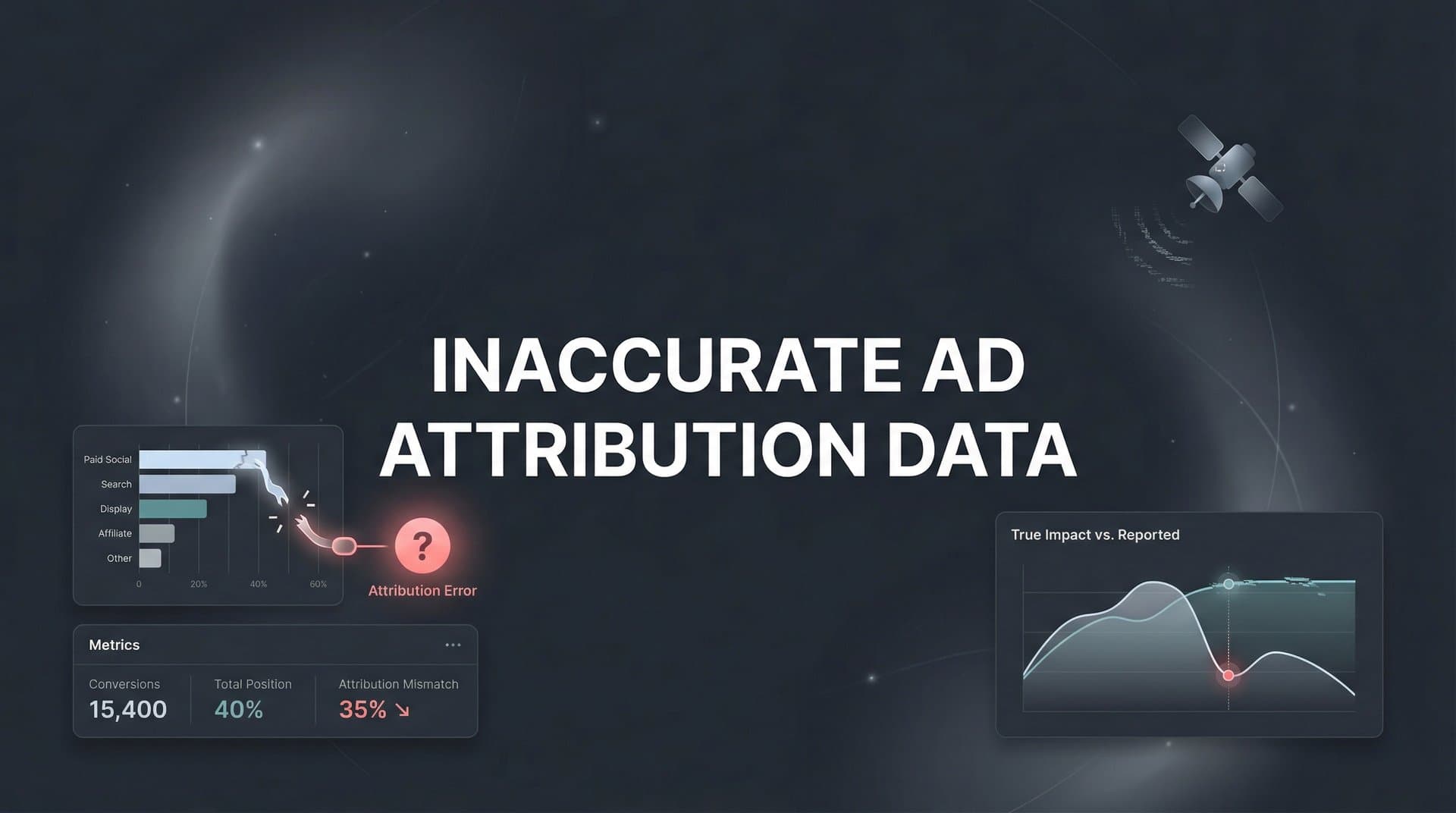
You open your campaign dashboard on Monday morning, coffee in hand, ready to review last week's performance. Facebook Ads Manager shows 247 conversions. Google Ads reports 198. Your CRM? It logged 156 actual sales. The numbers don't just differ slightly—they tell completely different stories about what's working.
This isn't a minor reporting glitch. It's inaccurate ad attribution data, and it's quietly steering your marketing budget toward campaigns that may not actually drive revenue. When your attribution is broken, you're making decisions in the dark, scaling ads based on phantom conversions while potentially starving your best performers of budget.
The frustration compounds when you realize this isn't just about messy reports. Bad attribution data feeds directly into platform algorithms, teaching them to optimize toward the wrong signals. The result? Your ad spend works against you, and the problem gets worse over time.
This guide breaks down exactly why attribution data becomes inaccurate, how to spot the warning signs, and what you can do to build a system that reflects reality. Because when you know what's truly driving revenue, you can make confident decisions that actually scale your business.
The Hidden Cost of Trusting Broken Data
When your attribution data lies to you, the damage goes far beyond confusing spreadsheets. You're actively funding the wrong campaigns while cutting budget from channels that actually convert. A Facebook campaign might show a stellar cost per acquisition, but if half those conversions never happened, you're pouring money into a black hole.
The real danger is that bad data creates a compounding problem. Every platform uses machine learning to optimize your campaigns. Facebook's algorithm learns which users are most likely to convert. Google's smart bidding adjusts based on conversion signals. TikTok's system identifies your ideal audience patterns.
But here's the thing: these algorithms are only as good as the data you feed them. When your tracking misses conversions or attributes them incorrectly, you're teaching the AI to optimize toward the wrong people. The algorithm gets confident in its decisions, doubles down on what it thinks works, and your campaigns drift further from actual revenue drivers. Understanding poor ad attribution data is the first step toward fixing this cycle.
Think of it like training a sales team using fake customer data. They'd develop all the wrong instincts, chase the wrong leads, and wonder why their closing rate keeps dropping. Your ad platforms are doing the same thing when they optimize based on inaccurate attribution.
The worst part? Most marketers don't realize their attribution is broken until they've burned through significant budget. The reports look reasonable. The platforms show conversions. Everything seems fine until you sit down with your finance team and discover that marketing claims 400 conversions this month, but the business only closed 250 deals.
By that point, you've already scaled the wrong campaigns, cut budget from channels that were actually working, and trained your platform algorithms to optimize toward phantom results. The cost isn't just the wasted ad spend. It's the lost opportunity from the campaigns you should have been scaling instead.
Five Root Causes Behind Attribution Gaps
Understanding why attribution breaks down starts with recognizing that the tracking methods marketers relied on for years simply don't work anymore. The digital advertising landscape has fundamentally changed, and traditional pixel-based tracking can't keep up.
Privacy Updates Broke Traditional Tracking: When Apple released iOS 14.5 in April 2021, it introduced App Tracking Transparency, requiring apps to ask permission before tracking users across other apps and websites. The result? Most users opted out, creating massive blind spots in your data. If someone clicks your Facebook ad on their iPhone, then converts on your website later, there's a good chance that conversion never gets attributed back to Facebook. The pixel simply can't see it. Many marketers are now losing attribution data due to privacy updates at an alarming rate.
Google Chrome's plans to phase out third-party cookies adds another layer of complexity. While timelines keep shifting, the direction is clear: browser-based tracking is becoming less reliable across the board. Safari already blocks most third-party cookies by default. Firefox does the same. The tracking foundation that digital advertising was built on is crumbling.
Cross-Device Journeys Create Attribution Black Holes: Your customer's path to purchase rarely happens on a single device. Someone might discover your brand through a Facebook ad on their phone during lunch, research your product on their work laptop that afternoon, and finally convert on their home computer that evening. Each platform only sees its own piece of this journey.
Facebook knows about the initial click. Google might see the research session if they searched for your brand. But connecting these dots into a single customer journey? That requires infrastructure most marketing teams don't have. Without it, you're looking at three separate anonymous users instead of one customer's complete path to purchase. Implementing multi-touch attribution models helps solve this fragmentation.
Platform Silos Hide the Full Picture: Your ad platforms don't talk to your website analytics. Your website analytics don't talk to your CRM. Your CRM doesn't feed data back to your ad platforms. Each system operates in isolation, creating blind spots at every transition point.
A lead might click your Google ad, fill out a form on your website, get nurtured through email, and close as a customer two weeks later. Google sees the click. Your website sees the form fill. Your CRM sees the closed deal. But nobody sees the complete journey, so attribution gets fragmented across systems that can't communicate.
Attribution Windows Don't Match Reality: Every platform uses different attribution windows, and none of them match how customers actually buy. Facebook might use a seven-day click window. Google might use 30 days. Your actual sales cycle might be 45 days for B2B products or two hours for impulse purchases. When the attribution window doesn't match your customer journey, conversions fall through the cracks or get attributed to the wrong source.
Server-Side Events Get Lost: Many important conversion events happen on your server, not in the browser where pixels can see them. A subscription renewal, a payment processing, an upgrade, or a CRM status change all happen behind the scenes. If your attribution system only tracks browser-based events, you're missing the actions that actually matter for your business.
How Platform Self-Reporting Skews Your Numbers
Here's a scenario that plays out in marketing teams everywhere: You run the same campaign across Facebook and Google. At the end of the month, Facebook reports 150 conversions. Google reports 130 conversions. You check your CRM, and you closed 180 deals total. The math doesn't just fail to add up. It's mathematically impossible unless both platforms are overcounting.
This happens because each ad platform operates as its own judge and jury when it comes to attribution. Facebook uses its attribution window and methodology to decide which conversions it gets credit for. Google does the same with completely different rules. The result? Both platforms often claim credit for the exact same conversion. Learning about attribution data discrepancies helps you understand why this happens.
Someone might click your Facebook ad on Monday, then search for your brand on Google on Tuesday and click that ad before converting. Facebook says it drove that conversion because the user clicked their ad first. Google says it drove the conversion because the user clicked their ad last before converting. Both platforms report the same conversion, inflating your total count.
The problem gets worse when you understand how attribution windows work. Facebook might use a seven-day click and one-day view window by default. That means any conversion within seven days of clicking a Facebook ad, or within one day of just viewing it, gets attributed to Facebook. Google might use a 30-day click window. These overlapping windows create massive double-counting.
Platform-reported data also doesn't account for what happens after the click. Someone might click your ad, land on your website, and then abandon their cart. Two weeks later, they return directly to your site and complete the purchase. Many platforms would still claim that conversion within their attribution window, even though the ad click had minimal influence on the final decision.
This is why comparing platform-reported conversions to your actual CRM revenue often reveals shocking discrepancies. The platforms are optimizing for their own attribution rules, not for your actual business results. A campaign might show a profitable cost per acquisition in Facebook Ads Manager, but when you track those conversions to closed revenue in your CRM, the numbers tell a different story. If you're seeing issues specifically with inaccurate conversion data in Ads Manager, you're not alone.
The real challenge is that platform algorithms optimize based on these self-reported conversions. When Facebook's algorithm sees a conversion within its attribution window, it learns from that signal and adjusts targeting accordingly. If that conversion was actually driven by a different channel, or would have happened anyway, the algorithm is learning from noise instead of signal.
This creates a feedback loop where platforms get increasingly confident in their optimization while drifting further from what actually drives your revenue. Your cost per acquisition looks great in the platform dashboard, but your actual return on ad spend keeps declining because the platform is chasing vanity conversions instead of real business results.
Signs Your Attribution Data Cannot Be Trusted
The first red flag is obvious once you know to look for it: your platform-reported conversions exceed your actual sales. If Facebook says you got 200 conversions this month, but your business only closed 150 deals, something is fundamentally broken. This isn't a small discrepancy you can explain away. It's proof that your attribution is counting things that never happened.
Watch for sudden, unexplained drops in reported conversions that don't match your business reality. Did your Facebook pixel suddenly report 40% fewer conversions after an iOS update, even though your actual sales stayed steady? That's not a performance problem. That's a tracking problem. Your campaigns didn't suddenly stop working. Your attribution system just lost the ability to see what's happening. This is a classic sign of losing attribution data without realizing it.
Inconsistent conversion counts across platforms raise another warning sign. If you're running the same offer on Facebook and Google with similar traffic levels, but one platform reports three times as many conversions, dig deeper. The discrepancy might reveal that one platform's tracking is broken, or that both platforms are using wildly different attribution methodologies that don't reflect reality.
Here's a practical audit you can run right now: Pull your conversion data from each ad platform for the last 30 days. Add up all the conversions each platform claims credit for. Now compare that total to your actual closed deals or completed purchases in your CRM or payment processor. If the platforms collectively report more conversions than you actually had, you've confirmed that attribution overlap is inflating your numbers.
Take the audit deeper by checking conversion values. Some platforms might report conversions but assign them zero value or incorrect values. Others might count micro-conversions like email signups as if they're equivalent to purchases. If your platform reports a $50 cost per conversion, but your average order value is $200, verify that it's actually tracking purchases and not form fills. Proper attribution data analysis can reveal these hidden issues.
Ask yourself these questions when evaluating your attribution data: Can you trace individual conversions from platform report back to actual customer records? When a platform claims a conversion happened, can you find that customer in your CRM? If you can't connect platform data to real customer records, you're making decisions based on numbers that may not represent actual people.
Do your attribution metrics match your business outcomes? If your attribution data says your best channel is Facebook, but when you pause Facebook campaigns your revenue doesn't drop, something is wrong. Good attribution should have predictive power. If changing your ad spend based on attribution data doesn't produce the expected revenue changes, the attribution isn't measuring what matters.
Another critical question: Has your attribution methodology changed recently, and did anyone tell you? Platform updates, pixel changes, or tag management modifications can silently break your tracking. If you notice sudden changes in your data, investigate whether something in your tracking infrastructure changed, not just whether your campaign performance actually shifted.
Building an Attribution System That Reflects Reality
Accurate attribution starts with accepting that browser-based pixels alone cannot capture the complete customer journey anymore. You need a system that works when pixels fail, tracks across devices and platforms, and connects every touchpoint to actual revenue. That system is built on server-side tracking.
Server-side tracking sends conversion data directly from your servers to ad platforms, bypassing the browser entirely. When someone converts on your website, your server logs that event and sends it to Facebook, Google, and other platforms through their server-side APIs. This approach is resilient to privacy restrictions, ad blockers, and cookie limitations because it doesn't rely on the user's browser to fire tracking pixels. Implementing first-party data tracking solutions is essential for this approach.
The difference is significant. A browser-based pixel might get blocked by privacy settings, fail to load due to slow connections, or miss the conversion entirely if the user closes the page too quickly. Server-side tracking happens on your infrastructure, where you control the environment and can ensure every conversion gets captured and reported accurately.
But server-side tracking is just the foundation. The real power comes from connecting all your data sources into a unified view. Your ad platforms need to talk to your website analytics. Your website needs to connect to your CRM. Your CRM needs to feed enriched data back to your ad platforms. This creates a closed loop where every touchpoint gets tracked and every conversion gets properly attributed.
Here's what this looks like in practice: Someone clicks your Facebook ad. Your attribution system logs that click with a unique identifier. They land on your website and browse several pages. Your website tracking connects those pageviews to the same identifier. They fill out a lead form. That form submission gets logged with the identifier and sent to your CRM. Your sales team nurtures the lead, and two weeks later, they close as a customer for $5,000.
In a unified attribution system, that entire journey gets connected. You know the Facebook ad drove that $5,000 in revenue. You can see every touchpoint along the way. And critically, you can feed that conversion back to Facebook with the actual revenue value, teaching their algorithm exactly what kind of users drive real business results. A dedicated attribution data platform makes this integration seamless.
This is where attribution transforms from a reporting tool into a growth engine. When you feed enriched conversion data back to ad platforms, you improve their optimization. Facebook's algorithm learns that users who follow this specific path are worth more. Google's smart bidding adjusts to bid more aggressively for similar users. Your platforms start optimizing toward actual revenue instead of phantom conversions.
The technical implementation requires connecting several pieces. You need tracking infrastructure that captures events across your website, ad platforms, and CRM. You need a system that assigns persistent identifiers to users across devices and sessions. You need server-side APIs configured to send conversion data to each ad platform. And you need ongoing monitoring to ensure everything stays connected as platforms update their requirements.
This is exactly what Cometly does. It captures every touchpoint from ad clicks to CRM events, providing a complete view of each customer journey. The platform connects your ad platforms, website, and CRM into a unified system where attribution actually reflects reality. And it feeds enriched conversion data back to Meta, Google, and other platforms, improving their targeting and optimization with better signals about what drives revenue.
Putting Accurate Data to Work
Accurate attribution isn't valuable because it makes prettier reports. It's valuable because it changes what you do with your marketing budget. When you know which campaigns truly drive revenue, you can confidently scale winners and cut losers without second-guessing whether your data is lying to you.
Start with budget allocation. With accurate attribution, you can move money from channels that look good in platform dashboards but don't drive actual revenue to channels that consistently deliver customers. Maybe your Google Search campaigns show a higher cost per acquisition than Facebook, but when you track conversions to closed revenue, Google customers have twice the lifetime value. Accurate attribution reveals that insight so you can allocate budget accordingly. Using attribution data for ad optimization transforms how you approach budget decisions.
Use your attribution data to identify which campaigns deserve more investment. Look beyond surface-level metrics like click-through rates or platform-reported conversions. Focus on campaigns that drive high-value customers, generate revenue efficiently, and scale profitably when you increase spend. These are your growth engines, and accurate attribution helps you find them.
The data also shows you what to stop doing. Every marketing team has campaigns that consume budget without delivering results. Maybe they generate clicks but no conversions. Maybe they drive conversions that never close. Maybe they attract customers who churn immediately. Accurate attribution exposes these budget drains so you can eliminate them and redirect resources to what works.
Beyond budget decisions, accurate attribution enables better creative and targeting strategies. When you know which ad variations drive actual revenue, you can double down on winning messaging and creative approaches. When you understand which audience segments convert at the highest rates, you can refine your targeting to focus on your most valuable prospects. Embracing data-driven attribution makes these insights actionable.
The ongoing process matters as much as the initial setup. Attribution accuracy isn't a one-time fix. Platforms update their tracking requirements. Privacy regulations evolve. Your business grows and your customer journey changes. Treating attribution as a continuous practice means regularly auditing your data, monitoring for discrepancies, and adjusting your tracking infrastructure as needed.
Set up regular checks where you compare platform-reported conversions to actual business results. Monthly reviews help you catch tracking issues before they compound into major problems. When you spot discrepancies, investigate immediately. Don't wait until you've wasted thousands on campaigns optimized toward bad data.
Take Control of Your Marketing Data
Inaccurate ad attribution data isn't just a reporting inconvenience. It's a direct threat to your marketing ROI that compounds over time. When your attribution is broken, you misallocate budget, scale the wrong campaigns, and teach platform algorithms to optimize toward phantom results. The cost goes far beyond wasted ad spend. It's the lost opportunity from the campaigns you should have been scaling instead.
The root causes are clear: privacy updates broke traditional pixel-based tracking, cross-device journeys create attribution black holes, platform silos hide the complete customer journey, and self-reported platform data inflates your numbers through overlapping attribution windows. These aren't problems you can fix by hoping platforms improve their tracking. You need infrastructure that captures the complete picture.
Building an attribution system that reflects reality requires server-side tracking to capture what pixels miss, unified data connections across ad platforms, website, and CRM, and enriched conversion data fed back to platforms to improve their optimization. This transforms attribution from a reporting tool into a growth engine that helps you scale with confidence.
Start by auditing your current attribution setup. Compare platform-reported conversions to actual CRM records. Look for red flags like inflated conversion counts or sudden unexplained drops. Ask whether your attribution data has predictive power. If changing your ad spend based on attribution doesn't produce expected revenue changes, your data isn't measuring what matters.
Ready to elevate your marketing game with precision and confidence? Discover how Cometly's AI-driven recommendations can transform your ad strategy. Get your free demo today and start capturing every touchpoint to maximize your conversions.



