

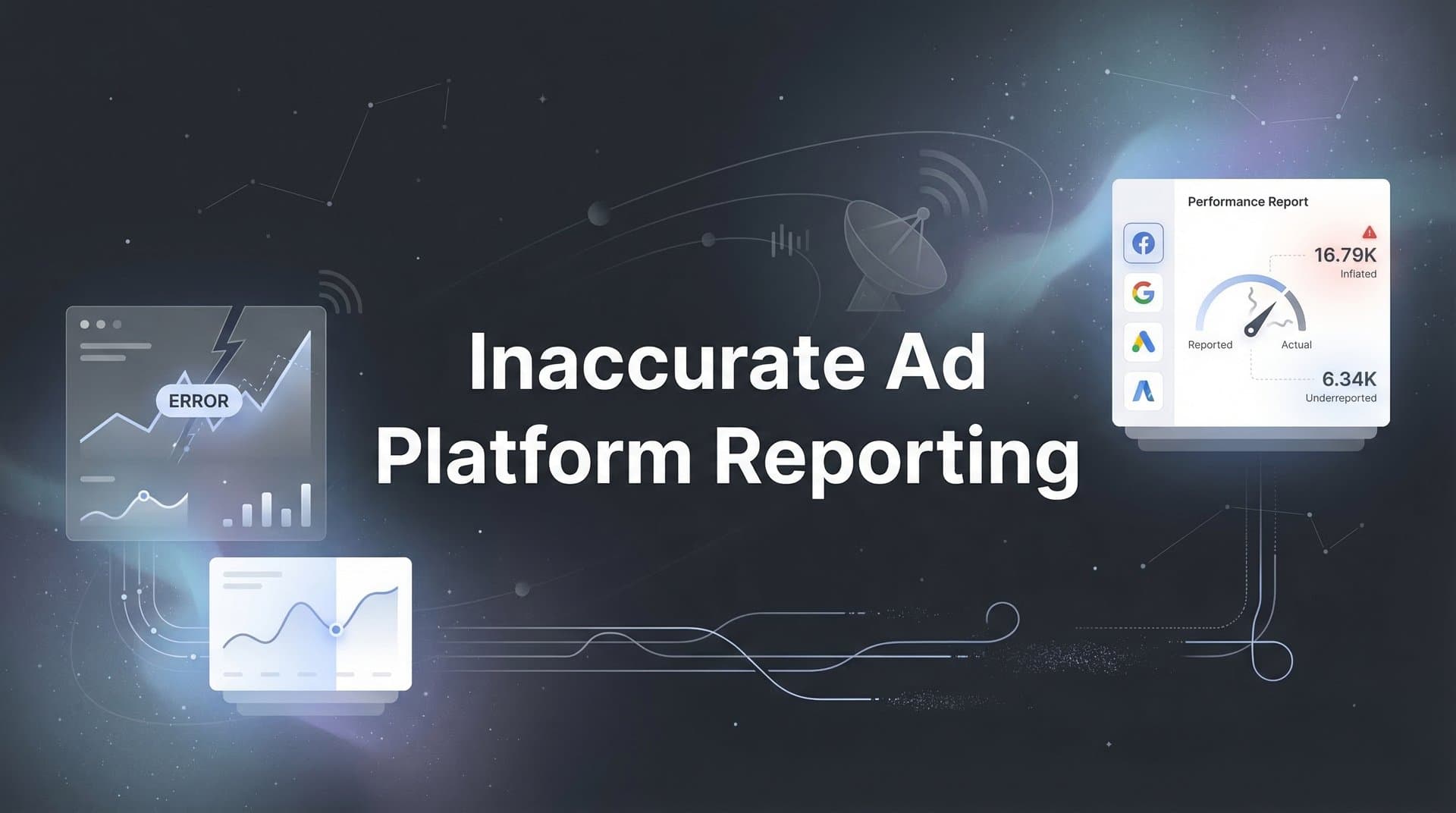
You check Facebook Ads Manager and see 50 conversions. Google Ads shows 40. TikTok claims 25. You feel good—until you open your CRM and count only 30 actual sales. The numbers don't add up. They never do.
This isn't a tracking glitch or a one-time error. It's the reality of modern digital advertising: every platform has its own version of the truth, and none of them match your bank account.
The problem runs deeper than simple miscounting. Each ad platform uses attribution models designed to make their performance look as strong as possible. They count conversions differently, use different time windows, and yes—they often claim credit for the same customer. The result? You're making budget decisions based on inflated metrics that don't reflect actual business outcomes.
This article breaks down exactly why ad platform reporting has become so unreliable, what it's costing you in wasted spend and missed opportunities, and how to build a measurement system that actually tells you the truth about what's driving revenue.
The Hidden Mechanics Behind Inflated Ad Metrics
Every ad platform operates as both player and referee. They run your ads, track the results, and report back on their own performance. The conflict of interest is obvious, but the specific mechanisms they use to inflate numbers are less visible.
Start with attribution windows. Meta counts conversions that happen up to 7 days after someone clicks your ad—or even views it without clicking. Google Ads uses similar windows but with different defaults. TikTok has its own rules. When someone sees your ad on three different platforms before buying, all three platforms can legitimately claim that conversion within their own attribution logic.
This creates systematic double-counting across your marketing stack. You're not dealing with three separate customer journeys—you're looking at one journey reported three different ways, with each platform taking full credit. Understanding multiple ad platforms attribution confusion is essential for any marketer trying to make sense of their data.
Then there's view-through attribution, where platforms count conversions from people who saw your ad but never clicked it. Someone scrolls past your sponsored post, then buys your product two days later after a Google search. Meta still counts it as a conversion because the person was "exposed" to your ad. The view might have influenced them, or they might have bought anyway—there's no way to know for certain.
The definition of "conversion" itself varies wildly. Some platforms count any click to your landing page. Others count page views, form submissions, or add-to-cart events. Unless you've configured conversion tracking identically across every platform—and most marketers haven't—you're comparing apples to oranges.
Here's where it gets expensive: platforms optimize toward the metrics they report. If Meta thinks it's driving 50 conversions when you're only seeing 30 sales, its algorithm will continue bidding aggressively on audiences that may not actually convert. You're training the machine learning on false positives.
The incentive structure guarantees this continues. No platform wants to report lower numbers than competitors. When every channel claims strong performance, marketers spread budgets across all of them—exactly what the platforms want. The one losing in this arrangement is you, making decisions on data that's systematically biased toward overreporting.
iOS Privacy Changes and the Data Gap They Created
Apple's App Tracking Transparency framework, launched with iOS 14.5 in 2021, fundamentally broke the measurement systems that digital advertising relied on for years. The change was simple: apps now had to ask permission before tracking users across other apps and websites. Most people said no.
Overnight, the advertising pixels that platforms embedded on your website lost visibility into huge portions of traffic. If someone uses an iPhone with iOS 14.5 or later and hasn't opted into tracking, Meta's pixel can't follow them from your Facebook ad to your checkout page. The conversion happens, but the platform can't see it.
The percentage of iOS users opting out of tracking is substantial. This means a large chunk of your actual conversions simply vanish from platform reporting. They're not miscounted—they're invisible. These ad platform tracking issues have become one of the biggest challenges facing digital marketers today.
Platforms responded by introducing "modeled conversions" and "estimated conversions." Instead of deterministic tracking that follows an actual user, they now use statistical modeling to estimate how many conversions probably happened based on patterns in the data they can still see. They're making educated guesses.
Think about what that means for your decision-making. You're looking at numbers that blend some real conversions with statistical estimates. You can't tell which conversions actually happened and which ones are projections. The confidence intervals on these estimates can be wide, but platforms don't surface that uncertainty in their dashboards.
Google Ads faced similar challenges. While Google has some advantages through its ownership of Chrome and Android, iOS changes still created significant blind spots in conversion tracking. The shift toward first-party data collection became urgent because third-party cookies and cross-site tracking were dying.
The practical impact shows up in campaign performance that suddenly became harder to measure. Retargeting campaigns lost effectiveness because platforms couldn't reliably identify who had visited your site. Conversion tracking became delayed—Meta now reports many conversions days after they actually happened, making real-time optimization nearly impossible.
Many marketers noticed their reported conversion rates dropped after iOS 14.5, even though actual sales stayed steady. The tracking got worse, not the performance. But if you're making decisions based on what platforms report, you might have killed winning campaigns because the data told you they stopped working.
Real-World Consequences of Trusting Flawed Data
Inaccurate reporting doesn't just create confusion—it directly costs you money and growth opportunities every single day.
The most common mistake is budget misallocation. You look at platform dashboards, see that Facebook is reporting a $30 cost per acquisition while Google shows $50, and naturally shift more budget to Facebook. But if Facebook is overcounting conversions by 40% while Google's reporting is more conservative, you're actually moving money away from your better-performing channel.
This happens constantly. Marketers scale campaigns based on inflated metrics, pouring budget into channels that look profitable in the dashboard but don't move the revenue needle. Meanwhile, truly effective campaigns get starved because they're not getting proper credit in platform reporting. When ad platforms show different numbers, the consequences for your budget decisions can be severe.
The opposite mistake is equally damaging: killing winners. A campaign drives significant revenue through an indirect path—maybe customers see your ad, don't click, but search for your brand later and convert. The ad created awareness that led to the sale, but the platform doesn't get credit. You see poor reported performance and pause the campaign, unknowingly cutting off a profitable acquisition channel.
Then there's the algorithmic feedback loop. Modern ad platforms use machine learning to optimize delivery. They need accurate conversion data to learn which audiences, placements, and creative variations actually work. When you feed them inflated or inaccurate conversion signals, you're training the AI on bad data.
The algorithm thinks it's doing great when it's actually wasting impressions on users who won't convert. It doubles down on tactics that generate platform-reported conversions but not real sales. Over time, this compounds—your campaigns drift further from actual performance as the machine learning optimizes toward the wrong goal. Learning how to improve ad platform algorithm performance starts with feeding better data into the system.
There's also the strategic cost of lost confidence. When you can't trust your data, you can't make bold decisions. You become tentative about scaling spend, testing new channels, or investing in upper-funnel awareness campaigns whose impact is hardest to measure. Your competitors who solve the measurement problem can move faster and more aggressively because they actually know what's working.
Perhaps most frustrating is the time wasted reconciling reports. Marketing teams spend hours every week trying to figure out why the numbers don't match, building spreadsheets to estimate "true" performance, and arguing about which platform's data to trust. That's time not spent on strategy, creative, or actual optimization.
Server-Side Tracking: The Foundation for Accurate Attribution
Server-side tracking represents a fundamental shift in how conversion data gets captured and reported. Instead of relying on pixels and cookies in someone's browser, you send conversion events directly from your server to ad platforms.
Here's why this matters: browser-based tracking fails constantly. Ad blockers remove pixels. Privacy settings block cookies. iOS restrictions prevent cross-site tracking. When someone converts on a different device than where they clicked your ad, pixels can't connect the dots. Server-side tracking bypasses all of these limitations.
The technical flow is straightforward. When someone completes a conversion on your site or in your app, your server records it with a unique identifier. That server then sends the conversion data directly to Meta, Google, and other platforms through their server-side APIs. No browser involvement means no browser-based failure points.
This approach captures conversions that pixels miss entirely. Someone clicks your ad on their phone but completes the purchase on their laptop three days later? Browser pixels lose that connection. Server-side tracking, when properly implemented with user identification, can maintain that thread across devices and sessions.
The real power comes from connecting ad clicks to actual business outcomes. Your server knows when someone becomes a paying customer, when they upgrade their subscription, or when they make a repeat purchase. You can send this verified revenue data back to ad platforms, giving them a complete picture of conversion value rather than just the initial transaction. This is what marketing attribution platforms revenue tracking enables at scale.
This is where first-party data collection becomes essential. You need to capture user identifiers—email addresses, customer IDs, phone numbers—with proper consent and match them to ad interactions. When someone who clicked your Meta ad eventually converts, you can definitively attribute that revenue to the correct source.
Server-side tracking also enables conversion sync, sometimes called offline conversion tracking. You send enriched conversion data back to platforms after the sale, including information like actual purchase amount, customer lifetime value predictions, or product categories. Proper ad platform data synchronization helps ad algorithms optimize toward your real business goals rather than proxy metrics.
The setup requires technical implementation. You need server-side tracking infrastructure, proper user identification systems, and integrations with your CRM or e-commerce platform. But the payoff is measurement that actually reflects reality—conversions counted once, attributed accurately, and tied to real revenue.
Platforms themselves now encourage server-side tracking. Meta's Conversions API and Google's Enhanced Conversions exist specifically to address the data loss from browser-based tracking. They know their pixels are unreliable, and they're providing server-side alternatives to help advertisers send better data.
Building a Single Source of Truth Across All Channels
The solution to conflicting platform reports isn't picking which one to trust—it's building an independent measurement system that sits above all your marketing channels.
Multi-touch attribution provides the framework. Instead of accepting each platform's self-serving attribution model, you track every touchpoint in the customer journey and apply consistent logic to credit conversions. Someone might see your YouTube ad, click a Facebook ad, search your brand on Google, and then convert. A multi-touch marketing attribution platform shows you this complete path.
Different attribution models weight these touchpoints differently. Linear attribution splits credit equally across all touches. Time-decay gives more credit to recent interactions. Position-based (U-shaped) emphasizes the first and last touch. Data-driven attribution uses machine learning to assign credit based on actual conversion patterns in your data.
The key insight is that no single model is "correct"—they're different lenses for understanding contribution. A channel might look weak in last-click attribution but strong in first-touch, revealing its role in awareness rather than conversion. Comparing models helps you understand what each channel actually does in your marketing ecosystem.
Unified analytics platforms consolidate data from all your marketing channels, your website, and your CRM into one database. This creates a single customer journey view that isn't biased toward any particular platform. A centralized marketing reporting platform ensures that when someone converts, you can see every ad they interacted with, every page they visited, and every email they opened—all in one timeline.
This reconciliation reveals the truth behind conflicting reports. You might discover that Facebook's 50 reported conversions include 20 that Google also claimed, plus 10 that were actually organic traffic. Your unified view shows 30 unique conversions with clear attribution to the touchpoints that actually influenced them.
The strategic advantage is making decisions based on contribution rather than claimed credit. You can identify channels that assist conversions even when they don't get the last click. You can spot diminishing returns earlier because you're measuring true incremental impact rather than inflated platform metrics.
Here's where measurement becomes optimization: when you feed accurate, enriched conversion data back to ad platforms, their algorithms get smarter. You're teaching them which users actually convert and what those conversions are worth. The machine learning optimizes toward real business outcomes instead of overcounted proxy metrics.
This creates a virtuous cycle. Better measurement leads to better optimization, which improves actual performance, which generates more accurate data to further refine your approach. Meanwhile, competitors relying on native platform reporting are optimizing toward inflated metrics that don't translate to revenue.
The technical foundation requires integration across your marketing stack. Your attribution platform needs to ingest data from all ad platforms, your website analytics, your CRM, and your transaction systems. Learning how to track cross platform ad performance effectively requires deduplicating conversions, matching users across devices, and maintaining data accuracy throughout the customer journey.
Moving Forward with Confidence
Inaccurate ad platform reporting isn't a minor inconvenience you can work around with spreadsheets and guesswork. It's a fundamental barrier to scaling profitably. Every budget decision made on flawed data compounds the problem—you waste money on channels that don't perform while starving the ones that actually drive revenue.
The marketers who win in this environment are the ones who stop accepting platform-reported metrics at face value. They build independent measurement systems that capture every touchpoint, track conversions accurately across devices and channels, and provide a single source of truth for decision-making.
This isn't about perfect attribution—that doesn't exist. It's about having data you can actually trust to be directionally correct and systematically unbiased. When you know which campaigns truly drive revenue, you can scale with confidence instead of hope.
The competitive advantage is real and growing. While most advertisers are still flying blind, trusting dashboards that systematically overreport performance, you can see the actual path to profitability. You can test aggressively, scale winners decisively, and cut losers quickly because your data reflects reality.
The foundation starts with server-side tracking to capture conversions that pixels miss, continues with unified analytics to reconcile conflicting reports, and culminates in feeding enriched conversion data back to platforms so their algorithms optimize toward your real business goals.
Cometly provides exactly this complete view. From capturing every touchpoint with server-side tracking to analyzing performance across attribution models to syncing enriched conversion data back to ad platforms, you get the accurate, unbiased measurement needed to scale profitably. When you can see which ads and channels actually drive revenue—not just which ones claim credit—you make better decisions every single day.
Ready to elevate your marketing game with precision and confidence? Discover how Cometly's AI-driven recommendations can transform your ad strategy—Get your free demo today and start capturing every touchpoint to maximize your conversions.



