If you run paid ads across Meta, Google, TikTok, or other platforms, you have likely noticed a growing gap between what your ad dashboards report and what actually happens in your business. Conversions seem lower than expected. ROAS looks off. Retargeting audiences feel smaller. And the campaigns you thought were performing well might not be telling the full story.
That gap is largely driven by iOS tracking limitations introduced with Apple's App Tracking Transparency framework, which started rolling out with iOS 14.5 in April 2021 and has only become more restrictive since. When users opt out of tracking, and the vast majority do when prompted, ad platforms lose visibility into conversions. Retargeting audiences shrink. The data feeding platform algorithms becomes incomplete. The result is underreported conversions, inaccurate ROAS, misallocated budgets, and ad platform AI that cannot optimize effectively because it is working with partial information.
The good news: these problems are fixable. You do not need to accept broken data as the new normal.
In this guide, you will walk through a clear, sequential process to diagnose where iOS tracking gaps are hurting your campaigns, implement server-side tracking infrastructure, restore accurate conversion data, and feed better signals back to ad platforms so their algorithms can do what they were designed to do.
Whether you are a solo media buyer or part of a larger marketing team managing six or seven figures in monthly ad spend, these steps will help you regain the attribution accuracy you need to scale with confidence. Let's get into it.
Step 1: Audit Your Current Tracking Gaps and Data Loss
Before you can fix anything, you need to understand exactly how much data you are losing and where. Many advertisers skip this step and jump straight to solutions, which means they have no baseline to measure improvement against. Do not make that mistake.
Start by pulling your conversion data from each ad platform dashboard over the last 30 to 90 days. Then compare those numbers directly against your CRM, your backend sales data, or your payment processor records for the same period. The difference between what your ad platforms claim and what your business actually recorded is your tracking gap. For most advertisers running significant Meta spend, this discrepancy can be substantial.
Compare platform data against backend data: Pull reported conversions from Meta Ads Manager, Google Ads, and any other active platforms. Then pull actual leads, sales, or revenue from your CRM or payment system. Calculate the difference as both a raw number and a percentage. This is your baseline. If you are wondering why your conversion tracking numbers are wrong, this audit will give you concrete answers.
Identify which platforms are most affected: Meta is typically hit hardest because it has historically relied on pixel-based, client-side tracking more heavily than other platforms. Google has somewhat more resilience due to its logged-in user ecosystem, but it is not immune. TikTok and other emerging platforms face similar challenges. Your audit should reveal which channels have the widest gaps.
Understand your ATT opt-out exposure: Think about what percentage of your audience is on iOS devices. If you are running direct-to-consumer campaigns in markets where iPhone penetration is high, your exposure to ATT opt-outs is significant. Users who opt out become effectively invisible to client-side pixels, meaning conversions they complete simply do not get reported. Understanding how iOS 14 changed digital advertising is essential context for this analysis.
Calculate your actual ROAS versus reported ROAS: Take your real revenue from backend data and divide it by your actual ad spend. Compare that to the ROAS your ad platforms are reporting. If reported ROAS is materially higher than actual ROAS, you are seeing the downstream effect of undercounted conversions inflating efficiency metrics.
Document all of these numbers carefully. They are your before snapshot. Every improvement you make in the following steps should move these numbers closer together. A common pitfall here is continuing to rely solely on platform dashboards without cross-referencing backend data. Platform dashboards will never show you what they cannot see. Your backend data always tells the truth.
Step 2: Implement Server-Side Tracking to Bypass Browser Restrictions
Here is the core problem with client-side tracking in a post-iOS world. When a user clicks your ad and lands on your website, a browser-based pixel fires a request from the user's browser to the ad platform's server. But if that user is on iOS and has opted out of tracking, or if they are using a privacy-focused browser, or if an ad blocker is running, that pixel request either never fires or gets blocked before it reaches its destination. The conversion disappears from your data entirely.
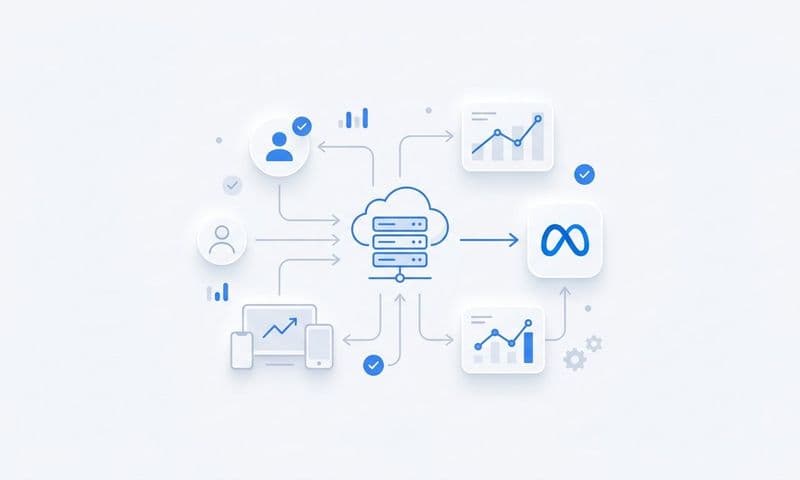
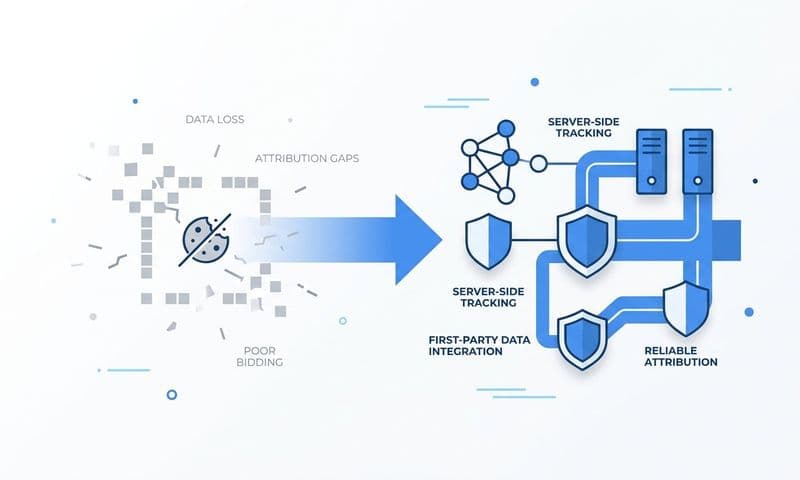
Server-side tracking solves this by moving the conversion signal off the user's device entirely. Instead of relying on the browser to send data, your own server sends the conversion event directly to the ad platform's server. The user's device and browser settings become irrelevant to the data transmission. This is why server-side tracking is more accurate and serves as the foundational fix for iOS tracking limitations.
Why client-side pixels are fundamentally broken: Browser-based pixels depend on the user's device, browser, and consent state to function. In an environment where privacy controls are tightening and opt-out rates are high, client-side tracking is structurally unreliable. It was designed for a different era of the web. You can learn more about the specific issues in our deep dive on pixel tracking problems on iOS.
Setting up server-side event tracking: The implementation involves creating a server-side endpoint that receives conversion events from your website or funnel, then forwards those events to your ad platforms using their server-to-server APIs. For Meta, this is the Conversions API. For Google, it is enhanced conversions. TikTok and other platforms have their own equivalents. Each requires configuration to pass the right event parameters and user matching data.
Key integrations you need: Your server-side tracking setup needs to connect three things. First, your website or funnel builder, so events like purchases, form submissions, and page views are captured at the server level. Second, your CRM, so lead and sales events that happen outside the browser are included. Third, your ad platforms, so the enriched events are delivered where they need to go.
What server-side tracking captures that pixels miss: Beyond iOS opt-outs, server-side tracking also captures conversions from users with ad blockers, users on privacy browsers, and users whose browser sessions timed out before the pixel fired. The coverage improvement is meaningful across all device types, not just iOS.
Cometly's server-side tracking infrastructure handles this setup and connects directly to Meta, Google, TikTok, and other platforms. Rather than building and maintaining custom server-side integrations for each ad platform separately, Cometly centralizes the infrastructure so your conversion data flows accurately from your server to every platform simultaneously. This significantly reduces implementation complexity and ongoing maintenance burden.
Step 3: Connect Your Full Customer Journey from Click to Revenue
Server-side tracking solves the data transmission problem, but there is a second challenge that iOS limitations have amplified: no single ad platform can see the complete customer journey on its own. A user might click a Meta ad, visit your site twice over the following week, open an email, join a sales call, and then convert. Meta sees the first click. Your email platform sees the open. Your sales team records the call. But none of them see the full picture.
This is where connecting your full customer journey becomes essential, and why multi-touch attribution matters more than ever in a post-iOS world. Effective touchpoint attribution tracking bridges the gaps that no single platform can fill on its own.
Map every touchpoint in your customer journey: Start by listing every interaction a customer has with your brand from first awareness to closed deal. This typically includes ad clicks, landing page visits, form submissions, email engagement, retargeting ad impressions, sales calls, demos, and final purchase. Each of these is a data point that should be captured and attributed.
Integrate your CRM and payment systems: Many high-value conversions, especially in B2B or higher-ticket B2C contexts, do not happen immediately after an ad click. They happen days or weeks later, often through channels that ad platforms cannot see. By integrating your CRM and payment processor into your attribution layer, you can capture these delayed and offline conversions and connect them back to the original ad interaction that started the journey.
Why multi-touch attribution matters now: When individual platforms cannot see the full picture due to iOS restrictions, relying on any single platform's attribution model means you are making budget decisions based on a partial view. Multi-touch attribution reconstructs the complete path from first click to revenue by pulling data from all sources into a unified view. This reveals which campaigns and channels are contributing at each stage of the funnel, not just the last touchpoint before conversion.
Revealing what actually drives revenue: One of the most common discoveries when marketers implement full journey tracking is that campaigns they had been undervaluing were actually playing a critical role in driving conversions. A top-of-funnel awareness campaign might not get credit for direct conversions, but it might be the first touch for a large percentage of your highest-value customers. Dedicated revenue attribution tracking tools make these insights visible.
Many high-value conversions happen days or weeks after the initial click. Without full journey tracking connected across your ad platforms, CRM, and payment systems, those conversions either go unattributed or get credited to the wrong channel entirely. Getting this right is what separates accurate attribution from educated guessing.
Step 4: Sync Enriched Conversion Data Back to Ad Platforms
Here is a piece of the puzzle that many advertisers overlook. Fixing your internal attribution data is valuable, but if you stop there, you are only solving half the problem. The other half is feeding better conversion signals back to the ad platforms themselves so their algorithms can optimize more effectively.
Ad platforms like Meta and Google use conversion data to power their bidding algorithms, build lookalike audiences, and determine which users to target with your ads. When iOS limitations reduce the quality and quantity of conversion signals those platforms receive, their algorithms become less effective. They are essentially flying partially blind. Conversion sync, also known as the Conversions API or CAPI, is how you restore their vision.
What conversion sync actually does: Instead of relying on the ad platform's pixel to capture conversions on the user's device, you send enriched conversion events from your server directly to the platform's API. These events include richer data than a pixel typically captures: hashed customer information, purchase values, product details, and customer lifetime data. The platform uses this to improve matching, attribution, and optimization. Understanding the difference between server-side tracking vs pixel tracking is key to appreciating why this approach works.
Setting up Meta's Conversions API: Meta CAPI allows you to send server-side events that supplement or replace pixel events. When properly configured, CAPI events can match to Meta users even when the pixel could not fire, recovering conversions that would otherwise be lost. The key is sending events with as much matching data as possible, including hashed email addresses, phone numbers, and other first-party identifiers that help Meta connect the event to a specific user.
Google enhanced conversions: Google's version of this concept works similarly, allowing you to send hashed first-party customer data alongside conversion events. This improves Google's ability to match conversions to users across devices and sessions, which is particularly valuable when third-party cookie signals are unavailable.
Why this directly addresses iOS limitations: When a user opts out of ATT on iOS, Meta's pixel loses the ability to track that user across apps and websites. But if you send a server-side conversion event with a hashed email address that matches a user in Meta's database, Meta can still attribute that conversion to the right campaign. You are restoring the signal through first-party data tracking rather than device-level tracking.
The algorithmic benefit: Better conversion signals mean better lookalike audiences, because the platform has more accurate data about who is actually converting. Better bidding decisions, because the algorithm has more complete conversion data to optimize against. And better targeting overall, because the system understands your actual customer more accurately.
Cometly's Conversion Sync feature automates this process across all connected ad platforms simultaneously. Rather than manually configuring CAPI for Meta, enhanced conversions for Google, and equivalent setups for TikTok and other platforms separately, Cometly handles the event routing and enrichment in one place. This ensures your conversion signals are consistently accurate across every platform where you are spending.
Step 5: Validate Your Data and Compare Attribution Models
You have implemented server-side tracking, connected your full customer journey, and synced enriched conversions back to your ad platforms. Now comes the critical step that most advertisers rush past: validation. Before you make any budget decisions based on your new data, you need to confirm that the data is actually accurate.
Start by running a side-by-side comparison across three data sources: your new server-side attribution data, your ad platform reported data, and your CRM or backend revenue data. These three numbers will not be identical, and they should not be. Each source has a different view of the customer journey. But they should be reasonably close, and the gaps between them should be explainable.
What to look for in your validation: Your attributed revenue from your attribution platform should closely match your actual backend revenue. If there is still a significant gap, investigate whether all conversion events are firing correctly, whether your CRM integration is capturing all closed deals, and whether there are any event deduplication issues between your pixel events and your server-side events. Understanding common tracking pixel limitations from privacy updates helps you identify where residual gaps originate.
Exploring attribution models: This is also the right moment to explore different attribution models and understand what each reveals. First-touch attribution gives full credit to the first ad interaction, which is useful for understanding what drives initial awareness. Last-touch attribution credits the final interaction before conversion, which reflects what closes the deal. Multi-touch models distribute credit across all interactions, which gives you the most complete view of channel contribution.
In a post-iOS world, multi-touch attribution is particularly valuable because it accounts for the reality that customers interact with multiple touchpoints before converting, and that no single platform can see all of those touchpoints on its own.
Discovering previously undervalued campaigns: One of the most valuable outcomes of this validation step is identifying campaigns that were being undervalued due to iOS data loss. A campaign that appeared to have poor ROAS in your platform dashboard might show much stronger performance in your server-side attribution data once the missing conversions are accounted for. These discoveries directly inform your budget decisions in the next step.
Setting up ongoing monitoring: Data accuracy is not a one-time achievement. Privacy policies continue to evolve, platforms update their APIs, and your own tech stack changes over time. Build a regular monitoring cadence, whether weekly or monthly, where you cross-reference your attribution data against backend revenue to catch any degradation early. Investing in real-time attribution tracking makes this ongoing validation far more efficient. The success indicator here is straightforward: your attributed revenue should closely match your actual backend revenue with minimal and explainable discrepancy.
Step 6: Reallocate Budget Based on Accurate Performance Data
This is where the work you have done in the previous five steps pays off in the most tangible way: smarter budget decisions based on data you can actually trust.
Before you fixed your tracking, your budget allocation was based on what your ad platforms could see, which was an incomplete picture distorted by iOS limitations. Some campaigns appeared more effective than they were because they happened to convert users who were still trackable. Others appeared weaker than they were because many of their conversions were invisible to platform pixels. Now you have the full picture.
Identify your true top performers: Look at your corrected attribution data and rank your campaigns, ad sets, and creatives by actual revenue contribution, not just platform-reported ROAS. You may find that the ranking looks different from what you expected. Some campaigns that seemed like underperformers may now show strong performance once their previously invisible conversions are counted. Understanding why your ad tracking was inaccurate in the first place helps contextualize these shifts.
Shift budget away from inflated performers: Conversely, some campaigns that appeared highly efficient in your platform dashboards may look less impressive once the attribution is accurate. If a campaign was benefiting from inflated ROAS due to misattributed or double-counted conversions, your corrected data will reveal that. Reallocating budget away from these toward genuinely high-performing campaigns is where you recapture efficiency.
Scale what is actually working: Once you have identified your true top performers, scale them with confidence. The key word is confidence. When your attribution data is accurate and validated against backend revenue, scaling decisions are grounded in reality rather than optimism. You know what is driving revenue, and you can invest more in it.
Use AI-powered recommendations to accelerate optimization: Platforms like Cometly use AI to surface optimization opportunities across your campaigns that human analysis might miss, including identifying high-performing ad combinations, flagging underperforming spend, and recommending budget shifts based on real performance signals. This turns your accurate data into actionable intelligence at scale.
Treat this as a continuous optimization loop, not a one-time fix. iOS and privacy changes will keep evolving. New platforms will emerge. Your customer journey will shift. The discipline of regularly auditing your attribution data, validating it against backend revenue, and reallocating budget based on accurate performance is what separates advertisers who scale sustainably from those who are constantly reacting to surprises.
Putting It All Together: Your iOS Tracking Fix in Action
Fixing iOS tracking limitations is not a single toggle or setting change. It requires a systematic approach, and now you have the complete playbook to execute it.
Here is your quick-reference checklist for everything covered in this guide:
1. Audit platform versus backend conversion discrepancies to quantify your tracking gap and establish a baseline.
2. Set up server-side tracking infrastructure to capture conversions that client-side pixels miss entirely.
3. Connect CRM and payment data for full customer journey visibility from first click to closed revenue.
4. Sync enriched conversion events back to Meta, Google, and other platforms to restore the signal quality their algorithms need to optimize effectively.
5. Validate attribution accuracy across models and confirm your attributed revenue aligns with actual backend revenue.
6. Reallocate spend based on real performance data and treat optimization as an ongoing loop, not a one-time project.
Cometly is built to handle every step of this process in one platform, from server-side tracking and multi-touch attribution to AI-powered optimization recommendations and automated conversion sync across Meta, Google, TikTok, and more. If you are ready to stop guessing and start scaling based on data you can trust, Get your free demo today and start capturing every touchpoint to maximize your conversions.