You are spending thousands on ads, your campaigns are generating clicks, and your landing pages look great. But when you check your conversion reports, the numbers feel off. Conversions reported by your ad platforms do not match what your CRM shows. Revenue in your analytics dashboard does not line up with actual sales.
Sound familiar? Lost conversions from tracking failures are one of the most expensive and most overlooked problems in digital advertising. Every conversion your system fails to capture is a data point your ad platform never sees. That means the algorithms optimizing your campaigns are working with incomplete information, leading to poor targeting, wasted budget, and scaling decisions built on flawed data.
The forces working against accurate tracking have grown significantly in recent years. Apple's App Tracking Transparency framework limits cross-app tracking on iOS devices. Safari's Intelligent Tracking Prevention shortens cookie lifespans dramatically. Firefox and Brave block third-party cookies by default. Ad blockers are in widespread use across desktop and mobile. The result is a tracking environment where browser-based pixels alone simply cannot capture the full picture of what your campaigns are driving.
The good news is that most lost conversions are recoverable once you know where to look and what to fix. This guide walks you through a practical, step-by-step process to audit your tracking setup, identify exactly where conversions are falling through the cracks, and implement fixes that ensure every touchpoint and every sale gets captured accurately.
Whether you are running campaigns on Meta, Google, TikTok, or multiple platforms at once, these steps will help you reclaim the data you are losing and start making decisions based on what is actually happening in your funnel.
Step 1: Audit the Gap Between Platform-Reported and Actual Conversions
Before you can fix anything, you need to understand the size of the problem. Most marketers have a vague sense that their tracking is imperfect, but they have never actually quantified how large the discrepancy is. That changes here.
Start by pulling conversion data from each ad platform you are running: Meta Ads Manager, Google Ads, TikTok Ads, or wherever your budget is allocated. Export the conversion numbers for a specific time period, ideally the last 30 to 90 days, so you have a meaningful sample size.
Then pull the actual conversion data from your source of truth. This is typically your CRM, your payment processor like Stripe, or your order management system. Use the same time period and the same conversion definition. If your ad platforms are counting "purchases," you want to count purchases in your payment system, not leads or form fills.
Now calculate your discrepancy rate. If your CRM shows 200 sales and your combined ad platforms are reporting 140 attributed conversions, you are looking at a significant gap. Keep in mind that attribution overlap between platforms is expected since multiple platforms may claim credit for the same conversion. What you are looking for here is whether the platforms are collectively undercounting, which signals a tracking problem rather than an attribution overlap issue. Understanding why conversion tracking numbers are wrong is the first step toward fixing them.
Document your findings by platform and by campaign. Some platforms may show larger gaps than others. Some campaign types, particularly those targeting mobile users or audiences more likely to use privacy-focused browsers, tend to show more severe undercounting. This documentation tells you where to focus your investigation first.
Watch for these warning signs: A sudden drop in reported conversions without any corresponding change in spend, creative, or landing pages is a classic signal of a tracking failure. Conversions appearing in your CRM that no ad platform takes credit for suggest the pixel is missing touchpoints. Revenue numbers that consistently run below what your payment processor reports point to systematic undercounting rather than random noise.
Once you have a clear picture of the gap, you have a baseline to measure your recovery against. Every step that follows will help you close that gap.
Step 2: Diagnose the Root Causes Behind Your Missing Data
Knowing there is a gap is step one. Understanding why the gap exists is where the real diagnostic work happens. There are several distinct failure modes that contribute to lost conversions from tracking, and they often occur simultaneously.
Browser-side tracking restrictions: This is the most pervasive category. Apple's ATT framework requires explicit user permission for cross-app tracking on iOS, and the majority of users opt out. Safari's Intelligent Tracking Prevention limits certain tracking cookies to as little as 24 hours. Firefox and Brave block third-party cookies by default. Ad blockers, which are widely used across desktop and mobile, frequently prevent tracking pixels from loading at all. The net effect is that a meaningful portion of your conversions are simply invisible to browser-based pixels. For a deeper look at how iOS changes affect your data, see this guide on tracking conversions after the iOS update.
Cross-device and cross-session blindspots: Think about how your customers actually behave. A user sees your ad on their phone during their commute, clicks through, browses your site, but does not convert. Three days later, they return on their laptop through a Google search and complete the purchase. Your pixel may capture the final conversion but has lost the connection to the original ad click. The campaign that drove the purchase gets no credit.
UTM parameter and redirect breakdowns: UTM parameters are fragile. They get stripped by certain email clients, link shorteners, and social platforms. Some CMS redirects drop query strings entirely. When this happens, conversions that originated from paid campaigns appear in your analytics as direct or organic traffic. You are not losing the conversion itself, but you are losing the attribution, which is just as damaging for optimization purposes. Following UTM parameter tracking best practices can help prevent these breakdowns.
Pixel misconfiguration: This category is more common than most teams realize. Duplicate pixel firing inflates numbers on some events while missing others entirely. Pixels placed incorrectly may load after a user has already navigated away from the confirmation page. Key conversion events like thank you pages, checkout completions, or subscription confirmations may simply not have a pixel trigger set up at all.
To verify what is actually firing, use your browser's developer tools. Open the Network tab and filter for requests to your tracking domains while walking through your conversion flow. You can also use Google Tag Manager's preview mode or the Meta Pixel Helper browser extension to see which tags fire on which pages and whether they are sending the correct event data.
Map out every failure point you find. This diagnostic step is what makes your fixes targeted and effective rather than guesswork.
Step 3: Implement Server-Side Tracking to Close the Biggest Gaps
If there is one single change that will recover more lost conversions than anything else, it is implementing server-side tracking. Everything you diagnosed in the previous step, browser restrictions, ad blockers, cookie limitations, becomes significantly less of a problem when you move conversion data off the browser and onto your server.
Here is the core concept. Traditional pixel-based tracking relies on the user's browser to execute JavaScript and send a signal to the ad platform. If the browser blocks that script, the conversion disappears. Server-side tracking removes the browser from the equation entirely. When a conversion occurs, your server captures the event and sends it directly to the ad platform via API. The user's browser settings, ad blocker status, and cookie preferences are irrelevant. Learn more about why server-side tracking is more accurate for modern attribution.
Meta's version is called the Conversions API (CAPI). Google has its Enhanced Conversions and Google Ads API. TikTok has its Events API. These are the channels through which server-side conversion data flows directly from your infrastructure to the ad platform, bypassing all client-side limitations.
An important clarification: server-side tracking should run alongside your existing pixel, not replace it. The pixel still captures what it can from browsers where it is allowed to fire. The server-side layer captures everything else. Together, they provide redundancy that ensures conversions are recorded regardless of how any individual user's browser behaves. For a detailed comparison, read about server-side tracking vs pixel tracking and how they complement each other.
Cometly's server-side tracking is built specifically for this purpose. It connects your ad platforms, CRM, and website to capture every touchpoint without depending on browser-based methods. Rather than manually configuring API connections for each platform separately, Cometly handles the data pipeline so that conversion events flow accurately from your server to wherever they need to go.
To verify your server-side setup is working, compare your conversion counts before and after implementation over a comparable time period. You should see an increase in reported conversions as previously invisible events get captured. If your discrepancy rate from Step 1 was significant, you should see meaningful convergence between your platform-reported numbers and your CRM data after server-side tracking is in place.
Step 4: Connect Your CRM and Payment Data to Your Attribution System
Server-side tracking solves the problem of conversions that go uncaptured at the browser level. But there is another category of lost conversions that requires a different fix: conversions that happen days or weeks after the initial ad click, deep inside your sales process.
This is especially relevant for B2B companies and high-value B2C sales. A lead fills out a form on your landing page. Your pixel captures that form fill and reports it as a conversion. But the actual revenue does not materialize until the lead is qualified, goes through a sales process, and closes as a customer three weeks later. From your ad platform's perspective, the story ends at the form fill. The revenue event is invisible. Using revenue attribution tracking tools ensures these downstream events get properly connected.
To fix this, you need to connect your CRM and payment processor to your attribution system so that downstream revenue events get tied back to the original ad click that started the journey.
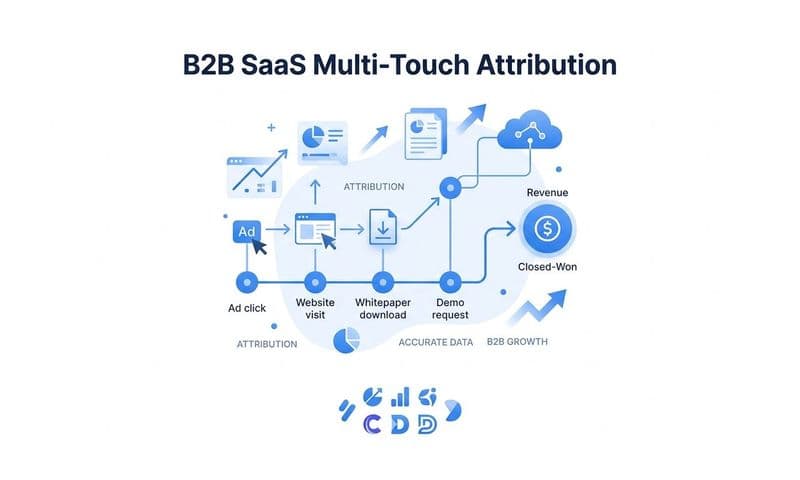
Start by mapping your full funnel explicitly: ad click to lead capture to qualification to opportunity to closed sale. Identify which stages represent meaningful conversion events and which ones you want to track and attribute. Not every stage needs to be reported back to your ad platforms, but the ones that represent actual revenue should be.
Connect your CRM, whether that is HubSpot, Salesforce, or another platform, so that when a deal closes, that event carries the attribution data from the original lead source. Connect your payment processor like Stripe so that actual revenue events are tied to specific campaigns and channels rather than sitting in isolation. This approach is critical for tracking attribution for lead generation funnels with longer sales cycles.
Cometly integrates with tools like Stripe and major CRM platforms to do exactly this. Every conversion event, from the first ad click through to closed revenue, gets connected and attributed correctly. You can see not just which campaigns are generating leads, but which ones are generating customers and revenue.
Test your integration by running a known conversion through your full pipeline. Create a test lead, move it through your CRM stages, and verify that the final revenue event appears correctly attributed in your dashboard. If the attribution is correct end-to-end, your setup is working.
Step 5: Sync Recovered Conversion Data Back to Your Ad Platforms
Recovering accurate conversion data for your own reporting is valuable. But if you stop there, you are leaving half the benefit on the table. The algorithms running your ad campaigns, Meta's Advantage+, Google's Smart Bidding, and similar systems, optimize based on the conversion signals they receive. Feed them incomplete data and they optimize toward an incomplete picture of success.
This is why syncing your recovered conversion data back to the ad platforms matters as much as capturing it in the first place. When your platforms receive enriched, accurate conversion data, including downstream revenue events that were previously invisible to them, their optimization improves. Lookalike audiences become sharper because they are built on actual buyers rather than just form fillers. Bidding strategies become more accurate because the algorithms understand which clicks are actually generating revenue. The entire feedback loop tightens.
Meta supports this through offline conversions and CAPI event matching. Google supports it through Enhanced Conversions and offline conversion imports. These mechanisms allow you to push conversion data that was captured outside the browser, or captured after a significant delay, back into the platform so it informs campaign optimization. You can learn more about how to track offline conversions from online ads to maximize this approach.
Doing this manually is possible but time-consuming. You would need to export conversion data, format it correctly for each platform's requirements, and upload it on a regular schedule. Any delays in that process mean the algorithms are still working with stale or incomplete data.
Cometly's Conversion Sync feature handles this automatically. It takes the enriched conversion events captured through your server-side tracking and CRM integrations and feeds them back to Meta, Google, and other platforms in real time. No manual exports, no formatting headaches, and no delays. The platforms receive accurate data continuously, which means their optimization is always working from the most complete picture available.
After enabling conversion sync, monitor your platform-reported metrics over the following one to two weeks. You should see convergence between what the platforms report and what your CRM shows, along with improvements in campaign performance as the algorithms recalibrate based on better data.
Step 6: Build an Ongoing Monitoring System to Prevent Future Tracking Loss
Tracking is not something you fix once and forget. Websites change. Platforms update their policies. New privacy regulations emerge. Tag management configurations drift. Any of these can silently break your tracking, and if you are not actively monitoring, you may not notice for weeks.
Set up a regular tracking health check, weekly or biweekly depending on your ad spend volume. The core of this check is simple: compare your ad platform conversions against your CRM or payment processor data for the same period and flag any discrepancy that exceeds your defined acceptable threshold. What counts as acceptable will depend on your business, but any sudden widening of the gap deserves immediate investigation.
Create alerts for sudden conversion drops. If your reported conversions fall significantly without a corresponding change in budget, creative, or audience, that is a tracking failure signal, not a performance problem. Set up monitoring that flags these drops automatically so you can investigate before the issue compounds over days or weeks.
Maintain a tracking change log. Every pixel update, tag modification, new landing page launch, or platform policy change should be documented with a date. When conversions drop unexpectedly, this log is what allows you to quickly identify what changed and when. Without it, debugging becomes a time-consuming process of elimination.
Review tracking after every major website update. New page layouts, CMS migrations, checkout flow changes, and A/B test implementations are all common moments when tracking breaks. Build a post-deployment tracking verification step into your standard process so issues get caught immediately rather than days later.
Finally, use touchpoint tracking analytics as a validation layer. If conversions are being captured correctly across the full customer journey, your attribution reports should show a coherent picture of how different channels contribute at different stages. Gaps or anomalies in that picture often signal tracking problems worth investigating.
Putting It All Together
Recovering lost conversions from tracking gaps is not a one-time fix. It is an ongoing discipline that directly impacts how well your ad platforms optimize and how confidently you can scale your campaigns.
Here is a quick checklist to keep you on track:
1. Audit platform versus CRM conversion discrepancies to quantify your tracking gap.
2. Diagnose root causes including browser restrictions, pixel misconfigurations, and cross-device blindspots.
3. Implement server-side tracking to bypass the most common points of failure.
4. Connect your CRM and payment data so revenue-level conversions are captured and attributed correctly.
5. Sync enriched conversion data back to ad platforms so their algorithms can optimize on accurate information.
6. Monitor your tracking health on a regular cadence to catch new issues before they compound.
Every conversion you recover is not just a number on a dashboard. It is better data flowing into your ad platform algorithms, sharper targeting, smarter budget allocation, and more confident scaling decisions.
Platforms like Cometly are built to handle this entire pipeline, from capturing every touchpoint with server-side tracking to connecting your CRM and payment data to syncing accurate conversion events back to your ad channels. The result is a complete, accurate picture of what your campaigns are actually driving, so you can focus on growing your results instead of troubleshooting your tracking.
Ready to elevate your marketing game with precision and confidence? Discover how Cometly's AI-driven recommendations can transform your ad strategy. Get your free demo today and start capturing every touchpoint to maximize your conversions.