You run ads across five channels. A lead converts after six touchpoints spread over three weeks. And your attribution model hands all the credit to the last click before the form fill. Sound familiar? It's one of the most common and costly blind spots in B2B SaaS marketing, and it's not a reporting problem. It's a structural flaw in how traditional attribution models work.
Rule-based attribution was designed for simpler buying journeys. When a prospect visits your site once and converts, last-click makes sense. But modern B2B buyers don't behave that way. They discover you through a LinkedIn ad, search your brand name a week later, click a retargeting banner, read a case study, and finally book a demo after a direct visit. Assigning all the credit to that final touchpoint tells you almost nothing useful about what actually drove the decision.
Machine learning attribution changes the equation. Instead of applying fixed rules to assign credit, it analyzes patterns across thousands of real conversion paths and uses statistical modeling to determine how much each touchpoint actually contributed to the outcome. The result is a dynamic, data-driven view of your marketing that reflects how buyers actually behave, not how a predetermined formula assumes they do. This article breaks down what machine learning attribution is, how it works, what it requires to function well, and how to translate its outputs into smarter budget decisions.
Why Rule-Based Attribution Models Break Down in Complex Buying Journeys
Traditional attribution models operate on a simple premise: apply a fixed rule to every conversion path and distribute credit accordingly. Last-click gives 100% of the credit to the final touchpoint. First-touch gives it all to the first. Linear spreads it evenly. Time-decay weights recent interactions more heavily. Each of these models has a certain logic to it, but they share a fundamental problem: the rule is set before any data is analyzed.
In a B2B SaaS context, that's a serious limitation. The average B2B buying cycle can span weeks or months, involve multiple stakeholders, and include a wide range of touchpoints across paid, organic, and direct channels. A prospect might first encounter your brand through a LinkedIn sponsored post, then find you again via a branded Google search, engage with a retargeting ad on Meta, download a whitepaper from organic search, and finally convert after a direct visit following a sales email. No single rule-based model captures which of those interactions genuinely moved the needle.
The consequences are predictable. Last-click attribution consistently over-credits bottom-of-funnel channels like branded search and direct, because those are where buyers tend to land right before converting. Meanwhile, the upper-funnel channels that built awareness and intent, like that initial LinkedIn ad or the organic content that educated the prospect, receive little or no credit. Marketers reading these reports naturally shift budget toward what appears to be converting, which often means pulling investment from the very channels that were doing the heavy lifting earlier in the journey.
First-touch attribution creates the opposite distortion. It rewards the channel that made first contact but ignores everything that happened in between, including the touchpoints that may have been most influential in moving a prospect from awareness to serious consideration.
Linear and time-decay models are improvements in that they spread credit across the path, but they still rely on assumptions rather than evidence. The linear attribution model treats every touchpoint as equally important regardless of its actual influence. Time-decay assumes recency equals relevance, which may or may not be true for any given campaign or audience segment.
The real cost of these blind spots is not just inaccurate reporting. It's systematic misallocation of budget over time, where channels that initiate and accelerate pipeline are consistently underfunded while channels that simply appear at conversion receive more than their share of investment.
What Machine Learning Attribution Actually Does
Machine learning attribution takes a fundamentally different approach. Rather than starting with a rule, it starts with data. Specifically, it analyzes historical conversion paths to identify which touchpoints, in which combinations, are most associated with conversion outcomes. The credit weights are derived from observed patterns, not predetermined by the marketer.
The core mechanism works by comparing conversion paths that include a given touchpoint against paths that do not. If prospects who engaged with your LinkedIn ads converted at a meaningfully higher rate than those who didn't, the model assigns positive credit to that channel. If a touchpoint appears frequently on both converting and non-converting paths, its incremental contribution is lower. This comparison logic allows the model to isolate what each channel or ad actually adds to conversion probability rather than just noting its presence in the path.
Several algorithmic approaches are commonly used in ML attribution. Shapley value models, borrowed from cooperative game theory, distribute credit by evaluating every possible combination of touchpoints in a conversion path and calculating each touchpoint's average marginal contribution across all those combinations. This approach is particularly fair in the sense that it accounts for interaction effects between channels, recognizing that some touchpoints are more valuable in combination than in isolation.
Markov chain models take a different approach. They map the transition probabilities between touchpoints and estimate each channel's contribution by simulating what happens when that channel is removed from the conversion path entirely. If removing LinkedIn from the model causes conversion rates to drop significantly, LinkedIn receives substantial credit. This removal effect logic is intuitive and closely related to the concept of incrementality.
Logistic regression-based approaches train a model on features of the conversion path, such as channel sequence, time between touchpoints, and number of interactions, to predict conversion probability. The model's learned coefficients then inform how credit is distributed.
What separates ML attribution from rule-based models is that it updates dynamically. As new conversion data comes in, the credit weights shift to reflect evolving buyer behavior and campaign performance. A channel that was highly influential six months ago may be less so today if your audience or messaging has changed. ML attribution captures that evolution in a way that static rules never can.
The practical output is fractional credit assignment across all touchpoints in a conversion path, giving marketers a more accurate picture of which channels and ads are genuinely contributing to pipeline and revenue rather than just appearing in the data.
The Data Requirements That Make or Break ML Attribution
Machine learning attribution is only as accurate as the data it trains on. This is not a minor caveat. It's the central constraint that determines whether your attribution model produces actionable insights or confidently wrong conclusions.
The first requirement is completeness. If your tracking misses touchpoints, the model will assign credit across an incomplete picture of the buyer journey. A prospect who clicked a LinkedIn ad that wasn't tracked, then converted via a form, will look like a direct conversion in your data. The model can only work with what it sees, and gaps in touchpoint data will systematically distort credit assignment in ways that are difficult to detect.
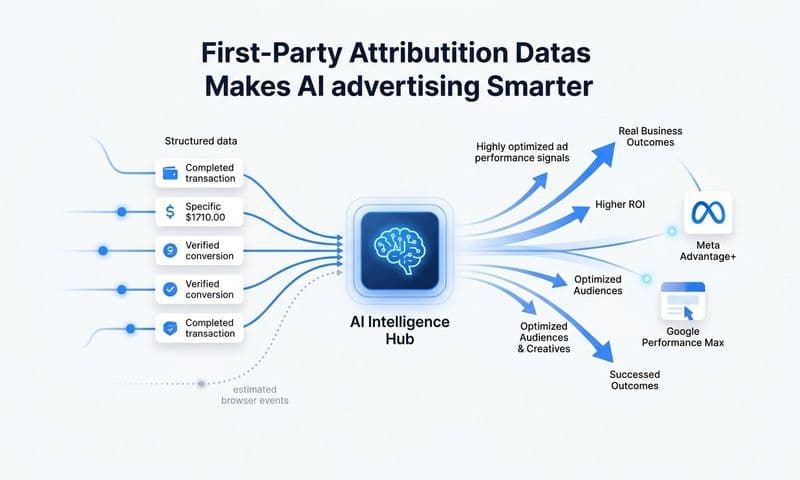
This is where first-party data quality becomes critical. Browser-based tracking has become increasingly unreliable due to ad blockers, third-party cookie restrictions, and privacy-related changes across major browsers. Pixels that fire inconsistently or get blocked entirely create exactly the kind of data gaps that undermine ML attribution accuracy. Server-side tracking and Conversion API integrations address this by capturing conversion events directly from your server rather than relying on the browser, producing more complete and accurate signals that the attribution model can actually trust.
For B2B SaaS companies, this also means connecting downstream CRM events to your attribution data. A lead converting on a form is not the end of the story. What matters is whether that lead became a qualified opportunity, moved through the pipeline, and eventually closed as revenue. If your attribution model only sees form fills and not pipeline stage progressions or closed-won events, it's optimizing for the wrong outcome. Connecting CRM data to ad platform signals gives the model the full picture of what a conversion is actually worth.
Volume is the second major constraint. ML models need sufficient conversion events to identify statistically meaningful patterns. If a campaign generates only a handful of conversions per month, there isn't enough data for the model to reliably distinguish signal from noise. In these situations, relying exclusively on ML attribution can lead to overcorrection based on thin data. Lower-volume campaigns often benefit from combining ML attribution outputs with other measurement approaches, such as incrementality testing or media mix modeling, to triangulate a more reliable view of performance.
The practical implication is that investing in data infrastructure is not separate from investing in attribution. It's the prerequisite. Better tracking coverage, server-side event capture, and CRM integration directly improve the quality of ML attribution outputs and, by extension, the quality of the budget decisions those outputs inform.
Cross-Channel ML Attribution vs. Platform-Native Data-Driven Models
Google Ads and Meta both offer versions of data-driven attribution within their respective platforms. These models use machine learning to distribute credit across touchpoints within each platform's ecosystem, and they're a meaningful improvement over last-click within those walled gardens. But they have a structural limitation that's important to understand before relying on them for cross-channel decisions.
Platform-native attribution models only see what happens inside their own ecosystem. Google's data-driven attribution can analyze the contribution of different Google Ads touchpoints relative to each other, but it has no visibility into the LinkedIn ad a prospect clicked two weeks earlier, the organic blog post they read, or the email that brought them back to your site. From Google's model, those touchpoints don't exist. The result is that every platform-native model will, by design, overstate its own contribution to conversion because it's the only channel in its own data set.
True cross-channel machine learning attribution operates across all channels simultaneously. It ingests data from paid social, paid search, organic, email, direct, and any other touchpoint source, then runs the attribution model across the complete picture. This unified view reveals something that platform-native models are structurally incapable of showing: how channels interact with and influence each other.
These interaction effects matter significantly for B2B SaaS companies running coordinated multi-channel campaigns. A LinkedIn ad may not drive direct conversions at a rate that looks impressive in isolation, but it may substantially increase the conversion rate of subsequent Google search clicks by building brand familiarity and intent. Cross-channel ML attribution can detect this halo effect. Platform-native models cannot, because they don't have access to the other channel's data.
This distinction has real budget implications. If you're relying on Google's attribution to evaluate Google's performance and Meta's attribution to evaluate Meta's performance, you're essentially asking each channel to grade its own homework. Cross-channel attribution provides the independent, unified view needed to make genuinely informed decisions about where to invest across your full marketing mix.
Applying ML Attribution Insights to Campaign Budget and Strategy
Accurate credit assignment is not the end goal. It's the input to better decisions. The real value of machine learning attribution is what it enables you to do differently with your budget and strategy once you have a more accurate picture of channel contribution.
The most direct application is budget reallocation. When ML attribution reveals that a channel you've been under-investing in, perhaps LinkedIn or a specific content campaign, is consistently appearing in the conversion paths of your best customers and contributing meaningful incremental lift, that's a signal to increase investment there. Conversely, when a channel that has been receiving significant budget shows low incremental contribution relative to its cost, that's a case for reallocation rather than continued spend based on surface-level metrics.
ML attribution also helps distinguish between channels that drive early-stage pipeline influence and those that accelerate late-stage conversion. These serve different functions in the buyer journey and should be evaluated differently. A channel that consistently appears in the early touchpoints of high-value accounts is doing important work even if it rarely appears as the last interaction before conversion. Understanding this distinction allows for more nuanced budget decisions across funnel stages rather than optimizing everything toward bottom-of-funnel metrics.
For B2B SaaS teams, the most powerful application comes from connecting ML attribution outputs to pipeline velocity and revenue data rather than stopping at lead volume or cost per acquisition. A channel that drives a high volume of leads but produces opportunities that stall in the pipeline or close at low average contract values has a different true ROI than a channel that drives fewer but higher-quality opportunities. When attribution is connected to revenue outcomes, the credit weights reflect actual business impact rather than just conversion counts.
This revenue-connected view also improves how you feed signals back to ad platform algorithms. When you can identify which ad interactions are associated with high-value closed deals rather than just any form fill, you can send those enriched conversion signals back to Google and Meta to improve their targeting and optimization. The result is a feedback loop where better attribution leads to better ad platform performance, which generates better data, which further improves attribution accuracy over time.
Practically, this means reviewing ML attribution outputs not just at the channel level but at the campaign and creative level. Identifying which specific ads are driving early pipeline influence versus late-stage conversion acceleration gives your creative and media teams actionable direction for what to produce and where to run it.
Building the Foundation for ML Attribution With the Right Platform
Machine learning attribution is a powerful analytical capability, but it doesn't operate in a vacuum. It requires a data foundation that captures every touchpoint across the full customer journey, connects those touchpoints to downstream revenue events, and surfaces the outputs in a way that translates directly into campaign decisions.
That foundation starts with comprehensive tracking. Every ad click, website visit, form submission, CRM event, and revenue milestone needs to be captured accurately and connected to the same customer record. Gaps anywhere in that chain degrade the model's inputs and, by extension, its outputs. Server-side tracking and Conversion API integrations are increasingly essential here, ensuring that conversion signals are captured reliably even as browser-based tracking becomes less dependable.
Cometly is built specifically for this challenge. It connects your ad platforms, CRM, and website events into a single source of truth, giving ML attribution models the complete, enriched conversion data they need to produce accurate credit assignments. Rather than stitching together data from multiple disconnected tools, Cometly aggregates everything in one place, from the first ad click through to closed-won revenue, so the attribution model is working from a full picture of the buyer journey rather than a fragmented one.
Beyond data aggregation, Cometly's AI-driven insights translate attribution outputs into actionable recommendations. Identifying which ads and campaigns are driving genuine incremental contribution, which channels are influencing early pipeline, and which touchpoints are accelerating late-stage conversion gives B2B SaaS marketing teams the clarity to make confident budget decisions rather than relying on gut feel or misleading platform-reported metrics.
Cometly also closes the feedback loop by sending enriched, conversion-ready events back to Meta, Google, and other ad platforms. When your attribution data is connected to actual revenue outcomes, the signals you feed back to ad platform algorithms are more meaningful, improving targeting quality and optimization performance over time. This is where accurate attribution stops being just a reporting benefit and becomes a direct driver of campaign ROI.
The Bottom Line on Machine Learning Attribution
The progression from rule-based to machine learning attribution is not just a technical upgrade. It's a shift in how you understand your marketing and, ultimately, how you allocate investment. Rule-based models impose fixed assumptions on complex, dynamic buying journeys. ML attribution derives credit weights from actual data, updating as behavior evolves and reflecting the real influence of each touchpoint rather than the influence a predetermined rule assigns to it.
But the accuracy of ML attribution depends entirely on the quality and completeness of the data it trains on. Incomplete tracking, missing CRM events, and gaps in ad platform signals will produce misleading outputs regardless of how sophisticated the underlying model is. Investing in first-party data infrastructure, server-side tracking, and revenue-connected attribution is the prerequisite for getting genuine value from ML attribution rather than just more confident-looking numbers.
When it works well, the payoff is not just better attribution reports. It's better decisions about where to invest ad spend, which channels to scale, which creatives to prioritize, and how to feed stronger signals back to the ad platforms that are optimizing your campaigns. That's the real return on getting attribution right.
Ready to elevate your marketing game with precision and confidence? Discover how Cometly's AI-driven recommendations can transform your ad strategy. Get your free demo today and start capturing every touchpoint to maximize your conversions.