You're spending $10,000 a month on Facebook ads, another $8,000 on Google, and $5,000 on LinkedIn. Your dashboard shows clicks, impressions, and each platform claiming credit for conversions. But here's the problem: when you add up all the conversions each platform reports, the total exceeds your actual sales by 40%. Something doesn't add up.
This is the reality for most marketers running multi-platform campaigns. You're making budget decisions based on incomplete, often contradictory data. Facebook says it drove 150 conversions. Google claims 120. LinkedIn reports 80. But your CRM shows only 200 total customers came in that month. Who's telling the truth?
Marketing attribution solves this fundamental problem by connecting every touchpoint in the customer journey to actual revenue outcomes. It's not about vanity metrics like clicks or impressions—it's about seeing which ads, channels, and campaigns genuinely drive business results. When you understand what's really working, you can scale with confidence instead of crossing your fingers and hoping your budget decisions pay off.
The Revenue Visibility Problem Attribution Solves
Traditional marketing metrics create an illusion of clarity while hiding the truth about performance. Each ad platform operates in its own silo, tracking conversions based on its own attribution window and claiming credit whenever it can draw a connection—however tenuous—between an ad interaction and a conversion.
The result? Massive overcounting. When Facebook sees that someone clicked an ad three weeks ago and later converted, it counts that as a Facebook conversion. When Google notices the same person clicked a search ad two days before purchasing, it claims credit too. LinkedIn spots an ad view in the mix and adds another tally. Everyone's a winner, except the marketer trying to figure out where to actually invest.
This fragmented view becomes even more problematic when you consider how customers actually behave. Think about your own buying journey for any significant purchase. You probably saw multiple ads across different platforms, searched for reviews, visited the website several times, maybe signed up for an email list, and eventually converted after seeing a retargeting ad or opening a promotional email.
Here's where it gets messy: Which touchpoint deserves credit? The awareness ad on Meta that introduced you to the product? The Google search ad you clicked when actively looking for solutions? The email that finally convinced you to buy? Traditional platform reporting can't answer this question—it just claims credit for whatever interaction it tracked. Understanding the dilemma of attribution in marketing is essential for solving these measurement challenges.
Marketing attribution platforms solve this by creating a unified view of the entire customer journey. Instead of relying on each platform's self-reported conversions, attribution connects your ad platforms, website analytics, CRM data, and conversion events into a single source of truth. You see the actual path customers take from first touch to revenue.
This complete picture reveals patterns that individual platforms can't show you. You might discover that most high-value customers interact with three specific touchpoints before converting, or that certain awareness campaigns never directly drive conversions but consistently appear early in winning customer journeys. These insights transform how you allocate budget and measure success.
The difference between platform reporting and attribution is the difference between asking each player on a sports team who scored the most points versus watching the actual game footage. One gives you biased, conflicting accounts. The other shows you what really happened.
Smarter Budget Allocation Across Every Channel
When you can't accurately measure which channels drive revenue, budget allocation becomes educated guesswork. Most marketers default to one of two approaches: spreading budget evenly across channels to "test everything," or doubling down on whatever platform reports the best-looking metrics. Both strategies waste money.
Attribution data shifts budget decisions from gut feelings to evidence. Instead of seeing that Facebook reported 100 conversions and Google reported 80, you see which channel actually drove customers who spent money. That Facebook campaign might look impressive until you realize most of those "conversions" were also counted by three other platforms, and the actual unique revenue it generated was half what the dashboard claimed.
This clarity becomes especially valuable when comparing channels with different strengths. LinkedIn might drive fewer total conversions than Facebook, but attribution could reveal that LinkedIn-sourced customers have 3x higher lifetime value and shorter sales cycles. Suddenly, that "expensive" LinkedIn campaign deserves more budget, not less. Implementing channel attribution for revenue tracking helps you uncover these valuable insights.
Real-time attribution enables faster optimization decisions. Traditional reporting requires waiting until month-end to analyze performance, by which time you've already spent the budget. With live attribution data, you can spot underperforming campaigns within days and reallocate that spend to proven winners before wasting thousands on ads that don't convert.
Consider this scenario: You launch three new campaign variations on Monday. By Wednesday, attribution data shows one campaign driving 60% of revenue despite receiving only 33% of the budget. You immediately shift more spend to the winner and pause the weakest performer. By Friday, you've captured opportunities that would have been missed entirely with monthly reporting cycles.
The compounding effect of smarter allocation adds up quickly. When you consistently move budget toward what works and away from what doesn't, every dollar becomes more efficient. A 10% improvement in allocation efficiency on a $20,000 monthly budget saves $2,000—money that can be reinvested in scaling the campaigns that actually drive results.
Attribution also reveals cross-channel synergies that single-platform reporting misses entirely. You might discover that Google Search performs significantly better when Meta awareness campaigns are running simultaneously, or that email conversions spike after LinkedIn engagement campaigns. Leveraging cross-channel marketing attribution software lets you orchestrate channels strategically instead of treating them as independent efforts.
Understanding the Full Customer Journey
First-click attribution gives all credit to whatever touchpoint introduced the customer to your brand. Last-click attribution awards everything to the final interaction before conversion. Both models are wrong because they ignore the complexity of how people actually make buying decisions.
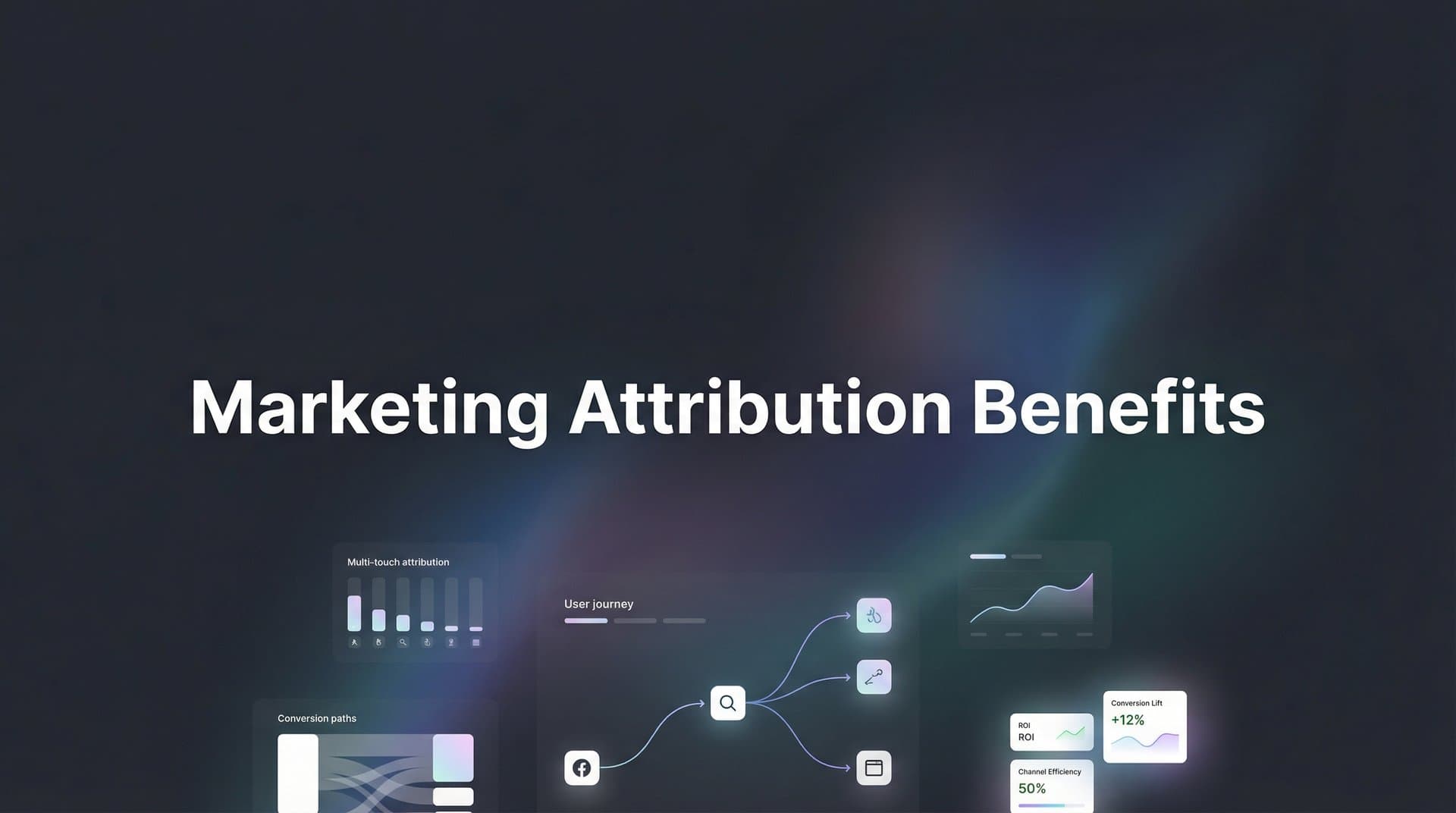
Multi-touch attribution recognizes that conversions rarely happen because of a single touchpoint. Customers see awareness ads, research options, compare competitors, read reviews, and interact with multiple marketing touchpoints before deciding to buy. Each interaction plays a role in moving them closer to conversion. Exploring multi-touch marketing attribution platforms can help you capture this complete picture.
When you can see the complete journey, patterns emerge that single-touch models obscure. You might notice that customers who convert typically interact with five touchpoints over two weeks, with specific sequences appearing repeatedly. Perhaps most valuable customers see a Meta video ad first, click a Google search ad within three days, visit your website twice, and convert after receiving an email.
This journey visibility transforms how you structure campaigns. Instead of treating each channel as a standalone revenue driver, you can design sequences that guide customers through awareness, consideration, and decision stages. Your Meta campaigns focus on introducing the problem and solution. Google captures high-intent searches. Retargeting and email close the deal.
Understanding journey stages also improves messaging strategy. When you know that most customers need to see your brand three times before converting, you stop expecting immediate results from awareness campaigns and start measuring them by how effectively they move people to the next stage. Your top-of-funnel ads don't need to drive conversions—they need to generate engaged audiences for mid-funnel campaigns to convert.
Different attribution models reveal different insights. Linear attribution distributes credit evenly across all touchpoints, showing which channels consistently appear in winning journeys. Time-decay models give more weight to recent interactions, highlighting which touchpoints effectively close deals. Position-based attribution emphasizes first and last touches while acknowledging middle interactions. Learning what each marketing attribution model offers helps you choose the right approach for your business.
The key isn't finding the "correct" model—it's using multiple perspectives to understand customer behavior. A SaaS company with a 60-day sales cycle might find time-decay attribution most useful for optimizing late-stage campaigns, while a position-based model reveals which awareness efforts generate qualified leads. An e-commerce brand with impulse purchases might focus more heavily on last-touch data while still tracking assist value from earlier touchpoints.
Feeding Better Data Back to Ad Platforms
Ad platform algorithms are only as good as the data they receive. Facebook's algorithm learns which audiences convert by tracking conversion events. Google's Smart Bidding optimizes based on conversion signals. TikTok's targeting improves when it knows which actions lead to sales. When these platforms receive incomplete or inaccurate data, their optimization suffers—and your ad performance declines.
The iOS 14.5 privacy changes fundamentally disrupted this data flow. When Apple gave users the ability to opt out of tracking, most did—suddenly, ad platforms lost visibility into a huge percentage of conversions. Facebook's pixel might only see 60% of actual purchases because iOS users who opted out appear as anonymous traffic. The algorithm thinks those campaigns aren't working when they actually are. These represent some of the most significant attribution challenges in marketing analytics that modern marketers face.
This creates a vicious cycle. Incomplete data leads to poor optimization. The algorithm shows ads to the wrong audiences because it's learning from a biased sample. Performance declines. Cost per acquisition increases. Marketers cut budgets, making the problem worse.
Server-side tracking solves this by capturing conversion data directly from your server rather than relying on browser pixels that privacy settings can block. When someone converts on your website, your server sends that conversion event to ad platforms through their Conversion APIs. This method bypasses browser-based tracking limitations while respecting user privacy.
The difference is dramatic. Instead of ad platforms seeing 60% of conversions, they see 95%+. The algorithm receives accurate signals about which audiences, creatives, and placements actually drive results. Optimization improves. Targeting becomes more precise. Your cost per acquisition drops because the platform's AI can finally learn what works.
Conversion sync takes this further by enriching the data sent back to platforms. Basic pixel tracking might tell Facebook that someone purchased. Enhanced conversion data includes purchase value, product category, customer lifetime value predictions, and other signals that help the algorithm optimize for quality, not just quantity.
This feedback loop creates compounding benefits. Better data leads to better optimization. Better optimization drives lower costs and higher conversion rates. Higher performance generates more data to improve optimization further. Marketers who implement proper server-side tracking gain an increasingly significant advantage over competitors still relying on degraded pixel data.
Making Confident Scaling Decisions
The difference between a $10,000 monthly ad budget and a $50,000 budget isn't just more spend—it's more risk. When you're not certain which campaigns actually drive revenue, scaling feels like gambling. You increase budgets and hope performance holds. Sometimes it does. Often it doesn't.
Attribution removes the guesswork from scaling decisions. You know exactly which campaigns, audiences, and creatives drive revenue at what cost. When you find a winner, you can confidently increase spend because you're not relying on platform-reported metrics that might be inflated—you're looking at actual revenue data tied to specific marketing efforts. Using marketing revenue attribution software gives you the confidence to scale aggressively.
This confidence transforms growth strategy. Instead of cautiously testing small budget increases and waiting weeks to evaluate results, you can aggressively scale proven performers while maintaining efficiency. When attribution shows that a campaign consistently drives $3 in revenue for every $1 spent, increasing budget from $1,000 to $5,000 becomes an obvious decision, not a risky bet.
AI-powered attribution takes this further by identifying patterns humans might miss. Machine learning algorithms can analyze thousands of campaigns across multiple channels to spot high-performing combinations of audience targeting, creative elements, placement strategies, and timing. Understanding how data science powers marketing attribution reveals scaling opportunities that would take weeks of manual analysis to discover.
For example, AI might notice that video ads featuring customer testimonials consistently outperform product demo videos by 40% across all channels, or that campaigns targeting specific geographic regions drive 2x higher lifetime value customers. These patterns become actionable recommendations: shift creative strategy toward testimonials, increase budget in high-value regions, adjust targeting parameters based on what's proven to work.
The psychological shift matters as much as the tactical benefits. When you're making decisions based on complete, accurate data, you move from defensive budget management to confident growth investment. You're not wondering if campaigns will work—you're executing a strategy built on evidence of what already works.
This confidence extends to stakeholder conversations. When executives question marketing ROI, you can show exactly which campaigns drove which revenue outcomes. When finance asks why you need more budget, you can demonstrate proven performance and projected returns. Attribution data transforms marketing from a cost center that "does advertising" into a revenue driver with measurable, predictable outcomes.
Scaling with attribution also means scaling smarter, not just bigger. You're not just increasing spend on winning campaigns—you're identifying the specific elements that make them winners and applying those insights across your entire marketing strategy. That knowledge compounds over time, making every new campaign more effective than the last.
Putting Attribution Into Practice
Marketing attribution delivers five core benefits that transform how you run campaigns: complete revenue visibility across all touchpoints, smarter budget allocation based on actual performance, deep understanding of customer journeys, improved ad platform optimization through better data, and confident scaling decisions backed by evidence.
Each benefit builds on the others. Revenue visibility enables smarter budgets. Journey understanding improves targeting and messaging. Better platform data enhances optimization. All of this combines to make scaling decisions obvious instead of risky.
The question isn't whether attribution delivers value—it's whether you can afford to keep making decisions without it. Every day you spend budget based on incomplete data is a day you're likely investing in the wrong places. Every campaign you launch without understanding the full customer journey is a missed opportunity to optimize the experience. Every scaling decision made on gut feeling instead of evidence carries unnecessary risk.
Start by evaluating your current attribution gaps. Can you definitively say which campaigns drove which revenue last month? Do you know the typical customer journey for your highest-value customers? Can you compare channel performance in a single view rather than jumping between platform dashboards? If the answer to any of these questions is no, you're operating with blind spots that are costing you money. Reviewing the best marketing attribution solutions for 2026 can help you identify the right fit for your needs.
Consider what accurate attribution data would change about your strategy. Would you reallocate budget between channels? Would you adjust your campaign sequencing? Would you scale certain campaigns more aggressively? The answers to these questions reveal the opportunity cost of not having proper attribution in place.
Modern attribution platforms make implementation straightforward. Solutions like Cometly connect your ad platforms, CRM, and website to track the complete customer journey in real time. Server-side tracking captures accurate conversion data that feeds back to ad platforms, improving their optimization. AI-powered insights identify high-performing campaigns and recommend scaling opportunities across every channel.
The marketers who invest in proper attribution today gain a compounding advantage. Every dollar they spend teaches them more about what works. Every campaign generates insights that improve the next one. While competitors make decisions based on incomplete data and wonder why scaling doesn't work, attribution-driven marketers confidently invest in proven strategies that deliver predictable returns.
The Path Forward
Marketing has always been about understanding customers and delivering the right message at the right time. Attribution simply makes that understanding possible at scale across complex, multi-platform campaigns. It's not a luxury tool for enterprises with massive budgets—it's a fundamental requirement for any marketer who wants to scale efficiently in today's fragmented digital landscape.
The gap between marketers who have accurate attribution and those who don't will only widen. As ad platforms become more sophisticated and customer journeys grow more complex, the ability to see what's really happening becomes increasingly valuable. The cost of flying blind compounds over time, while the benefits of clear visibility multiply with every optimized decision.
Ready to elevate your marketing game with precision and confidence? Discover how Cometly's AI-driven recommendations can transform your ad strategy—Get your free demo today and start capturing every touchpoint to maximize your conversions.